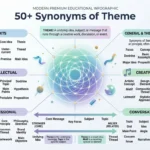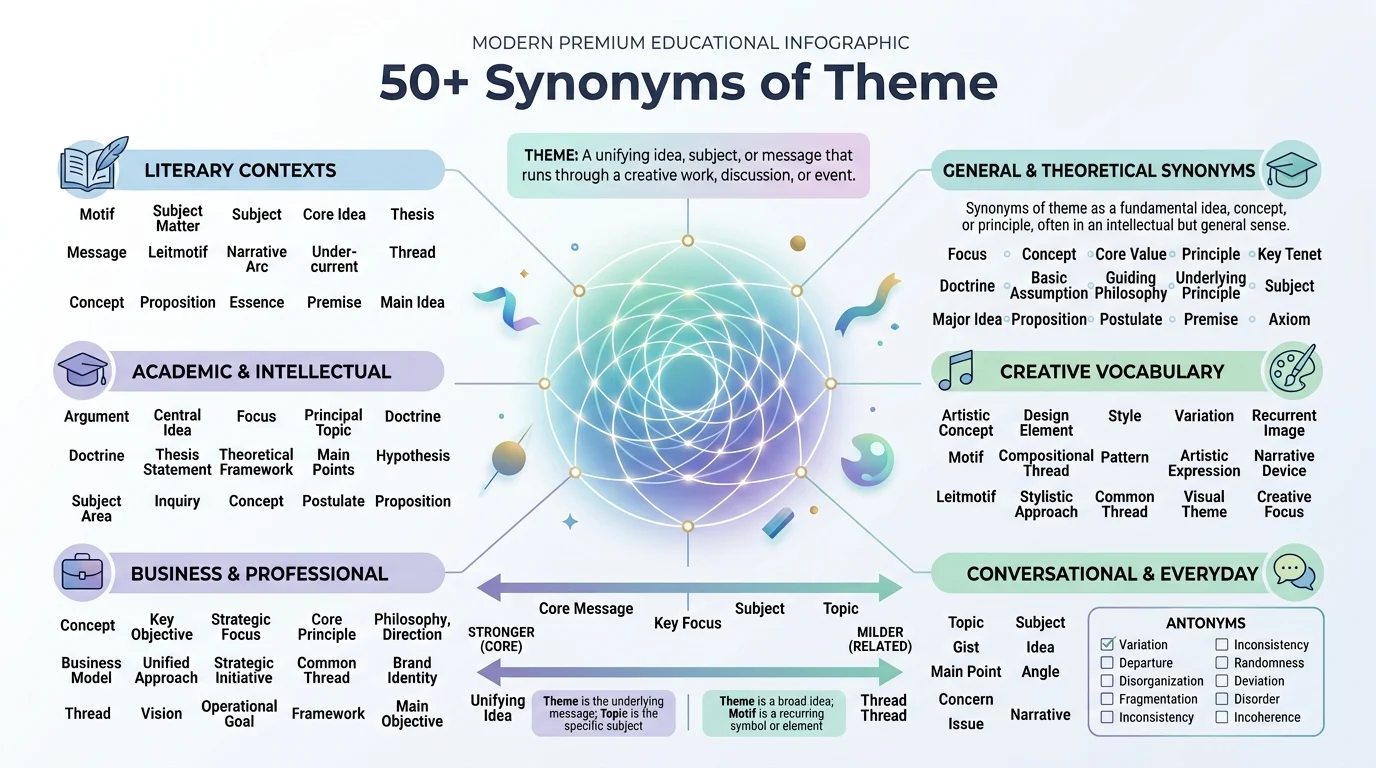
Have you ever struggled to describe the central idea of a story, the recurring pattern in a painting, or the main subject of a discussion but felt that “topic” or “idea” was too vague? You want to capture the underlying message or unifying concept, and the word “theme” comes to mind. Choosing the right synonym for “theme” can transform a general observation into a precise analysis of meaning, pattern, or purpose. This guide explores the best synonyms of theme, explaining exactly which word to use and when.
Quick Ans: “Theme” means the central topic, subject, or underlying idea in a discussion, work of art, literature, or music . It can also refer to a recurring motif or a short essay . For discussing central ideas, choose motif or concept. For formal writing, use thesis or argument. In music, melody or air are strong choices. For a more dramatic impact, select leitmotif or trope .
Meaning, Tone, and Context
Understanding the core meaning of “theme” is the first step to using it effectively .
Simple Definition: The main subject, topic, or underlying idea being discussed or developed in a work . It can also be a recurring element in art or a short written assignment.
Part of Speech: Noun .
Overall Tone: Neutral. It is a descriptive and analytical term used across various fields.
Formality Level: Neutral. The word works in almost any context, from casual conversation to formal academic writing.
Common Uses: Native English speakers use it to describe the central message of a movie, the recurring pattern in an artist’s work, the main subject of a conversation, or a school essay assignment. For example, “Love is a major theme in Shakespeare’s plays,” or “She wrote a theme on the history of the city.”
Word Forms: Related words include the adjective thematic, the adverb thematically, and the verb thematize.
When and How to Use “Theme”
“Theme” is the perfect choice when you want to identify the central, unifying, or recurring subject of something. Here are seven realistic examples.
Literary Analysis: “The novel explores the theme of identity and self-discovery.”
Academic: “The conference’s theme for this year is ‘Innovation in Education’.”
Workplace: “The main theme of the presentation was customer-centric growth.”
Personal: “Forgiveness is a recurring theme in her family’s history.”
Email: “The theme of our upcoming campaign is sustainability, which I think will resonate with our audience.”
Music: “The composer introduced the main theme with a simple but memorable melody” .
Social Media: “Persistence and hard work are the real themes of this success story.”
Best Synonyms of “Theme”
No synonym is identical in every situation. Here is your guide to the best replacement for “theme” based on your writing context.
Literary Writing: Motif. It suggests a recurring element or pattern that develops the theme. “The motif of birds in the novel symbolizes freedom” .
Academic/Formal Writing: Thesis. This is ideal when discussing the main argument or proposition. “Her central thesis is that economic growth can be sustainable” .
Conversational/Casual: Topic. A common, natural choice for general discussion. “What is the main topic of your speech?” .
Artistic Analysis: Trope. A strong word for a common, recurring theme in a genre. “The ‘chosen one’ is a classic fantasy trope” .
Music/Melodic: Melody. The musical equivalent of a theme . “The violinist played a beautiful melody.”
Describing Purpose/Message: Message. It implies a lesson or moral. “The message of the film was clear: hope conquers all.”
Describing Essence: Core. A strong word for the fundamental idea. “The core of his argument was about freedom” .
When Not to Use “Theme”
Using “theme” can sound wrong or awkward in certain situations.
When It Sounds Too Sophisticated: In casual conversation, “theme” can sound formal.
Better Choice: Topic or subject. “What is the topic of your speech?”
When You Mean a Simple, Non-Recurring Idea: “Theme” implies recurrence or centrality.
Better Choice: Idea or notion. “I had a good idea for a project.”
When It Sounds Too Vague: “Theme” can be vague if you need a specific pattern.
Better Choice: Motif or pattern. “The spiral is a recurring motif in the architecture.”
When Describing Music: “Theme” is for melody, but tune is more casual.
Better Choice: Tune or air. “The song has a catchy tune.”
Words Commonly Confused With “Theme”
Several words are often mixed up with “theme.” Here is how to keep them straight.
Word: Topic
Difference: “Topic” is the general subject. “Theme” is the underlying central idea .
When to Use: Use it when referring to the broad subject being discussed.
Example: “The topic of the lecture was climate change.”
Word: Motif
Difference: “Motif” is a recurring element. “Theme” is the central idea .
When to Use: Use this for specific repeated symbols, patterns, or images.
Example: “The recurring motif of light represents knowledge.”
Word: Thesis
Difference: “Thesis” is a specific argument or proposition. “Theme” is a broader subject .
When to Use: Use this for an arguable claim in an academic paper.
Example: “The thesis of his dissertation is that technology enhances human connection.”
Word: Message
Difference: “Message” often implies a moral or lesson. “Theme” is the broader idea.
When to Use: Use this for what a work is trying to convey.
Example: “The film’s message is that family comes first.”
Word: Trope
Difference: “Trope” refers to a common or overused theme. “Theme” is neutral.
When to Use: Use this for a widely recognized convention in a genre.
Example: “The trope of the wise old mentor is common in fantasy novels.”
Word: Subject Matter
Difference: “Subject matter” is the raw material. “Theme” is the abstract idea.
When to Use: Use this for the literal content.
Example: “The subject matter of the painting is the French Revolution.”
Best Synonyms of “Theme” by Context
| Context | Best Synonym | Why It Works | Example |
|---|---|---|---|
| Academic writing | Thesis | Precise for a core proposition | “The author’s main thesis challenges conventional thinking.” |
| Literary analysis | Motif | Emphasizes recurring patterns | “The motif of water symbolizes rebirth.” |
| Artistic analysis | Trope | Recognizes common conventions | “The ‘tortured artist’ is a well-known trope.” |
| Music | Melody | The musical subject | “The composer developed the melody into a symphony.” |
| Business writing | Core message | Focuses on key communication | “The campaign’s core message was about innovation.” |
| Casual conversation | Topic | Simple and natural | “The main topic we discussed was the new policy.” |
| Creative writing | Leitmotif | Evokes repeated association | “The leitmotif of the clock chiming represented the passage of time.” |
How to Choose the Best Synonym of “Theme”
Choosing the right word is a simple decision. Answer these questions.
What is my audience? For a professor or literary critic, thesis or motif is appropriate. For a friend, topic or idea is more natural.
What is my purpose? Are you analyzing a work, starting a conversation, or writing a song? Use motif for analysis, topic for conversation, and melody for music.
Am I describing a recurring element, a central argument, or a general subject? For recurring elements, motif or leitmotif is best. And for central arguments, thesis is better. For general subjects, topic works perfectly.
What is the emotional strength? Message is stronger and more moralistic. Trope can be critical. Pick the one that matches your message.
Real Life Examples of “Theme”
To truly master the word, it helps to see how it behaves in the wild and how a stronger synonym can elevate the sentence.
School: Basic: “The theme of the book is friendship.” Improved: “The book’s central message is about the enduring power of friendship.”
College: Basic: “The professor discussed the theme of power.” Improved: “The professor discussed the recurring trope of power and its corruption in literature.”
Workplace: Basic: “The theme of our meeting is productivity.” Improved: “The focus of our meeting will be on optimizing productivity tools.”
Business: Basic: “Their campaign’s theme is ‘value’.” Improved: “Their campaign’s core message revolves around long-term value for customers.”
Music: Basic: “The song’s theme is catchy.” Improved: “The song’s central melody is wonderfully catchy.”
Conversation: Basic: “What is the theme of this movie?” Improved: “What is the main idea of this movie?”
Storytelling: Basic: “The theme was sacrifice.” Improved: “The underlying concept of sacrifice drove the entire narrative.”
Top 10 Synonyms of “Theme”
| Synonym | Simple Meaning | Best Used For | Example Sentence |
|---|---|---|---|
| Motif | A recurring element or pattern | Art, literature, and design analysis. | “The motif of the labyrinth appears throughout the novel.” |
| Thesis | A central argument or proposition | Academic writing and persuasive essays. | “The thesis of the paper is well-supported by the evidence.” |
| Topic | The general subject | Casual conversation and general description. | “The weather is a common topic of conversation.” |
| Concept | An abstract idea | Philosophical, abstract, or design contexts. | “The concept of justice is central to the play.” |
| Message | An underlying lesson or moral | Persuasive writing, art, and media. | “The film’s message is one of hope and redemption.” |
| Trope | A common or overused theme | Literary criticism and genre analysis. | “The ‘love triangle’ is a common trope in romance novels.” |
| Melody | A musical subject | Music composition and analysis. | “The melody was simple but haunting.” |
| Core | The fundamental idea | Business and professional contexts. | “The core of the presentation was a new growth strategy.” |
| Leitmotif | A repeated theme associated with a person or idea | Advanced literary and musical analysis. | “The leitmotif of the ‘dragon’ underscored the villain’s scenes.” |
| Subject matter | The literal content | Describing what a work is physically about. | “The subject matter of the sculpture was everyday life.” |
Synonyms of “Theme” by Usage
Professional vs. Personal Synonyms
In the workplace (professional), choose core message, focus, or agenda to describe the central point of a meeting or campaign. These words convey practicality and clarity. “The core message of the presentation was clear” is more precise than “The theme of the presentation was clear.”
With friends (personal), topic, idea, or point keep the tone relaxed and relatable. These alternatives sound natural in everyday conversation.
Formal vs. Conversational Synonyms
For formal writing (reports, essays, academic papers), use thesis, motif, trope, or subject matter. These choices maintain the sophisticated tone expected in professional documents .
For casual conversations and texting, use topic, idea, or point. These options sound more natural and less pretentious.
Academic Synonyms
For research and essays, choose precise, authoritative words. Thesis is great for arguments, motif for patterns, and subject matter for literal content. These words sound considered and scholarly .
Professional and Business Synonyms
For maximum impact in business writing, choose core message, agenda, or focus. These words demonstrate confidence and professional awareness. “The agenda for this quarter is improving customer retention” is stronger than “The theme of this quarter is customer retention.”
Creative and Literary Synonyms
To add emotional depth and precision to your writing, choose leitmotif, trope, or motif. These words create atmosphere and demonstrate analytical depth . “The leitmotif of the ticking clock built a sense of urgency” is more evocative than “The theme of time was important.”
Slang or Modern Synonyms
There is no direct slang synonym for “theme” in mainstream American English. In modern texting, people use idea or vibe as a rough equivalent. For example, “The vibe of the movie was really dark.” This approach works best for casual digital communication.
Strongest to Mildest Synonyms
Mild: topic, point, idea
Moderate: theme, subject, concept
Strong: argument, thesis, motif, trope
Very Strong: leitmotif, core, crux, message
Emotional vs. Neutral Synonyms
Emotional Synonyms: Message, moral, import. These words often hint at a lesson or deeper meaning. Use them when you want to evoke a response.
Neutral Synonyms: Topic, subject, concept. These words simply communicate factual information. Use them when you want to inform without emotional coloring.
Antonyms of “Theme”
Here are 15 genuine opposites or contrasts of “theme.”
| Antonym | Meaning | Example Sentence |
|---|---|---|
| Digression | A departure from the main subject | “His rambling speech was full of pointless digressions.” |
| Detour | A roundabout or indirect course | “The conversation took a detour away from the main point.” |
| Subordinate idea | A secondary, non-central thought | “The plot was full of subordinate ideas that distracted from the main one.” |
| Irrelevance | Unrelated to the subject | “The argument was full of irrelevance and useless facts.” |
| Exclusion | The act of leaving out | “The exclusion of any central theme made the film feel aimless.” |
| Chaos | Complete disorder and confusion | “In contrast to the unified theme, the chaos of the painting was overwhelming.” |
| Rambling | A confused or disordered speech | “His rambling was the opposite of a clear, focused theme.” |
| Randomness | Lacking a definite plan or purpose | “The randomness of the details made the story weak.” |
| Incoherence | Lacking a clear logical connection | “The incoherence of the essay made it impossible to find a theme.” |
| Disorganization | Lack of order or arrangement | “The disorganization of the work made it chaotic.” |
| Physical detail | A concrete fact | “The story focused on physical detail rather than an abstract theme.” |
| Incidental | A minor, secondary detail | “The incidental details were interesting but irrelevant to the central theme.” |
| Miscellany | A collection of varied items | “The book was a miscellany of ideas with no single theme.” |
| Diversity | A range of different things | “The diversity of topics in the lecture made it hard to pick a theme.” |
| Unrelated | Having no connection | “The point was completely unrelated to the primary theme.” |
Comparison: “Theme” vs Similar Words
Theme vs. Topic
Main Difference: “Theme” is the central, abstract idea. “Topic” is the general subject .
Which Is Stronger? “Theme” is deeper and more analytical.
Which Is More Formal? Both are used in various contexts, but “theme” is more sophisticated.
When to Use Each: Use “topic” for general conversations. Use “theme” for analytical discussions about deeper meaning .
Examples:
Theme: “The theme of the novel is the search for identity.”
Topic: “The topic of the novel is a young man’s journey across America.”
Theme vs. Motif
Main Difference: “Motif” is a recurring element. “Theme” is the central idea .
Which Is Stronger? They serve different purposes. “Theme” is broader.
Which Is More Formal? Both are formal.
When to Use Each: Use “theme” for the overall message. Use “motif” for specific, repeated symbols .
Examples:
Theme: “The theme of the film was the corrupting nature of power.”
Motif: “The recurring motif of blood represented guilt.”
Theme vs. Thesis
Main Difference: “Thesis” is a specific, arguable claim. “Theme” is a broader idea .
Which Is Stronger? “Thesis” is more specific and argumentative.
Which Is More Formal? “Thesis” is more academic and formal .
When to Use Each: Use “thesis” for the main argument in an essay. Use “theme” for the general idea .
Examples:
Theme: “The theme of sustainability is important.”
Thesis: “The thesis is that economic growth can be sustainable if we change our practices” .
Theme vs. Message
Main Difference: “Theme” is the abstract idea. “Message” is the lesson or moral.
Which Is Stronger? “Message” is more purposeful and directive.
Which Is More Formal? Both are formal, but “theme” is more analytical.
When to Use Each: Use “theme” to describe ideas. Use “message” to describe a lesson.
Examples:
Theme: “The theme of power is explored throughout the play.”
Message: “The message of the play is that greed leads to destruction.”
Theme vs. Trope
Main Difference: “Trope” is a common, recognizable theme. “Theme” is neutral .
Which Is Stronger? “Trope” can have a critical or cliché connotation.
Which Is More Formal? “Trope” is used in literary criticism .
When to Use Each: Use “theme” for any idea. Use “trope” for a familiar, often overused idea .
Examples:
Theme: “The theme of sacrifice is important in the novel.”
Trope: “The ‘star-crossed lovers’ trope is overused in romance novels.”
Theme vs. Leitmotif
Main Difference: “Leitmotif” is a repeated musical or thematic phrase associated with a specific person or idea .
Which Is Stronger? “Leitmotif” is more specific and dramatic.
Which Is More Formal? “Leitmotif” is a highly formal term.
When to Use Each: Use “leitmotif” for a specific, repeated musical or literary association .
Examples:
Theme: “The theme of the movie was isolation.”
Leitmotif: “The leitmotif of the ‘dragon’ appeared whenever the villain was near” .
Common Phrases and Expressions with “Theme”
Phrase: Central theme
Meaning: The main or most important idea.
Example Sentence: “The central theme of the conference was innovation.”
Phrase: Recurring theme
Meaning: An idea that appears repeatedly.
Example Sentence: “Loss is a recurring theme in many of his poems.”
Phrase: Underlying theme
Meaning: The hidden or less obvious main idea.
Example Sentence: “The underlying theme of the film is about forgiveness.”
Phrase: Theme park
Meaning: An amusement park built around a specific idea.
Example Sentence: “They visited a theme park based on popular fairy tales.”
Phrase: Theme song
Meaning: A melody associated with a film or series.
Example Sentence: “The theme song of the show was incredibly popular.”
Phrase: Theme music
Meaning: Music written for a film or program.
Example Sentence: “The theme music set the tone for the entire broadcast.”
Common Mistakes to Avoid
Mistake 1: Using “theme” when you mean “topic”.
Incorrect: “The theme of the meeting is the budget.”
Better: “The topic of the meeting is the budget” .
Why: “Topic” is a more natural word for the general subject of a meeting.
Mistake 2: Confusing “theme” with “motif”.
Incorrect: “The theme of the birds represents freedom.”
Better: “The motif of the birds represents freedom” .
Why: “Motif” is for specific, recurring symbols or elements that develop the theme.
Mistake 3: Using “theme” when you mean “message”.
Incorrect: “The theme of the story is that lying is bad.”
Better: “The message of the story is that lying is bad.”
Why: “Message” is a better word for a direct lesson.
Mistake 4: Using “theme” when you mean “thesis”.
Incorrect: “The theme of his paper is that social media is harmful.”
Better: “The thesis of his paper is that social media is harmful” .
Why: “Thesis” is the precise word for an argument in a paper.
Mistake 5: Overusing “theme” in casual conversation.
Incorrect: “What is the theme of your day?”
Better: “What is the main idea of your day?”
Why: “Theme” is too formal for trivial subjects.
Frequently Asked Questions
1. What are the best synonyms of “theme”?
The best synonyms depend on your context. For literary analysis, choose motif or trope. And for academic writing, use thesis. For music, use melody. For casual conversation, topic is an ideal choice .
2. What are the best formal synonyms of “theme”?
The best formal synonyms are thesis, motif, argument, and subject matter. These words are suitable for academic papers, professional reports, and literary criticism .
3. What are common informal synonyms of “theme”?
For informal settings, use topic, idea, or point. These alternatives sound more natural in everyday conversation .
4. What is another word for “theme” in professional writing?
In professional writing, core message, agenda, or focus are excellent choices. These words convey clarity and purpose.
5. What is the difference between “theme” and “motif”?
“Motif” is a specific, recurring element. “Theme” is the broader, central idea. Use “motif” for patterns and “theme” for the overarching message .
6. What is the opposite of “theme”?
The most direct contrasts of “theme” are digression, irrelevance, and subordinate idea. These words describe things that are not central to the main subject.
Conclusion
“Theme” is a powerful and versatile word for describing the central, recurring, or underlying idea in any form of content. The term is neutral and widely accepted in most contexts, yet it can sound too formal for everyday small talk or too vague for specific academic analysis. The best choice among the synonyms of theme depends entirely on your audience, tone, and purpose. Remember, no single synonym works perfectly in every situation. Your goal is to choose the word that communicates your message with the most clarity and impact. A practical tip for your vocabulary growth is to analyze the themes and motifs in everything you read or watch, and practice using different synonyms in your writing.
Discover More:
- 50+ Synonyms of Ubiquitous: Meanings, Uses, Examples, and Best Alternatives
- 50+ Synonyms of Determined: Meanings, Uses, Examples, and Best Alternatives 2026

Alexander Cole is a professional content writer and researcher who specializes in creating informative, reader-friendly, and well-researched articles. He is committed to publishing accurate, valuable, and engaging content that helps readers stay informed and make smarter decisions.