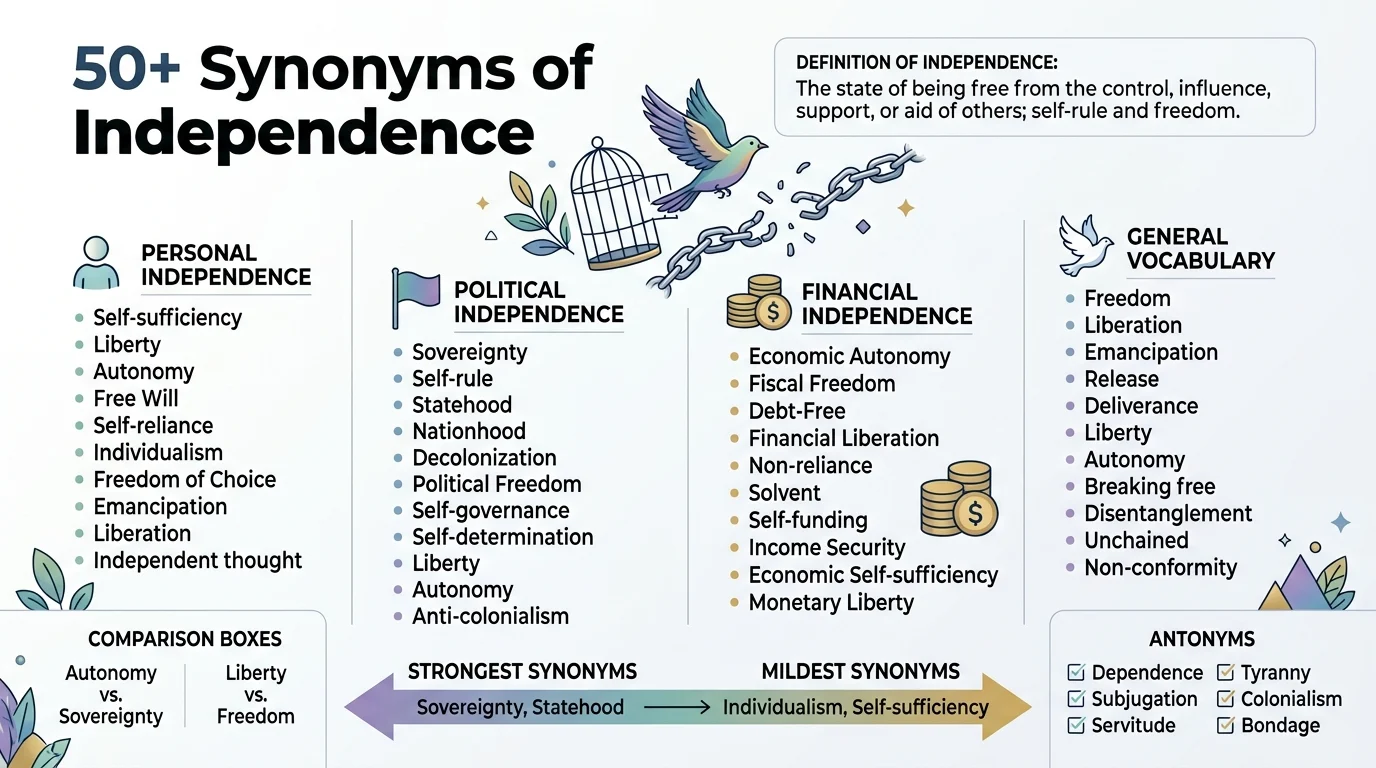
Have you ever needed to describe freedom from control, the ability to stand alone, or a nation’s self-rule but felt that “independence” was too broad or repetitive? You want to capture the specific nature of autonomy, whether it is personal, political, or financial, and the word “independence” comes to mind. Choosing the right synonym for “independence” can transform a general statement into a precise expression of freedom, self-reliance, or sovereignty. This guide explores the best synonyms of independence, explaining exactly which word to use and when.
Quick Ans: “Independence” means the state of being free from outside control or the ability to act alone. For personal contexts, choose autonomy or self-reliance. For political contexts, use sovereignty or self-governance. For financial contexts, use self-sufficiency or financial freedom. For general freedom, use liberty or freedom.
Meaning, Tone, and Context
Understanding the core meaning of “independence” is the first step to using it effectively.
Simple Definition: The state of being free from the control or influence of others; the ability to act, think, or govern oneself without outside interference.
Part of Speech: Noun.
Overall Tone: Positive and empowering. It indicates freedom, strength, and self-determination.
Formality Level: Neutral to formal. The word is appropriate in most contexts.
Common Uses: Native English speakers use it in personal (“financial independence”), political (“Declaration of Independence”), and professional (“independent contractor”) contexts.
Word Forms: Related words include the adjective independent, the adverb independently, and the verb independize (rare).
When and How to Use “Independence”
“Independence” is the perfect choice when you want to describe freedom from control or the ability to stand alone. Here are seven realistic examples.
Personal: “She values her independence and makes her own decisions.”
Political: “The country declared independence in 1960.”
Financial: “He achieved financial independence by age 40.”
Professional: “The consultant works as an independent contractor.”
Academic: “The study examines the independence of the judiciary.”
Workplace: “Employees are given independence to complete tasks their own way.”
Social Media: “Celebrating Independence Day with family and friends.”
Best Synonyms of “Independence”
No synonym is identical in every situation. Here is your guide to the best replacement for “independence” based on your writing context.
For Personal Freedom
Most Direct: Autonomy means the right to self-govern. “Employees value autonomy in their work.”
Self-Reliance: Self-reliance means depending on oneself. “Self-reliance is a valuable trait.”
Self-Determination: Self-determination means making one’s own choices. “The right of self-determination is fundamental.”
Free Will: Free will means the ability to choose. “She exercised her free will.”
For Political Freedom
Sovereignty: Sovereignty means supreme authority. “The nation’s sovereignty was recognized.”
Self-Governance: Self-governance means ruling oneself. “The region was granted self-governance.”
Liberty: Liberty means freedom from oppression. “Liberty is a cherished value.”
Freedom: Freedom is the broadest term. “Freedom is the right of all people.”
For Financial Freedom
Self-Sufficiency: Self-sufficiency means providing for oneself. “The farm achieved self-sufficiency.”
Financial Freedom: Financial freedom means having enough money to live without working. “Financial freedom is her goal.”
Economic Independence: Economic independence means not relying on others for money. “Economic independence is empowering.”
For General Autonomy
Self-Rule: Self-rule means governing oneself. “The colony sought self-rule.”
Noninterference: Noninterference means not interfering. “The policy of noninterference was maintained.”
Autarchy: Autarchy means absolute sovereignty. “The autarchy of the state was absolute.”
When Not to Use “Independence”
Using “independence” can sound wrong or awkward in certain situations.
When You Mean “Freedom”: “Independence” is about self-rule. “Freedom” is broader.
Better Choice: Freedom or liberty. “Freedom of speech is protected.”
When You Mean “Isolation”: “Independence” is positive. “Isolation” is negative.
Better Choice: Isolation or seclusion. “The isolation was difficult.”
When It Sounds Too Formal: In casual conversation, “independence” can sound stiff.
Better Choice: Freedom or doing your own thing. “I like doing my own thing.”
Words Commonly Confused With “Independence”
| Word | Difference | When to Use | Example |
|---|---|---|---|
| Autonomy | Self-governance | Personal and political | “Autonomy is valued.” |
| Freedom | Broad term for liberty | General and political | “Freedom is essential.” |
| Sovereignty | Supreme authority | Political and legal | “Sovereignty is recognized.” |
| Self-Reliance | Depending on oneself | Personal and practical | “Self-reliance is a virtue.” |
| Liberty | Freedom from oppression | Political and legal | “Liberty is cherished.” |
| Self-Sufficiency | Providing for oneself | Economic and practical | “Self-sufficiency is the goal.” |
Best Synonyms of “Independence” by Context
| Context | Best Synonym | Why It Works | Example |
|---|---|---|---|
| Formal writing | Sovereignty | Formal and precise | “Sovereignty is recognized.” |
| Political | Self-Governance | Specific to politics | “Self-governance was granted.” |
| Personal | Autonomy | Personal freedom | “Autonomy is valued.” |
| Financial | Self-Sufficiency | Economic freedom | “Self-sufficiency is empowering.” |
| Professional | Self-Reliance | Workplace independence | “Self-reliance is key.” |
| General | Freedom | Broad and universal | “Freedom is essential.” |
| Casual | Doing your own thing | Simple and natural | “I like doing my own thing.” |
How to Choose the Best Synonym of “Independence”
Choosing the right word is a simple decision. Answer these questions.
What type of independence am I describing? For personal, use autonomy or self-reliance. And For political, use sovereignty or self-governance. For financial, use self-sufficiency or financial freedom.
What is my audience? For a formal report, use sovereignty or autonomy. For a friend, use freedom or doing your own thing.
What is my purpose? Are you describing personal freedom, political freedom, or financial freedom? The correct synonym depends entirely on this.
What is the emotional strength? Freedom is broad and powerful. Autonomy is more specific. Pick the one that matches your message.
Real Life Examples of “Independence”
School: Basic: “The student showed independence.” Improved: “The student showed self-reliance in completing the project.”
College: Basic: “The country gained independence.” Improved: “The country achieved sovereignty in 1960.”
Workplace: Basic: “Employees want independence.” Improved: “Employees value autonomy in their work.”
Business: Basic: “Financial independence is the goal.” Improved: “Financial freedom is the ultimate goal.”
Email: Basic: “We value independence.” Improved: “We value self-governance.”
Conversation: Basic: “I like my independence.” Improved: “I like my freedom.”
Storytelling: Basic: “She fought for independence.” Improved: “She fought for liberty and justice.”
Top 10 Synonyms of “Independence”
| Synonym | Simple Meaning | Best Used For | Example Sentence |
|---|---|---|---|
| Autonomy | Right to self-govern | Personal and political | “Autonomy is valued.” |
| Freedom | Broad term for liberty | General and political | “Freedom is essential.” |
| Sovereignty | Supreme authority | Political and legal | “Sovereignty is recognized.” |
| Self-Reliance | Depending on oneself | Personal and practical | “Self-reliance is a virtue.” |
| Liberty | Freedom from oppression | Political and legal | “Liberty is cherished.” |
| Self-Sufficiency | Providing for oneself | Economic and practical | “Self-sufficiency is the goal.” |
| Self-Governance | Ruling oneself | Political | “Self-governance was granted.” |
| Self-Determination | Making one’s own choices | Personal and political | “Self-determination is a right.” |
| Financial Freedom | Having enough money | Financial | “Financial freedom is the goal.” |
| Free Will | Ability to choose | Philosophical | “She exercised her free will.” |
Synonyms of “Independence” by Usage
Professional vs. Personal Synonyms
In the workplace, choose autonomy, self-reliance, or self-governance. With friends, use freedom, doing your own thing, or independence.
Formal vs. Conversational Synonyms
For formal writing, use sovereignty, autonomy, or self-determination. For casual conversations, use freedom, doing your own thing, or independence.
Academic Synonyms
For research and essays, choose autonomy for personal contexts, sovereignty for political contexts, and self-sufficiency for economic contexts.
Professional and Business Synonyms
For maximum impact, choose autonomy for workplace, self-reliance for personal, and financial freedom for financial contexts.
Creative and Literary Synonyms
To add emotion and imagery, choose liberty, freedom, or self-determination. These words create atmosphere.
Slang or Modern Synonyms
In modern American slang, freedom, doing your own thing, or independence are common. For example, “I am doing my own thing.” These are casual and should be avoided in formal writing.
Strongest to Mildest Synonyms
Mild: freedom, liberty, doing your own thing
Moderate: independence, autonomy, self-reliance
Strong: self-sufficiency, self-governance, self-determination
Very Strong: sovereignty, financial freedom, free will
Emotional vs. Neutral Synonyms
Emotional Synonyms: Liberty, freedom, self-determination. These words hint at powerful emotion. Use them when you want to evoke feeling.
Neutral Synonyms: Independence, autonomy, self-sufficiency. These words communicate factual information.
Antonyms of “Independence”
| Antonym | Meaning | Example Sentence |
|---|---|---|
| Dependence | Relying on others | “Dependence is not desirable.” |
| Subjugation | Being under control | “Subjugation was unacceptable.” |
| Oppression | Unjust treatment | “Oppression must be fought.” |
| Colonialism | Control by another country | “Colonialism ended.” |
| Servitude | Being a servant | “Servitude was abolished.” |
| Tyranny | Cruel and oppressive rule | “Tyranny was overthrown.” |
| Control | Power over others | “Control was centralized.” |
| Domination | Exercising control | “Domination was resisted.” |
| Subjection | Being forced under control | “Subjection was resisted.” |
| Heteronomy | Being governed by others | “Heteronomy is the opposite.” |
| Reliance | Depending on others | “Reliance on others is high.” |
| Helplessness | Unable to act | “Helplessness was felt.” |
| Submission | Yielding to authority | “Submission was required.” |
| Obedience | Following orders | “Obedience was expected.” |
| Conformity | Following the crowd | “Conformity was the norm.” |
Comparison: “Independence” vs Similar Words
Independence vs. Freedom
Main Difference: “Independence” is about self-rule. “Freedom” is broader.
Which Is Stronger? “Freedom” is broader and more emotional.
Which Is More Formal? Both are formal.
When to Use Each: Use “independence” for political and personal. Use “freedom” for general.
Examples:
Independence: “The country gained independence.”
Freedom: “Freedom is a basic right.”
Independence vs. Autonomy
Main Difference: “Autonomy” is self-governance. “Independence” is broader.
Which Is Stronger? “Autonomy” is more specific.
Which Is More Formal? Both are formal.
When to Use Each: Use “autonomy” for personal and organizational. Use “independence” for general.
Examples:
Independence: “She values her independence.”
Autonomy: “Employees value autonomy.”
Independence vs. Sovereignty
Main Difference: “Sovereignty” is supreme authority. “Independence” is freedom from control.
Which Is Stronger? “Sovereignty” is stronger for political power.
Which Is More Formal? Both are formal.
When to Use Each: Use “sovereignty” for nations. Use “independence” for general.
Examples:
Independence: “The nation declared independence.”
Sovereignty: “The nation’s sovereignty was recognized.”
Independence vs. Self-Reliance
Main Difference: “Self-reliance” is personal. “Independence” is broader.
Which Is Stronger? “Self-reliance” is more personal.
Which Is More Formal? Both are formal.
When to Use Each: Use “self-reliance” for personal. Use “independence” for general.
Examples:
Independence: “She values her independence.”
Self-reliance: “Self-reliance is a virtue.”
Independence vs. Liberty
Main Difference: “Liberty” is freedom from oppression. “Independence” is self-rule.
Which Is Stronger? “Liberty” is more political.
Which Is More Formal? Both are formal.
When to Use Each: Use “liberty” for political. Use “independence” for general.
Examples:
Independence: “The country gained independence.”
Liberty: “Liberty is cherished.”
Independence vs. Self-Sufficiency
Main Difference: “Self-sufficiency” is economic. “Independence” is broader.
Which Is Stronger? “Self-sufficiency” is more practical.
Which Is More Formal? Both are formal.
When to Use Each: Use “self-sufficiency” for economic. Use “independence” for general.
Examples:
Independence: “Financial independence is the goal.”
Self-sufficiency: “The farm achieved self-sufficiency.”
Common Phrases and Expressions with “Independence”
Phrase: Independence Day
Meaning: A national holiday celebrating independence.
Example Sentence: “We celebrate Independence Day on July 4th.”
Phrase: Financial independence
Meaning: Having enough money to live without working.
Example Sentence: “Financial independence is her goal.”
Phrase: Declaration of Independence
Meaning: A formal statement of independence.
Example Sentence: “The Declaration of Independence was signed in 1776.”
Phrase: Independent contractor
Meaning: A self-employed worker.
Example Sentence: “She works as an independent contractor.”
Phrase: Independence of thought
Meaning: Thinking for oneself.
Example Sentence: “Independence of thought is encouraged.”
Phrase: War of Independence
Meaning: A war fought for independence.
Example Sentence: “The War of Independence was long.”
Common Mistakes to Avoid
Mistake 1: Using “independence” when you mean “freedom”.
Incorrect: “Freedom of speech is independence.”
Better: “Freedom of speech is a freedom.”
Why: “Freedom” is broader.
Mistake 2: Using “independence” when you mean “isolation”.
Incorrect: “His independence was lonely.”
Better: “His isolation was lonely.”
Why: “Isolation” is negative.
Mistake 3: Overusing “independence” in conversation.
Incorrect: “I like my independence.”
Better: “I like my freedom.”
Why: “Freedom” sounds more natural.
Mistake 4: Using “independence” when you mean “autonomy”.
Incorrect: “Employees want independence.”
Better: “Employees want autonomy.”
Why: “Autonomy” is more specific.
Mistake 5: Using “independence” when you mean “sovereignty”.
Incorrect: “The nation’s independence was recognized.”
Better: “The nation’s sovereignty was recognized.”
Why: “Sovereignty” is more political.
Frequently Asked Questions
1. What are the best synonyms of “independence”?
The best synonyms depend on your context. For personal, choose autonomy or self-reliance. And For political, use sovereignty or self-governance. For financial, use self-sufficiency or financial freedom.
2. What are the best formal synonyms of “independence”?
The best formal synonyms are sovereignty, autonomy, and self-determination. These words are suitable for academic papers, professional reports, and political documents.
3. What are common informal synonyms of “independence”?
For informal settings, use freedom, doing your own thing, or independence. These alternatives sound more natural in everyday conversation.
4. What is another word for “independence” in professional writing?
In professional writing, autonomy is an excellent choice. It conveys self-governance. Sovereignty is also strong for political contexts.
5. What is the difference between “independence” and “freedom”?
“Independence” is about self-rule. “Freedom” is broader and more emotional. Use “independence” for political and personal and “freedom” for general.
6. What is the opposite of “independence”?
The most direct opposites (antonyms) of independence are dependence, subjugation, and oppression. These words describe being under the control of others.
Conclusion
“Independence” is a powerful and empowering word for describing freedom from control, self-rule, and autonomy. The term is neutral and widely accepted in most contexts, yet it can sound too formal for casual conversation or too broad for specific descriptions. The best choice among the synonyms of independence depends entirely on your audience, tone, and purpose. Remember, no single synonym works perfectly in every situation. Your goal is to choose the word that communicates your message with the most clarity and impact. A practical tip for your vocabulary growth is to pay attention to how writers describe freedom and self-rule and practice using different synonyms in your writing.










1 thought on “50+ Synonyms of Independence: Meanings, Uses, Examples, and Best Alternatives 2026”