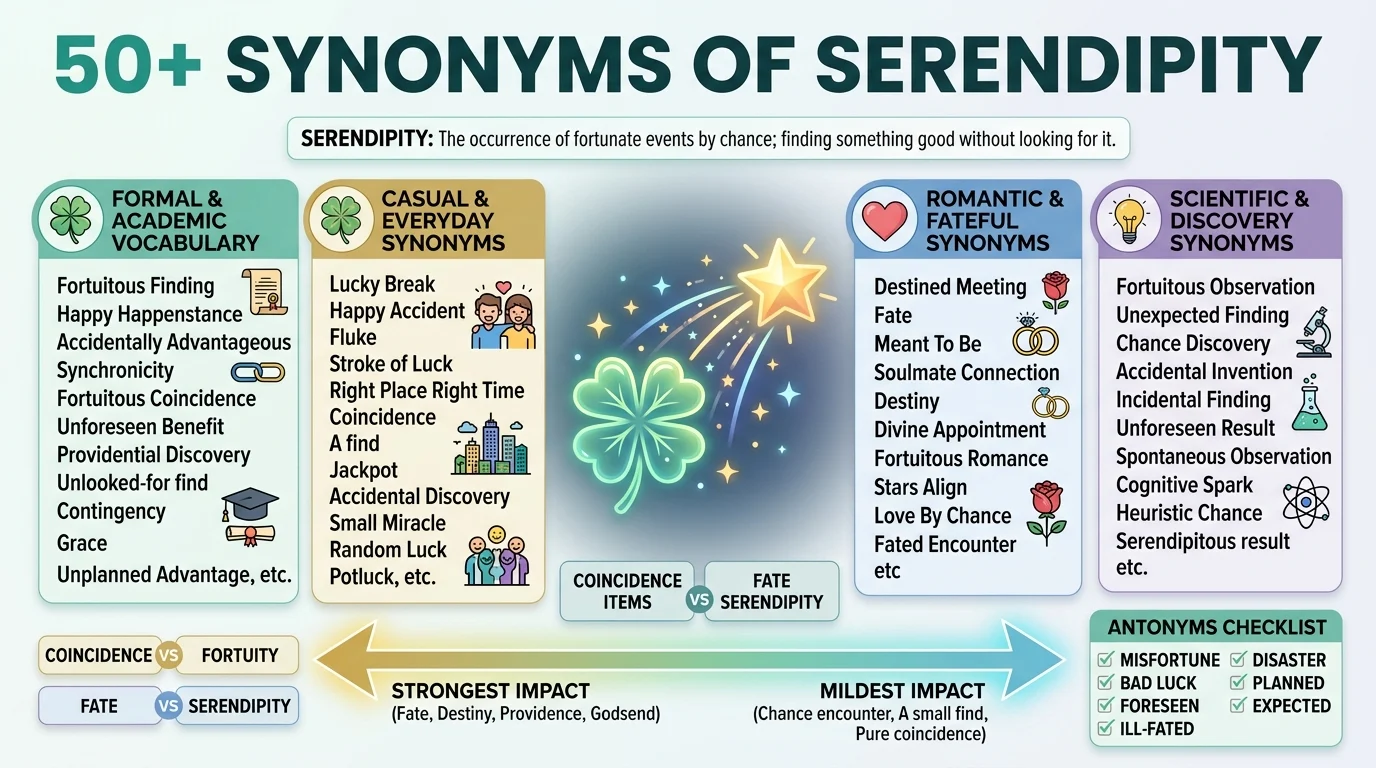
Have you ever experienced a happy accident, an unexpected discovery, or a fortunate coincidence that seemed too perfect to be planned? You want to capture that magical element of chance and good fortune, and the word “serendipity” comes to mind. Choosing the right synonym for “serendipity” can transform a simple description into a precise expression of fortunate discovery, lucky coincidence, or providential timing. This guide explores the best synonyms of serendipity, explaining exactly which word to use and when.
Quick Ans: “Serendipity” means the occurrence of fortunate discoveries by accident or chance. For formal writing, choose providence or fortuity. For casual conversation, use lucky coincidence or happy accident. For literary contexts, use fluke or chance. For a more technical term, use contingency or aleatory.
Meaning, Tone, and Context
Understanding the core meaning of “serendipity” is the first step to using it effectively.
Simple Definition: The occurrence and development of events by chance in a happy or beneficial way; the faculty of making fortunate discoveries by accident.
Part of Speech: Noun.
Overall Tone: Positive and magical. It evokes wonder, gratitude, and pleasant surprise.
Formality Level: Formal to literary. The word is often used in sophisticated or reflective contexts.
Common Uses: Native English speakers use it to describe unexpected good fortune, chance encounters, scientific discoveries, and romantic meetings. For example, “Meeting her was pure serendipity,” or “The discovery was a case of serendipity.”
Word Forms: Related words include the adjective serendipitous and the adverb serendipitously.
When and How to Use “Serendipity”
“Serendipity” is the perfect choice when you want to describe a fortunate accident or unexpected discovery. Here are seven realistic examples.
Scientific: “The discovery of penicillin was a famous case of serendipity.”
Personal: “Meeting my best friend was pure serendipity.”
Professional: “The partnership began through a moment of serendipity at a conference.”
Academic: “The research led to a serendipitous finding that changed the field.”
Romantic: “Their first encounter was a delightful serendipity.”
Business: “The company’s success was partly due to serendipity.”
Social Media: “Sometimes the best moments happen through serendipity.”
Best Synonyms of “Serendipity”
No synonym is identical in every situation. Here is your guide to the best replacement for “serendipity” based on your writing context.
For Formal and Literary Contexts
Most Formal: Providence means divine guidance or fortunate care. “It was providence that brought them together.”
Fortuity: Fortuity means a chance occurrence. “The fortuity of the meeting changed everything.”
Fluke: Fluke means an unlikely chance occurrence. “The win was a fluke.”
Chance: Chance means random occurrence. “It was pure chance that we met.”
For Casual and Conversational Contexts
Lucky coincidence: Lucky coincidence means a fortunate accidental event. “It was a lucky coincidence that we were on the same flight.”
Happy accident: Happy accident means a fortunate mistake. “The recipe was a happy accident.”
Stroke of luck: Stroke of luck means a sudden fortunate event. “It was a stroke of luck that we found the place.”
Twist of fate: Twist of fate means an unexpected change in events. “By a twist of fate, they ended up together.”
For Philosophical and Technical Contexts
Contingency: Contingency means a possible future event. “The contingency of the situation was unpredictable.”
Aleatory: Aleatory means depending on chance. “The aleatory nature of the process was fascinating.”
Fortune: Fortune means luck or chance. “Fortune smiled on them that day.”
Destiny: Destiny means a predetermined course of events. “It felt like destiny.”
When Not to Use “Serendipity”
Using “serendipity” can sound wrong or awkward in certain situations.
When You Mean “Luck”: “Serendipity” is specific to fortunate discoveries. “Luck” is broader.
Better Choice: Luck or good fortune. “We had good luck.”
When You Mean “Coincidence”: “Serendipity” implies a positive outcome. “Coincidence” can be neutral.
Better Choice: Coincidence. “It was a coincidence.”
When It Sounds Too Poetic: In casual conversation, “serendipity” can sound pretentious.
Better Choice: Lucky or fortunate. “That was lucky.”
Words Commonly Confused With “Serendipity”
| Word | Difference | When to Use | Example |
|---|---|---|---|
| Luck | General good fortune | General and casual | “Good luck!” |
| Coincidence | Accidental happening | Neutral events | “What a coincidence!” |
| Providence | Divine guidance | Religious and formal | “Divine providence.” |
| Fate | Predetermined events | Philosophical and romantic | “It was fate.” |
| Chance | Random occurrence | General and neutral | “By chance.” |
| Fluke | Unlikely chance | Casual and informal | “It was a fluke.” |
Best Synonyms of “Serendipity” by Context
| Context | Best Synonym | Why It Works | Example |
|---|---|---|---|
| Formal writing | Providence | Formal and elevated | “It was providence.” |
| Academic writing | Contingency | Technical and precise | “The contingency was unforeseen.” |
| Professional | Fortuity | Professional and formal | “The fortuity of the meeting.” |
| Casual conversation | Lucky coincidence | Simple and natural | “A lucky coincidence.” |
| Literary | Twist of fate | Evocative and dramatic | “A twist of fate.” |
| Romantic | Destiny | Emotional and personal | “It was destiny.” |
| Scientific | Happy accident | Descriptive and clear | “A happy accident.” |
How to Choose the Best Synonym of “Serendipity”
Choosing the right word is a simple decision. Answer these questions.
What type of serendipity am I describing? For formal, use providence or fortuity. And For casual, use lucky coincidence or happy accident. For romantic, use destiny or fate. For scientific, use happy accident or fluke.
What is my audience? For a formal report, use providence or contingency. For a friend, use lucky coincidence or stroke of luck.
What is my purpose? Are you describing a discovery, a meeting, or a fortunate event? The correct synonym depends entirely on this.
What is the emotional strength? Providence and destiny are stronger. Coincidence is milder. Pick the one that matches your message.
Real Life Examples of “Serendipity”
School: Basic: “Finding the book was serendipity.” Improved: “Finding the book was a lucky coincidence.”
College: Basic: “The discovery was serendipity.” Improved: “The discovery was a happy accident.”
Workplace: Basic: “Meeting her was serendipity.” Improved: “Meeting her was a stroke of luck.”
Business: Basic: “The deal was serendipity.” Improved: “The deal was a twist of fate.”
Email: Basic: “What serendipity!” Improved: “What a lucky coincidence!”
Conversation: Basic: “It was serendipity.” Improved: “It was fate.”
Storytelling: Basic: “Their meeting was serendipity.” Improved: “Their meeting was providence.”
Top 10 Synonyms of “Serendipity”
| Synonym | Simple Meaning | Best Used For | Example Sentence |
|---|---|---|---|
| Providence | Divine guidance or fortune | Formal and religious | “It was providence that saved us.” |
| Fortuity | A chance occurrence | Formal and academic | “The fortuity of the event was remarkable.” |
| Fluke | An unlikely chance occurrence | Casual and informal | “The win was a fluke.” |
| Chance | Random occurrence | General and neutral | “It was pure chance.” |
| Lucky coincidence | A fortunate accidental event | Casual and conversational | “It was a lucky coincidence.” |
| Happy accident | A fortunate mistake | Descriptive and positive | “The recipe was a happy accident.” |
| Stroke of luck | A sudden fortunate event | Casual and positive | “It was a stroke of luck.” |
| Twist of fate | An unexpected change | Dramatic and literary | “By a twist of fate.” |
| Fortune | Luck or chance | General and formal | “Fortune smiled on us.” |
| Destiny | Predetermined events | Romantic and philosophical | “It was destiny.” |
Synonyms of “Serendipity” by Usage
Professional vs. Personal Synonyms
In the workplace, choose fortuity, providence, or contingency. With friends, use lucky coincidence, stroke of luck, or happy accident.
Formal vs. Conversational Synonyms
For formal writing, use providence, fortuity, or contingency. For casual conversations, use lucky coincidence, fluke, or chance.
Academic Synonyms
For research and essays, choose contingency for philosophical contexts, fortuity for historical analysis, and serendipity for scientific discovery.
Professional and Business Synonyms
For maximum impact, choose fortuity for opportunities, providence for fortunate outcomes, and twist of fate for dramatic changes.
Creative and Literary Synonyms
To add emotion and imagery, choose twist of fate, destiny, or providence. These words create atmosphere.
Slang or Modern Synonyms
In modern American slang, lucky break, fluke, or happy accident are common. For example, “That was a lucky break.” These are casual and should be avoided in formal writing.
Strongest to Mildest Synonyms
Mild: chance, coincidence, luck
Moderate: serendipity, fluke, happy accident
Strong: fortuity, lucky coincidence, stroke of luck
Very Strong: providence, destiny, twist of fate
Emotional vs. Neutral Synonyms
Emotional Synonyms: Providence, destiny, twist of fate. These words hint at deeper meaning. Use them when you want to evoke feeling.
Neutral Synonyms: Chance, coincidence, fluke. These words communicate factual information.
Antonyms of “Serendipity”
| Antonym | Meaning | Example Sentence |
|---|---|---|
| Misfortune | Bad luck | “It was a misfortune.” |
| Bad luck | Unfortunate events | “It was just bad luck.” |
| Mishap | An unlucky accident | “The mishap ruined the day.” |
| Disaster | A sudden unfortunate event | “The disaster was unexpected.” |
| Calamity | A great misfortune | “The calamity struck without warning.” |
| Tragedy | A sad event | “The tragedy was devastating.” |
| Adversity | Difficulty and misfortune | “They faced adversity.” |
| Hardship | Suffering and difficulty | “The hardship was severe.” |
| Setback | A reversal of progress | “The setback was temporary.” |
| Blow | A sudden shock | “The news was a blow.” |
| Accident | An unfortunate event | “The accident caused delays.” |
| Mischance | Bad luck | “By mischance, we missed the train.” |
| Ill fortune | Bad luck | “Ill fortune plagued the project.” |
| Reverse | A change for the worse | “The reverse was unexpected.” |
| Downfall | A sudden failure | “The downfall was swift.” |
Comparison: “Serendipity” vs Similar Words
Serendipity vs. Luck
Main Difference: “Serendipity” is a fortunate discovery. “Luck” is broader.
Which Is Stronger? “Serendipity” is more specific and magical.
Which Is More Formal? “Serendipity” is more formal.
When to Use Each: Use “serendipity” for discoveries. Use “luck” for general fortune.
Examples:
Serendipity: “Meeting her was serendipity.”
Luck: “Good luck!”
Serendipity vs. Coincidence
Main Difference: “Serendipity” is positive. “Coincidence” is neutral.
Which Is Stronger? “Serendipity” is stronger for positive outcomes.
Which Is More Formal? Both are formal.
When to Use Each: Use “serendipity” for fortunate events. Use “coincidence” for neutral events.
Examples:
Serendipity: “The discovery was serendipity.”
Coincidence: “What a coincidence!”
Serendipity vs. Providence
Main Difference: “Providence” implies divine guidance. “Serendipity” is secular.
Which Is Stronger? “Providence” is stronger for divine intervention.
Which Is More Formal? Both are formal.
When to Use Each: Use “providence” in religious contexts. Use “serendipity” in secular contexts.
Examples:
Serendipity: “It was pure serendipity.”
Providence: “It was divine providence.”
Serendipity vs. Fluke
Main Difference: “Fluke” is casual and often unlikely. “Serendipity” is positive and magical.
Which Is Stronger? “Serendipity” is more positive.
Which Is More Formal? “Serendipity” is more formal.
When to Use Each: Use “fluke” in casual conversation. Use “serendipity” in formal writing.
Examples:
Serendipity: “The meeting was serendipity.”
Fluke: “The win was a fluke.”
Serendipity vs. Destiny
Main Difference: “Destiny” implies predetermination. “Serendipity” is about chance.
Which Is Stronger? “Destiny” is stronger for purpose.
Which Is More Formal? Both are formal.
When to Use Each: Use “destiny” for romantic contexts. Use “serendipity” for accidental discoveries.
Examples:
Serendipity: “Finding the job was serendipity.”
Destiny: “It was destiny that brought us together.”
Serendipity vs. Fortune
Main Difference: “Fortune” is luck. “Serendipity” is a fortunate discovery.
Which Is Stronger? “Serendipity” is more specific.
Which Is More Formal? Both are formal.
When to Use Each: Use “fortune” for general luck. Use “serendipity” for discoveries.
Examples:
Serendipity: “The discovery was serendipity.”
Fortune: “Fortune smiled on us.”
Common Phrases and Expressions with “Serendipity”
Phrase: Pure serendipity
Meaning: Completely fortunate accident.
Example Sentence: “Meeting you was pure serendipity.”
Phrase: A case of serendipity
Meaning: An instance of fortunate discovery.
Example Sentence: “The discovery was a case of serendipity.”
Phrase: Serendipitous moment
Meaning: A fortunate accidental moment.
Example Sentence: “It was a serendipitous moment.”
Phrase: Serendipitous encounter
Meaning: A fortunate accidental meeting.
Example Sentence: “The serendipitous encounter changed my life.”
Phrase: By serendipity
Meaning: Through fortunate accident.
Example Sentence: “By serendipity, we found the perfect house.”
Common Mistakes to Avoid
Mistake 1: Using “serendipity” when you mean “luck”.
Incorrect: “Good serendipity!”
Better: “Good luck!”
Why: “Serendipity” is for discoveries.
Mistake 2: Using “serendipity” when you mean “coincidence”.
Incorrect: “What a serendipity!”
Better: “What a coincidence!”
Why: “Coincidence” is neutral.
Mistake 3: Overusing “serendipity” in conversation.
Incorrect: “It was serendipity.”
Better: “It was lucky.”
Why: “Lucky” sounds more natural.
Mistake 4: Using “serendipity” when you mean “fate”.
Incorrect: “It was serendipity that we met.”
Better: “It was fate that we met.”
Why: “Fate” is for predetermined events.
Mistake 5: Using “serendipity” when you mean “providence”.
Incorrect: “It was serendipity that saved us.”
Better: “It was providence that saved us.”
Why: “Providence” is for divine intervention.
Frequently Asked Questions
1. What are the best synonyms of “serendipity”?
The best synonyms depend on your context. For formal writing, choose providence or fortuity. And For casual conversation, use lucky coincidence or happy accident. For literary contexts, use fluke or twist of fate.
2. What are the best formal synonyms of “serendipity”?
The best formal synonyms are providence, fortuity, and contingency. These words are suitable for academic papers, professional reports, and literary works.
3. What are common informal synonyms of “serendipity”?
For informal settings, use lucky coincidence, happy accident, or stroke of luck. These alternatives sound more natural in everyday conversation.
4. What is another word for “serendipity” in professional writing?
In professional writing, fortuity is an excellent choice. It conveys chance occurrence. Providence is also strong for fortunate outcomes.
5. What is the difference between “serendipity” and “luck”?
“Serendipity” is a fortunate discovery by accident. “Luck” is broader good fortune. Use “serendipity” for discoveries and “luck” for general fortune.
6. What is the opposite of “serendipity”?
The most direct opposites (antonyms) of serendipity are misfortune, bad luck, and mishap. These words describe unfortunate events.
Conclusion
“Serendipity” is a magical and evocative word for describing fortunate accidents and unexpected discoveries. The term is formal and literary, yet it can sound pretentious in casual conversation. The best choice among the synonyms of serendipity depends entirely on your audience, tone, and purpose. Remember, no single synonym works perfectly in every situation. Your goal is to choose the word that communicates your message with the most clarity and impact. A practical tip for your vocabulary growth is to pay attention to how writers describe fortunate discoveries and practice using different synonyms in your writing.










2 thoughts on “50+ Synonyms of Serendipity: Meanings, Uses, Examples, and Best Alternatives 2026”