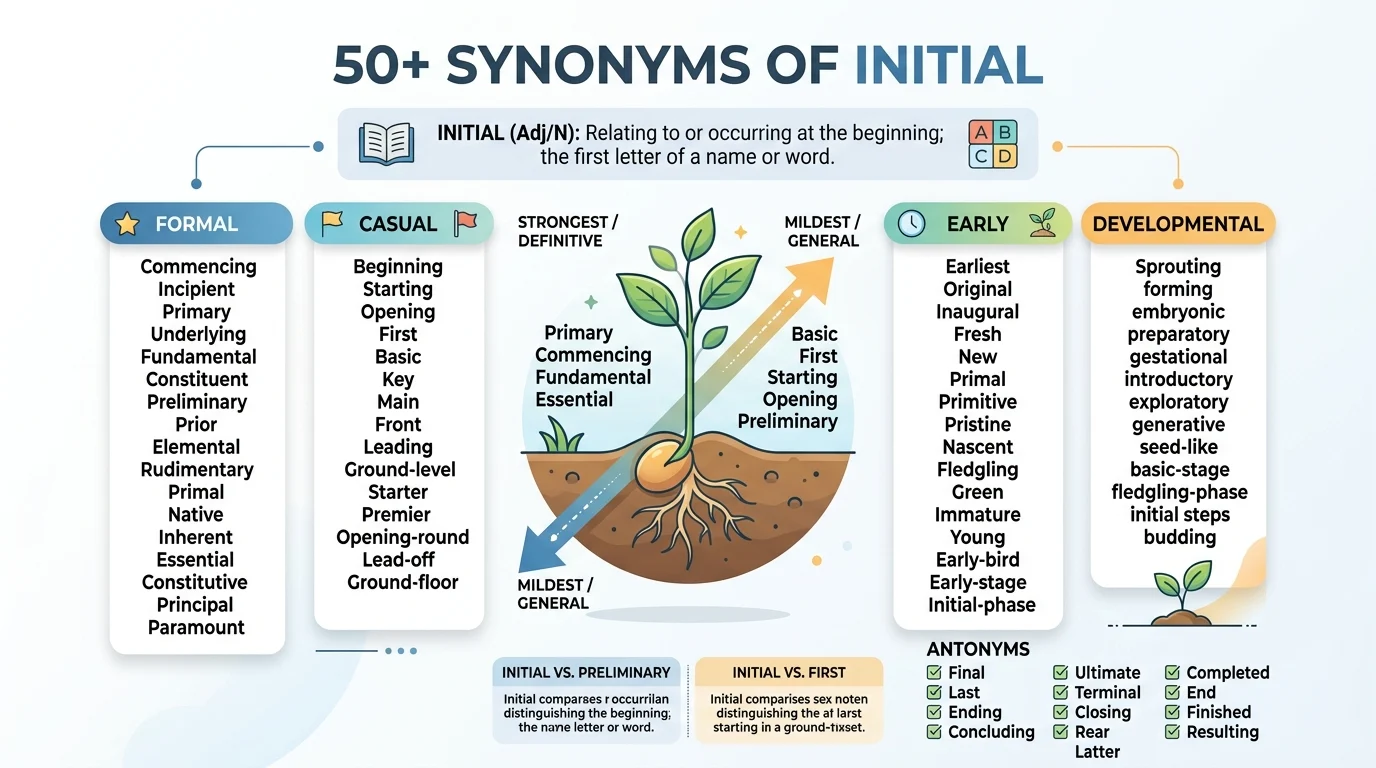
Have you ever needed to describe the first stage of a process, the beginning of a journey, or the opening move in a negotiation but felt that “first” or “early” was too simple? You want to capture the sense of something that comes at the very start, and the word “initial” comes to mind. Choosing the right synonym for “initial” can transform a basic statement into a precise description of beginnings, openings, or first steps. This guide explores the best synonyms of initial, explaining exactly which word to use and when.
Quick Ans: “Initial” means occurring at the beginning, first, or earliest stage. For formal writing, choose preliminary or inaugural. For casual conversation, use first or opening. For early stages, use early or primary. For formal beginnings, use commencing or initiatory.
Meaning, Tone, and Context
Understanding the core meaning of “initial” is the first step to using it effectively.
Simple Definition: Existing or occurring at the beginning; first; earliest.
Part of Speech: Adjective (also a noun meaning the first letter of a name).
Overall Tone: Neutral. It simply indicates the first in a sequence.
Formality Level: Neutral to formal. The word is appropriate in most contexts.
Common Uses: Native English speakers use it to describe stages, reactions, meetings, investments, and impressions. For example, “The initial results are promising,” or “My initial reaction was surprise.”
Word Forms: Related words include the verb initiate, the noun initiation, and the adverb initially.
When and How to Use “Initial”
“Initial” is the perfect choice when you want to describe the first stage or beginning of something. Here are seven realistic examples.
Professional: “The initial phase of the project is complete.”
Academic: “The initial findings support the hypothesis.”
Workplace: “My initial impression of the new manager was positive.”
Personal: “The initial excitement faded after a few weeks.”
Email: “Please review the initial draft and provide feedback.”
Resume: “Conducted initial assessments for all new clients.”
Social Media: “The initial response to the announcement was overwhelmingly positive.”
Best Synonyms of “Initial”
No synonym is identical in every situation. Here is your guide to the best replacement for “initial” based on your writing context.
For Formal and Professional Contexts
Most Formal: Preliminary means coming before the main part. “The preliminary results are encouraging.”
Opening: Inaugural means marking the beginning. “The inaugural meeting was held yesterday.”
Commencing: Commencing means beginning. “The commencing phase requires careful planning.”
Initiatory: Initiatory means serving to initiate. “The initiatory steps were straightforward.”
For General and Casual Contexts
First: First is the simplest synonym. “The first step is the hardest.”
Opening: Opening means beginning. “The opening remarks were brief.”
Early: Early means near the beginning. “The early stages were challenging.”
Primary: Primary means first in order. “The primary concern is safety.”
For Descriptive and Specific Contexts
Original: Original means first or earliest. “The original plan was different.”
Formative: Formative means shaping development. “The formative years are crucial.”
Nascent: Nascent means just beginning to develop. “The nascent industry shows promise.”
Embryonic: Embryonic means in an early stage. “The embryonic project needs support.”
When Not to Use “Initial”
Using “initial” can sound wrong or awkward in certain situations.
When You Mean “Only”: “Initial” is about sequence. “Only” is about exclusivity.
Better Choice: Only or sole. “The only option is to proceed.”
When You Mean “Main”: “Initial” is about timing. “Main” is about importance.
Better Choice: Main or primary. “The main goal is profitability.”
When It Sounds Too Formal: In casual conversation, “initial” can sound stiff.
Better Choice: First or early. “The first try was unsuccessful.”
Words Commonly Confused With “Initial”
| Word | Difference | When to Use | Example |
|---|---|---|---|
| Preliminary | Before the main part | Formal and technical | “Preliminary results.” |
| First | Simplest synonym | General and casual | “First impressions.” |
| Early | Near the beginning | General and descriptive | “Early stages.” |
| Primary | First in importance | Formal and ranking | “Primary concern.” |
| Original | First or earliest | Creative and historical | “Original design.” |
| Opening | Beginning | Events and performances | “Opening remarks.” |
Best Synonyms of “Initial” by Context
| Context | Best Synonym | Why It Works | Example |
|---|---|---|---|
| Formal writing | Preliminary | Formal and precise | “Preliminary findings.” |
| Academic writing | Primary | Standard in research | “Primary data.” |
| Professional | Opening | Professional and clear | “Opening statements.” |
| Business | Early | Business and general | “Early results.” |
| Casual conversation | First | Simple and natural | “First attempt.” |
| Creative | Original | Creative and historical | “Original concept.” |
| Scientific | Nascent | Developing and new | “Nascent technology.” |
How to Choose the Best Synonym of “Initial”
Choosing the right word is a simple decision. Answer these questions.
What type of initial am I describing? For formal, use preliminary or inaugural. And For casual, use first or early. For importance, use primary. For development, use nascent or formative.
What is my audience? For a formal report, use preliminary or primary. For a friend, use first or early.
What is my purpose? Are you describing a stage, a reaction, or a ranking? The correct synonym depends entirely on this.
What is the emotional strength? Nascent and embryonic are more evocative. First is neutral. Pick the one that matches your message.
Real Life Examples of “Initial”
School: Basic: “The initial test was easy.” Improved: “The preliminary test was easy.”
College: Basic: “The initial findings are good.” Improved: “The primary findings are promising.”
Workplace: Basic: “The initial meeting went well.” Improved: “The opening meeting went well.”
Business: Basic: “Initial sales are strong.” Improved: “Early sales are strong.”
Email: Basic: “Here is the initial draft.” Improved: “Here is the first draft.”
Conversation: Basic: “My initial thought was no.” Improved: “My first thought was no.”
Storytelling: Basic: “The initial idea was simple.” Improved: “The original idea was simple.”
Top 10 Synonyms of “Initial”
| Synonym | Simple Meaning | Best Used For | Example Sentence |
|---|---|---|---|
| Preliminary | Before the main part | Formal and technical | “Preliminary results are encouraging.” |
| First | Simplest synonym | General and casual | “First impressions matter.” |
| Early | Near the beginning | General and descriptive | “Early stages are critical.” |
| Primary | First in importance | Formal and ranking | “Primary concern is safety.” |
| Opening | Beginning | Events and performances | “Opening remarks were brief.” |
| Original | First or earliest | Creative and historical | “The original plan was different.” |
| Inaugural | Marking the beginning | Formal and ceremonial | “The inaugural address.” |
| Nascent | Just beginning to develop | Scientific and descriptive | “The nascent industry shows promise.” |
| Formative | Shaping development | Developmental and educational | “The formative years are crucial.” |
| Embryonic | In an early stage | Scientific and descriptive | “The embryonic project needs support.” |
Synonyms of “Initial” by Usage
Professional vs. Personal Synonyms
In the workplace, choose preliminary, opening, or primary. With friends, use first, early, or original.
Formal vs. Conversational Synonyms
For formal writing, use preliminary, inaugural, or primary. For casual conversations, use first, early, or opening.
Academic Synonyms
For research and essays, choose preliminary for results, primary for data, and nascent for emerging fields.
Professional and Business Synonyms
For maximum impact, choose preliminary for reports, early for results, and opening for meetings.
Creative and Literary Synonyms
To add emotion and imagery, choose original, formative, or embryonic. These words create atmosphere.
Slang or Modern Synonyms
In modern American slang, first, early, or opening are common. For example, “First try.” These are casual and should be avoided in formal writing.
Strongest to Mildest Synonyms
Mild: first, early, opening
Moderate: initial, preliminary, primary
Strong: original, inaugural, formative
Very Strong: nascent, embryonic, initiatory
Emotional vs. Neutral Synonyms
Emotional Synonyms: Formative, original, nascent. These words hint at development and significance. Use them when you want to evoke feeling.
Neutral Synonyms: Initial, first, preliminary. These words communicate factual information.
Antonyms of “Initial”
| Antonym | Meaning | Example Sentence |
|---|---|---|
| Final | Last in a sequence | “The final decision was made.” |
| Last | Coming after all others | “The last chapter was the best.” |
| Concluding | Ending | “The concluding remarks were brief.” |
| Ultimate | Final or eventual | “The ultimate goal is success.” |
| Terminal | At the end | “The terminal stage was reached.” |
| Closing | Bringing to an end | “The closing ceremony was emotional.” |
| Subsequent | Coming after | “Subsequent events proved him right.” |
| Later | After the usual time | “The later stages were easier.” |
| Final | Last | “The final answer was correct.” |
| Ending | Bringing to a close | “The ending was unexpected.” |
| Conclusive | Decisive and final | “The conclusive evidence was presented.” |
| Eventual | Occurring at the end | “The eventual outcome was positive.” |
| Retrospective | Looking back | “The retrospective analysis was insightful.” |
| Mature | Fully developed | “The mature stage was reached.” |
| Developed | Fully grown | “The developed economy is stable.” |
Comparison: “Initial” vs Similar Words
Initial vs. Preliminary
Main Difference: “Preliminary” means before the main part. “Initial” means first.
Which Is Stronger? “Preliminary” is more specific to preparation.
Which Is More Formal? “Preliminary” is more formal.
When to Use Each: Use “preliminary” for formal reports. Use “initial” for general contexts.
Examples:
Initial: “The initial results are good.”
Preliminary: “The preliminary results are encouraging.”
Initial vs. First
Main Difference: “First” is casual. “Initial” is more formal.
Which Is Stronger? They are similar.
Which Is More Formal? “Initial” is more formal.
When to Use Each: Use “first” in casual conversation. Use “initial” in formal writing.
Examples:
Initial: “My initial reaction was surprise.”
First: “My first reaction was surprise.”
Initial vs. Early
Main Difference: “Early” means near the beginning. “Initial” means first.
Which Is Stronger? “Initial” is more specific to the very start.
Which Is More Formal? Both are neutral.
When to Use Each: Use “early” for general stages. Use “initial” for the very beginning.
Examples:
Initial: “The initial phase is complete.”
Early: “The early phase was challenging.”
Initial vs. Primary
Main Difference: “Primary” means first in importance. “Initial” means first in time.
Which Is Stronger? “Primary” is about importance.
Which Is More Formal? Both are formal.
When to Use Each: Use “primary” for importance. Use “initial” for timing.
Examples:
Initial: “The initial concern was cost.”
Primary: “The primary concern is safety.”
Initial vs. Original
Main Difference: “Original” means first or earliest. “Initial” is more general.
Which Is Stronger? “Original” is stronger for uniqueness.
Which Is More Formal? Both are formal.
When to Use Each: Use “original” for creative works. Use “initial” for stages.
Examples:
Initial: “The initial plan was simple.”
Original: “The original plan was different.”
Initial vs. Nascent
Main Difference: “Nascent” means just beginning to develop. “Initial” is more general.
Which Is Stronger? “Nascent” is more evocative.
Which Is More Formal? “Nascent” is more formal and literary.
When to Use Each: Use “nascent” for emerging industries. Use “initial” for general contexts.
Examples:
Initial: “The initial stage is complete.”
Nascent: “The nascent industry shows promise.”
Common Phrases and Expressions with “Initial”
Phrase: Initial stage
Meaning: The first stage of a process.
Example Sentence: “The initial stage requires careful planning.”
Phrase: Initial reaction
Meaning: First response.
Example Sentence: “My initial reaction was shock.”
Phrase: Initial public offering
Meaning: First sale of stock to the public.
Example Sentence: “The initial public offering was successful.”
Phrase: Initial impression
Meaning: First opinion.
Example Sentence: “The initial impression was positive.”
Phrase: Initial investment
Meaning: First amount of money invested.
Example Sentence: “The initial investment was significant.”
Phrase: Initial findings
Meaning: First results.
Example Sentence: “The initial findings support the theory.”
Common Mistakes to Avoid
Mistake 1: Using “initial” when you mean “only”.
Incorrect: “The initial option is available.”
Better: “The only option is available.”
Why: “Initial” is about sequence.
Mistake 2: Using “initial” when you mean “main”.
Incorrect: “The initial goal is profitability.”
Better: “The main goal is profitability.”
Why: “Main” is about importance.
Mistake 3: Overusing “initial” in conversation.
Incorrect: “The initial try was unsuccessful.”
Better: “The first try was unsuccessful.”
Why: “First” sounds more natural.
Mistake 4: Using “initial” when you mean “primary”.
Incorrect: “The initial concern is safety.”
Better: “The primary concern is safety.”
Why: “Primary” is about importance.
Mistake 5: Using “initial” when you mean “original”.
Incorrect: “The initial design was unique.”
Better: “The original design was unique.”
Why: “Original” is for creative works.
Frequently Asked Questions
1. What are the best synonyms of “initial”?
The best synonyms depend on your context. For formal writing, choose preliminary or inaugural. And For casual conversation, use first or early. For importance, use primary.
2. What are the best formal synonyms of “initial”?
The best formal synonyms are preliminary, inaugural, and primary. These words are suitable for academic papers, professional reports, and business communications.
3. What are common informal synonyms of “initial”?
For informal settings, use first, early, or opening. These alternatives sound more natural in everyday conversation.
4. What is another word for “initial” in professional writing?
In professional writing, preliminary is an excellent choice. It conveys the early stage of a process. Primary is also strong for importance.
5. What is the difference between “initial” and “preliminary”?
“Initial” means first. “Preliminary” means before the main part. Use “preliminary” for formal reports and “initial” for general contexts.
6. What is the opposite of “initial”?
The most direct opposites (antonyms) of initial are final, last, and concluding. These words describe the end of a sequence.
Conclusion
“Initial” is a versatile and essential word for describing the first stage, beginning, or earliest point of something. The term is neutral and widely accepted in most contexts, yet it can sound too formal for casual conversation or too simple for specific descriptions. The best choice among the synonyms of initial depends entirely on your audience, tone, and purpose. Remember, no single synonym works perfectly in every situation. Your goal is to choose the word that communicates your message with the most clarity and impact. A practical tip for your vocabulary growth is to pay attention to how writers describe beginnings and first stages and practice using different synonyms in your writing.










2 thoughts on “50+ Synonyms of Initial: Meanings, Uses, Examples, and Best Alternatives 2026”