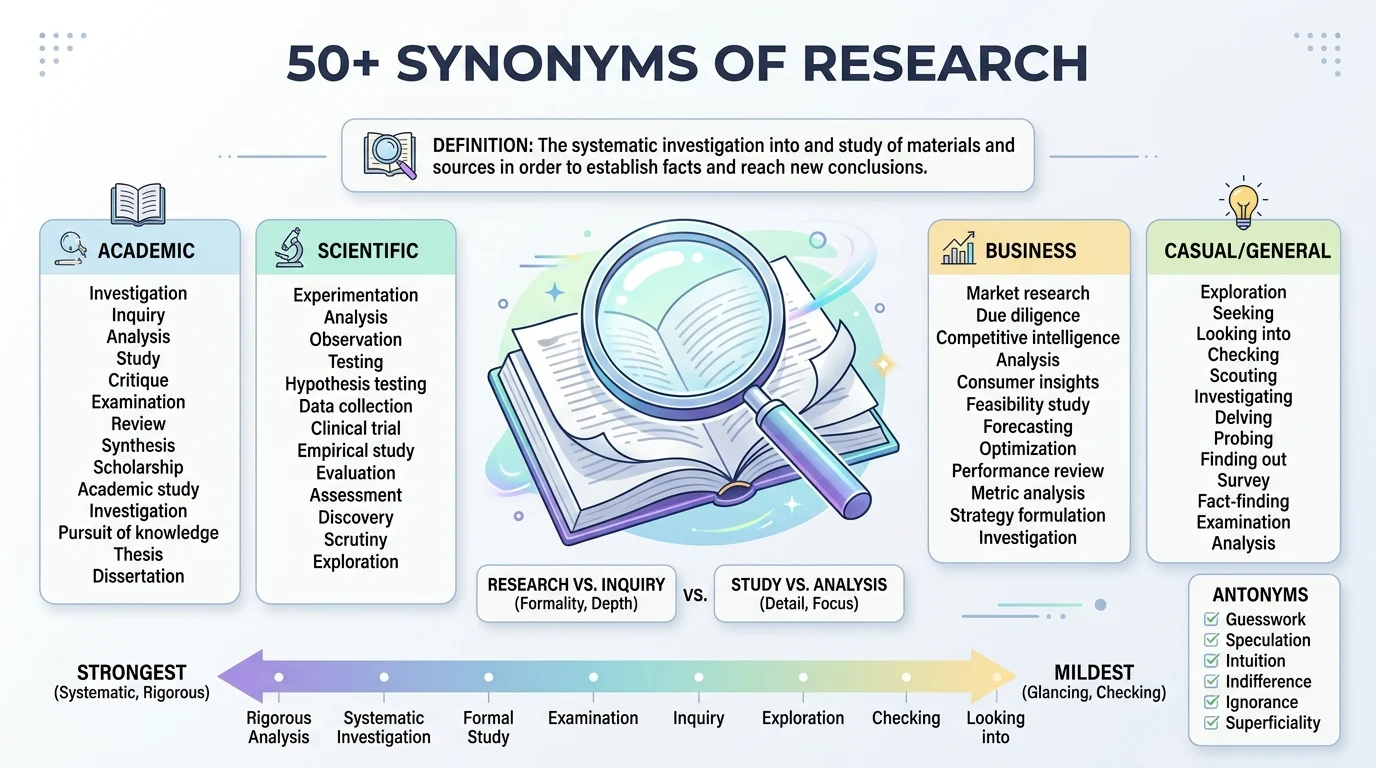
Have you ever needed to describe a careful study, an investigation, or a systematic search for information but felt that “research” was too broad or repetitive? You want to capture the specific nature of the inquiry, whether it is scientific, academic, or personal, and the word “research” comes to mind. Choosing the right synonym for “research” can transform a general statement into a precise description of investigation, study, or discovery. This guide explores the best synonyms of research, explaining exactly which word to use and when.
Quick Ans: “Research” means a systematic investigation into a subject to discover facts or reach new conclusions. For academic contexts, choose study, investigation, or scholarship. For scientific contexts, use experimentation, analysis, or inquiry. For general contexts, use examination, exploration, or probe. For casual conversation, use digging or looking into.
Meaning, Tone, and Context
Understanding the core meaning of “research” is the first step to using it effectively.
Simple Definition: The systematic investigation into and study of materials and sources in order to establish facts and reach new conclusions.
Part of Speech: Noun and verb.
Overall Tone: Neutral to formal. It is an academic and professional term.
Formality Level: Formal to neutral. The word is appropriate in most contexts.
Common Uses: Native English speakers use it in academic (“scientific research”), business (“market research”), journalism (“investigative research”), and personal contexts (“researching a topic”).
Word Forms: Related words include the noun researcher, the verb research, and the adjective research-based.
When and How to Use “Research”
“Research” is the perfect choice when you want to describe systematic investigation or study. Here are seven realistic examples.
Academic: “The research focuses on climate change impacts.”
Scientific: “The research team published their findings.”
Business: “We conducted market research before launching the product.”
Journalism: “The reporter did extensive research for the article.”
Professional: “The report is based on years of research.”
Personal: “I did some research before buying the car.”
Social Media: “Research shows that sleep is essential for health.”
Best Synonyms of “Research”
No synonym is identical in every situation. Here is your guide to the best replacement for “research” based on your writing context.
For Academic and Formal Contexts
Most Common: Study means a detailed investigation. “The study examined the effects of stress.”
Formal: Investigation means a systematic inquiry. “The investigation revealed new facts.”
Academic: Scholarship means academic study and research. “Her scholarship is widely respected.”
Inquiry: Inquiry means a request for information or an investigation. “The inquiry lasted several months.”
Analysis: Analysis means a detailed examination. “The analysis of the data took weeks.”
For Scientific Contexts
Experimentation: Experimentation means testing hypotheses. “The experimentation produced consistent results.”
Observation: Observation means watching and recording. “The observation of the species took years.”
Fieldwork: Fieldwork means research conducted outside. “The fieldwork was conducted in remote areas.”
Empirical Study: Empirical study means research based on observation. “The empirical study confirmed the theory.”
For General and Casual Contexts
Examination: Examination means a close inspection. “The examination of the evidence was thorough.”
Exploration: Exploration means an investigation of unknown areas. “The exploration of the topic was enlightening.”
Probe: Probe means a thorough investigation. “The probe into the scandal continued.”
Digging: Digging means searching for information. “He did some digging before the interview.”
Looking into: Looking into means investigating. “I am looking into the matter.”
When Not to Use “Research”
Using “research” can sound wrong or awkward in certain situations.
When You Mean “Study”: “Research” is broader. “Study” is specific to a single project.
Better Choice: Study or analysis. “The study was published.”
When You Mean “Search”: “Research” is systematic. “Search” is more general.
Better Choice: Search or look. “I did a quick search online.”
When It Sounds Too Formal: In casual conversation, “research” can sound stiff.
Better Choice: Digging or looking into. “I did some digging.”
Words Commonly Confused With “Research”
| Word | Difference | When to Use | Example |
|---|---|---|---|
| Study | A single investigation | Academic and scientific | “The study was published.” |
| Investigation | Systematic inquiry | Formal and journalistic | “The investigation is ongoing.” |
| Analysis | Detailed examination | Data and technical | “The analysis was thorough.” |
| Inquiry | Request for information | Formal and legal | “The inquiry was launched.” |
| Exploration | Investigation of unknown | General and academic | “The exploration was exciting.” |
| Probe | Thorough investigation | Journalistic and formal | “The probe revealed corruption.” |
Best Synonyms of “Research” by Context
| Context | Best Synonym | Why It Works | Example |
|---|---|---|---|
| Formal writing | Investigation | Formal and precise | “The investigation revealed new facts.” |
| Academic writing | Study | Standard in research | “The study examined the data.” |
| Scientific | Experimentation | Scientific and precise | “The experimentation was successful.” |
| Business | Analysis | Business and data | “The analysis showed a trend.” |
| Journalism | Probe | Investigative and formal | “The probe uncovered corruption.” |
| Casual conversation | Digging | Simple and natural | “I did some digging.” |
| Creative writing | Exploration | Evocative and literary | “The exploration of ideas.” |
How to Choose the Best Synonym of “Research”
Choosing the right word is a simple decision. Answer these questions.
What type of research am I describing? For academic, use study or investigation. And For scientific, use experimentation or analysis. For journalism, use probe or inquiry. For casual, use digging or looking into.
What is my audience? For a formal report, use investigation or study. For a friend, use digging or looking into.
What is my purpose? Are you describing a process, a result, or an inquiry? The correct synonym depends entirely on this.
What is the emotional strength? Exploration is more evocative. Analysis is neutral. Pick the one that matches your message.
Real Life Examples of “Research”
School: Basic: “The student did research.” Improved: “The student conducted a study on local wildlife.”
College: Basic: “The research was published.” Improved: “The investigation was published in a journal.”
Workplace: Basic: “We need to do research.” Improved: “We need to conduct an analysis of the market.”
Business: Basic: “The research shows growth.” Improved: “The analysis shows significant growth.”
Email: Basic: “I did some research.” Improved: “I did some digging on the topic.”
Conversation: Basic: “The research is ongoing.” Improved: “The investigation is ongoing.”
Storytelling: Basic: “Her research was thorough.” Improved: “Her exploration of the subject was thorough.”
Top 10 Synonyms of “Research”
| Synonym | Simple Meaning | Best Used For | Example Sentence |
|---|---|---|---|
| Study | A detailed investigation | Academic and scientific | “The study examined the effects.” |
| Investigation | Systematic inquiry | Formal and journalistic | “The investigation revealed facts.” |
| Analysis | Detailed examination | Data and technical | “The analysis was thorough.” |
| Inquiry | Request for information | Formal and legal | “The inquiry was launched.” |
| Scholarship | Academic study | Academic and formal | “Her scholarship is respected.” |
| Experimentation | Testing hypotheses | Scientific | “The experimentation was successful.” |
| Examination | Close inspection | General and formal | “The examination was detailed.” |
| Exploration | Investigation of unknown | General and academic | “The exploration was enlightening.” |
| Probe | Thorough investigation | Journalistic and formal | “The probe revealed corruption.” |
| Fieldwork | Research conducted outside | Scientific and academic | “The fieldwork was conducted in remote areas.” |
Synonyms of “Research” by Usage
Professional vs. Personal Synonyms
In the workplace, choose study, analysis, or investigation. With friends, use digging, looking into, or search.
Formal vs. Conversational Synonyms
For formal writing, use investigation, inquiry, or scholarship. For casual conversations, use digging, looking into, or search.
Academic Synonyms
For research and essays, choose study for a single project, investigation for systematic inquiry, and scholarship for academic work.
Professional and Business Synonyms
For maximum impact, choose analysis for data, study for reports, and investigation for problems.
Creative and Literary Synonyms
To add emotion and imagery, choose exploration, inquiry, or probe. These words create atmosphere.
Slang or Modern Synonyms
In modern American slang, digging, looking into, or googling are common. For example, “I googled it.” These are casual and should be avoided in formal writing.
Strongest to Mildest Synonyms
Mild: search, look, digging
Moderate: research, study, examination
Strong: investigation, analysis, inquiry
Very Strong: scholarship, experimentation, probe
Emotional vs. Neutral Synonyms
Emotional Synonyms: Exploration, inquiry, probe. These words hint at curiosity and discovery. Use them when you want to evoke feeling.
Neutral Synonyms: Research, study, analysis. These words communicate factual information.
Antonyms of “Research”
| Antonym | Meaning | Example Sentence |
|---|---|---|
| Ignorance | Lack of knowledge | “Ignorance is not an excuse.” |
| Neglect | Failure to care | “Neglect caused the decline.” |
| Inattention | Lack of attention | “Inattention led to errors.” |
| Disregard | Lack of concern | “Disregard for facts is dangerous.” |
| Assumption | Something taken for granted | “The assumption was incorrect.” |
| Guess | A random estimate | “The guess was wrong.” |
| Speculation | Forming theories without evidence | “Speculation is not research.” |
| Intuition | Knowing without reasoning | “Intuition is not enough.” |
| Hunch | A feeling or guess | “The hunch was wrong.” |
| Belief | Acceptance without proof | “Belief is not evidence.” |
| Opinion | A personal view | “Opinion is not fact.” |
| Conjecture | An opinion without proof | “Conjecture is not research.” |
| Supposition | An assumption | “Supposition is not proof.” |
| Hypothesis | A proposed explanation | “The hypothesis was tested.” |
| Theory | A system of ideas | “The theory was proven.” |
Comparison: “Research” vs Similar Words
Research vs. Study
Main Difference: “Research” is broad. “Study” is a specific investigation.
Which Is Stronger? “Study” is more specific.
Which Is More Formal? Both are formal.
When to Use Each: Use “research” for general contexts. Use “study” for specific projects.
Examples:
Research: “She conducts research.”
Study: “The study was published.”
Research vs. Investigation
Main Difference: “Investigation” is systematic and often official. “Research” is broader.
Which Is Stronger? “Investigation” is more formal and specific.
Which Is More Formal? “Investigation” is more formal.
When to Use Each: Use “investigation” for official inquiries. Use “research” for general contexts.
Examples:
Research: “The research is ongoing.”
Investigation: “The investigation is ongoing.”
Research vs. Analysis
Main Difference: “Analysis” is detailed examination. “Research” is broader.
Which Is Stronger? “Analysis” is more specific to data.
Which Is More Formal? Both are formal.
When to Use Each: Use “analysis” for data. Use “research” for general contexts.
Examples:
Research: “The research is extensive.”
Analysis: “The analysis is thorough.”
Research vs. Inquiry
Main Difference: “Inquiry” is a request for information. “Research” is broader.
Which Is Stronger? “Inquiry” is more specific to questions.
Which Is More Formal? Both are formal.
When to Use Each: Use “inquiry” for formal questions. Use “research” for general contexts.
Examples:
Research: “The research was published.”
Inquiry: “The inquiry was launched.”
Research vs. Exploration
Main Difference: “Exploration” is investigation of unknown. “Research” is broader.
Which Is Stronger? “Exploration” is more evocative.
Which Is More Formal? Both are formal.
When to Use Each: Use “exploration” in creative contexts. Use “research” in formal contexts.
Examples:
Research: “The research is detailed.”
Exploration: “The exploration was exciting.”
Research vs. Probe
Main Difference: “Probe” is thorough investigation. “Research” is broader.
Which Is Stronger? “Probe” is stronger for depth.
Which Is More Formal? Both are formal.
When to Use Each: Use “probe” for investigations. Use “research” for general contexts.
Examples:
Research: “The research is extensive.”
Probe: “The probe revealed corruption.”
Common Phrases and Expressions with “Research”
Phrase: Market research
Meaning: Gathering information about consumers.
Example Sentence: “Market research is essential before launch.”
Phrase: Scientific research
Meaning: Systematic study in science.
Example Sentence: “Scientific research is peer-reviewed.”
Phrase: Research and development
Meaning: Innovation and improvement.
Example Sentence: “The company invests in research and development.”
Phrase: Primary research
Meaning: Firsthand data collection.
Example Sentence: “Primary research involves surveys.”
Phrase: Secondary research
Meaning: Using existing data.
Example Sentence: “Secondary research uses published sources.”
Phrase: Do research
Meaning: Conduct an investigation.
Example Sentence: “I need to do research on this topic.”
Common Mistakes to Avoid
Mistake 1: Using “research” when you mean “study”.
Incorrect: “The research was published.”
Better: “The study was published.”
Why: “Study” is more specific.
Mistake 2: Using “research” when you mean “search”.
Incorrect: “I did a research online.”
Better: “I did a search online.”
Why: “Search” is for quick lookups.
Mistake 3: Overusing “research” in casual conversation.
Incorrect: “I did research on the restaurant.”
Better: “I looked into the restaurant.”
Why: “Looked into” sounds more natural.
Mistake 4: Using “research” when you mean “investigation”.
Incorrect: “The research into the crime is ongoing.”
Better: “The investigation into the crime is ongoing.”
Why: “Investigation” is for official inquiries.
Mistake 5: Using “research” when you mean “analysis”.
Incorrect: “The research of the data took weeks.”
Better: “The analysis of the data took weeks.”
Why: “Analysis” is for data.
Frequently Asked Questions
1. What are the best synonyms of “research”?
The best synonyms depend on your context. For academic, choose study or investigation. And For scientific, use experimentation or analysis. For general, use examination or exploration.
2. What are the best formal synonyms of “research”?
The best formal synonyms are investigation, inquiry, and scholarship. These words are suitable for academic papers, professional reports, and business communications.
3. What are common informal synonyms of “research”?
For informal settings, use digging, looking into, or search. These alternatives sound more natural in everyday conversation.
4. What is another word for “research” in professional writing?
In professional writing, study is an excellent choice. It conveys a focused investigation. Analysis is also strong for data.
5. What is the difference between “research” and “study”?
“Research” is broad. “Study” is a specific investigation. Use “study” for a single project and “research” for general contexts.
6. What is the opposite of “research”?
The most direct opposites (antonyms) of research are ignorance, neglect, and assumption. These words describe a lack of investigation or knowledge.
Conclusion
“Research” is a versatile and essential word for describing systematic investigation, study, and discovery. The term is formal and widely accepted in most contexts, yet it can sound too broad for specific descriptions or too formal for casual conversation. The best choice among the synonyms of research depends entirely on your audience, tone, and purpose. Remember, no single synonym works perfectly in every situation. Your goal is to choose the word that communicates your message with the most clarity and impact. A practical tip for your vocabulary growth is to pay attention to how writers describe investigation and study and practice using different synonyms in your writing.









