Have you ever needed to describe a new idea, a breakthrough method, or a fresh approach but felt that “innovation” was too broad or overused? You want to capture the specific type of creativity, whether it is a technological leap, a process improvement, or a creative solution, and the word “innovation” comes to mind. Choosing the right synonym for “innovation” can transform a general statement into a precise description of creativity, progress, or originality. This guide explores the best synonyms of innovation, explaining exactly which word to use and when.
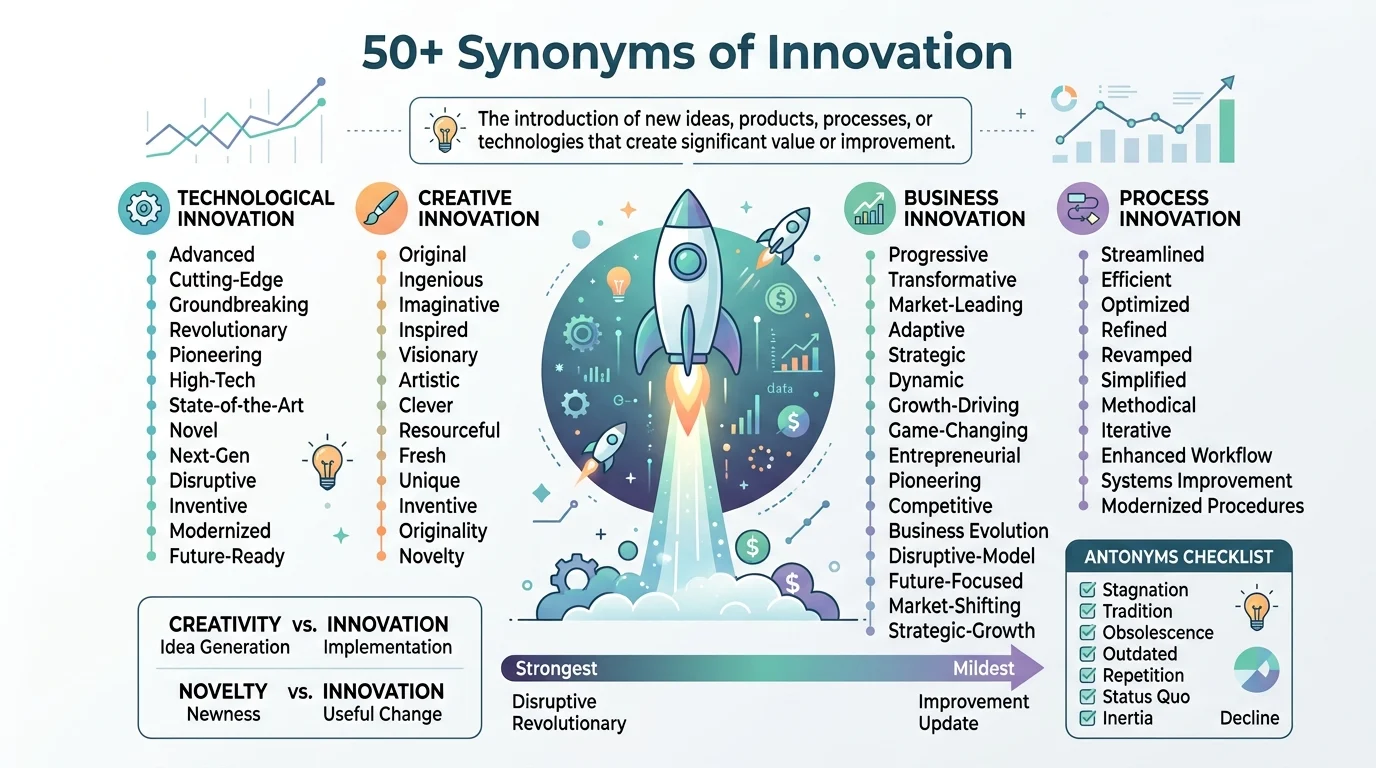
Quick Ans: “Innovation” means the introduction of something new, a new idea, method, or product. For technological contexts, choose breakthrough or pioneering. For creative contexts, use originality or creativity. For business contexts, use modernization or transformation. For process improvements, use improvement or advancement. For a fresh approach, use novelty or newness.
Meaning, Tone, and Context
Understanding the core meaning of “innovation” is the first step to using it effectively.
Simple Definition: The action or process of introducing new methods, ideas, or products; a new idea, method, or product.
Part of Speech: Noun.
Overall Tone: Positive. It indicates progress, creativity, and forward thinking.
Formality Level: Neutral to formal. The word is appropriate in business, academic, and professional contexts.
Common Uses: Native English speakers use it to describe technological advances, business strategies, creative solutions, and process improvements. For example, “The company is known for its innovation in renewable energy,” or “Innovation is key to our success.”
Word Forms: Related words include the verb innovate, the adjective innovative, and the adverb innovatively.
When and How to Use “Innovation”
“Innovation” is the perfect choice when you want to describe the introduction of something new and valuable. Here are seven realistic examples.
Professional: “Our company’s success is driven by continuous innovation.”
Academic: “The study examines innovation in educational technology.”
Workplace: “We need more innovation to stay ahead of competitors.”
Personal: “Her innovation in the kitchen led to a new recipe.”
Email: “The proposal outlines a strategy for fostering innovation.”
Resume: “Led a team that delivered innovation in product design.”
Social Media: “Innovation is not just about technology. It is about solving problems creatively.”
Best Synonyms of “Innovation”
No synonym is identical in every situation. Here is your guide to the best replacement for “innovation” based on your writing context.
For Technological and Scientific Contexts
Major Advance: Breakthrough means a significant discovery or development. “The vaccine was a major breakthrough.”
Cutting Edge: Pioneering means introducing new methods. “Her pioneering work changed the field.”
Technical Improvement: Advancement means progress or improvement. “The advancement in AI is remarkable.”
For Creative and Artistic Contexts
Creative Quality: Originality means the quality of being new and unique. “The originality of her design was praised.”
Creative Ability: Creativity means the use of imagination. “The team’s creativity solved the problem.”
New Quality: Novelty means the quality of being new. “The novelty of the approach excited investors.”
For Business and Process Contexts
Business Update: Modernization means adapting to modern needs. “The modernization of our systems improved efficiency.”
Major Change: Transformation means a thorough change. “The digital transformation changed the industry.”
Process Improvement: Improvement means making something better. “The improvement in workflow saved time.”
Refinement: Refinement means a small but important change. “The refinement to the process increased output.”
For General Contexts
Newness: Newness means the state of being new. “The newness of the idea was appealing.”
Freshness: Freshness means a new or different quality. “The freshness of her perspective was welcome.”
Creative Solution: Ingenuity means cleverness and originality. “The ingenuity of the solution impressed everyone.”
When Not to Use “Innovation”
Using “innovation” can sound wrong or awkward in certain situations.
When You Mean “Invention”: “Innovation” is the process or result. “Invention” is the creation of something new.
Better Choice: Invention. “The invention of the telephone changed communication.”
When You Mean “Discovery”: “Innovation” is about new methods. “Discovery” is about finding something.
Better Choice: Discovery. “The discovery of penicillin was accidental.”
When It Sounds Too Broad: “Innovation” can be vague.
Better Choice: Improvement or refinement. “The improvement was small but effective.”
Words Commonly Confused With “Innovation”
| Word | Difference | When to Use | Example |
|---|---|---|---|
| Invention | The creation of something entirely new | Scientific and historical contexts | “The invention of the wheel was revolutionary.” |
| Discovery | Finding something existing | Scientific and exploratory contexts | “The discovery of a new planet excited astronomers.” |
| Creativity | The use of imagination | Artistic and personal contexts | “Her creativity knows no bounds.” |
| Originality | The quality of being new | Artistic and design contexts | “The originality of the design stood out.” |
| Improvement | Making something better | Business and process contexts | “The improvement in sales was significant.” |
| Transformation | A thorough change | Business and digital contexts | “The transformation was complete.” |
Best Synonyms of “Innovation” by Context
| Context | Best Synonym | Why It Works | Example |
|---|---|---|---|
| Technological breakthrough | Breakthrough | Dramatic and significant | “The breakthrough in battery technology was huge.” |
| Scientific advancement | Advancement | Formal and precise | “The advancement in medicine saved lives.” |
| Creative design | Originality | Emphasizes uniqueness | “The originality of the design was praised.” |
| Business strategy | Transformation | Implies major change | “The digital transformation was successful.” |
| Process improvement | Improvement | Practical and clear | “The improvement saved time and money.” |
| New idea | Novelty | Focus on newness | “The novelty of the idea excited the team.” |
| Clever solution | Ingenuity | Emphasizes cleverness | “The ingenuity of the solution was remarkable.” |
| Pioneering work | Pioneering | Suggests leading the way | “Her pioneering research changed the field.” |
| Business update | Modernization | Suggests updating | “The modernization of the factory increased output.” |
| Refined process | Refinement | Subtle but important | “The refinement improved the user experience.” |
How to Choose the Best Synonym of “Innovation”
Choosing the right word is a simple decision. Answer these questions.
What type of innovation am I describing? For technological, use breakthrough or advancement. And For creative, use originality or creativity. For business, use transformation or modernization. For process, use improvement or refinement.
What is my audience? For a formal report, use breakthrough or transformation. For a friend, use new idea or fresh approach.
What is my purpose? Are you describing a major change, a creative solution, or a small improvement? The correct synonym depends entirely on this.
What is the emotional strength? Breakthrough and pioneering are stronger. Improvement and refinement are milder. Pick the one that matches your message.
Real Life Examples of “Innovation”
School: Basic: “The project shows innovation.” Improved: “The project demonstrates originality and creativity.”
College: Basic: “The research is innovative.” Improved: “The research represents a breakthrough in the field.”
Workplace: Basic: “We need innovation.” Improved: “We need a transformation in our approach.”
Business: Basic: “The company values innovation.” Improved: “The company values pioneering thinking.”
Email: Basic: “The proposal is innovative.” Improved: “The proposal offers a novel approach to the problem.”
Conversation: Basic: “That is a good innovation.” Improved: “That is a clever improvement.”
Storytelling: Basic: “His innovation changed the world.” Improved: “His pioneering work changed the world.”
Top 10 Synonyms of “Innovation”
| Synonym | Simple Meaning | Best Used For | Example Sentence |
|---|---|---|---|
| Breakthrough | A significant discovery or development | Technological and scientific contexts | “The breakthrough in cancer research was celebrated.” |
| Advancement | Progress or improvement | Academic and professional contexts | “The advancement in technology was rapid.” |
| Originality | The quality of being new and unique | Creative and artistic contexts | “The originality of her work was praised.” |
| Creativity | The use of imagination | Personal and artistic contexts | “The team’s creativity solved the problem.” |
| Transformation | A thorough change | Business and digital contexts | “The digital transformation was complete.” |
| Modernization | Adapting to modern needs | Business and industrial contexts | “The modernization of the factory increased output.” |
| Improvement | Making something better | General and business contexts | “The improvement in sales was significant.” |
| Novelty | The quality of being new | General and descriptive contexts | “The novelty of the idea excited the team.” |
| Ingenuity | Cleverness and originality | Problem-solving contexts | “The ingenuity of the solution was remarkable.” |
| Pioneering | Introducing new methods | Scientific and exploratory contexts | “Her pioneering research changed the field.” |
Synonyms of “Innovation” by Usage
Professional vs. Personal Synonyms
In the workplace, choose breakthrough, transformation, or pioneering. With friends, use new idea, fresh approach, or creative solution.
Formal vs. Conversational Synonyms
For formal writing, use advancement, transformation, or modernization. For casual conversations, use new idea, improvement, or fresh take.
Academic Synonyms
For research and essays, choose breakthrough for major discoveries, advancement for progress, and pioneering for leading work.
Professional and Business Synonyms
For maximum impact, choose transformation for strategy, modernization for operations, and breakthrough for products.
Creative and Literary Synonyms
To add emotion and imagery, choose originality, creativity, or ingenuity. These words create atmosphere.
Slang or Modern Synonyms
In modern American slang, game-changer, disruptive, or next-level are common. For example, “That is a game-changer.” These are casual and should be avoided in formal writing.
Strongest to Mildest Synonyms
Mild: improvement, refinement, novelty
Moderate: innovation, advancement, originality
Strong: breakthrough, transformation, pioneering
Very Strong: revolution, disruption, game-changer
Emotional vs. Neutral Synonyms
Emotional Synonyms: Breakthrough, pioneering, revolution. These words hint at excitement and progress. Use them when you want to evoke feeling.
Neutral Synonyms: Improvement, refinement, advancement. These words simply communicate factual information.
Antonyms of “Innovation”
| Antonym | Meaning | Example Sentence |
|---|---|---|
| Stagnation | Lack of growth or development | “The stagnation of the industry was concerning.” |
| Tradition | Long-established customs | “They preferred tradition over change.” |
| Conformity | Following established norms | “Conformity stifled creativity.” |
| Routine | A regular procedure | “The routine was predictable.” |
| Status quo | The existing state | “They defended the status quo.” |
| Obsolescence | The state of being outdated | “The obsolescence of the technology was evident.” |
| Stagnancy | Lack of activity | “The stagnancy of the market worried investors.” |
| Conservatism | Preference for tradition | “Conservatism resisted the new approach.” |
| Sameness | Lack of variety | “The sameness of the products was boring.” |
| Imitation | Copying others | “Imitation is not innovation.” |
Comparison: “Innovation” vs Similar Words
Innovation vs. Invention
Main Difference: “Invention” is the creation of something entirely new. “Innovation” is the introduction of new methods or improvements.
Which Is Stronger? “Invention” is more fundamental.
Which Is More Formal? Both are formal.
When to Use Each: Use “invention” for new creations. Use “innovation” for new approaches.
Examples:
Innovation: “The innovation improved the product.”
Invention: “The invention of the telephone was revolutionary.”
Innovation vs. Creativity
Main Difference: “Creativity” is the ability to imagine. “Innovation” is the implementation of new ideas.
Which Is Stronger? “Innovation” is more action-oriented.
Which Is More Formal? Both are formal.
When to Use Each: Use “creativity” for artistic contexts. Use “innovation” for business contexts.
Examples:
Innovation: “The company is known for innovation.”
Creativity: “Her creativity is inspiring.”
Innovation vs. Improvement
Main Difference: “Improvement” is making something better. “Innovation” is introducing something new.
Which Is Stronger? “Innovation” is more transformative.
Which Is More Formal? Both are formal.
When to Use Each: Use “improvement” for small changes. Use “innovation” for major changes.
Examples:
Innovation: “The innovation changed the industry.”
Improvement: “The improvement increased efficiency.”
Innovation vs. Breakthrough
Main Difference: “Breakthrough” is a major discovery. “Innovation” is broader.
Which Is Stronger? “Breakthrough” is more dramatic.
Which Is More Formal? Both are formal.
When to Use Each: Use “breakthrough” for significant discoveries. Use “innovation” for general new ideas.
Examples:
Innovation: “The innovation was well-received.”
Breakthrough: “The breakthrough in medicine saved lives.”
Innovation vs. Transformation
Main Difference: “Transformation” is a thorough change. “Innovation” is the introduction of something new.
Which Is Stronger? “Transformation” is more comprehensive.
Which Is More Formal? Both are formal.
When to Use Each: Use “transformation” for major changes. Use “innovation” for new ideas.
Examples:
Innovation: “The innovation improved the process.”
Transformation: “The transformation changed the company.”
Innovation vs. Novelty
Main Difference: “Novelty” is the quality of being new. “Innovation” is the introduction of something new.
Which Is Stronger? “Innovation” is more substantial.
Which Is More Formal? Both are formal.
When to Use Each: Use “novelty” for newness. Use “innovation” for new methods.
Examples:
Innovation: “The innovation was practical.”
Novelty: “The novelty of the idea was appealing.”
Common Phrases and Expressions with “Innovation”
Phrase: Innovation hub
Meaning: A place where new ideas are developed.
Example Sentence: “Silicon Valley is a global innovation hub.”
Phrase: Innovation strategy
Meaning: A plan for developing new ideas.
Example Sentence: “The company’s innovation strategy focuses on sustainability.”
Phrase: Innovation ecosystem
Meaning: The network that supports innovation.
Example Sentence: “The innovation ecosystem includes startups and universities.”
Phrase: Disruptive innovation
Meaning: Innovation that changes an industry.
Example Sentence: “The smartphone was a disruptive innovation.”
Phrase: Innovation-driven
Meaning: Motivated by innovation.
Example Sentence: “The company is innovation-driven.”
Phrase: Foster innovation
Meaning: To encourage new ideas.
Example Sentence: “The manager’s goal is to foster innovation.”
Common Mistakes to Avoid
Mistake 1: Using “innovation” when you mean “invention”.
Incorrect: “The innovation of the lightbulb changed the world.”
Better: “The invention of the lightbulb changed the world.”
Why: “Invention” is for new creations. “Innovation” is for new methods.
Mistake 2: Using “innovation” when you mean “improvement”.
Incorrect: “The small innovation saved time.”
Better: “The small improvement saved time.”
Why: “Improvement” is for small changes.
Mistake 3: Using “innovation” in casual conversation.
Incorrect: “That is a cool innovation.”
Better: “That is a cool new idea.”
Why: “New idea” sounds more natural in casual conversation.
Mistake 4: Using “innovation” when you mean “creativity”.
Incorrect: “Her innovation in painting is impressive.”
Better: “Her creativity in painting is impressive.”
Why: “Creativity” is for artistic contexts.
Mistake 5: Overusing “innovation” in business writing.
Incorrect: “We need innovation.”
Better: “We need a breakthrough in our approach.”
Why: “Breakthrough” is more specific and impactful.
Frequently Asked Questions
1. What are the best synonyms of “innovation”?
The best synonyms depend on your context. For technological contexts, choose breakthrough or advancement. And For creative contexts, use originality or creativity. For business contexts, use transformation or modernization.
2. What are the best formal synonyms of “innovation”?
The best formal synonyms are breakthrough, advancement, and transformation. These words are suitable for academic papers, professional reports, and business communications.
3. What are common informal synonyms of “innovation”?
For informal settings, use new idea, fresh approach, or game-changer. These alternatives sound more natural in everyday conversation.
4. What is another word for “innovation” in professional writing?
In professional writing, breakthrough is an excellent choice for major developments. Transformation is also strong for significant changes.
5. What is the difference between “innovation” and “invention”?
“Invention” is the creation of something entirely new. “Innovation” is the introduction of new methods or improvements to existing things. Use “invention” for new creations and “innovation” for new approaches.
6. What is the opposite of “innovation”?
The most direct opposites (antonyms) of innovation are stagnation, tradition, and conformity. These words describe resistance to change.
Conclusion
“Innovation” is a powerful and positive word for describing new ideas, methods, and progress. The term is widely accepted in most contexts, yet it can sound too broad or overused. The best choice among the synonyms of innovation depends entirely on your audience, tone, and purpose. Remember, no single synonym works perfectly in every situation. Your goal is to choose the word that communicates your message with the most clarity and impact. A practical tip for your vocabulary growth is to pay attention to how innovators describe their work and practice using different synonyms in your writing.










1 thought on “50+ Synonyms of Innovation: Meanings, Uses, Examples, and Best Alternatives 2026”