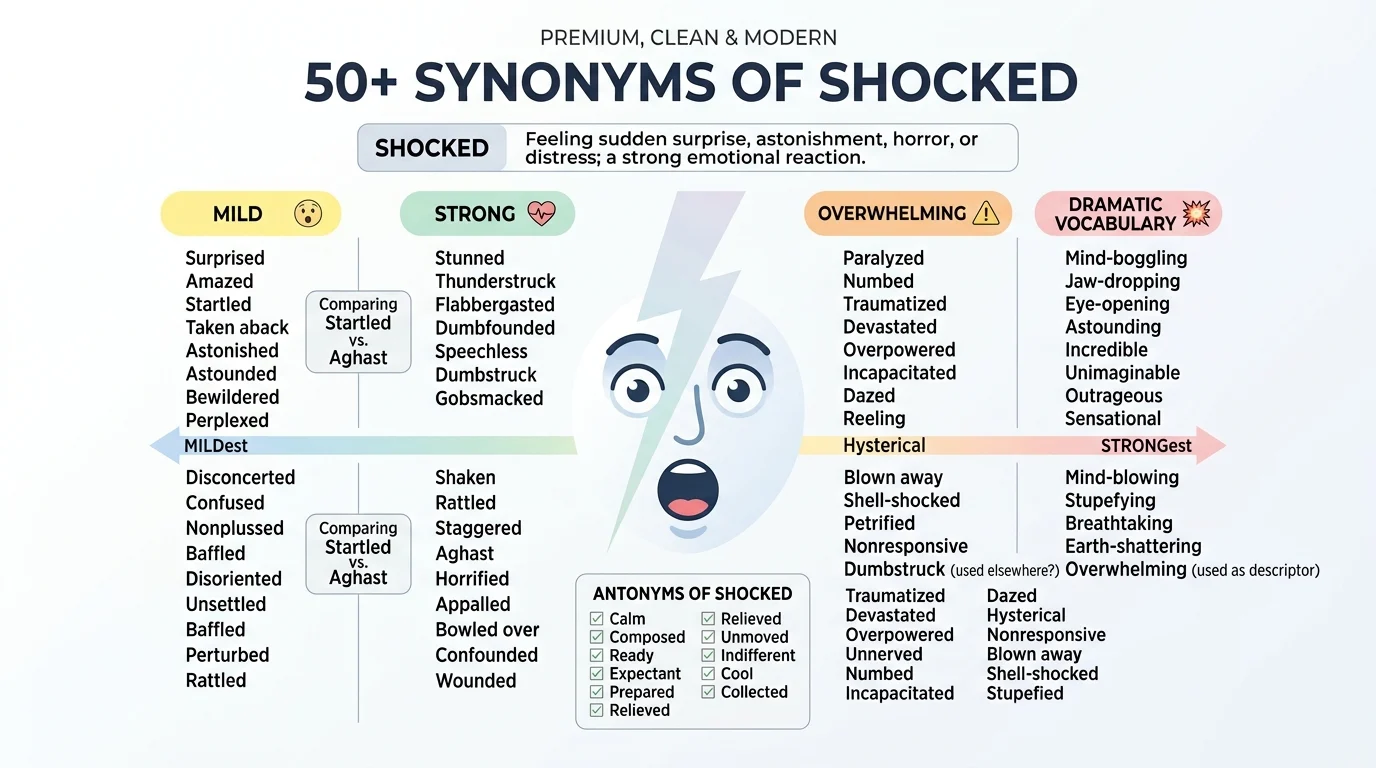
Have you ever received news so unexpected that you did not know how to react, or witnessed something so startling that words failed you? You want to describe that sudden jolt of surprise, and the word “shocked” comes to mind. Choosing the right synonym for “shocked” can transform a simple reaction into a precise expression of astonishment, dismay, or disbelief. This guide explores the best synonyms of shocked, explaining exactly which word to use and when.
Quick Ans: “Shocked” means feeling sudden surprise, distress, or disbelief caused by something unexpected. For formal writing, choose astonished or astounded. For negative reactions, use appalled or horrified. In casual conversation, stunned or flabbergasted works well. For a milder reaction, choose surprised or startled.
Meaning, Tone, and Context
Understanding the core meaning of “shocked” is the first step to using it effectively.
Simple Definition: A sudden, intense feeling of surprise, upset, or disbelief caused by an unexpected event or piece of news.
Part of Speech: Adjective (past participle of the verb shock).
Overall Tone: Negative to neutral. It often implies distress, but can also describe pleasant surprises.
Formality Level: Neutral. The word is appropriate in most contexts, though more formal and more casual alternatives exist.
Common Uses: Native English speakers use it to describe reactions to bad news, startling events, and unexpected behavior. For example, “I was shocked to hear about the accident,” or “She was shocked by his rude comment.”
Word Forms: Related words include the noun shock, the adjective shocking, the adverb shockingly, and the verb shock.
When and How to Use “Shocked”
“Shocked” is the perfect choice when you want to describe a strong, sudden reaction to something unexpected. Here are seven realistic examples.
Professional: “The board was shocked by the sudden resignation of the CEO.”
Academic: “The researchers were shocked to discover the extent of the damage.”
Workplace: “We were all shocked alongwith when the project was canceled without warning.”
Personal: “I was shocked to learn that my old friend had moved away.”
Email: “We were shocked to receive your complaint and are investigating immediately.”
Social Media: “I am absolutely shocked by this news. Sending love to everyone affected.”
Conversational: “She was shocked especially when she saw the final bill.”
Best Synonyms of “Shocked”
No synonym is identical in every situation. Here is your guide to the best replacement for “shocked” based on your writing context.
For Strong Surprise (Neutral or Positive)
Most Formal: Astonished suggests great surprise or wonder. “She was astonished by the generous gift.”
Strong and Dramatic: Astounded means overwhelmed with shock and wonder. “He was astounded by the view from the mountain.”
Overwhelmed: Stunned suggests being so shocked that you cannot react. “The audience was stunned into silence.”
Extremely Surprised: Dumbfounded means unable to speak due to shock. “He was dumbfounded by the accusation.”
Colloquial: Flabbergasted is a strong, informal word for extreme surprise. “I was flabbergasted by the news.”
For Negative Reactions (Distress and Disgust)
Strong Disapproval: Appalled suggests shock mixed with disgust. “We were appalled by the conditions in the factory.”
Horror: Horrified means shocked with horror. “She was horrified by the violence in the film.”
Disbelief: Aghast means filled with shock or horror. “He was aghast at the proposal.”
Very Strong: Devastated means overwhelmed by shock and grief. “The family was devastated by the news.”
For Milder Reactions
Mild Surprise: Surprised is a general word for unexpected events. “I was surprised to see him at the party.”
Sudden Start: Startled means surprised briefly. “The loud noise startled her.”
Taken Aback: Taken aback means surprised and disconcerted. “I was taken aback by his rudeness.”
When Not to Use “Shocked”
Using “shocked” can sound wrong or awkward in certain situations.
When It Sounds Too Strong: For minor surprises, “shocked” is too dramatic.
Better Choice: Surprised or startled. “I was surprised by the change in schedule.”
When You Mean “Angry”: “Shocked” is about surprise. “Angry” is about emotion.
Better Choice: Outraged or furious. “She was outraged by the unfair decision.”
When You Mean “Sad”: “Shocked” is about surprise. “Sad” is about grief.
Better Choice: Heartbroken or devastated. “He was heartbroken by the loss.”
Words Commonly Confused With “Shocked”
| Word | Difference | When to Use | Example |
|---|---|---|---|
| Surprised | Milder and more general | Everyday unexpected events | “I was surprised to see her.” |
| Startled | Sudden, brief surprise | Sudden noises or movements | “The door slamming startled me.” |
| Appalled | Shocked and disgusted | Moral outrage | “We were appalled by the cruelty.” |
| Horrified | Shocked and frightened | Fear and revulsion | “She was horrified by the accident.” |
| Stunned | So shocked you cannot react | Overwhelming news | “He was stunned by the verdict.” |
| Astonished | Great surprise and wonder | Positive or neutral surprise | “I was astonished by her talent.” |
Best Synonyms of “Shocked” by Context
| Context | Best Synonym | Why It Works | Example |
|---|---|---|---|
| Formal writing | Astonished | Formal and strong | “The committee was astonished by the findings.” |
| Negative reaction | Appalled | Suggests moral outrage | “We were appalled by the conditions.” |
| Fear-based | Horrified | Suggests fear and revulsion | “She was horrified by the violence.” |
| Unable to react | Stunned | Suggests paralysis | “The crowd was stunned into silence.” |
| Disbelief | Dumbfounded | Suggests speechlessness | “He was dumbfounded by the accusation.” |
| Casual conversation | Flabbergasted | Informal and expressive | “I was flabbergasted by the news.” |
| Mild surprise | Surprised | Simple and general | “I was surprised by the change.” |
| Sudden start | Startled | Brief and sudden | “The noise startled her.” |
| Disconcerted | Taken aback | Surprised and unsettled | “I was taken aback by his comment.” |
How to Choose the Best Synonym of “Shocked”
Choosing the right word is a simple decision. Answer these questions.
What type of shock am I describing? For wonder, use astonished. And For disgust, use appalled. For fear, use horrified. And For paralysis, use stunned. For speechlessness, use dumbfounded.
What is my audience? For a formal report, use astonished or appalled. For a friend, use flabbergasted or stunned.
What is my purpose? Are you describing wonder, outrage, or disbelief? The correct synonym depends entirely on this.
What is the emotional strength? Devastated and horrified are stronger. Surprised and startled are milder. Pick the one that matches your message.
Real Life Examples of “Shocked”
To truly master the word, it helps to see how it behaves in the wild and how a stronger synonym can elevate the sentence.
School: Basic: “The students were shocked by the pop quiz.” Improved: “The students were surprised by the pop quiz.”
College: Basic: “The professor was shocked by the plagiarism.” Improved: “The professor was appalled by the plagiarism.”
Workplace: Basic: “We were shocked by the layoffs.” Improved: “We were stunned by the sudden layoffs.”
Business: Basic: “The investors were shocked by the losses.” Improved: “The investors were dumbfounded by the unexpected losses.”
Email: Basic: “I was shocked by your email.” Improved: “I was taken aback by your email.”
Conversation: Basic: “I was shocked to see him.” Improved: “I was startled to see him.”
Storytelling: Basic: “She was shocked by the news.” Improved: “She was devastated by the news.”
Top 10 Synonyms of “Shocked”
| Synonym | Simple Meaning | Best Used For | Example Sentence |
|---|---|---|---|
| Astonished | Greatly surprised or impressed | Formal and positive contexts | “She was astonished by the beautiful gift.” |
| Astounded | Overwhelmed with shock and wonder | Strong, dramatic contexts | “He was astounded by the view.” |
| Stunned | So shocked that you cannot react | Overwhelming and paralyzing news | “The audience was stunned into silence.” |
| Dumbfounded | Unable to speak due to shock | Disbelief and speechlessness | “He was dumbfounded by the accusation.” |
| Flabbergasted | Extremely surprised | Casual and expressive contexts | “I was flabbergasted by the news.” |
| Appalled | Shocked and disgusted | Moral outrage | “We were appalled by the cruelty.” |
| Horrified | Shocked and frightened | Fear and revulsion | “She was horrified by the accident.” |
| Aghast | Filled with shock or horror | Formal and dramatic contexts | “He was aghast at the proposal.” |
| Startled | Briefly surprised | Sudden noises or movements | “The loud noise startled her.” |
| Taken aback | Surprised and disconcerted | Unsettling comments or events | “I was taken aback by his rudeness.” |
Synonyms of “Shocked” by Usage
Professional vs. Personal Synonyms
In the workplace (professional), choose astonished, appalled, or stunned to describe reactions to news. “The board was astonished by the results” is more precise than “The board was shocked.”
With friends (personal), flabbergasted, stunned, or surprised keep the tone relaxed and relatable.
Formal vs. Conversational Synonyms
For formal writing (reports, essays, professional emails), use astonished, appalled, horrified, or aghast. These choices maintain the sophisticated tone expected in professional documents.
For casual conversations and texting, use flabbergasted, stunned, or surprised. These options sound more natural.
Academic Synonyms
For research and essays, choose precise, authoritative words. Astonished is great for wonder, appalled for moral outrage, and dumbfounded for disbelief.
Professional and Business Synonyms
For maximum impact in business writing, choose astonished for surprise, appalled for disapproval, and stunned for paralysis.
Creative and Literary Synonyms
To add emotion and imagery to your writing, choose aghast, horrified, or devastated. These words create atmosphere.
Slang and Colloquial Synonyms
In modern American slang, shook, gobsmacked, or blown away are commonly used. For example, “I am absolutely shook,” or “I was gobsmacked by the news.” These are acceptable in casual contexts but should be avoided in professional or academic writing.
Strongest to Mildest Synonyms
Mild: surprised, startled, taken aback
Moderate: shocked, stunned, astonished
Strong: astounded, dumbfounded, appalled
Very Strong: horrified, aghast, devastated
Emotional vs. Neutral Synonyms
Emotional Synonyms: Horrified, appalled, devastated. These words hint at fear, disgust, or grief. Use them when you want to evoke feeling.
Neutral Synonyms: Surprised, astonished, startled. These words simply communicate factual information.
Antonyms of “Shocked”
| Antonym | Meaning | Example Sentence |
|---|---|---|
| Calm | Peaceful and untroubled | “She remained calm during the crisis.” |
| Composed | In control of emotions | “He was composed despite the pressure.” |
| Unfazed | Not disturbed | “She was unfazed by the criticism.” |
| Indifferent | Not interested or concerned | “He was indifferent to the news.” |
| Expectant | Expecting something | “The crowd was expectant.” |
| Prepared | Ready for something | “We were prepared for the changes.” |
| Relaxed | Free from tension | “He felt relaxed after the vacation.” |
| Unimpressed | Not impressed | “She was unimpressed by the display.” |
| Nonchalant | Casually calm | “He was nonchalant about the results.” |
| Serene | Calm and peaceful | “The lake was serene.” |
| Unperturbed | Not worried | “She was unperturbed by the delay.” |
| Collected | Calm and in control | “He remained collected under pressure.” |
| Stoic | Enduring without complaint | “She was stoic in the face of adversity.” |
| Unmoved | Not affected emotionally | “He was unmoved by the appeal.” |
| Bored | Not interested | “The audience was bored.” |
Comparison: “Shocked” vs Similar Words
Shocked vs. Surprised
Main Difference: “Surprised” is milder and more general. “Shocked” is stronger and more intense.
Which Is Stronger? “Shocked” is much stronger.
Which Is More Formal? Both are neutral.
When to Use Each: Use “surprised” for minor unexpected events. Use “shocked” for strong, sudden reactions.
Examples:
Shocked: “I was shocked by the news.”
Surprised: “I was surprised to see her.”
Shocked vs. Appalled
Main Difference: “Appalled” implies moral outrage and disgust. “Shocked” is broader.
Which Is Stronger? “Appalled” is stronger for disapproval.
Which Is More Formal? Both are formal.
When to Use Each: Use “appalled” for moral outrage. Use “shocked” for general surprise.
Examples:
Shocked: “She was shocked by the decision.”
Appalled: “We were appalled by the cruelty.”
Shocked vs. Stunned
Main Difference: “Stunned” suggests being so shocked you cannot react. “Shocked” is more general.
Which Is Stronger? “Stunned” is stronger for paralysis.
Which Is More Formal? Both are formal.
When to Use Each: Use “stunned” for overwhelming news. Use “shocked” for general surprise.
Examples:
Shocked: “I was shocked by the announcement.”
Stunned: “The crowd was stunned into silence.”
Shocked vs. Astonished
Main Difference: “Astonished” suggests great surprise and wonder. “Shocked” is more general.
Which Is Stronger? “Astonished” is stronger for wonder.
Which Is More Formal? “Astonished” is more formal.
When to Use Each: Use “astonished” for positive surprise. Use “shocked” for general surprise.
Examples:
Shocked: “He was shocked by the results.”
Astonished: “She was astonished by the beautiful gift.”
Shocked vs. Horrified
Main Difference: “Horrified” suggests shock mixed with fear and revulsion. “Shocked” is broader.
Which Is Stronger? “Horrified” is much stronger for fear.
Which Is More Formal? Both are formal.
When to Use Each: Use “horrified” for frightening events. Use “shocked” for general surprise.
Examples:
Shocked: “I was shocked by the news.”
Horrified: “She was horrified by the violence.”
Shocked vs. Flabbergasted
Main Difference: “Flabbergasted” is informal and expressive. “Shocked” is neutral.
Which Is Stronger? “Flabbergasted” is stronger for casual surprise.
Which Is More Formal? “Shocked” is more formal. “Flabbergasted” is casual.
When to Use Each: Use “flabbergasted” in casual conversation. Use “shocked” in general contexts.
Examples:
Shocked: “I was shocked by the news.”
Flabbergasted: “I was flabbergasted by the news.”
Common Phrases and Expressions with “Shocked”
Phrase: Shocked to the core
Meaning: Extremely shocked.
Example Sentence: “She was shocked to the core by the betrayal.”
Phrase: Shell-shocked
Meaning: Stunned and confused after a traumatic event.
Example Sentence: “The soldiers were shell-shocked after the battle.”
Phrase: Shocked silence
Meaning: A silence caused by shock.
Example Sentence: “A shocked silence fell over the room.”
Phrase: Shocked expression
Meaning: A face showing shock.
Example Sentence: “He had a shocked expression when he heard the news.”
Phrase: Shocked disbelief
Meaning: A state of not believing what happened.
Example Sentence: “She stared in shocked disbelief.”
Common Mistakes to Avoid
Mistake 1: Using “shocked” when you mean “surprised”.
Incorrect: “I was shocked to see you here.”
Better: “I was surprised to see you here.”
Why: “Surprised” is milder and more appropriate for minor events.
Mistake 2: Using “shocked” when you mean “appalled”.
Incorrect: “We were shocked by the cruelty.”
Better: “We were appalled by the cruelty.”
Why: “Appalled” is stronger for moral outrage.
Mistake 3: Using “shocked” when you mean “horrified”.
Incorrect: “She was shocked by the violence.”
Better: “She was horrified by the violence.”
Why: “Horrified” is stronger for fear and revulsion.
Mistake 4: Overusing “shocked” in casual conversation.
Incorrect: “I was shocked by the price of coffee.”
Better: “I was surprised by the price of coffee.”
Why: “Surprised” is more appropriate for minor events.
Mistake 5: Using “shocked” when you mean “stunned”.
Incorrect: “The crowd was shocked into silence.”
Better: “The crowd was stunned into silence.”
Why: “Stunned” is stronger for paralysis.
Frequently Asked Questions
1. What are the best synonyms of “shocked”?
The best synonyms depend on your context. For formal writing, choose astonished or appalled. And For negative reactions, use appalled or horrified. For casual conversation, use stunned or flabbergasted.
2. What are the best formal synonyms of “shocked”?
The best formal synonyms are astonished, appalled, horrified, and aghast. These words are suitable for academic papers, professional reports, and business communications.
3. What are common informal synonyms of “shocked”?
For informal settings, use flabbergasted, stunned, shook, or gobsmacked. These alternatives sound more natural in everyday conversation.
4. What is another word for “shocked” in professional writing?
In professional writing, astonished is an excellent choice for surprise. Especially Appalled is also strong for disapproval.
5. What is the difference between “shocked” and “appalled”?
“Shocked” is a general reaction to something unexpected. “Appalled” is stronger and implies moral outrage and disgust.
6. What is the opposite of “shocked”?
The most direct opposites (antonyms) of shocked are calm, composed, and unfazed. These words describe people who are not easily disturbed.
Conclusion
“Shocked” is a powerful and common word for describing sudden, intense reactions to unexpected events. The term is widely accepted in most contexts, yet it can sound too strong for minor surprises or too general for specific emotional states. The best choice among the synonyms of shocked depends entirely on your audience, tone, and purpose. Remember, no single synonym works perfectly in every situation. Your goal is to choose the word that communicates your message with the most clarity and impact. A practical tip for your vocabulary growth is to pay attention to how news and literature describe reactions and practice using different synonyms in your writing.









