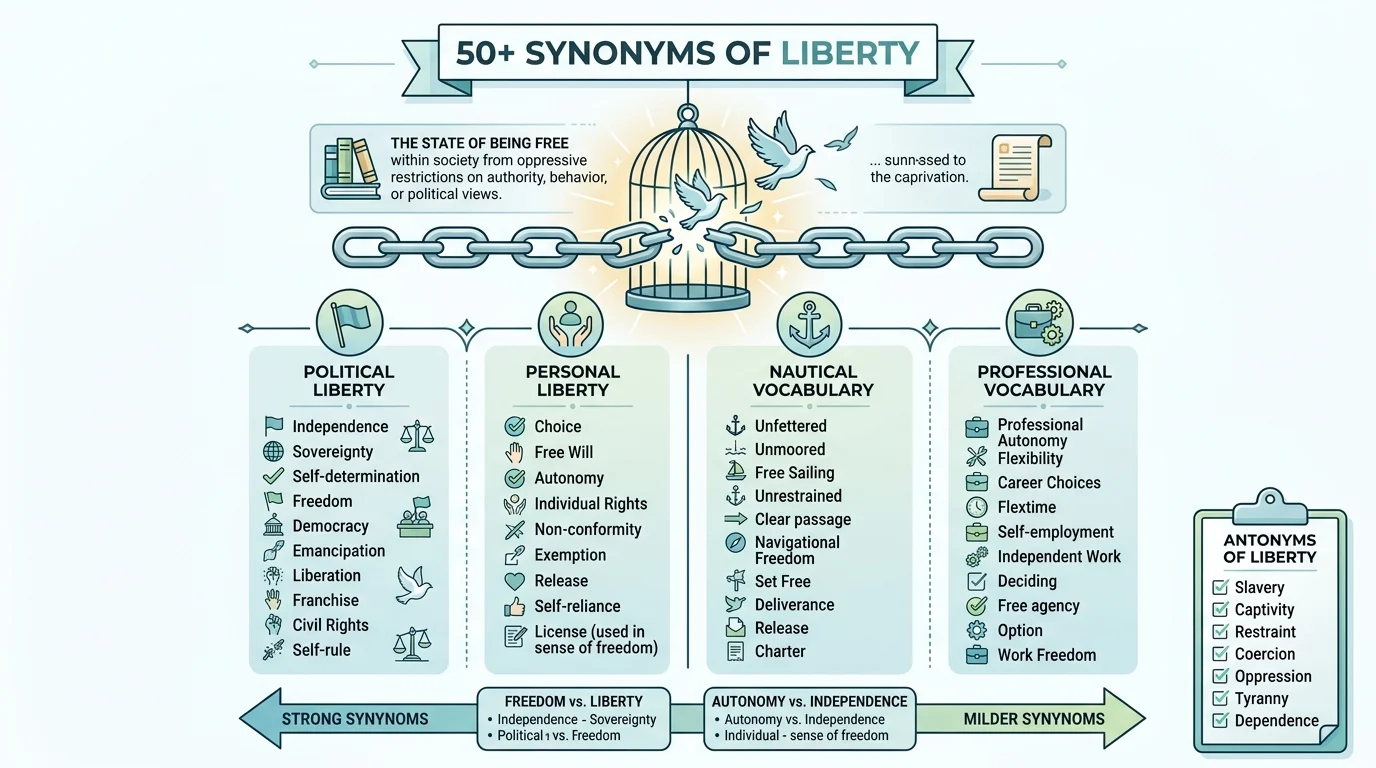
Have you ever wanted to describe the state of being free, the power to act as you choose, or the right to do as you please but felt that “freedom” was too broad? You want to highlight independence, autonomy, or even a shore leave, and the word “liberty” comes to mind. Choosing the right synonym for “liberty” can transform a general statement into a precise description of political independence, personal choice, or authorized permission. This guide explores the best synonyms of liberty, explaining exactly which word to use and when.
Quick Ans: “Liberty” means the state of being free from oppressive restrictions, the power to act and choose freely, or permission granted for a specific purpose . For political independence, choose independence or autonomy . For personal freedom of choice, use freedom or license . For the act of releasing from bondage, emancipation or liberation are strong choices . For a sailor’s shore leave, use shore leave .
Meaning, Tone, and Context
Understanding the core meaning of “liberty” is the first step to using it effectively .
Simple Definition: The state of being free; the power to act, think, or speak as one chooses; the right to do something .
Part of Speech: Noun .
Overall Tone: Positive and aspirational. It indicates independence, autonomy, and fundamental rights.
Formality Level: Formal to neutral. The word is appropriate in professional, academic, political, and casual contexts.
Common Uses: Native English speakers use it to describe political independence, personal rights, religious freedom, and the authority to act. For example, “The country fought for its liberty,” or “The sailor was given shore leave.”
Word Forms: Related words include the noun liberties (plural), the adjective liberal (relating to liberty), and the adverb liberally. The phrase at liberty means free to do something .
When and How to Use “Liberty”
“Liberty” is the perfect choice when you want to emphasize freedom from oppression, the right to choose, or authorized permission. Here are seven realistic examples.
Political: “The people fought for their liberty from tyrannical rule” .
Academic: “The treatise explores the concept of liberty and its role in a just society.”
Workplace: “Employees have the liberty to choose their own work schedules.”
Personal: “She took the liberty of rearranging the furniture while I was away.”
Email: “You are at liberty to use the conference room for your presentation” .
Resume: “Championed civil liberties and community engagement in previous public policy roles.”
Social Media: “A nation that values liberty values its people.”
Best Synonyms of “Liberty”
No synonym is identical in every situation. Here is your guide to the best replacement for “liberty” based on your writing context.
Political Context: Independence. It emphasizes freedom from external control . “The country gained its independence in 1962.”
Individual Rights Context: Autonomy. It suggests self-governance and the ability to make independent decisions . “They stepped up their demands for local autonomy.”
Describing Release: Emancipation. This is ideal when discussing liberation from slavery or oppression . “She championed the cause of the emancipation of women.”
Casual Conversation: Freedom. A common, natural choice for general discussion . “I have the freedom to choose my own path.”
Describing a Privilege: Prerogative. It implies a special right or privilege . “It is the CEO’s prerogative to make the final decision.”
Nautical Context: Shore leave. The specific term for a sailor’s authorized absence from duty . “The sailors were granted shore leave for the weekend.”
When Not to Use “Liberty”
Using “liberty” can sound wrong or awkward in certain situations.
When It Sounds Too Formal: In casual conversation, “liberty” can sound overly formal or poetic.
Better Choice: Freedom or choice. “I have the freedom to decide.”
When You Mean Physical Release: “Liberty” is often abstract. Liberation is more concrete.
Better Choice: Liberation or release. “The liberation of the hostages was celebrated.”
When It Sounds Too Political: “Liberty” is a heavily political word. For simple decisions, choice is better.
Better Choice: Choice or option. “You have the choice to accept or decline.”
Words Commonly Confused With “Liberty”
Several words are often mixed up with “liberty.” Here is how to keep them straight.
Word: Freedom
Difference: “Freedom” is the general condition of being free. “Liberty” is often more specific or formal .
When to Use: Use it in general, everyday contexts.
Example: “The freedom to travel is a basic right.”
Word: Autonomy
Difference: “Autonomy” emphasizes self-governance. “Liberty” is broader .
When to Use: Use this for independence within a larger organization.
Example: “The region was granted considerable autonomy.”
Word: Independence
Difference: “Independence” emphasizes not being controlled by others. “Liberty” is similar but also includes personal rights .
When to Use: Use this for nations or individuals.
Example: “The country declared independence in 1776.”
Word: License
Difference: “License” implies permission, often excessive. “Liberty” is about inherent rights .
When to Use: Use this for freedom that is granted or abuses of freedom.
Example: “He took too much license with the rules.”
Word: Privilege
Difference: “Privilege” is a special advantage. “Liberty” is a fundamental right .
When to Use: Use this for benefits not available to everyone.
Example: “The privilege of driving is earned.”
Best Synonyms of “Liberty” by Context
| Context | Best Synonym | Why It Works | Example |
|---|---|---|---|
| Political | Independence | Specific for freedom from rule . | “The country achieved independence after a long struggle.” |
| Individual Rights | Autonomy | Emphasizes self-governance . | “The employees were given autonomy to manage their tasks.” |
| Personal Choice | Freedom | General and widely understood . | “He has the freedom to live where he chooses.” |
| Release from Oppression | Emancipation | Strong word for liberation . | “The abolitionists fought for the emancipation of slaves.” |
| Nautical | Shore leave | The specific term for sailors . | “The crew was granted shore leave for 48 hours.” |
| Business Writing | Prerogative | Professional word for a right . | “It is the manager’s prerogative to approve the budget.” |
| Formal Writing | Self-determination | Emphasizes choosing one’s own path . | “The principle of self-determination is sacred to us.” |
How to Choose the Best Synonym of “Liberty”
Choosing the right word is a simple decision. Answer these questions.
What type of liberty am I describing? Is it political independence (independence), personal choice (freedom), self-governance (autonomy), release (emancipation), or permission (shore leave)?
What is my audience? For a professor or politician, self-determination or autonomy is powerful. For a friend, freedom or choice is more natural.
What is my purpose? Are you talking about a right, a privilege, or a specific permission? The correct synonym depends entirely on this.
Real Life Examples of “Liberty”
To truly master the word, it helps to see how it behaves in the wild.
School: Basic: “The school teaches about liberty.” Improved: “The school teaches about civil liberties and constitutional rights.”
College: Basic: “The student exercised liberty.” Improved: “The student exercised academic freedom in her research.”
Workplace: Basic: “He took the liberty to leave early.” Improved: “He took the initiative to leave early.”
Business: Basic: “We have liberty in the project.” Improved: “We have autonomy in managing the project’s timeline.”
Email: Basic: “You are at liberty to go.” Improved: “You are free to leave whenever you are finished.”
Conversation: Basic: “I took the liberty of adding you.” Improved: “I went ahead and added you to the group.”
Top 10 Synonyms of “Liberty”
| Synonym | Simple Meaning | Best Used For | Example Sentence |
|---|---|---|---|
| Freedom | The state of being free | General, everyday, and casual contexts . | “The freedom of speech is a fundamental right.” |
| Independence | Not being controlled by others | Political, historical, and personal contexts . | “The country gained independence in 1962.” |
| Autonomy | Self-governance | Professional, political, and organizational contexts . | “They stepped up their demands for local autonomy.” |
| Emancipation | Liberation from oppression | Historical, social justice, and formal contexts . | “Passover recalls the liberation from slavery in Egypt.” |
| Self-determination | Choosing one’s own path | Political and philosophical contexts . | “The principle of self-determination is sacred.” |
| Prerogative | A special right or privilege | Professional and legal contexts . | “It is the CEO’s prerogative to make the final decision.” |
| Shore leave | Authorized absence for sailors | Nautical and military contexts . | “Three convictions meant three months’ loss of liberty.” |
| Liberation | The act of setting free | Social, historical, and emotional contexts . | “The liberation of the hostages was celebrated.” |
| License | Freedom to deviate | Creative and behavioral contexts . | “The poet took poetic license with the facts.” |
| Immunity | Exemption from control | Legal and formal contexts . | “The police are offering immunity to witnesses.” |
Synonyms of “Liberty” by Usage
Professional vs. Personal Synonyms
In the workplace (professional), choose autonomy, prerogative, or license to describe permissions and decision-making power. With friends (personal), freedom or choice keep the tone relaxed.
Formal vs. Conversational Synonyms
For formal writing (reports, essays, political analysis), use self-determination, emancipation, or autonomy . For casual conversations, use freedom, choice, or right .
Academic Synonyms
For research and essays, choose precise, authoritative words. Self-determination is great for political science, autonomy for psychology and organizational studies, and emancipation for history and sociology .
Professional and Business Synonyms
For maximum impact in business writing, choose autonomy for self-governance, prerogative for decision-making, and license for creative freedom.
Creative and Literary Synonyms
To add emotion and imagery to your writing, choose liberation, deliverance, or redemption . “Their sudden deliverance from war” evokes a powerful sense of relief.
Strongest to Mildest Synonyms
Mild: choice, option, leisure
Moderate: freedom, liberty, permission
Strong: independence, autonomy, sovereignty
Very Strong: emancipation, liberation, deliverance, redemption
Emotional vs. Neutral Synonyms
Emotional Synonyms: Liberation, deliverance, redemption. These words often hint at triumph and hope. Use them when you want to evoke strong feelings.
Neutral Synonyms: Freedom, choice, permission. These words simply communicate factual information. Use them when you want to inform without emotional coloring.
Antonyms of “Liberty”
Here are 15 genuine opposites of “liberty” .
| Antonym | Meaning | Example Sentence |
|---|---|---|
| Slavery | The state of being enslaved | “The abolition of slavery was a milestone in history.” |
| Bondage | The state of being trapped | “The prisoners were kept in bondage for years.” |
| Captivity | The state of being imprisoned | “The animals lived in captivity.” |
| Imprisonment | Confinement in prison | “The imprisonment of the activists was condemned.” |
| Oppression | Prolonged cruel treatment | “The people fought against tyranny and oppression.” |
| Subjugation | The act of bringing under control | “The subjugation of the people was brutal.” |
| Dependence | The state of relying on others | “The colony’s dependence on the mother country was total.” |
| Restraint | The act of holding back | “The restraint of the prisoners was harsh.” |
| Constraint | A limitation or restriction | “The constraints of the law were binding.” |
| Repression | The act of suppressing | “The repression of dissent was widespread.” |
Comparison: “Liberty” vs Similar Words
Liberty vs. Freedom
Main Difference: “Freedom” is the general condition. “Liberty” is often more formal and implies specific rights and privileges .
Which Is Stronger? They are similar. “Liberty” is often used in political and legal contexts. “Freedom” is more versatile.
Which Is More Formal? “Liberty” is often considered more formal than “freedom.”
When to Use Each: Use “freedom” for general situations. Use “liberty” for political, legal, or formal documents.
Examples:
Liberty: “The constitution guarantees the liberty of the citizens.”
Freedom: “I have the freedom to choose my career.”
Liberty vs. Autonomy
Main Difference: “Autonomy” is about self-governance. “Liberty” is broader .
Which Is Stronger? “Autonomy” is more specific to decision-making authority.
Which Is More Formal? Both are formal.
When to Use Each: Use “autonomy” for groups or individuals who make their own decisions. Use “liberty” for fundamental rights and freedoms.
Examples:
Liberty: “The city was granted special liberties.”
Autonomy: “The region was given financial autonomy.”
Liberty vs. Independence
Main Difference: “Independence” means not being controlled. “Liberty” includes personal rights .
Which Is Stronger? “Independence” is absolute. “Liberty” can exist within a system.
Which Is More Formal? Both are formal.
When to Use Each: Use “independence” for nations and individuals. Use “liberty” for rights and freedoms.
Examples:
Liberty: “I am at liberty to discuss this matter.”
Independence: “The colony achieved independence.”
Common Phrases and Expressions with “Liberty”
Phrase: At liberty
Meaning: Free to do as one chooses .
Example Sentence: “You are at liberty to leave at any time during the meeting.”
Phrase: Take liberties
Meaning: To act with freedom, often to the point of being rude .
Example Sentence: “He took liberties with the translation.”
Phrase: Civil liberties
Meaning: The basic rights and freedoms guaranteed to individuals .
Example Sentence: “The government must protect civil liberties.”
Phrase: Shore leave
Meaning: A period of time when a sailor is allowed to go ashore .
Example Sentence: “The sailors were granted shore leave for the weekend.”
Phrase: Liberty of conscience
Meaning: The right to follow one’s beliefs.
Example Sentence: “The constitution guarantees liberty of conscience.”
Common Mistakes to Avoid
Mistake 1: Using “liberty” when you mean “freedom”.
Incorrect: “I have the liberty to go to the store.”
Better: “I have the freedom to go to the store.”
Why: “Freedom” is a more natural word for everyday choices.
Mistake 2: Using “liberty” when you mean “permission”.
Incorrect: “I took the liberty of borrowing your pen.”
Better: “I went ahead and borrowed your pen.”
Why: “Taking the liberty” is a specific phrase that implies overstepping.
Mistake 3: Confusing “liberty” with “license”.
Incorrect: “The excessive liberty was criticized.”
Better: “The excessive license was criticized.”
Why: “License” is the word for excessive freedom .
Mistake 4: Using “liberty” when you mean “choice”.
Incorrect: “I had the liberty of two options.”
Better: “I had the choice of two options.”
Why: “Choice” is a more precise word for a simple decision.
Frequently Asked Questions
1. What are the best synonyms of “liberty”?
The best synonyms depend on your context. For political contexts, choose independence or autonomy. And for personal rights, use freedom or choice. For release from oppression, use emancipation or liberation . For nautical contexts, use shore leave .
2. What are the best formal synonyms of “liberty”?
The best formal synonyms are self-determination, autonomy, and emancipation . These words are suitable for academic papers, political reports, and legal documents.
3. What are common informal synonyms of “liberty”?
For informal settings, use freedom, choice, or right. These alternatives sound more natural in everyday conversation.
4. What is the difference between “liberty” and “freedom”?
“Freedom” is the general state of being free. “Liberty” is more formal and often refers to specific rights and privileges .
5. What is the opposite of “liberty”?
The most direct opposites of liberty are slavery, bondage, and oppression .
Conclusion
“Liberty” is a powerful and essential word for describing freedom, independence, and the power of choice. The best choice among the synonyms of liberty depends entirely on your audience, tone, and purpose. Remember, no single synonym works perfectly in every situation. Your goal is to choose the word that communicates your message with the most clarity and impact. A practical tip for your vocabulary growth is to pay attention to how the news and literature use these words and practice using different synonyms in your writing.










1 thought on “50+ Synonyms of Liberty: Meanings, Uses, Examples, and Best Alternatives 2026”