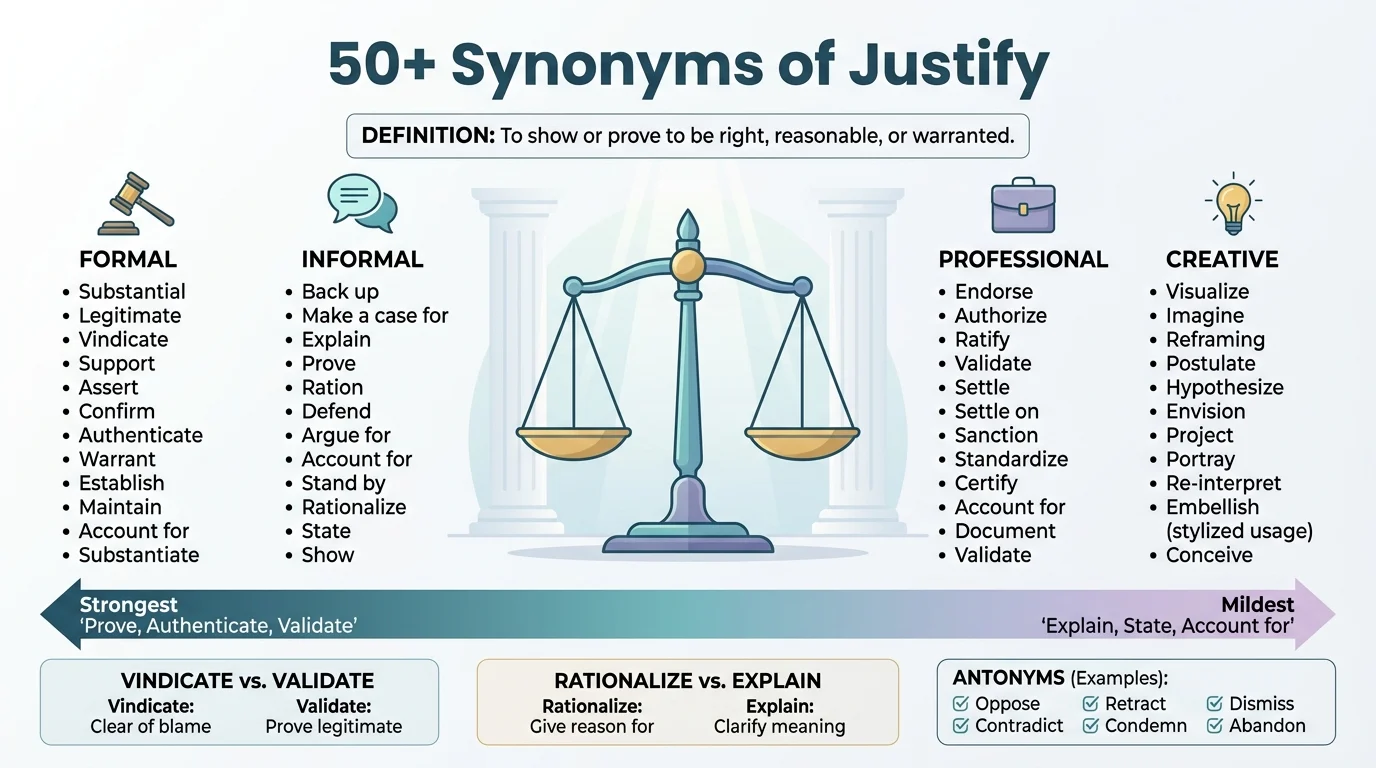
Have you ever needed to explain why you made a particular decision or defend an action that seemed questionable? You want to show that something is right, reasonable, or necessary, and the word “justify” comes to mind. But is it the best fit for your audience? Choosing the right synonym for “justify” can transform a defensive explanation into a confident, rational defense of your position. This guide explores the best synonyms of justify, explaining exactly which word to use and when.
Quick Ans: “Justify” means to show or prove that something is right, reasonable, or necessary. It is a neutral, formal verb. For professional writing, choose substantiate or validate. For casual conversation, use explain or defend. In academic contexts, corroborate and substantiate are strong choices. For a stronger, more authoritative impact, select vindicate or warrant.
Meaning, Tone, and Context
Understanding the core meaning of “justify” is the first step to using it effectively.
Simple Definition: To give a good reason or explanation for something. To prove that an action or decision was right and reasonable .
Part of Speech: Verb.
Overall Tone: Neutral to slightly defensive. It indicates providing rational grounds for something.
Formality Level: Formal. The word is appropriate in professional, academic, and legal contexts.
Common Uses: Native English speakers use it when explaining decisions, defending actions, or providing proof. For example, “How do you justify your decision?” or “The evidence justifies his claim.”
Word Forms: Related words include the noun justification, the adjective justifiable, and the adverb justifiably.
When and How to Use “Justify”
“Justify” is the perfect choice when you want to provide reasoning or proof for something. Here are seven realistic examples.
Professional: “The manager had to justify the budget increase to the board.”
Academic: “The student must justify every claim with proper citations.”
Workplace: “Can you justify why we should invest in this new software?”
Personal: “I don’t have to justify my choices to anyone.”
Email: “Please justify the additional expenses in your report.”
Resume: “Developed a system to justify marketing expenditure through ROI tracking.”
Social Media: “No need to justify your preferences to strangers.”
Best Synonyms of “Justify”
No synonym is identical in every situation. Here is your guide to the best replacement for “justify” based on your writing context .
Professional Writing: Substantiate. It suggests providing solid evidence. “We need data to substantiate this claim.”
Academic Writing: Corroborate. This is ideal when confirming findings. “The results corroborate the initial hypothesis.”
Business Communication: Validate. A practical choice for confirming value. “The market research validates our strategy.”
Casual Conversation: Explain. It tones down the formality. “Can you explain why you did that?”
Emotional Writing: Vindicate. This word carries weight, suggesting clearing from blame. “The evidence will vindicate her reputation.”
Creative Writing: Exonerate. It implies clearing from blame or guilt. “The testimony will exonerate the accused.”
Resume Writing: Defend. Use it to describe standing up for ideas. “Defended strategic decisions to senior leadership.”
When Not to Use “Justify”
Using “justify” can sound wrong or awkward in certain situations.
When It Sounds Defensive: “Justify” can imply you are on the defensive.
Better Choice: Explain or clarify. “Let me explain the reasons behind this.”
When You Mean Prove: “Justify” can be replaced by stronger proof words.
Better Choice: Prove or confirm. “The evidence confirms the theory.”
When It Is Too Formal: In casual conversation, “justify” sounds stiff.
Better Choice: Make sense of or account for. “Can you make sense of this?”
When It Sounds Too Strong: “Justify” can be too strong for simple explanations.
Better Choice: Clarify or elaborate. “Could you elaborate on your point?”
Words Commonly Confused With “Justify”
Several words are often mixed up with “justify.” Here is how to keep them straight .
Word: Substantiate
Difference: Focuses on providing solid evidence. “Justify” is broader and includes reasoning.
When to Use: Use it when you have concrete evidence.
Example: “The study substantiates the theory with data.”
Word: Validate
Difference: Means to confirm that something is valid. “Justify” focuses on reasoning.
When to Use: Use this for confirming value or accuracy.
Example: “The results validate the hypothesis.”
Word: Corroborate
Difference: Means to support with additional evidence. “Justify” is more about reasoning.
When to Use: Use this for confirming claims.
Example: “The witness corroborated his story.”
Word: Vindicate
Difference: Means to clear from suspicion or blame. “Justify” can also mean this.
When to Use: Use this when someone has been accused.
Example: “The verdict vindicated his actions.”
Word: Warrant
Difference: Means to justify or authorize. “Justify” can mean to warrant.
When to Use: Use this for actions that are called for.
Example: “The situation warrants immediate action.”
Word: Exonerate
Difference: Means to declare blameless. “Justify” is more about reasoning .
When to Use: Use this for clearing from blame.
Example: “The evidence will exonerate him.”
Best Synonyms of “Justify” by Context
| Context | Best Synonym | Why It Works | Example |
|---|---|---|---|
| Formal writing | Substantiate | Emphasizes solid evidence. | “We need data to substantiate our claim.” |
| Academic writing | Corroborate | Precise for confirming findings. | “The research corroborates previous studies.” |
| Professional communication | Validate | Confirms value and accuracy. | “The data validates our approach.” |
| Business emails | Explain | Professional yet accessible. | “Let me explain the reasoning behind this.” |
| Resume writing | Defend | Suggests confidence and advocacy. | “Defended key decisions to stakeholders.” |
| Workplace communication | Support | Emphasizes giving reasons. | “The report supports her recommendation.” |
| Casual conversation | Account for | Simple and conversational. | “Can you account for the missing funds?” |
| Creative writing | Vindicate | Suggests clearing from blame. | “The truth will vindicate his name.” |
| Emotional writing | Exonerate | Evokes clearing from guilt . | “The testimony exonerated the accused.” |
| Strong emphasis | Warrant | Suggests necessity . | “The results warrant further investigation.” |
| Mild tone | Clarify | Simple and non-defensive. | “Let me clarify my position.” |
| Social media captions | Explain | Widely understood and relatable. | “Don’t feel the need to explain yourself.” |
How to Choose the Best Synonym of “Justify”
Choosing the right word is a simple decision. Answer these questions.
What is my audience? For a professor or CEO, substantiate or validate is powerful. For a friend, explain or account for is more natural.
What is my purpose? Are you trying to prove, defend, or clarify? Use corroborate for proof, vindicate for defense, and clarify for explanation.
Am I providing evidence or reasoning? For evidence, substantiate or corroborate are best. For reasoning, explain or justify work well.
What is the emotional strength? Vindicate and exonerate are stronger. Clarify and explain are mild. Pick the one that matches your message.
Real Life Examples of “Justify”
To truly master the word, it helps to see how it behaves in the wild and how a stronger synonym can elevate the sentence.
School: Basic: “The student had to justify her answer.” Improved: “The student had to substantiate her answer with evidence.”
College: Basic: “The study justifies the theory.” Improved: “The study corroborates the theory with empirical data.”
Workplace: Basic: “He had to justify his decision.” Improved: “He had to defend his decision to the management team.”
Business: Basic: “The data justifies our investment.” Improved: “The data validates our investment strategy.”
Email: Basic: “Please justify the additional cost.” Improved: “Please account for the additional cost in your report.”
Conversation: Basic: “I don’t need to justify myself.” Improved: “I don’t need to explain myself to anyone.”
Storytelling: Basic: “The evidence justified her actions.” Improved: “The evidence vindicated her actions and cleared her name.”
Top 10 Synonyms of “Justify”
| Synonym | Simple Meaning | Best Used For | Example Sentence |
|---|---|---|---|
| Substantiate | To provide solid evidence | Formal, academic, and evidence-based contexts. | “The data substantiates the claims .” |
| Corroborate | To support with additional evidence | Academic, legal, and research contexts . | “The witness corroborated his statement.” |
| Validate | To confirm validity or value | Business, science, and professional contexts. | “The results validate the hypothesis.” |
| Vindicate | To clear from suspicion or blame | Legal, emotional, and justice contexts . | “The verdict vindicated his reputation.” |
| Exonerate | To declare blameless | Legal, moral, and justice contexts . | “The evidence exonerated the accused.” |
| Warrant | To justify or authorize | Legal, formal, and necessity contexts . | “The situation warrants immediate action.” |
| Support | To give reasons or evidence | General, professional, and everyday contexts . | “The data supports her argument.” |
| Defend | To argue for something | Professional, personal, and debate contexts . | “She defended her position effectively.” |
| Account for | To explain or justify | Casual, conversational, and explanatory contexts. | “Can you account for the discrepancy?” |
| Explain | To make clear or understandable | Casual, educational, and general contexts . | “Let me explain the reasoning behind this.” |
Synonyms of “Justify” by Usage
Professional vs. Personal Synonyms
In the workplace (professional), choose substantiate, validate, or defend to describe providing proof or reasoning. These words convey professionalism and precision. “We need to substantiate our claim with data” is more precise than “We need to justify our claim.”
With friends (personal), explain, account for, or defend keep the tone relaxed and relatable. These alternatives sound natural in everyday conversation.
Formal vs. Conversational Synonyms
For formal writing (reports, essays, professional emails), use substantiate, corroborate, or validate. These choices maintain the sophisticated tone expected in professional documents.
For casual conversations and texting, use explain, account for, or make sense of. These options sound more natural and less pretentious.
Academic Synonyms
For research and essays, choose precise, authoritative words. Corroborate is great for confirming findings, substantiate for providing evidence, and validate for confirming hypotheses . These words sound considered and scholarly.
Using precise academic vocabulary demonstrates expertise and careful thinking. Professors and reviewers expect this level of precision.
Professional and Business Synonyms
For maximum impact in business writing, choose validate for confirming strategy, substantiate for supporting claims, and warrant for justifying action . These words demonstrate confidence and professional awareness.
Business leaders respond to language that conveys proof and necessity. These synonyms project authority.
Creative and Literary Synonyms
To add emotion and imagery to your writing, choose vindicate or exonerate. These words create drama and evoke justice .
Literary writers use these alternatives to build tension and resolution. They transform ordinary descriptions into evocative prose.
Slang or Modern Synonyms
There is no direct slang synonym for “justify” in mainstream American English. In modern texting, people use explain, defend, or make sense of. This straightforward approach works best for casual digital communication.
Strongest to Mildest Synonyms
Mild: explain, clarify, account for
Moderate: support, defend, justify
Strong: validate, warrant, substantiate
Very Strong: corroborate, vindicate, exonerate
Emotional vs. Neutral Synonyms
Emotional Synonyms: Vindicate, exonerate, defend. These words often hint at justice, blame, or righteousness. Use them when you want to evoke feeling .
Neutral Synonyms: Explain, support, substantiate. These words simply communicate factual information. Use them when you want to inform without emotional coloring.
Antonyms of “Justify”
Here are 15 genuine opposites of “justify” .
| Antonym | Meaning | Example Sentence |
|---|---|---|
| Condemn | To express strong disapproval | “The court condemned his actions.” |
| Disprove | To show something is false | “The evidence disproves the theory.” |
| Refute | To prove wrong | “The scientist refuted the hypothesis.” |
| Deny | To refuse to accept | “The company denied the allegations.” |
| Invalidate | To make invalid | “The new evidence invalidates the claim.” |
| Reject | To refuse to accept | “The board rejected the proposal.” |
| Discredit | To harm the reputation | “The scandal discredited the politician.” |
| Debunk | To expose as false | “The article debunked the myth.” |
| Contradict | To go against | “The evidence contradicts his story.” |
| Falsify | To make false | “The data was falsified.” |
| Disqualify | To deem unqualified | “The error disqualified his argument.” |
| Prohibit | To forbid | “The law prohibits such actions.” |
| Prevent | To stop from happening | “The rules prevent such behavior.” |
| Undermine | To weaken or damage | “The criticism undermined his credibility.” |
| Negate | To nullify | “The contradiction negates his claim.” |
Comparison: “Justify” vs Similar Words
Justify vs. Substantiate
Main Difference: Justify is about reasoning. Substantiate is about providing evidence .
Which Is Stronger? Substantiate is stronger for evidence-based claims.
Which Is More Formal? Both are formal, but substantiate is more academic.
When to Use Each: Use justify for reasoning. Use substantiate for evidence.
Examples:
Justify: “Can you justify your decision?”
Substantiate: “We need to substantiate this claim with data .”
Justify vs. Corroborate
Main Difference: Justify is about reasoning. Corroborate is about confirming .
Which Is Stronger? Corroborate is stronger for confirming with evidence.
Which Is More Formal? Both are formal, but corroborate is more legal.
When to Use Each: Use justify for reasoning. Use corroborate for confirming.
Examples:
Justify: “She justified her actions.”
Corroborate: “The witness corroborated his story .”
Justify vs. Validate
Main Difference: Justify is about reasoning. Validate is about confirming value or accuracy.
Which Is Stronger? They are similar. Validate is more about confirmation.
Which Is More Formal? Both are formal.
When to Use Each: Use justify for reasoning. Use validate for confirming.
Examples:
Justify: “He justified the expense.”
Validate: “The results validate the hypothesis.”
Justify vs. Vindicate
Main Difference: Justify is about reasoning. Vindicate is about clearing from blame .
Which Is Stronger? Vindicate is much stronger and more dramatic.
Which Is More Formal? Both are formal, but vindicate is more legal.
When to Use Each: Use justify for reasoning. Use vindicate for clearing from blame.
Examples:
Justify: “She justified her choice.”
Vindicate: “The evidence vindicated his actions.”
Justify vs. Warrant
Main Difference: Justify is about reasoning. Warrant is about authorizing or calling for action .
Which Is Stronger? Warrant suggests necessity.
Which Is More Formal? Both are formal.
When to Use Each: Use justify for reasoning. Use warrant for necessity.
Examples:
Justify: “Can you justify this decision?”
Warrant: “The situation warrants further investigation.”
Justify vs. Exonerate
Main Difference: Justify is about reasoning. Exonerate is about clearing from blame .
Which Is Stronger? Exonerate is stronger for clearing from guilt.
Which Is More Formal? Exonerate is more legal.
When to Use Each: Use justify for reasoning. Use exonerate for clearing from blame.
Examples:
Justify: “He justified his actions.”
Exonerate: “The evidence exonerated him .”
Common Phrases and Expressions with “Justify”
Phrase: Justify your answer
Meaning: Provide reasons for your response.
Example Sentence: “The exam requires students to justify their answers with evidence.”
Phrase: The end justifies the means
Meaning: The result is worth any method used to achieve it .
Example Sentence: “Some argue that the end justifies the means, but ethics must be considered.”
Phrase: Hard to justify
Meaning: Difficult to give good reasons for.
Example Sentence: “The expense is hard to justify given the budget constraints.”
Phrase: Justify the cost
Meaning: Provide reasons for spending money.
Example Sentence: “We need to justify the cost of this project.”
Phrase: Justify yourself
Meaning: Provide reasons for your actions.
Example Sentence: “You don’t have to justify yourself to anyone.”
Common Mistakes to Avoid
Mistake 1: Using “justify” when you mean “prove”.
Incorrect: “The evidence justifies the theory completely.”
Better: “The evidence proves the theory completely.”
Why: Justify means give reasons. Prove means establish beyond doubt.
Mistake 2: Using “justify” when you mean “excuse”.
Incorrect: “He tried to justify his lateness.”
Better: “He tried to excuse his lateness.”
Why: Excuse is more about forgiving. Justify is about reasoning.
Mistake 3: Overusing “justify” in casual conversation.
Incorrect: “I need to justify why I bought this.”
Better: “I need to explain why I bought this.”
Why: Explain sounds more natural in casual conversation.
Mistake 4: Using “vindicate” when you mean “justify”.
Incorrect: “I need to vindicate my decision to my boss.”
Better: “I need to justify my decision to my boss.”
Why: Vindicate implies clearing from blame, not just reasoning.
Mistake 5: Confusing “warrant” with “justify”.
Incorrect: “Can you warrant this decision?”
Better: “Can you justify this decision?”
Why: Warrant means authorize or call for, not provide reasons.
Frequently Asked Questions
1. What are the best synonyms of “justify”?
The best synonyms depend on your context. For formal writing, choose substantiate or validate. And for casual conversation, explain or account for are ideal choices. For clearing from blame, use vindicate or exonerate.
2. What are the best formal synonyms of “justify”?
The best formal synonyms are substantiate, corroborate, and validate. These words are suitable for academic papers, professional reports, and business communications.
3. What are common informal synonyms of “justify”?
For informal settings, use explain, account for, or defend. These alternatives sound more natural in everyday conversation.
4. What is another word for “justify” in professional writing?
In professional writing, substantiate is an excellent choice. It conveys providing solid evidence. Validate is also strong for confirming value.
5. What is the difference between “justify” and “vindicate”?
While both involve showing something is right, justify is about reasoning. Vindicate is about clearing from suspicion or blame. Use vindicate when someone has been accused .
6. What is the opposite of “justify”?
The most direct opposites (antonyms) of justify are condemn, disprove, and refute. These words describe showing something is wrong or invalid.
Conclusion
“Justify” is a valuable verb for explaining reasoning and defending actions. The term is formal and widely accepted in most contexts, yet it can sound defensive or too formal in casual conversation. The best choice among the synonyms of justify depends entirely on your audience, tone, and purpose. Remember, no single synonym works perfectly in every situation. Your goal is to choose the word that communicates your message with the most clarity and impact. A practical tip for your vocabulary growth is to notice how lawyers, academics, and business professionals use different synonyms and practice using them in your writing.
Discover More:
- 50+ Synonyms of Summary: Meanings, Uses, Examples, and Best Alternatives 2026
- 50+ Synonyms of Culture: Meanings, Uses, Examples, and Best Alternatives 2026

Amelia Brooks is a professional content writer and digital publishing specialist with a passion for creating clear, engaging, and informative content. She has extensive experience writing about technology, business, lifestyle, and online services.