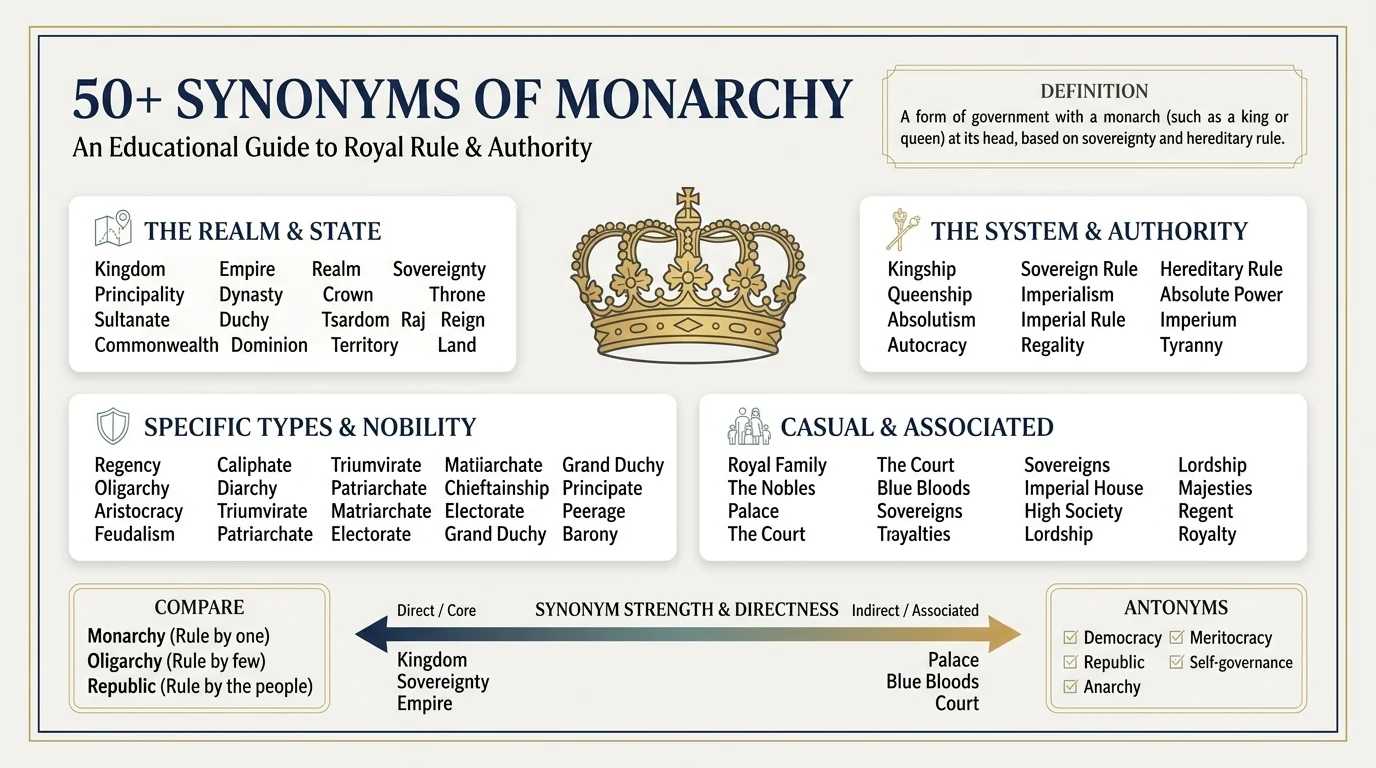
Have you ever needed to describe a system of government ruled by a king or queen but felt that “monarchy” was too specific or repetitive? You want to capture the specific nature of royal rule, whether it is absolute, constitutional, or traditional, and the word “monarchy” comes to mind. Choosing the right synonym for “monarchy” can transform a basic description into a precise expression of royal authority, hereditary rule, or sovereign power. This guide explores the best synonyms of monarchy, explaining exactly which word to use and when.
Quick Ans: “Monarchy” means a form of government with a monarch at the head, such as a king, queen, or emperor. For formal writing, choose kingdom, realm, or sovereignty. For describing the system, use royal rule, hereditary rule, or crown. For specific types, use empire, principality, or duchy. For casual conversation, use royal family or throne.
Meaning, Tone, and Context
Understanding the core meaning of “monarchy” is the first step to using it effectively.
Simple Definition: A form of government in which a single person, usually a hereditary ruler, holds supreme authority; a state or nation ruled by a monarch.
Part of Speech: Noun.
Overall Tone: Neutral to formal. It is a political and historical term.
Formality Level: Formal. The word is appropriate in academic, historical, and political contexts.
Common Uses: Native English speakers use it in history (“the British monarchy”), politics (“constitutional monarchy”), and general discussions (“the fall of the monarchy”).
Word Forms: Related words include the noun monarch, the adjective monarchical, and the noun monarchism.
When and How to Use “Monarchy”
“Monarchy” is the perfect choice when you want to describe a system of royal rule. Here are seven realistic examples.
Historical: “The French monarchy was overthrown during the revolution.”
Political: “The country transitioned from a monarchy to a republic.”
Academic: “The study examines the role of the monarchy in modern democracies.”
Professional: “The constitutional monarchy limits the powers of the king.”
Personal: “She is fascinated by the history of the British monarchy.”
Email: “The article discusses the future of the monarchy in Europe.”
Social Media: “The monarchy has become a topic of debate again.”
Best Synonyms of “Monarchy”
No synonym is identical in every situation. Here is your guide to the best replacement for “monarchy” based on your writing context.
For the State or Territory
Most Direct: Kingdom means a country ruled by a king or queen. “The kingdom prospered under her rule.”
Realm: Realm means a kingdom or domain. “The realm extended across the sea.”
Empire: Empire means a group of countries ruled by an emperor. “The Roman Empire was vast.”
Principality: Principality means a territory ruled by a prince. “Monaco is a principality.”
For the System of Rule
Sovereignty: Sovereignty means supreme authority. “The sovereignty of the monarch was absolute.”
Royal rule: Royal rule means government by a monarch. “Royal rule lasted for centuries.”
Hereditary rule: Hereditary rule means power passed through family lines. “Hereditary rule was the tradition.”
Crown: Crown means the monarch or the monarchy as an institution. “The crown represents the state.”
For Specific Types
Absolute monarchy: Absolute monarchy means unlimited power. “The absolute monarchy suppressed dissent.”
Constitutional monarchy: Constitutional monarchy means limited by law. “The constitutional monarchy is largely ceremonial.”
Elective monarchy: Elective monarchy means the monarch is elected. “The elective monarchy was unusual.”
Duchy: Duchy means a territory ruled by a duke or duchess. “The duchy was wealthy.”
For Informal and General Use
Royal family: Royal family means the family of the monarch. “The royal family attended the ceremony.”
Throne: Throne means the position of the monarch. “He ascended the throne at a young age.”
Court: Court means the royal household. “The court was filled with nobles.”
Palace: Palace means the official residence of a monarch. “The palace was heavily guarded.”
When Not to Use “Monarchy”
Using “monarchy” can sound wrong or awkward in certain situations.
When You Mean “Government”: “Monarchy” is a specific type. “Government” is general.
Better Choice: Government or regime. “The government changed after the election.”
When You Mean “Dictatorship”: “Monarchy” is hereditary. “Dictatorship” is not.
Better Choice: Dictatorship or autocracy. “The dictatorship suppressed freedom.”
When It Sounds Too Formal: In casual conversation, “monarchy” can sound academic.
Better Choice: Royal family or king. “The king visited the city.”
Words Commonly Confused With “Monarchy”
| Word | Difference | When to Use | Example |
|---|---|---|---|
| Kingdom | The territory ruled by a king | Geography and history | “The kingdom was powerful.” |
| Empire | Ruled by an emperor | Historical and large-scale | “The empire expanded.” |
| Dictatorship | Absolute power, not hereditary | Political and modern | “The dictatorship ended.” |
| Republic | Elected representatives | Political and modern | “The republic was founded.” |
| Theocracy | Ruled by religious leaders | Religious and political | “The theocracy was strict.” |
| Oligarchy | Ruled by a small group | Political and elite | “The oligarchy controlled the wealth.” |
Best Synonyms of “Monarchy” by Context
| Context | Best Synonym | Why It Works | Example |
|---|---|---|---|
| Formal writing | Sovereignty | Formal and political | “The sovereignty of the crown.” |
| Academic writing | Hereditary rule | Precise and historical | “Hereditary rule was the norm.” |
| Professional | Constitutional monarchy | Specific and modern | “The constitutional monarchy endures.” |
| Historical | Kingdom | Classic and clear | “The kingdom flourished.” |
| Political | Crown | Institutional and symbolic | “The crown represents unity.” |
| Casual | Royal family | Simple and natural | “The royal family visited.” |
| Dramatic | Throne | Symbolic and powerful | “He claimed the throne.” |
How to Choose the Best Synonym of “Monarchy”
Choosing the right word is a simple decision. Answer these questions.
What type of monarchy am I describing? For a state, use kingdom, realm, or empire. And For a system, use sovereignty, royal rule, or crown. For specific types, use absolute monarchy or constitutional monarchy. For casual use, use royal family or throne.
What is my audience? For a formal report, use sovereignty or hereditary rule. For a friend, use royal family or king.
What is my purpose? Are you describing a territory, a system, or a symbol? The correct synonym depends entirely on this.
What is the emotional strength? Throne and crown are symbolic. Kingdom is neutral. Pick the one that matches your message.
Real Life Examples of “Monarchy”
School: Basic: “The monarchy ruled the country.” Improved: “The kingdom was ruled by a wise monarch.”
College: Basic: “The study examines monarchy.” Improved: “The study examines hereditary rule in medieval Europe.”
Workplace: Basic: “The monarchy is old.” Improved: “The crown has a long history.”
Business: Basic: “The monarchy affects tourism.” Improved: “The royal family attracts millions of tourists.”
Email: Basic: “The monarchy is discussed.” Improved: “The future of the constitutional monarchy is debated.”
Conversation: Basic: “I like the monarchy.” Improved: “I find the royal family fascinating.”
Storytelling: Basic: “The monarchy fell.” Improved: “The throne was lost forever.”
Top 10 Synonyms of “Monarchy”
| Synonym | Simple Meaning | Best Used For | Example Sentence |
|---|---|---|---|
| Kingdom | A country ruled by a king or queen | Historical and geographical | “The kingdom prospered under her rule.” |
| Realm | A kingdom or domain | Literary and formal | “The realm extended across the sea.” |
| Empire | A group of countries ruled by an emperor | Historical and large-scale | “The Roman Empire was vast.” |
| Sovereignty | Supreme authority | Political and formal | “The sovereignty of the monarch was absolute.” |
| Crown | The monarch or monarchy as an institution | Symbolic and institutional | “The crown represents the state.” |
| Throne | The position of the monarch | Symbolic and dramatic | “He ascended the throne at a young age.” |
| Royal family | The family of the monarch | Casual and modern | “The royal family attended the ceremony.” |
| Principality | A territory ruled by a prince | Specific and geographical | “Monaco is a principality.” |
| Duchy | A territory ruled by a duke | Historical and specific | “The duchy was wealthy.” |
| Hereditary rule | Power passed through family lines | Academic and historical | “Hereditary rule was the tradition.” |
Synonyms of “Monarchy” by Usage
Professional vs. Personal Synonyms
In the workplace, choose sovereignty, crown, or constitutional monarchy. With friends, use royal family, king, or queen.
Formal vs. Conversational Synonyms
For formal writing, use sovereignty, hereditary rule, or crown. For casual conversations, use royal family, throne, or king.
Academic Synonyms
For research and essays, choose hereditary rule for systems, sovereignty for authority, and constitutional monarchy for modern contexts.
Professional and Business Synonyms
For maximum impact, choose constitutional monarchy for politics, crown for institutions, and royal family for tourism.
Creative and Literary Synonyms
To add emotion and imagery, choose throne, realm, or crown. These words create atmosphere.
Slang or Modern Synonyms
In modern American slang, royals or the crown are common. For example, “The royals visited.” These are casual and should be avoided in formal writing.
Strongest to Mildest Synonyms
Mild: royal family, king, queen
Moderate: monarchy, kingdom, throne
Strong: sovereignty, crown, empire
Very Strong: absolute monarchy, hereditary rule, realm
Emotional vs. Neutral Synonyms
Emotional Synonyms: Throne, crown, realm. These words hint at power and tradition. Use them when you want to evoke feeling.
Neutral Synonyms: Monarchy, kingdom, royal family. These words communicate factual information.
Antonyms of “Monarchy”
| Antonym | Meaning | Example Sentence |
|---|---|---|
| Republic | Government by elected representatives | “The republic was founded after the revolution.” |
| Democracy | Government by the people | “Democracy replaced the monarchy.” |
| Dictatorship | Absolute power, not hereditary | “The dictatorship suppressed dissent.” |
| Oligarchy | Rule by a small group | “The oligarchy controlled the wealth.” |
| Theocracy | Rule by religious leaders | “The theocracy was strict.” |
| Anarchy | Absence of government | “Anarchy followed the collapse.” |
| Communism | State ownership of property | “Communism replaced the old regime.” |
| Federation | Union of self-governing states | “The federation was formed.” |
| Confederation | Alliance of states | “The confederation was loose.” |
| Autocracy | Rule by one person | “The autocracy was brutal.” |
| Plutocracy | Rule by the wealthy | “The plutocracy controlled the economy.” |
| Kleptocracy | Rule by thieves | “The kleptocracy drained the treasury.” |
| Technocracy | Rule by experts | “The technocracy made decisions.” |
| Meritocracy | Rule by the most able | “The meritocracy rewarded talent.” |
| Federal republic | A republic with states | “The federal republic was stable.” |
Comparison: “Monarchy” vs Similar Words
Monarchy vs. Kingdom
Main Difference: “Monarchy” is the system. “Kingdom” is the territory.
Which Is Stronger? They are different.
Which Is More Formal? Both are formal.
When to Use Each: Use “monarchy” for the system. Use “kingdom” for the place.
Examples:
Monarchy: “The monarchy was abolished.”
Kingdom: “The kingdom was wealthy.”
Monarchy vs. Empire
Main Difference: “Monarchy” is ruled by a king or queen. “Empire” is ruled by an emperor and often includes many territories.
Which Is Stronger? “Empire” is larger.
Which Is More Formal? Both are formal.
When to Use Each: Use “empire” for large, multi-territory states. Use “monarchy” for general contexts.
Examples:
Monarchy: “The British monarchy is constitutional.”
Empire: “The Roman Empire was vast.”
Monarchy vs. Dictatorship
Main Difference: “Monarchy” is hereditary. “Dictatorship” is not.
Which Is Stronger? “Dictatorship” is more negative.
Which Is More Formal? Both are formal.
When to Use Each: Use “dictatorship” for absolute, non-hereditary rule. Use “monarchy” for hereditary rule.
Examples:
Monarchy: “The monarchy lasted for centuries.”
Dictatorship: “The dictatorship ended in revolution.”
Monarchy vs. Republic
Main Difference: “Monarchy” has a hereditary ruler. “Republic” has elected representatives.
Which Is Stronger? They are opposites.
Which Is More Formal? Both are formal.
When to Use Each: Use “republic” for elected government. Use “monarchy” for royal rule.
Examples:
Monarchy: “The monarchy was overthrown.”
Republic: “The republic was founded.”
Monarchy vs. Sovereignty
Main Difference: “Monarchy” is a system. “Sovereignty” is supreme authority.
Which Is Stronger? “Sovereignty” is more abstract.
Which Is More Formal? “Sovereignty” is more formal.
When to Use Each: Use “sovereignty” for authority. Use “monarchy” for the system.
Examples:
Monarchy: “The monarchy was absolute.”
Sovereignty: “The sovereignty of the crown was unquestioned.”
Monarchy vs. Crown
Main Difference: “Monarchy” is the system. “Crown” is the institution or symbol.
Which Is Stronger? “Crown” is more symbolic.
Which Is More Formal? Both are formal.
When to Use Each: Use “crown” for symbolic contexts. Use “monarchy” for general contexts.
Examples:
Monarchy: “The monarchy is popular.”
Crown: “The crown represents the state.”
Common Phrases and Expressions with “Monarchy”
Phrase: Constitutional monarchy
Meaning: A monarchy limited by law.
Example Sentence: “The United Kingdom is a constitutional monarchy.”
Phrase: Absolute monarchy
Meaning: A monarchy with unlimited power.
Example Sentence: “The absolute monarchy suppressed dissent.”
Phrase: Fall of the monarchy
Meaning: The end of royal rule.
Example Sentence: “The fall of the monarchy changed the nation.”
Phrase: Restore the monarchy
Meaning: To bring back royal rule.
Example Sentence: “Some groups want to restore the monarchy.”
Phrase: Abolish the monarchy
Meaning: To end royal rule.
Example Sentence: “The movement aimed to abolish the monarchy.”
Common Mistakes to Avoid
Mistake 1: Using “monarchy” when you mean “kingdom”.
Incorrect: “The monarchy was wealthy.”
Better: “The kingdom was wealthy.”
Why: “Kingdom” is the territory.
Mistake 2: Using “monarchy” when you mean “dictatorship”.
Incorrect: “The monarchy suppressed all dissent.”
Better: “The dictatorship suppressed all dissent.”
Why: “Dictatorship” is not hereditary.
Mistake 3: Overusing “monarchy” in conversation.
Incorrect: “I like the monarchy.”
Better: “I like the royal family.”
Why: “Royal family” sounds more natural.
Mistake 4: Using “monarchy” when you mean “republic”.
Incorrect: “The monarchy elected a president.”
Better: “The republic elected a president.”
Why: “Republic” has elected leaders.
Mistake 5: Using “monarchy” when you mean “sovereignty”.
Incorrect: “The monarchy of the nation was challenged.”
Better: “The sovereignty of the nation was challenged.”
Why: “Sovereignty” is about authority.
Frequently Asked Questions
1. What are the best synonyms of “monarchy”?
The best synonyms depend on your context. For a state, choose kingdom, realm, or empire. And For a system, use sovereignty, royal rule, or crown. For casual use, use royal family or throne.
2. What are the best formal synonyms of “monarchy”?
The best formal synonyms are sovereignty, hereditary rule, and crown. These words are suitable for academic papers, professional reports, and political communications.
3. What are common informal synonyms of “monarchy”?
For informal settings, use royal family, throne, or king. These alternatives sound more natural in everyday conversation.
4. What is another word for “monarchy” in professional writing?
In professional writing, sovereignty is an excellent choice. It conveys supreme authority. Constitutional monarchy is also strong for modern contexts.
5. What is the difference between “monarchy” and “kingdom”?
“Monarchy” is the system of rule. “Kingdom” is the territory ruled. Use “monarchy” for the system and “kingdom” for the place.
6. What is the opposite of “monarchy”?
The most direct opposites (antonyms) of monarchy are republic, democracy, and dictatorship. These words describe different forms of government.
Conclusion
“Monarchy” is a formal and historical word for describing a system of government ruled by a king, queen, or emperor. The term is widely accepted in academic, political, and historical contexts, yet it can sound too formal for casual conversation or too specific for general descriptions. The best choice among the synonyms of monarchy depends entirely on your audience, tone, and purpose. Remember, no single synonym works perfectly in every situation. Your goal is to choose the word that communicates your message with the most clarity and impact. A practical tip for your vocabulary growth is to pay attention to how writers describe systems of government and practice using different synonyms in your writing.









