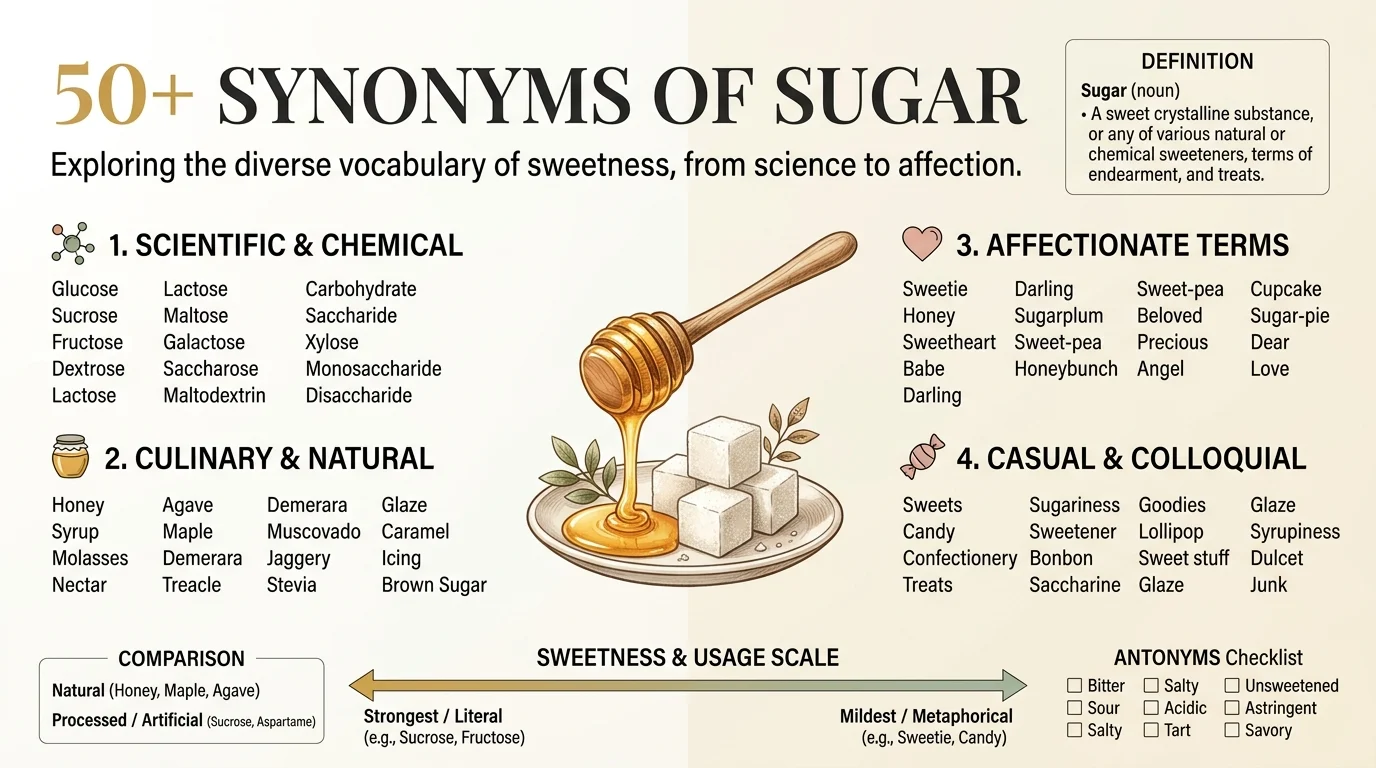
Have you ever needed to describe sweetness, a term of endearment, or a type of carbohydrate but felt that “sugar” was too simple or repetitive? You want to capture the specific form of sweetness, whether it is a chemical compound, a loving nickname, or a flavor enhancer, and the word “sugar” comes to mind. Choosing the right synonym for “sugar” can transform a basic statement into a precise expression of taste, affection, or science. This guide explores the best synonyms of sugar, explaining exactly which word to use and when.
Quick Ans: “Sugar” means a sweet crystalline substance, a term of endearment, or a carbohydrate. For culinary contexts, choose sweetener, syrup, or honey. For scientific contexts, use sucrose, glucose, or carbohydrate. For affectionate terms, use sweetheart, darling, or honey. For casual conversation, use sweet stuff or treat.
Meaning, Tone, and Context
Understanding the core meaning of “sugar” is the first step to using it effectively.
Simple Definition: A sweet crystalline substance obtained from various plants, especially sugar cane and sugar beet; a term of endearment; a carbohydrate.
Part of Speech: Noun and verb.
Overall Tone: Neutral to positive. It can indicate sweetness, affection, or scientific classification.
Formality Level: Neutral. The word works in most contexts, with more specific alternatives for science and terms of endearment.
Common Uses: Native English speakers use it in cooking (“add sugar”), science (“blood sugar”), affection (“Hey, sugar”), and general contexts (“sugar rush”).
Word Forms: Related words include the adjective sugary, the noun sucrose, and the verb sugar (to sweeten).
When and How to Use “Sugar”
“Sugar” is the perfect choice when you want to describe sweetness, a term of endearment, or a carbohydrate. Here are seven realistic examples.
Culinary: “Add two cups of sugar to the recipe.”
Scientific: “The body converts carbohydrates into sugar.”
Affectionate: “Good morning, sugar.”
Medical: “Her blood sugar levels are stable.”
Casual: “I need a sugar fix.”
Business: “The sugar industry is a major economic driver.”
Social Media: “Sugar rush after eating all that candy!”
Best Synonyms of “Sugar”
No synonym is identical in every situation. Here is your guide to the best replacement for “sugar” based on your writing context.
For Culinary and Sweetener Contexts
Most Common: Sweetener means a substance used to sweeten. “Honey is a natural sweetener.”
Liquid: Syrup means a thick, sweet liquid. “Maple syrup is delicious.”
Natural: Honey means a sweet substance made by bees. “Add honey to your tea.”
Alternative: Molasses means a thick, dark syrup. “Molasses adds depth to baking.”
For Scientific and Chemical Contexts
Most Formal: Sucrose means common table sugar. “Sucrose is composed of glucose and fructose.”
Simple: Glucose means a simple sugar. “Glucose is a source of energy.”
Fructose: Fructose means fruit sugar. “Fructose is found in fruits and honey.”
Carbohydrate: Carbohydrate means a macronutrient. “Carbohydrates break down into sugar.”
For Affectionate Terms
Most Common: Sweetheart means a beloved person. “Goodnight, sweetheart.”
Darling: Darling means a beloved person. “You look wonderful, darling.”
Honey: Honey means a term of endearment. “Pass the salt, honey.”
Dear: Dear means a beloved person. “Yes, dear.”
For Casual and Slang Contexts
Sweet stuff: Sweet stuff means sugary treats. “I crave sweet stuff.”
Treat: Treat means a sweet snack. “She gave the kids a treat.”
Junk: Junk means unhealthy sweets. “He eats too much junk.”
Candy: Candy means a sugar-based confection. “The candy store is full of sweets.”
When Not to Use “Sugar”
Using “sugar” can sound wrong or awkward in certain situations.
When You Mean “Sweetener”: “Sugar” is specific. “Sweetener” is broader.
Better Choice: Sweetener. “Use a natural sweetener.”
When You Mean “Affection”: “Sugar” can sound old-fashioned.
Better Choice: Sweetheart or darling. “Good morning, sweetheart.”
When It Sounds Too Scientific: In casual conversation, “sucrose” can sound technical.
Better Choice: Sugar. “Add more sugar.”
Words Commonly Confused With “Sugar”
| Word | Difference | When to Use | Example |
|---|---|---|---|
| Sweetener | Any sweet substance | Culinary and diet | “Honey is a sweetener.” |
| Syrup | Thick sweet liquid | Pancakes and drinks | “Maple syrup.” |
| Honey | Natural sweetener | Tea and affection | “Add honey.” |
| Sucrose | Table sugar | Scientific | “Sucrose is a disaccharide.” |
| Glucose | Simple sugar | Medical and scientific | “Blood glucose.” |
| Candy | Sugar-based confection | Snacks and treats | “Halloween candy.” |
Best Synonyms of “Sugar” by Context
| Context | Best Synonym | Why It Works | Example |
|---|---|---|---|
| Formal writing | Sucrose | Scientific and precise | “Sucrose is a carbohydrate.” |
| Academic writing | Carbohydrate | Standard in nutrition | “Carbohydrates provide energy.” |
| Professional | Sweetener | Business and food | “The sweetener market is growing.” |
| Culinary | Syrup | Cooking and baking | “Drizzle syrup on pancakes.” |
| Affectionate | Sweetheart | Emotional and personal | “Goodnight, sweetheart.” |
| Casual | Treat | Simple and natural | “She gave the dog a treat.” |
| Medical | Glucose | Medical and scientific | “Check your glucose levels.” |
How to Choose the Best Synonym of “Sugar”
Choosing the right word is a simple decision. Answer these questions.
What type of sugar am I describing? For culinary, use sweetener, syrup, or honey. And For scientific, use sucrose, glucose, or fructose. For affection, use sweetheart, darling, or honey.
What is my audience? For a formal report, use sucrose or carbohydrate. For a friend, use sugar or treat.
What is my purpose? Are you describing a food, a chemical, or a term of endearment? The correct synonym depends entirely on this.
What is the emotional strength? Sweetheart is warmer. Sucrose is neutral. Pick the one that matches your message.
Real Life Examples of “Sugar”
School: Basic: “The recipe needs sugar.” Improved: “The recipe needs a sweetener.”
College: Basic: “The study examined sugar.” Improved: “The study examined sucrose metabolism.”
Workplace: Basic: “She takes sugar in her coffee.” Improved: “She takes a sweetener in her coffee.”
Business: Basic: “The sugar market is growing.” Improved: “The sweetener market is growing.”
Email: Basic: “Thanks, sugar.” Improved: “Thanks, sweetheart.”
Conversation: Basic: “I want sugar.” Improved: “I want something sweet.”
Storytelling: Basic: “The sugar melted.” Improved: “The honey melted into the tea.”
Top 10 Synonyms of “Sugar”
| Synonym | Simple Meaning | Best Used For | Example Sentence |
|---|---|---|---|
| Sweetener | A substance used to sweeten | Culinary and diet | “Honey is a natural sweetener.” |
| Syrup | A thick, sweet liquid | Pancakes and drinks | “Maple syrup is delicious.” |
| Honey | A sweet substance made by bees | Tea and affection | “Add honey to your tea.” |
| Sucrose | Common table sugar | Scientific | “Sucrose is a disaccharide.” |
| Glucose | A simple sugar | Medical and scientific | “Glucose is a source of energy.” |
| Fructose | Fruit sugar | Nutrition and science | “Fructose is found in fruits.” |
| Carbohydrate | A macronutrient | Nutrition and academic | “Carbohydrates break down into sugar.” |
| Sweetheart | A term of endearment | Affectionate and personal | “Goodnight, sweetheart.” |
| Darling | A term of endearment | Affectionate and personal | “You look wonderful, darling.” |
| Treat | A sweet snack | Casual and general | “She gave the kids a treat.” |
Synonyms of “Sugar” by Usage
Professional vs. Personal Synonyms
In the workplace, choose sweetener, sucrose, or carbohydrate. With friends, use sugar, treat, or sweetheart.
Formal vs. Conversational Synonyms
For formal writing, use sucrose, carbohydrate, or sweetener. For casual conversations, use sugar, treat, or honey.
Academic Synonyms
For research and essays, choose sucrose for chemistry, glucose for biology, and carbohydrate for nutrition.
Professional and Business Synonyms
For maximum impact, choose sweetener for food industry, syrup for products, and sucrose for scientific reports.
Creative and Literary Synonyms
To add emotion and imagery, choose honey, sweetheart, or nectar. These words create warmth.
Slang or Modern Synonyms
In modern American slang, sugar, sweet stuff, or junk are common. For example, “I need a sugar fix.” These are casual and should be avoided in formal writing.
Strongest to Mildest Synonyms
Mild: treat, candy, sweet
Moderate: sugar, sweetener, syrup
Strong: honey, sucrose, glucose
Very Strong: sweetheart, darling, carbohydrate
Emotional vs. Neutral Synonyms
Emotional Synonyms: Sweetheart, darling, honey. These words hint at affection. Use them when you want to evoke feeling.
Neutral Synonyms: Sucrose, glucose, carbohydrate. These words communicate factual information.
Antonyms of “Sugar”
| Antonym | Meaning | Example Sentence |
|---|---|---|
| Salt | A savory seasoning | “Add salt to the soup.” |
| Bitter | A sharp, unpleasant taste | “The medicine was bitter.” |
| Sour | A tart taste | “The lemon was sour.” |
| Savory | A salty or spicy taste | “The dish was savory.” |
| Unsweetened | Without sugar | “The tea was unsweetened.” |
| Sugar-free | Containing no sugar | “The candy is sugar-free.” |
| Artificial | Not natural | “The sweetener is artificial.” |
| Plain | Simple and unflavored | “The yogurt is plain.” |
| Tart | Sharp and sour | “The apple was tart.” |
| Acidic | Sour in taste | “The vinegar is acidic.” |
| Pungent | Strong and sharp | “The cheese was pungent.” |
| Spicy | Hot and flavorful | “The chili was spicy.” |
| Salty | Tasting of salt | “The chips were salty.” |
| Bland | Lacking flavor | “The rice was bland.” |
| Unpalatable | Unpleasant to taste | “The dish was unpalatable.” |
Comparison: “Sugar” vs Similar Words
Sugar vs. Sweetener
Main Difference: “Sugar” is a specific substance. “Sweetener” is any sweet substance.
Which Is Stronger? “Sweetener” is broader.
Which Is More Formal? Both are neutral.
When to Use Each: Use “sugar” for table sugar. Use “sweetener” for alternatives.
Examples:
Sugar: “Add two cups of sugar.”
Sweetener: “Honey is a natural sweetener.”
Sugar vs. Syrup
Main Difference: “Sugar” is crystalline. “Syrup” is liquid.
Which Is Stronger? They are different forms.
Which Is More Formal? Both are neutral.
When to Use Each: Use “sugar” for baking. Use “syrup” for pancakes.
Examples:
Sugar: “The recipe calls for sugar.”
Syrup: “Drizzle syrup on the pancakes.”
Sugar vs. Honey
Main Difference: “Sugar” is processed. “Honey” is natural.
Which Is Stronger? “Honey” is more natural and emotional.
Which Is More Formal? Both are neutral.
When to Use Each: Use “honey” for tea and affection. Use “sugar” for general contexts.
Examples:
Sugar: “She added sugar to her coffee.”
Honey: “Add honey to your tea.”
Sugar vs. Sucrose
Main Difference: “Sugar” is common. “Sucrose” is scientific.
Which Is Stronger? “Sucrose” is more formal.
Which Is More Formal? “Sucrose” is more formal.
When to Use Each: Use “sucrose” in science. Use “sugar” in everyday contexts.
Examples:
Sugar: “Sugar is sweet.”
Sucrose: “Sucrose is a disaccharide.”
Sugar vs. Glucose
Main Difference: “Sugar” is general. “Glucose” is a specific simple sugar.
Which Is Stronger? “Glucose” is more specific.
Which Is More Formal? “Glucose” is more formal.
When to Use Each: Use “glucose” in medicine. Use “sugar” in general contexts.
Examples:
Sugar: “Blood sugar levels.”
Glucose: “Glucose is a source of energy.”
Sugar vs. Sweetheart
Main Difference: “Sugar” is a substance. “Sweetheart” is a term of endearment.
Which Is Stronger? “Sweetheart” is more emotional.
Which Is More Formal? Both are neutral.
When to Use Each: Use “sweetheart” for affection. Use “sugar” for food.
Examples:
Sugar: “Pass the sugar.”
Sweetheart: “Goodnight, sweetheart.”
Common Phrases and Expressions with “Sugar”
Phrase: Sugar rush
Meaning: A sudden burst of energy from eating sugar.
Example Sentence: “The kids had a sugar rush after the party.”
Phrase: Sugar coat
Meaning: To make something seem better than it is.
Example Sentence: “Do not sugar coat the truth.”
Phrase: Blood sugar
Meaning: The level of glucose in the blood.
Example Sentence: “Her blood sugar is stable.”
Phrase: Sugar-free
Meaning: Containing no sugar.
Example Sentence: “The drink is sugar-free.”
Phrase: Sugar daddy
Meaning: A wealthy older man who supports a younger partner.
Example Sentence: “He is her sugar daddy.”
Phrase: Sugar and spice
Meaning: A phrase describing girls as sweet but spirited.
Example Sentence: “She is made of sugar and spice.”
Common Mistakes to Avoid
Mistake 1: Using “sugar” when you mean “sweetener”.
Incorrect: “Honey is a sugar.”
Better: “Honey is a sweetener.”
Why: “Sweetener” is the broader term.
Mistake 2: Using “sugar” when you mean “sucrose”.
Incorrect: “The study examined sugar.”
Better: “The study examined sucrose.”
Why: “Sucrose” is scientific.
Mistake 3: Overusing “sugar” in conversation.
Incorrect: “Add sugar to the recipe.”
Better: “Add sweetener to the recipe.”
Why: “Sweetener” adds variety.
Mistake 4: Using “sugar” when you mean “honey”.
Incorrect: “Add sugar to your tea.”
Better: “Add honey to your tea.”
Why: “Honey” is natural.
Mistake 5: Using “sugar” when you mean “sweetheart”.
Incorrect: “Good morning, sugar.”
Better: “Good morning, sweetheart.”
Why: “Sweetheart” is a term of endearment.
Frequently Asked Questions
1. What are the best synonyms of “sugar”?
The best synonyms depend on your context. For culinary, choose sweetener or syrup. And For scientific, use sucrose or glucose. For affection, use sweetheart or darling.
2. What are the best formal synonyms of “sugar”?
The best formal synonyms are sucrose, carbohydrate, and sweetener. These words are suitable for academic papers, professional reports, and business communications.
3. What are common informal synonyms of “sugar”?
For informal settings, use sweet stuff, treat, or candy. These alternatives sound more natural in everyday conversation.
4. What is another word for “sugar” in professional writing?
In professional writing, sweetener is an excellent choice. It conveys a substance used to sweeten. Sucrose is also strong for science.
5. What is the difference between “sugar” and “sucrose”?
“Sugar” is general. “Sucrose” is the scientific term for table sugar. Use “sucrose” in scientific contexts.
6. What is the opposite of “sugar”?
The most direct opposites (antonyms) of sugar are salt, bitter, and sour. These words describe non-sweet tastes.
Conclusion
“Sugar” is a versatile and essential word for describing sweetness, affection, and carbohydrates. The term is neutral and widely accepted in all contexts, yet it can sound too simple for formal writing or too vague for scientific descriptions. The best choice among the synonyms of sugar depends entirely on your audience, tone, and purpose. Remember, no single synonym works perfectly in every situation. Your goal is to choose the word that communicates your message with the most clarity and impact. A practical tip for your vocabulary growth is to pay attention to how writers describe sweetness and affection and practice using different synonyms in your writing.










1 thought on “50+ Synonyms of Sugar: Meanings, Uses, Examples, and Best Alternatives 2026”