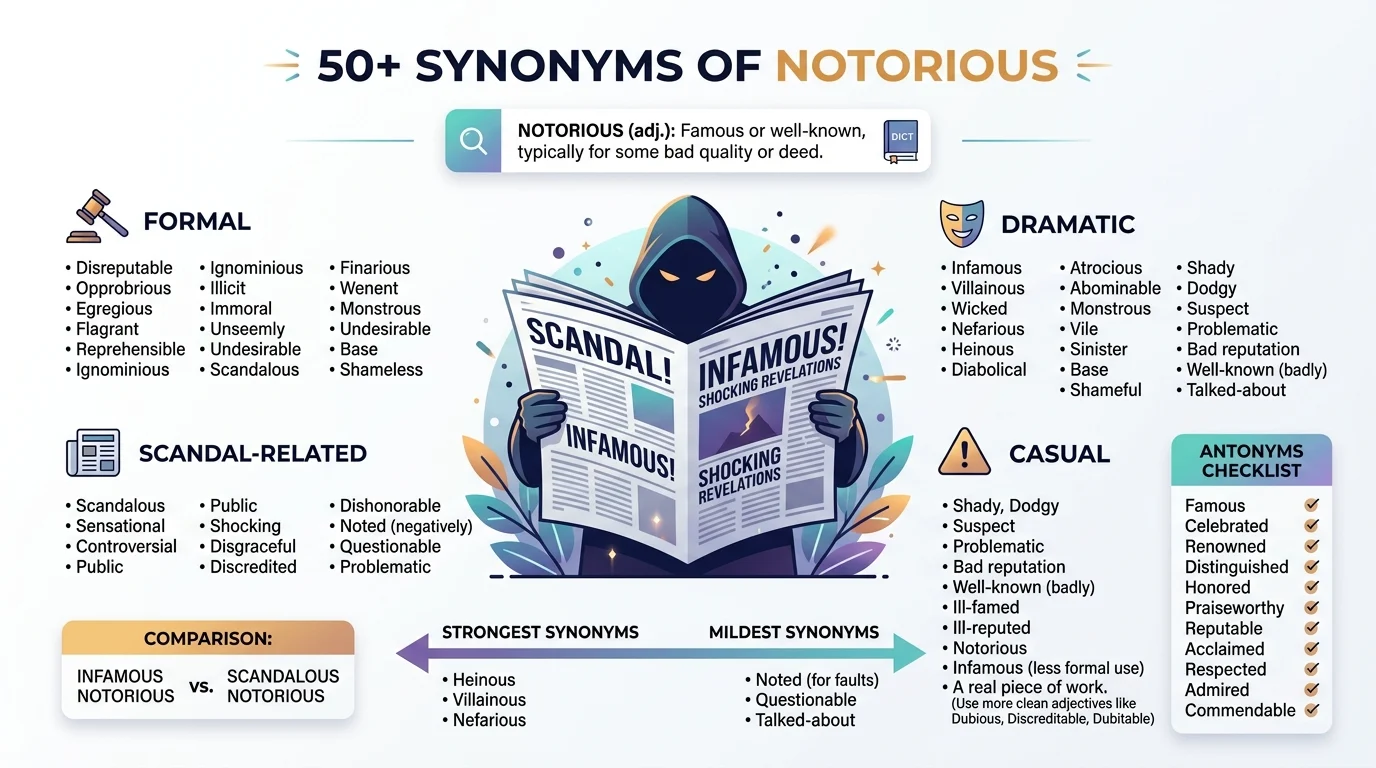
Have you ever needed to describe someone or something famous for a bad reason but felt that “famous” or “well-known” did not capture the negative reputation? You want to highlight infamy, scandal, or a widely known bad quality, and the word “notorious” comes to mind. Choosing the right synonym for “notorious” can transform a simple statement into a precise description of ill repute, scandal, or infamy. This guide explores the best synonyms of notorious, explaining exactly which word to use and when.
Quick Ans: “Notorious” means famous or well-known for a bad quality, deed, or reputation. For formal writing, choose infamous or disreputable. For dramatic effect, use nefarious or villainous. In casual conversation, famous for the wrong reasons works well. For a milder tone, select ill-famed or ill-reputed.
Meaning, Tone, and Context
Understanding the core meaning of “notorious” is the first step to using it effectively.
Simple Definition: Famous or well-known for some bad quality, deed, or characteristic; having a widely known bad reputation.
Part of Speech: Adjective.
Overall Tone: Negative. It indicates a bad reputation, scandal, or infamy.
Formality Level: Neutral to formal. The word is appropriate in news, academic, and professional contexts.
Common Uses: Native English speakers use it to describe criminals, scandals, places, and behaviors. For example, “The city is notorious for its traffic,” or “He is a notorious criminal.”
Word Forms: Related words include the noun notoriety, the adverb notoriously, and the adjective notorious.
When and How to Use “Notorious”
“Notorious” is the perfect choice when you want to emphasize a bad reputation or scandal. Here are seven realistic examples.
News: “The company is notorious for its poor treatment of workers.”
Academic: “The study examines the notorious corruption scandal of the 1990s.”
Workplace: “He is notorious for missing deadlines.”
Personal: “The restaurant is notorious for its long wait times.”
Email: “Please be aware that this vendor is notorious for delays.”
Resume: (Avoid in resumes) Use “challenging” or “demanding” instead.
Social Media: “This influencer is notorious for controversial takes.”
Best Synonyms of “Notorious”
No synonym is identical in every situation. Here is your guide to the best replacement for “notorious” based on your writing context.
For Formal and Legal Contexts
Most Direct: Infamous is the closest synonym, meaning well-known for a bad quality or deed. “The infamous criminal was finally captured.”
Legal/Formal: Disreputable means not respectable in appearance or character. “The disreputable establishment was shut down.”
Formal: Ill-famed means having a bad reputation. “The ill-famed politician resigned.”
Formal: Ill-reputed means having a bad reputation. “The ill-reputed company lost its license.”
For Dramatic and Literary Contexts
Dramatic: Nefarious means wicked or villainous. “The nefarious plot was uncovered.”
Dramatic: Villainous means characteristic of a villain. “The villainous leader was overthrown.”
Literary: Dark means mysterious and sinister. “He had a dark reputation.”
Literary: Sinister means suggesting evil. “The sinister figure was feared by all.”
For Scandal and Shame
Scandalous: Scandalous means causing public outrage. “The scandalous affair ruined his career.”
Shameful: Shameful means deserving of shame. “The shameful behavior was condemned.”
Disgraceful: Disgraceful means shockingly unacceptable. “The disgraceful conduct led to his dismissal.”
For Casual Contexts
Casual: Famous for the wrong reasons is a simple phrase. “He is famous for the wrong reasons.”
Casual: Bad reputation is a straightforward phrase. “The bar has a bad reputation.”
Casual: Infamous works in casual contexts too. “That movie is infamous for its bad acting.”
When Not to Use “Notorious”
Using “notorious” can sound wrong or awkward in certain situations.
When It Sounds Too Negative: “Notorious” is strongly negative. For neutral fame, use “famous.”
Better Choice: Famous or well-known. “She is a famous actress.”
When It Sounds Too Dramatic: In casual conversation, “notorious” can sound overly dramatic.
Better Choice: Known for or famous for. “He is known for being late.”
When It Sounds Too Formal: In casual conversation, “notorious” can sound stiff.
Better Choice: Infamous or bad reputation. “That place has a bad reputation.”
Words Commonly Confused With “Notorious”
| Word | Difference | When to Use | Example |
|---|---|---|---|
| Famous | Well-known, usually positive | General fame | “She is a famous singer.” |
| Infamous | Well-known for a bad reason | Strong negative fame | “The infamous criminal was caught.” |
| Celebrated | Well-known and praised | Positive fame | “The celebrated author won awards.” |
| Renowned | Well-known and respected | Positive reputation | “The renowned surgeon saved lives.” |
| Disreputable | Not respectable | Formal negative reputation | “The disreputable bar was closed.” |
| Nefarious | Wicked and villainous | Dramatic and literary | “The nefarious scheme was foiled.” |
Best Synonyms of “Notorious” by Context
| Context | Best Synonym | Why It Works | Example |
|---|---|---|---|
| Formal writing | Infamous | Direct and strong | “The infamous dictator was overthrown.” |
| Legal context | Disreputable | Formal and precise | “The disreputable business was shut down.” |
| Dramatic writing | Nefarious | Wicked and villainous | “The nefarious plot was uncovered.” |
| Literary | Sinister | Suggests evil | “The sinister figure was feared.” |
| Scandal | Scandalous | Public outrage | “The scandalous affair was exposed.” |
| Casual conversation | Famous for the wrong reasons | Simple and clear | “He is famous for the wrong reasons.” |
| News | Ill-famed | Formal and specific | “The ill-famed politician resigned.” |
How to Choose the Best Synonym of “Notorious”
Choosing the right word is a simple decision. Answer these questions.
What type of notoriety am I describing? For formal, use infamous or disreputable. And For dramatic, use nefarious or villainous. For scandal, use scandalous or shameful. For casual, use famous for the wrong reasons.
What is my audience? For a formal report, use infamous or disreputable. For a friend, use famous for the wrong reasons or bad reputation.
What is my purpose? Are you describing a person, a place, or a behavior? The correct synonym depends entirely on this.
What is the emotional strength? Nefarious and villainous are stronger. Famous for the wrong reasons is milder. Pick the one that matches your message.
Real Life Examples of “Notorious”
School: Basic: “The student is notorious for being late.” Improved: “The student is infamous for being late.”
College: Basic: “The professor is notorious for hard exams.” Improved: “The professor is notorious for challenging exams.”
Workplace: Basic: “The manager is notorious for being strict.” Improved: “The manager is disreputable for being unfair.”
Business: Basic: “The company is notorious for bad service.” Improved: “The company is ill-reputed for poor service.”
Email: Basic: “The vendor is notorious for delays.” Improved: “The vendor is infamous for delays.”
Conversation: Basic: “He is notorious.” Improved: “He is famous for the wrong reasons.”
Storytelling: Basic: “The villain was notorious.” Improved: “The nefarious villain was feared by all.”
Top 10 Synonyms of “Notorious”
| Synonym | Simple Meaning | Best Used For | Example Sentence |
|---|---|---|---|
| Infamous | Well-known for a bad reason | Formal and news contexts | “The infamous criminal was captured.” |
| Disreputable | Not respectable | Legal and formal contexts | “The disreputable bar was closed.” |
| Nefarious | Wicked and villainous | Dramatic and literary contexts | “The nefarious plot was foiled.” |
| Villainous | Characteristic of a villain | Dramatic and literary contexts | “The villainous leader was overthrown.” |
| Scandalous | Causing public outrage | Scandal and gossip contexts | “The scandalous affair was exposed.” |
| Shameful | Deserving of shame | Moral and ethical contexts | “The shameful behavior was condemned.” |
| Disgraceful | Shockingly unacceptable | Strong criticism contexts | “The disgraceful conduct led to dismissal.” |
| Ill-famed | Having a bad reputation | Formal and literary contexts | “The ill-famed politician resigned.” |
| Ill-reputed | Having a bad reputation | Formal and business contexts | “The ill-reputed company lost its license.” |
| Sinister | Suggesting evil | Literary and descriptive contexts | “The sinister figure was feared.” |
Synonyms of “Notorious” by Usage
Professional vs. Personal Synonyms
In the workplace, choose infamous, disreputable, or ill-reputed. With friends, use famous for the wrong reasons or bad reputation.
Formal vs. Conversational Synonyms
For formal writing, use infamous, disreputable, or nefarious. For casual conversations, use famous for the wrong reasons or infamous.
Academic Synonyms
For research and essays, choose infamous for historical figures, disreputable for institutions, and scandalous for events.
Professional and Business Synonyms
For maximum impact, choose ill-reputed for companies, disreputable for practices, and infamous for scandals.
Creative and Literary Synonyms
To add emotion and imagery, choose nefarious, villainous, sinister, or dark. These words create atmosphere.
Slang or Modern Synonyms
In modern American slang, sketchy, shady, or cancelled are common. For example, “That guy is sketchy.” These are casual and should be avoided in formal writing.
Strongest to Mildest Synonyms
Mild: famous for the wrong reasons, bad reputation
Moderate: notorious, infamous, ill-famed
Strong: disreputable, scandalous, shameful
Very Strong: nefarious, villainous, sinister, disgraceful
Emotional vs. Neutral Synonyms
Emotional Synonyms: Nefarious, villainous, sinister. These words hint at evil and danger. Use them when you want to evoke feeling.
Neutral Synonyms: Infamous, disreputable, ill-reputed. These words simply communicate factual information.
Antonyms of “Notorious”
| Antonym | Meaning | Example Sentence |
|---|---|---|
| Respected | Held in high regard | “She is a respected leader.” |
| Honored | Deserving of honor | “The honored guest spoke.” |
| Esteemed | Highly respected | “The esteemed professor retired.” |
| Renowned | Well-known and admired | “The renowned artist painted.” |
| Celebrated | Praised publicly | “The celebrated author won awards.” |
| Reputable | Having a good reputation | “The reputable company was trusted.” |
| Honorable | Deserving of honor | “His honorable conduct was praised.” |
| Virtuous | Having high moral standards | “She led a virtuous life.” |
| Praiseworthy | Deserving praise | “His praiseworthy efforts were noted.” |
| Exemplary | Serving as a model | “Her exemplary behavior was rewarded.” |
| Laudable | Deserving praise | “The laudable initiative was supported.” |
| Upright | Morally good | “He was an upright citizen.” |
| Good | Morally right | “She is a good person.” |
| Honest | Truthful and fair | “The honest merchant was trusted.” |
| Trustworthy | Reliable and honest | “The trustworthy employee was promoted.” |
Comparison: “Notorious” vs Similar Words
Notorious vs. Famous
Main Difference: “Famous” is neutral or positive. “Notorious” is negative.
Which Is Stronger? “Notorious” is stronger for negative fame.
Which Is More Formal? Both are neutral.
When to Use Each: Use “famous” for positive fame. Use “notorious” for negative fame.
Examples:
Notorious: “He is a notorious criminal.”
Famous: “She is a famous actress.”
Notorious vs. Infamous
Main Difference: “Infamous” is a stronger, more formal synonym for “notorious.”
Which Is Stronger? “Infamous” is stronger and more dramatic.
Which Is More Formal? “Infamous” is more formal.
When to Use Each: Use “infamous” for historical or dramatic contexts. Use “notorious” for general contexts.
Examples:
Notorious: “He is notorious for being late.”
Infamous: “The infamous dictator was overthrown.”
Notorious vs. Disreputable
Main Difference: “Disreputable” means not respectable. “Notorious” means famous for a bad reason.
Which Is Stronger? “Disreputable” is more formal and specific.
Which Is More Formal? “Disreputable” is more formal.
When to Use Each: Use “disreputable” for institutions. Use “notorious” for general contexts.
Examples:
Notorious: “The restaurant is notorious for bad service.”
Disreputable: “The disreputable bar was closed.”
Notorious vs. Nefarious
Main Difference: “Nefarious” means wicked. “Notorious” means famous for a bad reason.
Which Is Stronger? “Nefarious” is stronger and more dramatic.
Which Is More Formal? “Nefarious” is more formal.
When to Use Each: Use “nefarious” for villains. Use “notorious” for general contexts.
Examples:
Notorious: “He is notorious for cheating.”
Nefarious: “The nefarious plot was foiled.”
Notorious vs. Scandalous
Main Difference: “Scandalous” means causing public outrage. “Notorious” means famous for a bad reason.
Which Is Stronger? “Scandalous” is stronger for outrage.
Which Is More Formal? Both are formal.
When to Use Each: Use “scandalous” for events. Use “notorious” for people and places.
Examples:
Notorious: “The hotel is notorious for its high prices.”
Scandalous: “The scandalous affair was exposed.”
Notorious vs. Sinister
Main Difference: “Sinister” suggests evil. “Notorious” suggests bad reputation.
Which Is Stronger? “Sinister” is stronger for evil.
Which Is More Formal? Both are formal.
When to Use Each: Use “sinister” for atmosphere. Use “notorious” for reputation.
Examples:
Notorious: “The street is notorious for crime.”
Sinister: “The sinister figure was feared.”
Common Phrases and Expressions with “Notorious”
Phrase: Notorious for
Meaning: Famous for a bad quality.
Example Sentence: “The city is notorious for its traffic.”
Phrase: Notorious criminal
Meaning: A criminal who is widely known.
Example Sentence: “The notorious criminal was finally captured.”
Phrase: Notorious reputation
Meaning: A widely known bad reputation.
Example Sentence: “The club has a notorious reputation.”
Phrase: Notorious scandal
Meaning: A widely known scandal.
Example Sentence: “The notorious scandal rocked the government.”
Phrase: Notorious behavior
Meaning: Widely known bad behavior.
Example Sentence: “His notorious behavior got him fired.”
Common Mistakes to Avoid
Mistake 1: Using “notorious” when you mean “famous”.
Incorrect: “She is notorious for her charity work.”
Better: “She is famous for her charity work.”
Why: “Notorious” is negative. “Famous” is neutral or positive.
Mistake 2: Using “notorious” in casual conversation.
Incorrect: “He is notorious for being late.”
Better: “He is known for being late.”
Why: “Known for” sounds more natural.
Mistake 3: Using “notorious” when you mean “infamous”.
Incorrect: “The dictator was notorious.”
Better: “The dictator was infamous.”
Why: “Infamous” is stronger for historical figures.
Mistake 4: Using “notorious” when you mean “disreputable”.
Incorrect: “The company is notorious.”
Better: “The company is disreputable.”
Why: “Disreputable” is more formal for institutions.
Mistake 5: Using “notorious” when you mean “nefarious”.
Incorrect: “The plot was notorious.”
Better: “The plot was nefarious.”
Why: “Nefarious” is stronger for wickedness.
Frequently Asked Questions
1. What are the best synonyms of “notorious”?
The best synonyms depend on your context. For formal writing, choose infamous or disreputable. And For dramatic effect, use nefarious or villainous. For casual conversation, use famous for the wrong reasons.
2. What are the best formal synonyms of “notorious”?
The best formal synonyms are infamous, disreputable, and ill-reputed. These words are suitable for academic papers, professional reports, and news articles.
3. What are common informal synonyms of “notorious”?
For informal settings, use famous for the wrong reasons, bad reputation, or sketchy. These alternatives sound more natural in everyday conversation.
4. What is another word for “notorious” in professional writing?
In professional writing, infamous is an excellent choice. It conveys strong negative fame. Disreputable is also strong for institutions.
5. What is the difference between “notorious” and “infamous”?
“Infamous” is a stronger, more formal synonym for “notorious.” Both mean famous for a bad reason, but “infamous” is more dramatic.
6. What is the opposite of “notorious”?
The most direct opposites (antonyms) of notorious are respected, honored, and esteemed. These words describe a good reputation.
Conclusion
“Notorious” is a powerful and precise word for describing a bad reputation, scandal, or infamy. The term is neutral in formality but strongly negative in tone, making it ideal for news, academic, and professional contexts. The best choice among the synonyms of notorious depends entirely on your audience, tone, and purpose. Remember, no single synonym works perfectly in every situation. Your goal is to choose the word that communicates your message with the most clarity and impact. A practical tip for your vocabulary growth is to pay attention to how writers describe reputation and practice using different synonyms in your writing.










2 thoughts on “50+ Synonyms of Notorious: Meanings, Uses, Examples, and Best Alternatives 2026”