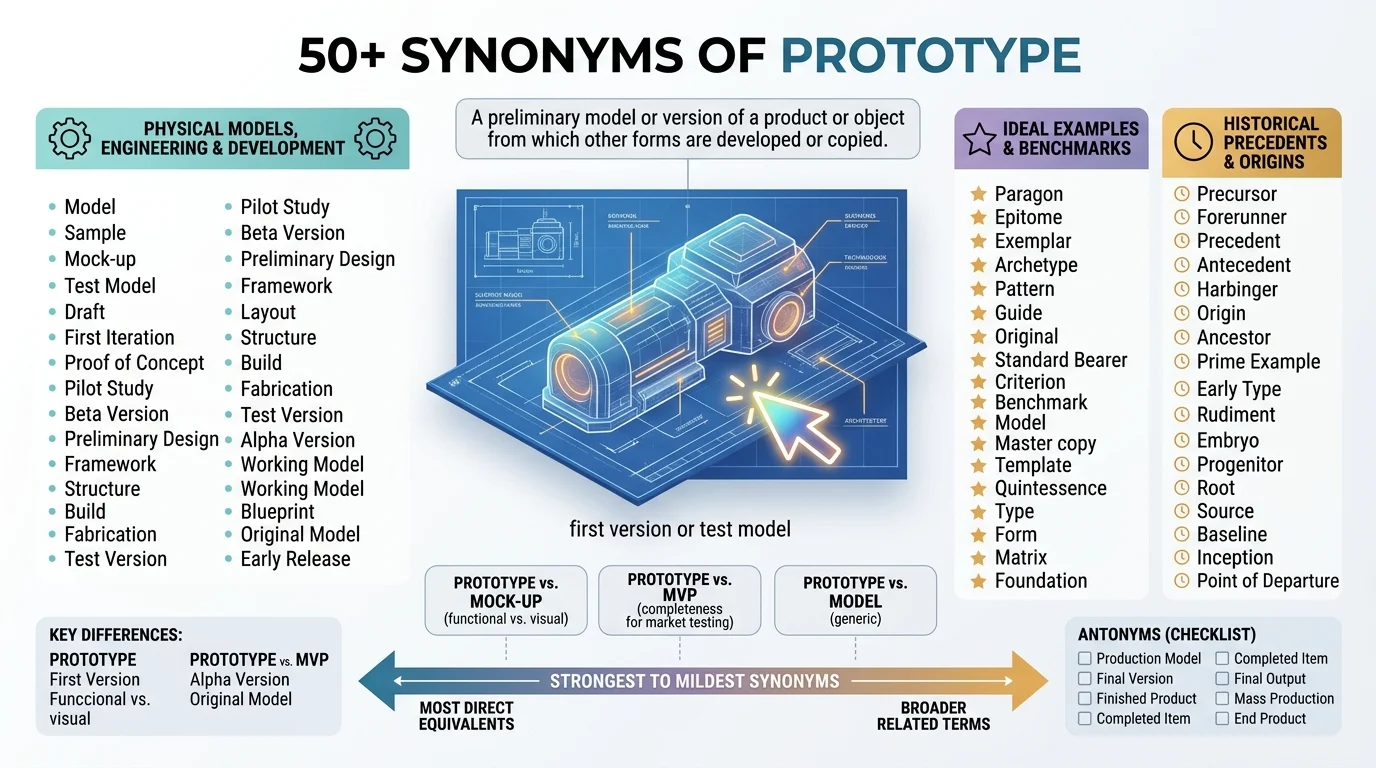
Have you ever needed to describe a first version, an early sample, or a perfect example but found yourself overusing “model” or “original”? You want to highlight innovation, representation, or the ideal standard, and the word “prototype” comes to mind. Choosing the right synonym for “prototype” can transform a simple description into a precise expression of creation, testing, or excellence. This guide explores the best synonyms of prototype, explaining exactly which word to use and when.
Quick Ans: “Prototype” has two primary meanings: an early physical model used for testing and a person or thing that serves as a perfect example of a type . For an early model, choose mock-up, sample, or pilot . For a perfect example, use archetype, exemplar, or paradigm . In technical contexts, model or original are strong choices . For a broader sense of precedent, use precursor or forerunner.
Meaning, Tone, and Context
Understanding the core meaning of “prototype” is the first step to using it effectively.
Simple Definition: An original or first model of something from which other forms are copied or developed; a standard or typical example of a class .
Part of Speech: Noun (and sometimes verb) .
Overall Tone: Neutral to positive. It can describe innovation, excellence, or serve as a benchmark for quality.
Formality Level: Neutral. The word is appropriate in professional, academic, and everyday contexts.
Common Uses: Native English speakers use it to describe a first working model in engineering, a person who embodies the best qualities of a group, or a work that sets a standard for its genre. For example, “They built a prototype of the new car,” or “He is the prototype of a successful entrepreneur.”
Word Forms: Related words include the verb prototype (to create), the adjective prototypical, and the noun prototyping .
When and How to Use “Prototype”
“Prototype” is the perfect choice when you want to describe an original model, a perfect example, or a first of its kind. Here are seven realistic examples.
Engineering & Product Design: “The engineers built a prototype of the new electric car to test its battery life and performance” .
Business: “We developed a prototype of our service to demonstrate its value to potential investors” .
Academic: “The ancient text is considered the prototype of modern detective fiction” .
Personal: “She is the prototype of a dedicated and caring teacher.”
Email: “I have attached the prototype for the new app design; please review it.”
Resume: “Led the development of the functional prototype, resulting in $2 million in seed funding.”
Social Media: “Just tested the prototype of our new product. Exciting times ahead!”
Best Synonyms of “Prototype”
No synonym is identical in every situation. Here is your guide to the best replacement for “prototype” based on your writing context .
For a Physical or Early Model
Descriptive: Mock-up. Use it for a non-functional or limited model to show scale or design. “The team created a mock-up of the new building.”
Technical: Sample. Use it for a small part of the whole used to evaluate the rest. “They produced a sample of the new fabric for testing” .
Trial: Pilot. Use it for a test run of a program or process. “The pilot program was launched in two cities” .
Functional: Model. Use it for a simulation or a representation of a system. “The computer model predicts the weather” .
Original: Original. Use it to emphasize the first creation. “The original was locked in a vault” .
For an Ideal or Standard Example
Perfect Standard: Archetype. Use it for the perfect, original model that is imitated. “The lawyer was the archetype of the confident professional” .
Best Representation: Exemplar. Use it for an excellent example worthy of imitation. “This painting is the exemplar of the impressionist style” .
Conceptual Framework: Paradigm. Use it for a typical example, especially for a pattern of thought . “The smartphone is the paradigm of modern convenience.”
Embodiment: Epitome. Use it for a person who perfectly represents a quality . “She is the epitome of grace.”
Worthy of Imitation: Model. Use it for the idea of something to be copied. “Her work ethic is a model for others” .
The Real Thing: Image. Use it for a direct visual representation or copy . “The statue was the very image of the king.”
For Precedents or Forerunners
Historical Precedent: Precursor. Use it for something that came before and led to a later development. “The radio was a precursor to the television” .
Signaling Ahead: Forerunner. Use it for something that announced the approach of something else. “The party was the forerunner of a larger movement” .
When Not to Use “Prototype”
Using “prototype” can sound wrong or awkward in certain situations.
When It Sounds Too Technical: For a casual description, “prototype” can sound overly technical.
Better Choice: Sample or test version. “Let’s release a test version to our best customers.”
When You Mean a Final Product: A prototype is an early version. The final, complete product is different.
Better Choice: Product or release. “The final release of the software will be available next week.”
When You Mean a Physical Copy: “Prototype” is for a first model, not a reproduction.
Better Choice: Copy or reproduction. “Can I get a copy of that report?”
When You Lack an Example: “Prototype” implies an example or standard exists.
Better Choice: Concept or idea. “I am working on a concept for a new app.”
Words Commonly Confused With “Prototype”
Several words are often mixed up with “prototype.” Here is how to keep them straight.
Word: Archetype
Difference: The original model from which all copies are made. “Prototype” can be a specific first version, while archetype is the ideal or standard .
When to Use: Use it for a perfect and original model.
Example: “The novel is the archetype of the coming-of-age story.”
Word: Exemplar
Difference: A person or thing that serves as a model to be imitated. “Prototype” emphasizes being the first; exemplar emphasizes excellence .
When to Use: Use it for an excellent example worth copying.
Example: “She is an exemplar of kindness and generosity.”
Word: Paradigm
Difference: A typical example or pattern of something. Prototype is a physical model, while paradigm is often a conceptual framework .
When to Use: Use it for a standard way of thinking or doing things.
Example: “The shift to digital media created a new paradigm.”
Word: Model
Difference: A representation or copy. Prototype is the original; a model can be a simplified version .
When to Use: Use it for a smaller or simplified representation.
Example: “She built a scale model of the city.”
Word: Mock-up
Difference: A physical model to show layout or design. Prototype is often functional, while a mock-up is for display .
When to Use: Use it for a non-functional demonstration.
Example: “The designer presented a mock-up of the new packaging.”
Best Synonyms of “Prototype” by Context
| Context | Best Synonym | Why It Works | Example |
|---|---|---|---|
| Product Design | Mock-up | Describes a visual model for feedback. | “The team presented a mock-up of the new interface.” |
| Engineering | Model | Precise for a testable version. | “The engineers built a working model of the engine.” |
| Business & Testing | Pilot | Good for a test run of a service. | “The pilot program was a huge success.” |
| Showing a Sample | Sample | Describes a test piece. | “They took a sample of the fabric to the lab.” |
| Perfect Example | Archetype | The original and ideal example. | “The ancient building is the archetype of its style.” |
| Worthy Example | Exemplar | Excellent example to be imitated. | “This work is the exemplar of quality.” |
| Conceptual Pattern | Paradigm | For a standard way of thinking. | “The invention created a new paradigm for the industry.” |
| Personification | Epitome | Someone who perfectly represents a quality. | “She is the epitome of professionalism.” |
| Historical Precedent | Precursor | Something that came before. | “Silent films were a precursor to talkies.” |
| Signaling Ahead | Forerunner | Something that announced the future. | “The protest was a forerunner of the revolution.” |
How to Choose the Best Synonym of “Prototype”
Choosing the right word is a simple decision. Answer these questions.
What kind of prototype am I describing? Is it a physical model for testing (model), a visual design (mock-up), an ideal standard (archetype), or a historical precedent (precursor)?
What is my audience? For a scientist, model or sample is accurate. And for a designer, mock-up works. For a general audience, example or model is clearer.
What is my purpose? Are you describing a process of creation, setting a standard, or giving an example? The correct synonym depends entirely on this.
What is the emotional strength? Archetype and paradigm are stronger and more conceptual. Sample and example are mild and practical. Pick the one that matches your message.
Real Life Examples of “Prototype”
To truly master the word, it helps to see how it behaves in the wild and how a stronger synonym can elevate the sentence.
School: Basic: “The student made a prototype of a machine.” Improved: “The student built a working model of a machine for the science fair.”
College: Basic: “The professor discussed the prototype of the theory.” Improved: “The professor discussed the paradigm of the new scientific theory.”
Workplace: Basic: “We have a prototype of the product.” Improved: “We have a functional mock-up of the product ready for user testing.”
Business: Basic: “The prototype will be ready soon.” Improved: “The pilot of our new service will be ready for launch soon.”
Email: Basic: “I sent you the prototype.” Improved: “I have attached the sample of the document for your review.”
Conversation: Basic: “He is the prototype of a good leader.” Improved: “He is the epitome of a good leader.”
Storytelling: Basic: “The old car was the prototype.” Improved: “The old car was the forerunner of modern sports cars.”
Top 10 Synonyms of “Prototype”
| Synonym | Simple Meaning | Best Used For | Example Sentence |
|---|---|---|---|
| Archetype | The original, ideal model | Formal, literary, and conceptual contexts. | “The mentor character is the archetype of the wise old man.” |
| Exemplar | An excellent model to be imitated | Formal, academic, and praise contexts. | “The charity is an exemplar of compassion.” |
| Paradigm | A typical pattern or framework | Academic, scientific, and professional contexts. | “The new process is a paradigm of efficiency.” |
| Epitome | The perfect embodiment of a quality | Emotional, literary, and character contexts. | “She is the epitome of generosity.” |
| Model | A standard or representation | General, technical, and practical contexts. | “The computer model predicted the outcome.” |
| Mock-up | A physical representation for design | Product design and engineering contexts. | “The designer showed us a mock-up of the building.” |
| Sample | A small part representing the whole | General, scientific, and product contexts. | “We tested a sample of the new material.” |
| Pilot | A test run of a program | Business, government, and project contexts. | “The pilot program was launched yesterday.” |
| Precursor | Something that came before | Historical, scientific, and logical contexts. | “The ancient method was a precursor to modern medicine.” |
| Forerunner | Something that signals the future | Historical, political, and social contexts. | “The campaign was a forerunner of social change.” |
Synonyms of “Prototype” by Usage
Professional vs. Personal Synonyms
In the workplace (professional), choose model, mock-up, or pilot to describe test products and services. These words convey practicality and precision. “We are launching a pilot program” is more precise than “We are launching a prototype program.”
With friends (personal), model, example, or type keep the tone relaxed and relatable.
Formal vs. Conversational Synonyms
For formal writing (reports, essays, professional emails), use archetype, exemplar, or paradigm . For casual conversations and texting, use model, example, or type. These options sound more natural.
Academic Synonyms
For research and essays, choose precise, authoritative words. Archetype is great for literary analysis, paradigm for scientific revolutions, and exemplar for moral or ethical discussions.
Professional and Business Synonyms
For maximum impact in business writing, choose pilot for tests, model for representations, and example for illustrations. These words demonstrate confidence and professional awareness.
Creative and Literary Synonyms
To add emotion and imagery to your writing, choose archetype, epitome, or forerunner. These words create atmosphere and deepen meaning.
Slang or Modern Synonyms
There is no direct slang synonym for “prototype.” In modern texting, people use model, test version, or example. Avoid in professional writing.
Strongest to Mildest Synonyms
Mild: example, sample, type
Moderate: model, prototype, mock-up, pilot
Strong: exemplar, precursor, forerunner
Very Strong: archetype, paradigm, epitome
Emotional vs. Neutral Synonyms
Emotional Synonyms: Epitome, archetype, forerunner. These words often hint at admiration, awe, or historical significance.
Neutral Synonyms: Model, sample, example. These words simply communicate factual information.
Antonyms of “Prototype”
| Antonym | Meaning | Example Sentence |
|---|---|---|
| Copy | An imitation of the original | “The copy was a poor imitation of the prototype.” |
| Replica | An exact copy or reproduction | “The replica was sold in the gift shop.” |
| Fake | A counterfeit version | “The police uncovered a fake of the designer bag.” |
| Imitation | A copy, often inferior | “Her performance was a pale imitation.” |
| Derivative | A work based on something else | “The film was a derivative of the novel.” |
| Forgery | An illegal copy | “The painting was found to be a forgery.” |
| Reproduction | A copy of a work | “The museum sold reproductions of the artwork.” |
| Duplicate | An exact copy | “I made a duplicate of the key.” |
| Counterfeit | A false imitation | “The counterfeit money was seized.” |
| Mockery | An absurd imitation | “His version was a mockery of the original.” |
Comparison: “Prototype” vs Similar Words
Prototype vs. Archetype
Main Difference: “Prototype” is a specific first model. “Archetype” is the original, ideal pattern .
Which Is Stronger? “Archetype” is stronger for a perfect, timeless model.
Which Is More Formal? Both are formal.
When to Use Each: Use “prototype” for a working model. Use “archetype” for a literary or philosophical ideal.
Examples:
Prototype: “They built a prototype of the new bridge.”
Archetype: “The hero is the archetype of strength and virtue.”
Prototype vs. Exemplar
Main Difference: “Prototype” is the first version. “Exemplar” is an excellent example worthy of imitation .
Which Is Stronger? They are different. “Exemplar” emphasizes excellence.
Which Is More Formal? Both are formal.
When to Use Each: Use “prototype” for testing. Use “exemplar” for a model of excellence.
Examples:
Prototype: “The prototype of the engine failed.”
Exemplar: “The research paper is an exemplar of thorough study.”
Prototype vs. Model
Main Difference: “Prototype” is the original. “Model” can be a representation or a copy .
Which Is Stronger? “Prototype” is unique. “Model” is more general.
Which Is More Formal? Both are neutral.
When to Use Each: Use “prototype” for the first version. Use “model” for any representation.
Examples:
Prototype: “The prototype was tested extensively.”
Model: “The model of the city was used for planning.”
Prototype vs. Mock-up
Main Difference: “Prototype” is often functional. “Mock-up” is for display and design .
Which Is Stronger? “Prototype” implies a higher level of development.
Which Is More Formal? Both are formal.
When to Use Each: Use “mock-up” for a visual demonstration. Use “prototype” for a working test.
Examples:
Prototype: “They tested the prototype on the track.”
Mock-up: “The mock-up of the dashboard was realistic.”
Prototype vs. Paradigm
Main Difference: “Prototype” is a physical model. “Paradigm” is a conceptual framework .
Which Is Stronger? “Paradigm” is more profound and world-changing.
Which Is More Formal? Both are very formal.
When to Use Each: Use “prototype” for products. Use “paradigm” for ideas and theories.
Examples:
Prototype: “The prototype of the car was built.”
Paradigm: “Einstein changed the paradigm of physics.”
Prototype vs. Precursor
Main Difference: “Prototype” is a model. “Precursor” is something that comes before and leads to something else .
Which Is Stronger? They are different. “Precursor” emphasizes historical sequence.
Which Is More Formal? Both are formal.
When to Use Each: Use “prototype” for a model. Use “precursor” for historical context.
Examples:
Prototype: “The prototype was unveiled yesterday.”
Precursor: “The steam engine was a precursor to the automobile.”
Common Phrases and Expressions with “Prototype”
Phrase: Working prototype
Meaning: A functional version of a product for testing.
Example Sentence: “The engineers produced a working prototype in six months.”
Phrase: Prototype design
Meaning: The early-stage design of a product.
Example Sentence: “The prototype design was approved by the board.”
Phrase: Prototype testing
Meaning: The process of evaluating a prototype.
Example Sentence: “Prototype testing revealed several weaknesses.”
Phrase: Early prototype
Meaning: A very first version of a product.
Example Sentence: “The early prototype was crude but promising.”
Phrase: Functional prototype
Meaning: A prototype that works.
Example Sentence: “They needed a functional prototype to demonstrate the concept.”
Phrase: Prototype stage
Meaning: The phase of product development involving prototypes.
Example Sentence: “The project is still in the prototype stage.”
Common Mistakes to Avoid
Mistake 1: Using “prototype” when you mean “archetype”.
Incorrect: “The character is the prototype of a hero.”
Better: “The character is the archetype of a hero.”
Why: “Archetype” is for the original, perfect pattern, while “prototype” is for a test model.
Mistake 2: Using “prototype” when you mean “mock-up”.
Incorrect: “The prototype of the building looked great.”
Better: “The mock-up of the building looked great.”
Why: A “mock-up” is a visual display, often non-functional, while a “prototype” is a working model.
Mistake 3: Overusing “prototype” in casual conversation.
Incorrect: “The pizza is the prototype of good food.”
Better: “The pizza is the epitome of good food.”
Why: “Prototype” sounds too technical for describing food.
Mistake 4: Confusing “prototype” with “precursor”.
Incorrect: “The horse is the prototype of the car.”
Better: “The horse is the precursor of the car.”
Why: “Precursor” means something that came before and led to something else, which is more historically accurate than “prototype.”
Mistake 5: Using “prototype” for a final product.
Incorrect: “We will ship the prototype to customers.”
Better: “We will ship the final product to customers.”
Why: A “prototype” is a test version, not a final product ready for sale.
Frequently Asked Questions
1. What are the best synonyms of “prototype”?
The best synonyms depend on your context. For an early model, choose mock-up, sample, or pilot . For a perfect example, use archetype, exemplar, or paradigm .
2. What are the best formal synonyms of “prototype”?
The best formal synonyms are archetype, exemplar, and paradigm. These words are suitable for academic papers and professional reports .
3. What are common informal synonyms of “prototype”?
For informal settings, use model, sample, or example. These alternatives sound more natural in everyday conversation.
4. What is the difference between “prototype” and “archetype”?
“Prototype” is a specific, early test model. “Archetype” is the original, ideal pattern from which all copies are made .
5. What is the difference between “prototype” and “mock-up”?
“Prototype” is often a functional, working model. “Mock-up” is a visual representation used for design and display .
6. What is the opposite of “prototype”?
The most direct opposites (antonyms) are copy, replica, and imitation. These words describe something that is made after the original or as a copy.
Conclusion
“Prototype” is a versatile and powerful word for describing original models, ideal examples, and historical precedents. The best choice among the synonyms of prototype depends entirely on your audience, tone, and purpose. Remember, no single synonym works perfectly in every situation. Your goal is to choose the word that communicates your message with the most clarity and impact. A practical tip for your vocabulary growth is to pay attention to how engineers, designers, and writers describe creation and standards, and practice using different synonyms in your writing.









