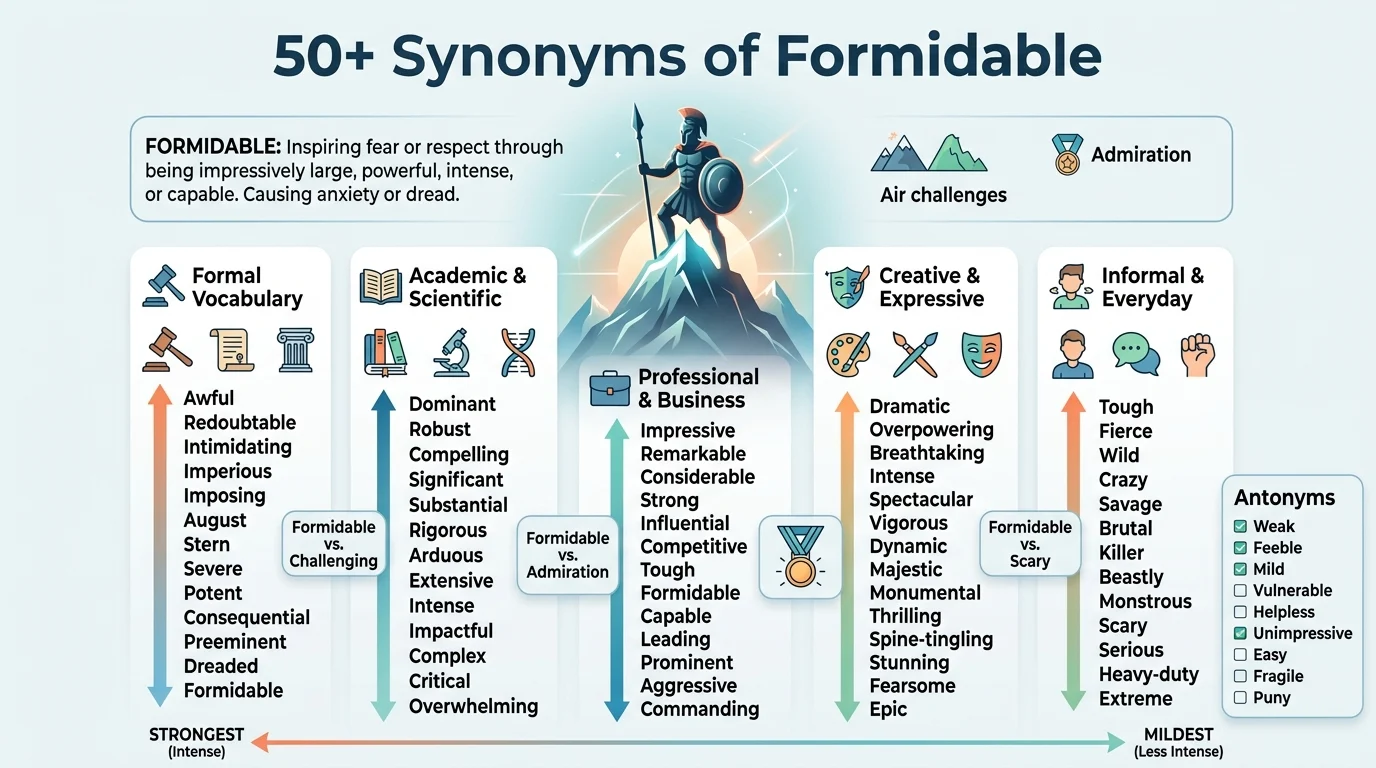
Have you ever needed to describe a challenge that inspires awe or fear, a competitor who is incredibly strong, or a task that seems daunting but impressive? You want to convey a sense of power, difficulty, or respect, and the word “formidable” comes to mind. Choosing the right synonym for “formidable” can transform a simple description into a powerful expression of admiration, fear, or intimidation. This guide explores the best synonyms of formidable, explaining exactly which word to use and when.
Quick Ans: “Formidable” means inspiring fear, dread, or respect due to great size, power, or difficulty. It is a powerful adjective with a neutral-to-positive or negative tone depending on context. For describing a strong opponent, choose daunting or intimidating. For expressing admiration, use impressive or awe-inspiring. In academic contexts, redoubtable and mighty are strong choices. For a more dramatic impact, select herculean or monumental.
Meaning, Tone, and Context
Understanding the core meaning of “formidable” is the first step to using it effectively.
Simple Definition: Inspiring fear, dread, or respect due to being very powerful, large, or difficult. It can be a positive or negative quality depending on context .
Part of Speech: Adjective .
Overall Tone: Negative (fearsome) or positive (admirable). It conveys power, strength, and difficulty .
Formality Level: Formal. The word is appropriate in professional, academic, and literary contexts.
Common Uses: Native English speakers use it to describe challenges, opponents, tasks, or qualities that are impressive and difficult. For example, “The company faced a formidable challenge,” or “She is a formidable opponent.”
Word Forms: Related words include the noun formidableness, the adverb formidably, and the noun formidability.
When and How to Use “Formidable”
“Formidable” is the perfect choice when you want to emphasize power, difficulty, or impressiveness. Here are seven realistic examples.
Professional: “The company’s formidable reputation made it a leader in the industry.”
Academic: “The researcher tackled a formidable problem that had stumped scientists for decades.”
Workplace: “Our team faced a formidable deadline, but we managed to deliver on time.”
Personal: “Her formidable willpower helped her overcome every obstacle.”
Email: “The client’s expectations are formidable, but I believe we can meet them.”
Resume: “Successfully managed a formidable budget and delivered results under pressure.”
Social Media: “This mountain is a formidable sight. Can’t wait to conquer it.”
Best Synonyms of “Formidable”
No synonym is identical in every situation. Here is your guide to the best replacement for “formidable” based on your writing context.
Professional Writing: Imposing. It suggests something that commands attention and respect. “The imposing figure of the CEO commanded the room” .
Academic Writing: Redoubtable. This is ideal when discussing a person or idea that is worthy of respect . “The redoubtable scholar was a leading authority on the subject.”
Casual Conversation: Intimidating. It captures the sense of fear and awe in a conversational way. “He seemed very intimidating at first.”
Describing Challenges: Daunting. It focuses on the difficulty and fear a task inspires . “The prospect of climbing the mountain was daunting.”
Expressing Admiration: Awe-inspiring. This is a purely positive synonym for something that evokes deep respect and wonder . “The Grand Canyon is an awe-inspiring sight.”
Describing Strength: Mighty. It conveys great power and strength . “The mighty warrior was undefeated in battle.”
Describing a Difficult Task: Herculean. It implies a task requiring great strength and effort . “The clean-up operation was a Herculean task” .
When Not to Use “Formidable”
Using “formidable” can sound wrong or awkward in certain situations.
When It Sounds Too Dramatic: “Formidable” is a powerful word. It sounds ridiculous for small tasks.
Better Choice: Tough or challenging. “The task was tough, but we managed.”
When You Mean “Impressive” Without Difficulty: “Formidable” often implies difficulty.
Better Choice: Impressive. “The presentation was impressive.”
When It Is Too Formal: In casual conversation, “formidable” can sound pretentious.
Better Choice: Intimidating or impressive. “The boss is pretty intimidating.”
When You Mean “Large” Without Fear: “Formidable” implies power or fear.
Better Choice: Massive or huge. “The massive building was visible from miles away.”
Words Commonly Confused With “Formidable”
Several words are often mixed up with “formidable.” Here is how to keep them straight.
Word: Intimidating
Difference: Focuses on causing fear or nervousness. “Formidable” can also cause respect .
When to Use: Use it for people or situations that make you nervous.
Example: “The intimidating professor scared the students.”
Word: Daunting
Difference: Focuses on difficulty and causing apprehension. “Formidable” also implies strength .
When to Use: Use this for tasks or challenges.
Example: “The daunting task seemed impossible.”
Word: Redoubtable
Difference: Specifically means worthy of respect and reverence . “Formidable” is broader .
When to Use: Use this for people of great status or achievement.
Example: “The redoubtable surgeon had saved countless lives.”
Word: Imposing
Difference: Focuses on appearance and size. “Formidable” focuses on power .
When to Use: Use this for physical presence and grandeur.
Example: “The imposing building dominated the skyline.”
Word: Awe-inspiring
Difference: Focuses on positive admiration and wonder. “Formidable” can be fear-inducing.
When to Use: Use this for beautiful or magnificent things.
Example: “The awe-inspiring sunset was breathtaking.”
Word: Herculean
Difference: Refers specifically to tasks requiring great strength. “Formidable” is broader.
When to Use: Use this for extremely difficult physical or mental tasks.
Example: “The herculean effort took months of preparation.”
Best Synonyms of “Formidable” by Context
| Context | Best Synonym | Why It Works | Example |
|---|---|---|---|
| Professional writing | Imposing | Commands attention and respect. | “The CEO’s imposing presence motivated the team.” |
| Academic writing | Redoubtable | Precise for respected figures. | “The redoubtable professor was known for her research.” |
| Casual conversation | Intimidating | Accessible and natural. | “He looked really intimidating at first.” |
| Describing challenges | Daunting | Accurate for difficult tasks. | “The daunting project required extra resources.” |
| Expressing admiration | Awe-inspiring | Positive and powerful. | “The awe-inspiring performance left the audience speechless.” |
| Describing strength | Mighty | Emphasizes raw power. | “The mighty army conquered the region.” |
| Describing a difficult task | Herculean | Evokes great effort. | “The herculean task took months to complete.” |
How to Choose the Best Synonym of “Formidable”
Choosing the right word is a simple decision. Answer these questions.
What is my audience? For a professor or CEO, redoubtable or imposing is powerful. For a friend, intimidating or impressive is more natural.
What is my purpose? Are you describing a task, a person, or a quality? Use daunting for tasks, redoubtable for people, and mighty for qualities.
Am I expressing fear or admiration? For fear, intimidating or daunting works. For admiration, awe-inspiring or imposing are better.
What is the emotional strength? Herculean and redoubtable are stronger. Tough and impressive are milder. Pick the one that matches your message.
Real Life Examples of “Formidable”
To truly master the word, it helps to see how it behaves in the wild and how a stronger synonym can elevate the sentence.
School: Basic: “The exam was formidable.” Improved: “The exam was daunting, but I felt prepared.”
College: Basic: “She is a formidable researcher.” Improved: “She is a redoubtable researcher in her field.”
Workplace: Basic: “We faced formidable challenges.” Improved: “We faced daunting challenges, but the team rose to the occasion.”
Business: Basic: “Their reputation is formidable.” Improved: “Their reputation is imposing and commands respect.”
Email: Basic: “The client is formidable.” Improved: “The client is an intimidating figure, but we know how to handle them.”
Conversation: Basic: “That was a formidable performance.” Improved: “That was an awe-inspiring performance.”
Storytelling: Basic: “The dragon was formidable.” Improved: “The dragon was a mighty beast, covered in thick scales.”
Top 10 Synonyms of “Formidable”
| Synonym | Simple Meaning | Best Used For | Example Sentence |
|---|---|---|---|
| Imposing | Grand and impressive in appearance | Professional, descriptive, and visual contexts. | “The imposing castle stood on the hill.” |
| Redoubtable | Commanding respect and reverence | Academic, professional, and admiration contexts. | “The redoubtable scholar was an expert in her field.” |
| Daunting | Seeming difficult to deal with | Challenges, tasks, and projects. | “The daunting workload was overwhelming.” |
| Intimidating | Causing fear or nervousness | Personal, social, and casual contexts. | “The intimidating crowd made him nervous.” |
| Awe-inspiring | Causing deep admiration and wonder | Positive, expressive, and descriptive contexts. | “The awe-inspiring view made everyone stop.” |
| Mighty | Possessing great power and strength | Strength, power, and force contexts. | “The mighty empire stretched across the continent.” |
| Herculean | Requiring great strength or effort | Tasks, efforts, and achievements. | “The herculean task took years to complete.” |
| Fearsome | Causing fear and dread | Negative, dramatic, and descriptive contexts. | “The fearsome dragon terrorized the village.” |
| Monumental | Very large and significant | Achievements, changes, and challenges. | “The monumental achievement was celebrated.” |
| Frightening | Causing fear | Emotional, personal, and casual contexts. | “The frightening prospect of failure kept him awake.” |
Synonyms of “Formidable” by Usage
Professional vs. Personal Synonyms
In the workplace (professional), choose imposing, redoubtable, or daunting to describe challenges, figures, or situations. These words convey seriousness and respect. “The daunting task required a new approach” is more professional than “The intimidating task required a new approach.”
With friends (personal), intimidating, impressive, or scary keep the tone relaxed and relatable. These alternatives sound natural in everyday conversation.
Formal vs. Conversational Synonyms
For formal writing (reports, essays, professional emails), use redoubtable, imposing, or monumental. These choices maintain the sophisticated tone expected in professional documents.
For casual conversations and texting, use intimidating, impressive, or tough. These options sound more natural and less pretentious.
Academic Synonyms
For research and essays, choose precise, authoritative words. Redoubtable is great for respected figures, monumental for significant changes, and daunting for methodological challenges. These words sound considered and scholarly .
Using precise academic vocabulary demonstrates expertise and careful thinking. Professors and reviewers expect this level of precision.
Professional and Business Synonyms
For maximum impact in business writing, choose imposing for presence, daunting for challenges, and herculean for efforts. These words demonstrate confidence and professional awareness.
Business leaders respond to language that conveys strength and determination. These synonyms project authority.
Creative and Literary Synonyms
To add drama and depth to your writing, choose fearsome, mighty, or redoubtable. These words create atmosphere and evoke strong emotions.
Literary writers use these alternatives to build character and tension. They transform ordinary descriptions into evocative prose.
Slang or Modern Synonyms
In modern American slang, beast or huge can be used as alternatives. For example, “That was a beast of a task,” or “He is a huge presence.” These are acceptable in casual, friendly contexts. Avoid them in professional or academic writing.
Strongest to Mildest Synonyms
Mild: tough, hard, impressive
Moderate: daunting, intimidating, imposing
Strong: fearsome, mighty, formidable
Very Strong: herculean, redoubtable, monumental
Emotional vs. Neutral Synonyms
Emotional Synonyms: Fearsome, intimidating, awe-inspiring. These words often hint at fear, awe, or admiration. Use them when you want to evoke feeling.
Neutral Synonyms: Large, powerful, strong. These words simply communicate factual information. Use them when you want to inform without emotional coloring.
Antonyms of “Formidable”
Here are 15 genuine opposites of “formidable.”
| Antonym | Meaning | Example Sentence |
|---|---|---|
| Weak | Lacking power and strength | “The weak opponent was easily defeated.” |
| Insignificant | Small and unimportant | “The insignificant detail was overlooked.” |
| Unimpressive | Not inspiring admiration | “The unimpressive speech failed to motivate.” |
| Easy | Not difficult | “The easy task took only five minutes.” |
| Puny | Small and weak | “His puny effort was laughable.” |
| Subdued | Quiet and restrained | “Her subdued presence was hardly noticeable.” |
| Mild | Gentle and not severe | “The mild challenge was easily overcome.” |
| Trivial | Of little value or importance | “The trivial issue was quickly resolved.” |
| Disarming | Reducing hostility | “His disarming smile relaxed everyone.” |
| Feeble | Lacking physical strength | “The feeble protest was ignored.” |
| Miserable | Very poor or inadequate | “The miserable attempt failed.” |
| Negligible | So small as to be unimportant | “The negligible impact was barely felt.” |
| Soft | Not hard or severe | “The soft approach was more effective.” |
| Shameful | Causing disgrace | “His shameful display disappointed everyone.” |
| Pathetic | Miserably inadequate | “The pathetic effort was embarrassing.” |
Comparison: “Formidable” vs Similar Words
Formidable vs. Intimidating
Main Difference: Formidable can imply respect. Intimidating implies fear or nervousness .
Which Is Stronger? They are similar. Formidable is broader.
Which Is More Formal? Formidable is more formal. Intimidating is more casual.
When to Use Each: Use formidable for respect and power. Use intimidating for fear.
Examples:
Formidable: “The formidable opponent earned everyone’s respect.”
Intimidating: “The intimidating boss made everyone nervous.”
Formidable vs. Daunting
Main Difference: Daunting focuses on difficulty. Formidable focuses on power .
Which Is Stronger? They are similar. Daunting is more task-specific.
Which Is More Formal? Both are formal.
When to Use Each: Use daunting for tasks. Use formidable for people or qualities.
Examples:
Formidable: “Her formidable intelligence made her a great leader.”
Daunting: “The daunting task required months of planning.”
Formidable vs. Redoubtable
Main Difference: Redoubtable specifically means worthy of respect. Formidable is broader .
Which Is Stronger? Redoubtable is more specific to admiration.
Which Is More Formal? Redoubtable is very formal and literary.
When to Use Each: Use redoubtable for respected people. Use formidable for general power.
Examples:
Formidable: “The formidable challenge was met.”
Redoubtable: “The redoubtable professor was a leading authority.”
Formidable vs. Imposing
Main Difference: Imposing focuses on appearance. Formidable focuses on power .
Which Is Stronger? They are similar. Imposing is more visual.
Which Is More Formal? Both are formal.
When to Use Each: Use imposing for appearance. Use formidable for ability.
Examples:
Formidable: “Her formidable intellect was unmatched.”
Imposing: “The imposing building dominated the city.”
Formidable vs. Awe-inspiring
Main Difference: Awe-inspiring is positive. Formidable can be negative or positive .
Which Is Stronger? Awe-inspiring is more emotional.
Which Is More Formal? Both are formal.
When to Use Each: Use awe-inspiring for wonder. Use formidable for power.
Examples:
Formidable: “The formidable army was feared.”
Awe-inspiring: “The awe-inspiring sunset was beautiful.”
Formidable vs. Herculean
Main Difference: Herculean refers specifically to effort. Formidable is broader .
Which Is Stronger? Herculean is specific to difficulty.
Which Is More Formal? Both are formal.
When to Use Each: Use herculean for tasks and efforts. Use formidable for general power.
Examples:
Formidable: “The formidable challenge was met with courage.”
Herculean: “The herculean task took years to complete.”
Common Phrases and Expressions with “Formidable”
Phrase: Formidable opponent
Meaning: A strong and worthy adversary.
Example Sentence: “The team faced a formidable opponent in the championship.”
Phrase: Formidable challenge
Meaning: A very difficult and impressive challenge.
Example Sentence: “The company overcame a formidable challenge to achieve success.”
Phrase: Formidable reputation
Meaning: A reputation that inspires awe and respect.
Example Sentence: “The company’s formidable reputation attracted top talent.”
Phrase: Formidable task
Meaning: A very difficult task.
Example Sentence: “The formidable task required months of preparation.”
Phrase: Formidable opponent
Meaning: A strong and difficult adversary.
Example Sentence: “She proved to be a formidable opponent in the negotiations.”
Common Mistakes to Avoid
Mistake 1: Using “formidable” when you mean “impressive”.
Incorrect: “The impressive building was quite formidable.”
Better: “The impressive building stood tall.”
Why: Formidable implies difficulty or power, not just beauty.
Mistake 2: Using “formidable” for small tasks.
Incorrect: “I have a formidable pile of laundry.”
Better: “I have a large pile of laundry.”
Why: Formidable is too dramatic for trivial things.
Mistake 3: Overusing “formidable” in casual conversation.
Incorrect: “The formidable coffee was strong.”
Better: “The strong coffee gave me energy.”
Why: Formidable sounds pretentious for everyday things.
Mistake 4: Confusing “formidable” with “frightening”.
Incorrect: “The frightening lion was formidable.”
Better: “The fearsome lion was formidable.”
Why: Frightening implies fear. Formidable implies respect.
Mistake 5: Using “formidable” when you mean “monumental”.
Incorrect: “The formidable achievement was celebrated.”
Better: “The monumental achievement was celebrated.”
Why: Monumental is better for historical significance.
Frequently Asked Questions
1. What are the best synonyms of “formidable”?
The best synonyms depend on your context. For formal writing, choose redoubtable or imposing. And for casual conversation, intimidating or daunting are ideal choices. For positive admiration, use awe-inspiring.
2. What are the best formal synonyms of “formidable”?
The best formal synonyms are redoubtable, imposing, and monumental. These words are suitable for academic papers, professional reports, and business communications.
3. What are common informal synonyms of “formidable”?
For informal settings, use intimidating, impressive, or tough. These alternatives sound more natural in everyday conversation.
4. What is another word for “formidable” in professional writing?
In professional writing, imposing is an excellent choice. It conveys presence and respect. Daunting is also strong for describing challenges.
5. What is the difference between “formidable” and “intimidating”?
While both can cause fear, formidable can also imply deep respect. Intimidating usually implies fear and nervousness. Use formidable for power you respect and intimidating for power that makes you nervous.
6. What is the opposite of “formidable”?
The most direct opposites (antonyms) of formidable are weak, insignificant, and unimpressive. These words describe things that lack power or importance.
Conclusion
“Formidable” is a powerful and versatile word for describing strength, difficulty, and impressiveness. The term is formal and widely accepted in sophisticated contexts, yet it can sound too dramatic or pretentious in casual conversation. The best choice among the synonyms of formidable depends entirely on your audience, tone, and purpose. Remember, no single synonym works perfectly in every situation. Your goal is to choose the word that communicates your message with the most clarity and impact. A practical tip for your vocabulary growth is to pay attention to how writers describe power and difficulty and practice using different synonyms in your writing.










1 thought on “50+ Synonyms of Formidable: Meanings, Uses, Examples, and Best Alternatives 2026”