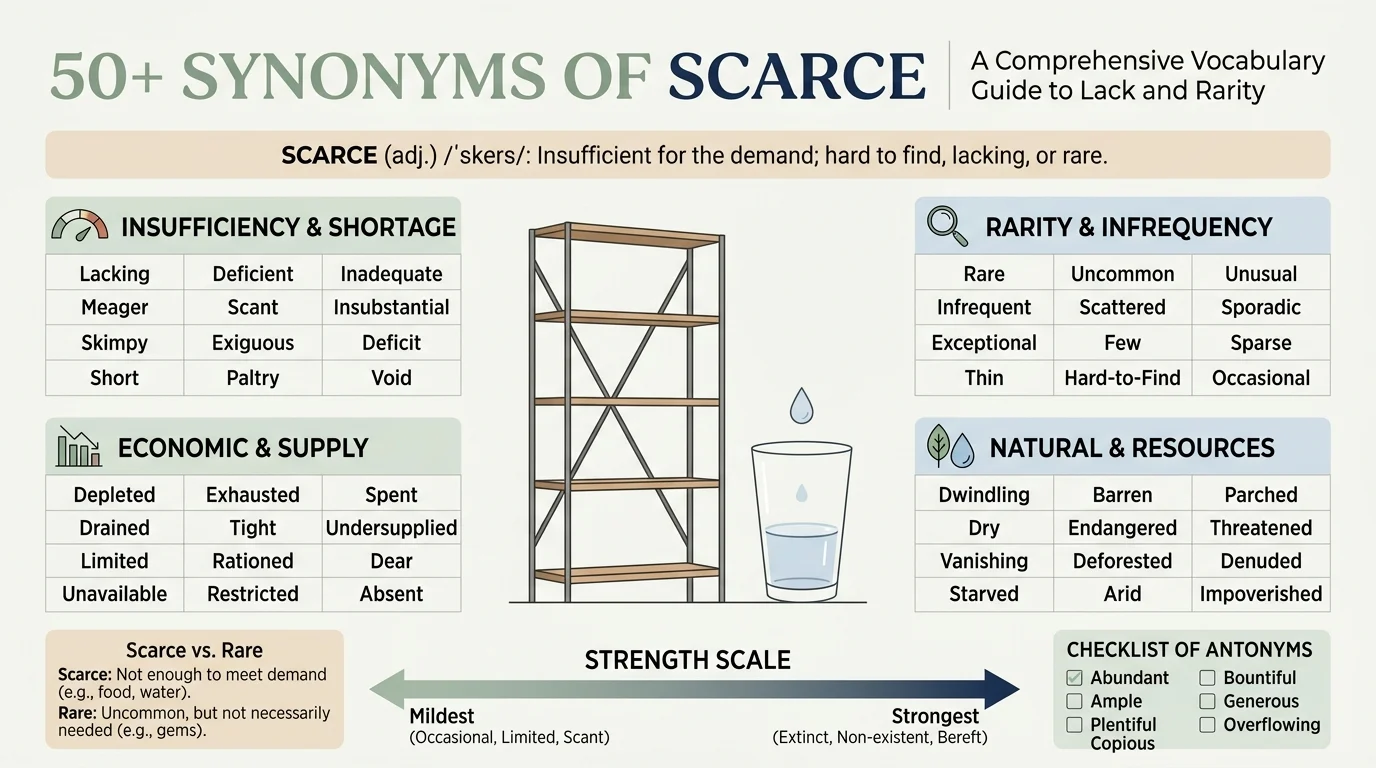
Have you ever needed to describe something that is hard to find, in short supply, or insufficient but felt that “rare” or “limited” was too simple? You want to capture the specific nature of the shortage, whether it is a lack of resources, a shortage of goods, or an infrequent occurrence, and the word “scarce” comes to mind. Choosing the right synonym for “scarce” can transform a basic statement into a precise expression of insufficiency, rarity, or scarcity. This guide explores the best synonyms of scarce, explaining exactly which word to use and when.
Quick Ans: “Scarce” means insufficient for the demand, hard to find, or not plentiful. For formal writing, choose insufficient or deficient. For economic contexts, use in short supply or limited. For rarity, use rare or uncommon. For casual conversation, use hard to find or not enough.
Meaning, Tone, and Context
Understanding the core meaning of “scarce” is the first step to using it effectively.
Simple Definition: Insufficient to meet a demand or requirement; hard to find; not abundant.
Part of Speech: Adjective.
Overall Tone: Negative to neutral. It indicates a lack or shortage.
Formality Level: Neutral to formal. The word is appropriate in economic, academic, and general contexts.
Common Uses: Native English speakers use it in economics (“scarce resources”), everyday life (“scarce supplies”), and general observations (“scarce opportunities”).
Word Forms: Related words include the noun scarcity, the adverb scarcely, and the noun scarceness.
When and How to Use “Scarce”
“Scarce” is the perfect choice when you want to describe a shortage or lack of something. Here are seven realistic examples.
Economic: “Clean water is becoming scarce in many regions.”
Academic: “The study examines the allocation of scarce resources.”
Professional: “Talent is scarce in this specialized field.”
Personal: “Jobs are scarce in this small town.”
Environmental: “Food became scarce after the drought.”
Historical: “During wartime, everyday goods were scarce.”
Social Media: “Good opportunities are scarce, so seize them when they appear.”
Best Synonyms of “Scarce”
No synonym is identical in every situation. Here is your guide to the best replacement for “scarce” based on your writing context.
For Insufficiency and Shortage
Most Formal: Insufficient means not enough. “The funding was insufficient for the project.”
Deficient: Deficient means lacking or inadequate. “The diet was deficient in vitamins.”
Inadequate: Inadequate means not enough or not good enough. “The supply was inadequate for the demand.”
Limited: Limited means restricted in amount. “We have limited resources.”
For Rarity and Infrequency
Rare: Rare means not occurring very often. “The bird is a rare sight.”
Uncommon: Uncommon means not happening often. “Such opportunities are uncommon.”
Sparse: Sparse means thinly distributed. “The vegetation is sparse in the desert.”
Infrequent: Infrequent means not occurring often. “His visits were infrequent.”
For Economic and Business Contexts
In short supply: In short supply means not available in sufficient quantities. “Housing is in short supply.”
Tight: Tight means limited in availability. “The job market is tight.”
Constrained: Constrained means restricted. “The budget is constrained.”
Dwindling: Dwindling means gradually decreasing. “The supplies are dwindling.”
For Scarcity in Nature
Depleted: Depleted means reduced in quantity. “The fish stocks are depleted.”
Exhausted: Exhausted means completely used up. “The soil is exhausted.”
Barren: Barren means unable to produce. “The barren land offered little.”
When Not to Use “Scarce”
Using “scarce” can sound wrong or awkward in certain situations.
When You Mean “Rare”: “Scarce” is about supply. “Rare” is about frequency.
Better Choice: Rare or uncommon. “The artifact is rare.”
When You Mean “Expensive”: “Scarce” is about availability. “Expensive” is about cost.
Better Choice: Expensive or costly. “The car is expensive.”
When It Sounds Too Formal: In casual conversation, “scarce” can sound academic.
Better Choice: Hard to find or not enough. “Jobs are hard to find.”
Words Commonly Confused With “Scarce”
| Word | Difference | When to Use | Example |
|---|---|---|---|
| Rare | Not occurring often | Frequency | “A rare bird.” |
| Limited | Restricted in amount | Supply and availability | “Limited resources.” |
| Insufficient | Not enough | Quantity and adequacy | “Insufficient funds.” |
| Sparse | Thinly distributed | Density and distribution | “Sparse vegetation.” |
| Deficient | Lacking | Nutrition and quality | “Deficient diet.” |
| Dwindling | Gradually decreasing | Supply and resources | “Dwindling supplies.” |
Best Synonyms of “Scarce” by Context
| Context | Best Synonym | Why It Works | Example |
|---|---|---|---|
| Formal writing | Insufficient | Formal and precise | “The evidence was insufficient.” |
| Academic writing | Deficient | Standard in research | “The sample was deficient.” |
| Economic | In short supply | Economic and clear | “Housing is in short supply.” |
| Professional | Limited | Business and general | “Limited opportunities.” |
| Environmental | Depleted | Environmental and serious | “Depleted resources.” |
| Casual | Hard to find | Simple and natural | “Parking is hard to find.” |
| Rarity | Rare | Frequency and uniqueness | “A rare occurrence.” |
How to Choose the Best Synonym of “Scarce”
Choosing the right word is a simple decision. Answer these questions.
What type of scarcity am I describing? For shortage, use insufficient or limited. And For rarity, use rare or uncommon. For economics, use in short supply or dwindling. For nature, use depleted or sparse.
What is my audience? For a formal report, use insufficient or deficient. For a friend, use hard to find or not enough.
What is my purpose? Are you describing a shortage, a rarity, or a depletion? The correct synonym depends entirely on this.
What is the emotional strength? Depleted and exhausted are stronger. Limited is milder. Pick the one that matches your message.
Real Life Examples of “Scarce”
School: Basic: “Books are scarce.” Improved: “Books are in short supply.”
College: Basic: “The resources are scarce.” Improved: “The resources are insufficient for the research.”
Workplace: Basic: “Talent is scarce.” Improved: “Qualified talent is rare in this field.”
Business: Basic: “Supplies are scarce.” Improved: “Supplies are dwindling rapidly.”
Email: Basic: “Time is scarce.” Improved: “Time is limited.”
Conversation: Basic: “Parking is scarce.” Improved: “Parking is hard to find.”
Storytelling: Basic: “Water was scarce.” Improved: “Water was depleted after the long drought.”
Top 10 Synonyms of “Scarce”
| Synonym | Simple Meaning | Best Used For | Example Sentence |
|---|---|---|---|
| Insufficient | Not enough | Formal and general | “The funds were insufficient.” |
| Limited | Restricted in amount | Business and general | “Limited resources.” |
| Rare | Not occurring often | Frequency and uniqueness | “A rare opportunity.” |
| Uncommon | Not happening often | General and formal | “Such events are uncommon.” |
| Deficient | Lacking or inadequate | Nutrition and quality | “A deficient diet.” |
| Sparse | Thinly distributed | Density and distribution | “Sparse rainfall.” |
| In short supply | Not available in sufficient quantities | Economic and business | “Housing is in short supply.” |
| Dwindling | Gradually decreasing | Supply and resources | “Dwindling reserves.” |
| Depleted | Reduced in quantity | Environmental and resources | “Depleted fish stocks.” |
| Inadequate | Not enough or not good enough | General and formal | “Inadequate preparation.” |
Synonyms of “Scarce” by Usage
Professional vs. Personal Synonyms
In the workplace, choose insufficient, limited, or in short supply. With friends, use hard to find, not enough, or rare.
Formal vs. Conversational Synonyms
For formal writing, use insufficient, deficient, or inadequate. For casual conversations, use hard to find, not enough, or rare.
Academic Synonyms
For research and essays, choose deficient for samples, insufficient for evidence, and sparse for data.
Professional and Business Synonyms
For maximum impact, choose in short supply for resources, limited for opportunities, and dwindling for reserves.
Creative and Literary Synonyms
To add emotion and imagery, choose barren, depleted, or sparse. These words create atmosphere.
Slang or Modern Synonyms
In modern American slang, hard to find, not enough, or slim pickings are common. For example, “Slim pickings for jobs.” These are casual and should be avoided in formal writing.
Strongest to Mildest Synonyms
Mild: limited, uncommon, infrequent
Moderate: scarce, insufficient, inadequate
Strong: deficient, sparse, dwindling
Very Strong: depleted, barren, exhausted
Emotional vs. Neutral Synonyms
Emotional Synonyms: Depleted, barren, dwindling. These words hint at loss and desperation. Use them when you want to evoke feeling.
Neutral Synonyms: Scarce, limited, insufficient. These words communicate factual information.
Antonyms of “Scarce”
| Antonym | Meaning | Example Sentence |
|---|---|---|
| Abundant | Existing in large quantities | “The harvest was abundant.” |
| Plentiful | Existing in large amounts | “The supplies were plentiful.” |
| Ample | Enough or more than enough | “We have ample time.” |
| Copious | Abundant in supply | “She took copious notes.” |
| Profuse | Plentiful and abundant | “The flowers were profuse.” |
| Bountiful | Large in quantity | “The bountiful harvest fed the village.” |
| Plenteous | Plentiful | “The plenteous rainfall helped crops.” |
| Rife | Widespread and abundant | “The area is rife with opportunities.” |
| Teeming | Full of things | “The sea is teeming with life.” |
| Swarming | Crowded with | “The market was swarming with people.” |
| Overflowing | Full to excess | “The bin was overflowing.” |
| Excessive | More than necessary | “The excessive supply drove prices down.” |
| Surplus | More than needed | “The surplus was stored.” |
| Replete | Well supplied | “The report is replete with details.” |
| Lavish | Extravagant and abundant | “The lavish feast impressed everyone.” |
Comparison: “Scarce” vs Similar Words
Scarce vs. Rare
Main Difference: “Scarce” is about supply and demand. “Rare” is about frequency.
Which Is Stronger? “Rare” is stronger for uniqueness.
Which Is More Formal? Both are formal.
When to Use Each: Use “scarce” for resources. Use “rare” for events.
Examples:
Scarce: “Water is scarce in the desert.”
Rare: “The bird is a rare sight.”
Scarce vs. Limited
Main Difference: “Limited” is restricted. “Scarce” is insufficient.
Which Is Stronger? “Scarce” is stronger for shortage.
Which Is More Formal? Both are formal.
When to Use Each: Use “limited” for restricted availability. Use “scarce” for insufficient supply.
Examples:
Scarce: “Jobs are scarce.”
Limited: “Seats are limited.”
Scarce vs. Insufficient
Main Difference: “Insufficient” is not enough. “Scarce” is hard to find.
Which Is Stronger? “Insufficient” is more specific to quantity.
Which Is More Formal? Both are formal.
When to Use Each: Use “insufficient” for amounts. Use “scarce” for availability.
Examples:
Scarce: “Resources are scarce.”
Insufficient: “The funds are insufficient.”
Scarce vs. Sparse
Main Difference: “Sparse” is thinly distributed. “Scarce” is insufficient.
Which Is Stronger? “Sparse” is more specific to distribution.
Which Is More Formal? Both are formal.
When to Use Each: Use “sparse” for vegetation and data. Use “scarce” for resources.
Examples:
Scarce: “Food is scarce.”
Sparse: “The vegetation is sparse.”
Scarce vs. Deficient
Main Difference: “Deficient” is lacking in quality or quantity. “Scarce” is hard to find.
Which Is Stronger? “Deficient” is more specific to lack.
Which Is More Formal? Both are formal.
When to Use Each: Use “deficient” for nutrition. Use “scarce” for resources.
Examples:
Scarce: “Supplies are scarce.”
Deficient: “The diet is deficient.”
Scarce vs. Dwindling
Main Difference: “Dwindling” is gradually decreasing. “Scarce” is insufficient now.
Which Is Stronger? “Dwindling” is more dynamic.
Which Is More Formal? Both are formal.
When to Use Each: Use “dwindling” for ongoing reduction. Use “scarce” for current shortage.
Examples:
Scarce: “Supplies are scarce.”
Dwindling: “Supplies are dwindling.”
Common Phrases and Expressions with “Scarce”
Phrase: Scarce resources
Meaning: Limited available resources.
Example Sentence: “We must allocate scarce resources wisely.”
Phrase: Scarce supply
Meaning: Not enough available.
Example Sentence: “The scarce supply drove prices up.”
Phrase: Scarce commodity
Meaning: Something hard to find.
Example Sentence: “Trust is a scarce commodity.”
Phrase: Make oneself scarce
Meaning: Leave or stay away.
Example Sentence: “He made himself scarce when the work began.”
Phrase: Scarce as hen’s teeth
Meaning: Extremely rare.
Example Sentence: “Parking is as scarce as hen’s teeth.”
Common Mistakes to Avoid
Mistake 1: Using “scarce” when you mean “rare”.
Incorrect: “The bird is scarce.”
Better: “The bird is rare.”
Why: “Rare” is for frequency.
Mistake 2: Using “scarce” when you mean “expensive”.
Incorrect: “The car is scarce.”
Better: “The car is expensive.”
Why: “Expensive” is for cost.
Mistake 3: Overusing “scarce” in conversation.
Incorrect: “Parking is scarce.”
Better: “Parking is hard to find.”
Why: “Hard to find” sounds more natural.
Mistake 4: Using “scarce” when you mean “limited”.
Incorrect: “Seats are scarce.”
Better: “Seats are limited.”
Why: “Limited” is for restricted availability.
Mistake 5: Using “scarce” when you mean “deficient”.
Incorrect: “The diet is scarce.”
Better: “The diet is deficient.”
Why: “Deficient” is for nutrition.
Frequently Asked Questions
1. What are the best synonyms of “scarce”?
The best synonyms depend on your context. For shortage, choose insufficient or limited. And For rarity, use rare or uncommon. For economics, use in short supply or dwindling.
2. What are the best formal synonyms of “scarce”?
The best formal synonyms are insufficient, deficient, and inadequate. These words are suitable for academic papers, professional reports, and business communications.
3. What are common informal synonyms of “scarce”?
For informal settings, use hard to find, not enough, or rare. These alternatives sound more natural in everyday conversation.
4. What is another word for “scarce” in professional writing?
In professional writing, limited is an excellent choice. It conveys restricted availability. In short supply is also strong for resources.
5. What is the difference between “scarce” and “rare”?
“Scarce” is about supply and demand. “Rare” is about frequency. Use “scarce” for resources and “rare” for events.
6. What is the opposite of “scarce”?
The most direct opposites (antonyms) of scarce are abundant, plentiful, and ample. These words describe things that are available in large quantities.
Conclusion
“Scarce” is a useful and precise word for describing shortages, rarity, and insufficiency. The term is neutral and widely accepted in economic, academic, and general contexts, yet it can sound too formal for casual conversation or too broad for specific descriptions. The best choice among the synonyms of scarce depends entirely on your audience, tone, and purpose. Remember, no single synonym works perfectly in every situation. Your goal is to choose the word that communicates your message with the most clarity and impact. A practical tip for your vocabulary growth is to pay attention to how writers describe shortages and rarity and practice using different synonyms in your writing.










2 thoughts on “50+ Synonyms of Scarce: Meanings, Uses, Examples, and Best Alternatives 2026”