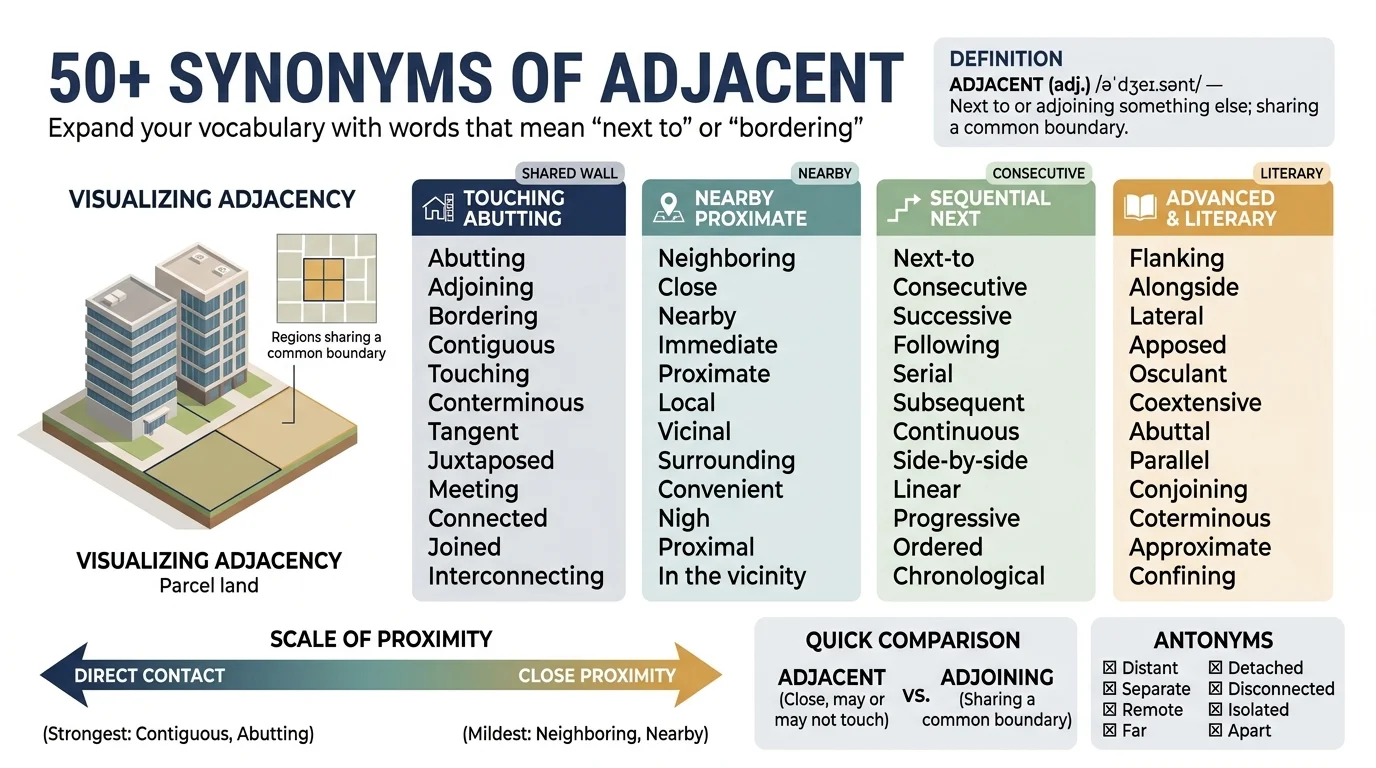
Have you ever needed to describe something that is next to or near something else but felt that “next to” or “close” was too simple? You want to capture the precise spatial relationship, whether it is touching, nearby, or side by side, and the word “adjacent” comes to mind. Choosing the right synonym for “adjacent” can transform a basic description into a precise expression of proximity, position, or connection. This guide explores the best synonyms of adjacent, explaining exactly which word to use and when.
Quick Ans: “Adjacent” means next to or adjoining something else, or nearby. For physical proximity, choose adjoining, neighboring, or bordering. For general nearness, use nearby, close, or proximate. For touching or sharing a boundary, use contiguous, abutting, or touching. For sequential order, use consecutive or successive.
Meaning, Tone, and Context
Understanding the core meaning of “adjacent” is the first step to using it effectively.
Simple Definition: Next to or adjoining something else; having a common boundary or edge; nearby.
Part of Speech: Adjective.
Overall Tone: Neutral. It is a descriptive and technical word.
Formality Level: Neutral to formal. The word is appropriate in technical, academic, and general contexts.
Common Uses: Native English speakers use it in real estate (“adjacent property”), geography (“adjacent countries”), mathematics (“adjacent angles”), and general descriptions (“adjacent rooms”).
Word Forms: Related words include the noun adjacency and the adverb adjacently.
When and How to Use “Adjacent”
“Adjacent” is the perfect choice when you want to describe something next to or near something else. Here are seven realistic examples.
Real Estate: “The adjacent property was sold last week.”
Geography: “The two adjacent countries share a long border.”
Architecture: “The adjacent rooms are connected by a door.”
Mathematics: “Adjacent angles share a common side.”
Business: “The adjacent market offers new opportunities.”
Academic: “The study examined the effects on adjacent ecosystems.”
Social Media: “We sat in adjacent seats at the concert.”
Best Synonyms of “Adjacent”
No synonym is identical in every situation. Here is your guide to the best replacement for “adjacent” based on your writing context.
For Touching or Sharing a Boundary
Most Direct: Adjoining means next to and connected. “The adjoining room was occupied.”
Bordering: Bordering means sharing a boundary. “The bordering states have similar laws.”
Abutting: Abutting means touching along a boundary. “The abutting properties were combined.”
Contiguous: Contiguous means sharing a boundary or touching. “The contiguous states form a single landmass.”
For Nearby or Close
Neighboring: Neighboring means nearby or adjacent. “The neighboring town is quiet.”
Nearby: Nearby means close in distance. “The nearby park is beautiful.”
Close: Close means near in space or time. “The close proximity was convenient.”
Proximate: Proximate means very near. “The proximate cause was identified.”
For Sequential or Consecutive
Consecutive: Consecutive means following in order. “The consecutive pages were missing.”
Successive: Successive means following one after another. “The successive waves crashed on the shore.”
Following: Following means coming after. “The following chapter is important.”
Sequential: Sequential means in a logical order. “The sequential steps were clear.”
For General Proximity
Next to: Next to is the most common phrase. “She sat next to me.”
Beside: Beside means at the side of. “The lamp is beside the bed.”
Alongside: Alongside means side by side. “The boat docked alongside the pier.”
Cheek by jowl: Cheek by jowl means close together. “The houses were cheek by jowl.”
When Not to Use “Adjacent”
Using “adjacent” can sound wrong or awkward in certain situations.
When You Mean “Near”: “Adjacent” implies touching or very close. “Near” is broader.
Better Choice: Near or nearby. “The store is near my house.”
When You Mean “Similar”: “Adjacent” is spatial. “Similar” is about resemblance.
Better Choice: Similar or related. “The topics are related.”
When It Sounds Too Technical: In casual conversation, “adjacent” can sound formal.
Better Choice: Next to or beside. “The bank is next to the post office.”
Words Commonly Confused With “Adjacent”
| Word | Difference | When to Use | Example |
|---|---|---|---|
| Adjoining | Next to and connected | Rooms and buildings | “The adjoining room.” |
| Neighboring | Nearby | Towns and properties | “The neighboring town.” |
| Bordering | Sharing a boundary | Countries and regions | “The bordering state.” |
| Nearby | Close in distance | General proximity | “The nearby store.” |
| Contiguous | Sharing a boundary | Formal and technical | “The contiguous states.” |
| Beside | At the side of | General and casual | “Beside the bed.” |
Best Synonyms of “Adjacent” by Context
| Context | Best Synonym | Why It Works | Example |
|---|---|---|---|
| Formal writing | Contiguous | Formal and precise | “The contiguous territories.” |
| Academic writing | Proximate | Standard in research | “The proximate factors.” |
| Professional | Adjoining | Professional and clear | “The adjoining office.” |
| Business | Neighboring | Business and markets | “The neighboring market.” |
| Geography | Bordering | Specific to boundaries | “The bordering countries.” |
| Casual conversation | Next to | Simple and natural | “Next to the bank.” |
| Technical | Abutting | Technical and precise | “The abutting properties.” |
How to Choose the Best Synonym of “Adjacent”
Choosing the right word is a simple decision. Answer these questions.
What type of adjacency am I describing? For touching, use adjoining or contiguous. And For nearby, use neighboring or nearby. For sequential, use consecutive or successive. For general, use next to or beside.
What is my audience? For a formal report, use contiguous or proximate. For a friend, use next to or beside.
What is my purpose? Are you describing physical position, sequence, or proximity? The correct synonym depends entirely on this.
What is the emotional strength? Cheek by jowl is vivid. Nearby is neutral. Pick the one that matches your message.
Real Life Examples of “Adjacent”
School: Basic: “The adjacent classroom is empty.” Improved: “The adjoining classroom is empty.”
College: Basic: “The adjacent buildings are connected.” Improved: “The contiguous buildings are connected.”
Workplace: Basic: “The adjacent office is mine.” Improved: “The neighboring office is mine.”
Business: Basic: “The adjacent market is growing.” Improved: “The neighboring market is growing.”
Email: Basic: “The adjacent file is attached.” Improved: “The following file is attached.”
Conversation: Basic: “The adjacent house is for sale.” Improved: “The house next to mine is for sale.”
Storytelling: Basic: “The adjacent rooms were quiet.” Improved: “The adjoining rooms were quiet.”
Top 10 Synonyms of “Adjacent”
| Synonym | Simple Meaning | Best Used For | Example Sentence |
|---|---|---|---|
| Adjoining | Next to and connected | Rooms and buildings | “The adjoining room.” |
| Neighboring | Nearby | Towns and properties | “The neighboring town.” |
| Bordering | Sharing a boundary | Countries and regions | “The bordering state.” |
| Contiguous | Sharing a boundary | Formal and technical | “The contiguous states.” |
| Abutting | Touching along a boundary | Technical and legal | “The abutting properties.” |
| Nearby | Close in distance | General proximity | “The nearby store.” |
| Proximate | Very near | Formal and academic | “The proximate cause.” |
| Beside | At the side of | General and casual | “Beside the bed.” |
| Next to | Adjacent to | Casual and general | “Next to the bank.” |
| Consecutive | Following in order | Sequential contexts | “The consecutive pages.” |
Synonyms of “Adjacent” by Usage
Professional vs. Personal Synonyms
In the workplace, choose adjoining, neighboring, or contiguous. With friends, use next to, beside, or nearby.
Formal vs. Conversational Synonyms
For formal writing, use contiguous, proximate, or abutting. For casual conversations, use next to, beside, or nearby.
Academic Synonyms
For research and essays, choose proximate for causes, contiguous for boundaries, and adjacent for general contexts.
Professional and Business Synonyms
For maximum impact, choose neighboring for markets, adjoining for offices, and contiguous for properties.
Creative and Literary Synonyms
To add emotion and imagery, choose cheek by jowl, abutting, or bordering. These words create atmosphere.
Slang or Modern Synonyms
In modern American slang, next to, beside, or right there are common. For example, “It is right there.” These are casual and should be avoided in formal writing.
Strongest to Mildest Synonyms
Mild: nearby, close, near
Moderate: adjacent, neighboring, beside
Strong: adjoining, bordering, abutting
Very Strong: contiguous, proximate, cheek by jowl
Emotional vs. Neutral Synonyms
Emotional Synonyms: Cheek by jowl, abutting. These words hint at closeness and density. Use them when you want to evoke feeling.
Neutral Synonyms: Adjacent, nearby, next to. These words communicate factual information.
Antonyms of “Adjacent”
| Antonym | Meaning | Example Sentence |
|---|---|---|
| Distant | Far away | “The distant mountains.” |
| Remote | Far removed | “The remote village.” |
| Separated | Kept apart | “The separated properties.” |
| Detached | Not connected | “The detached house.” |
| Isolated | Far from others | “The isolated cabin.” |
| Apart | Separated by distance | “The two towns are miles apart.” |
| Far | At a great distance | “The far shore.” |
| Nonadjacent | Not next to | “The nonadjacent rooms.” |
| Disconnected | Not linked | “The disconnected buildings.” |
| Disparate | Distinctly separate | “The disparate elements.” |
| Separate | Apart | “The separate entrances.” |
| Distant | Far away | “The distant relative.” |
| Removed | Far apart | “The removed location.” |
| Far-off | Distant | “The far-off land.” |
| Secluded | Private and isolated | “The secluded estate.” |
Comparison: “Adjacent” vs Similar Words
Adjacent vs. Adjoining
Main Difference: “Adjoining” implies connected. “Adjacent” implies next to but not necessarily connected.
Which Is Stronger? “Adjoining” is stronger for connection.
Which Is More Formal? Both are formal.
When to Use Each: Use “adjoining” for connected rooms. Use “adjacent” for general proximity.
Examples:
Adjacent: “The adjacent building.”
Adjoining: “The adjoining room.”
Adjacent vs. Neighboring
Main Difference: “Neighboring” is nearby. “Adjacent” is next to.
Which Is Stronger? “Adjacent” is stronger for closeness.
Which Is More Formal? Both are formal.
When to Use Each: Use “neighboring” for towns. Use “adjacent” for properties.
Examples:
Adjacent: “The adjacent property.”
Neighboring: “The neighboring town.”
Adjacent vs. Bordering
Main Difference: “Bordering” shares a boundary. “Adjacent” is broader.
Which Is Stronger? “Bordering” is more specific to boundaries.
Which Is More Formal? Both are formal.
When to Use Each: Use “bordering” for countries. Use “adjacent” for general contexts.
Examples:
Adjacent: “The adjacent states.”
Bordering: “The bordering countries.”
Adjacent vs. Contiguous
Main Difference: “Contiguous” is formal and technical. “Adjacent” is broader.
Which Is Stronger? “Contiguous” is stronger for touching.
Which Is More Formal? “Contiguous” is more formal.
When to Use Each: Use “contiguous” in technical writing. Use “adjacent” in general contexts.
Examples:
Adjacent: “The adjacent rooms.”
Contiguous: “The contiguous states.”
Adjacent vs. Nearby
Main Difference: “Nearby” is close. “Adjacent” is next to.
Which Is Stronger? “Adjacent” is stronger for closeness.
Which Is More Formal? Both are neutral.
When to Use Each: Use “nearby” for general proximity. Use “adjacent” for immediate proximity.
Examples:
Adjacent: “The adjacent house.”
Nearby: “The nearby store.”
Adjacent vs. Next to
Main Difference: “Next to” is casual. “Adjacent” is formal.
Which Is Stronger? They are similar.
Which Is More Formal? “Adjacent” is more formal.
When to Use Each: Use “next to” in casual conversation. Use “adjacent” in formal writing.
Examples:
Adjacent: “The adjacent seat.”
Next to: “The seat next to me.”
Common Phrases and Expressions with “Adjacent”
Phrase: Adjacent to
Meaning: Next to.
Example Sentence: “The hotel is adjacent to the beach.”
Phrase: Adjacent room
Meaning: A room next door.
Example Sentence: “The adjacent room was quiet.”
Phrase: Adjacent property
Meaning: A property next door.
Example Sentence: “The adjacent property was sold.”
Phrase: Adjacent angle
Meaning: An angle next to another.
Example Sentence: “Adjacent angles share a side.”
Phrase: Adjacent market
Meaning: A nearby market.
Example Sentence: “The adjacent market offers opportunities.”
Common Mistakes to Avoid
Mistake 1: Using “adjacent” when you mean “near”.
Incorrect: “The adjacent city is far away.”
Better: “The nearby city is close.”
Why: “Adjacent” implies next to.
Mistake 2: Using “adjacent” when you mean “similar”.
Incorrect: “The adjacent topics are related.”
Better: “The similar topics are related.”
Why: “Adjacent” is spatial.
Mistake 3: Overusing “adjacent” in conversation.
Incorrect: “The adjacent house is for sale.”
Better: “The house next to mine is for sale.”
Why: “Next to” sounds more natural.
Mistake 4: Using “adjacent” when you mean “adjoining”.
Incorrect: “The adjacent rooms are connected.”
Better: “The adjoining rooms are connected.”
Why: “Adjoining” implies connection.
Mistake 5: Using “adjacent” when you mean “bordering”.
Incorrect: “The adjacent countries share a border.”
Better: “The bordering countries share a border.”
Why: “Bordering” is for boundaries.
Frequently Asked Questions
1. What are the best synonyms of “adjacent”?
The best synonyms depend on your context. For touching, choose adjoining or contiguous. And For nearby, use neighboring or nearby. For sequential, use consecutive or successive. For general, use next to or beside.
2. What are the best formal synonyms of “adjacent”?
The best formal synonyms are contiguous, proximate, and abutting. These words are suitable for academic papers, professional reports, and technical communications.
3. What are common informal synonyms of “adjacent”?
For informal settings, use next to, beside, or nearby. These alternatives sound more natural in everyday conversation.
4. What is another word for “adjacent” in professional writing?
In professional writing, adjoining is an excellent choice. It conveys connection. Neighboring is also strong for markets.
5. What is the difference between “adjacent” and “adjoining”?
“Adjacent” means next to. “Adjoining” means next to and connected. Use “adjoining” for connected rooms.
6. What is the opposite of “adjacent”?
The most direct opposites (antonyms) of adjacent are distant, remote, and separated. These words describe things that are far apart.
Conclusion
“Adjacent” is a precise and versatile word for describing proximity, position, and connection. The term is neutral and widely accepted in technical, academic, and general contexts, yet it can sound too formal for casual conversation or too specific for general proximity. The best choice among the synonyms of adjacent depends entirely on your audience, tone, and purpose. Remember, no single synonym works perfectly in every situation. Your goal is to choose the word that communicates your message with the most clarity and impact. A practical tip for your vocabulary growth is to pay attention to how writers describe position and proximity and practice using different synonyms in your writing.










1 thought on “50+ Synonyms of Adjacent: Meanings, Uses, Examples, and Best Alternatives 2026”