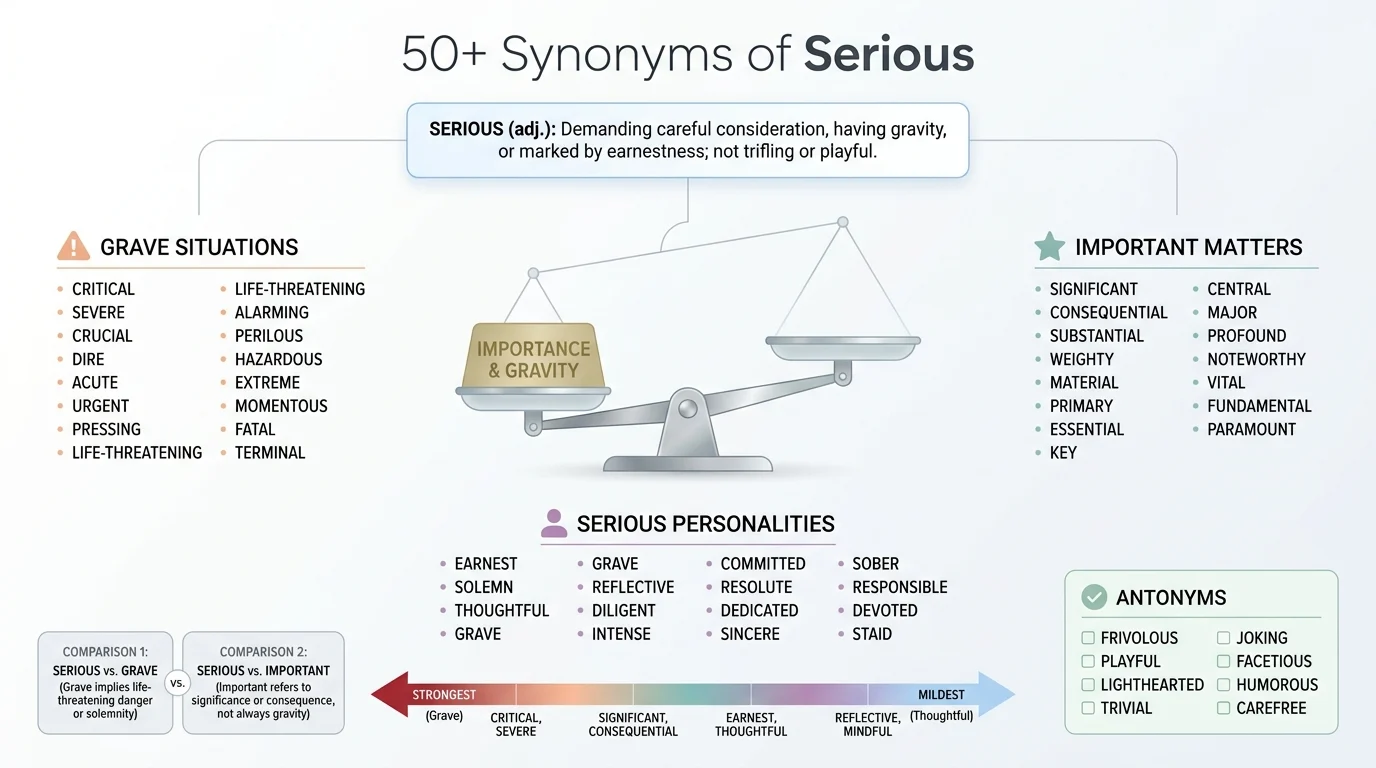
Have you ever needed to describe something as important, grave, or not joking but felt that “serious” was too general or overused? You want to capture the specific weight of the situation, whether it is a stern expression, a critical decision, or a severe problem, and the word “serious” comes to mind. Choosing the right synonym for “serious” can transform a simple description into a precise characterization of gravity, importance, or earnestness. This guide explores the best synonyms of serious, explaining exactly which word to use and when.
Quick Ans: “Serious” means thoughtful, solemn, important, or requiring careful consideration. For formal writing, choose grave or solemn. For describing importance, use significant or consequential. For describing someone’s demeanor, use earnest or somber. For severe situations, use critical or dire.
Meaning, Tone, and Context
Understanding the core meaning of “serious” is the first step to using it effectively.
Simple Definition: Thoughtful, solemn, not joking; of great importance, requiring careful consideration.
Part of Speech: Adjective.
Overall Tone: Neutral to negative. It can indicate importance, gravity, or a lack of humor.
Formality Level: Neutral. The word is appropriate in most contexts, though more formal alternatives exist.
Common Uses: Native English speakers use it to describe people (“a serious person”), situations (“a serious problem”), and importance (“a serious matter”).
Word Forms: Related words include the noun seriousness, the adverb seriously, and the verb serious (rare).
When and How to Use “Serious”
“Serious” is the perfect choice when you want to emphasize importance, gravity, or a lack of frivolity. Here are seven realistic examples.
Professional: “We need to discuss the serious implications of this decision.”
Academic: “The study addresses a serious gap in the current literature.”
Workplace: “His serious demeanor commands respect from his colleagues.”
Personal: “This is a serious matter that requires immediate attention.”
Email: “I must raise a serious concern about the project timeline.”
Resume: “Demonstrated serious commitment to professional development.”
Social Media: “On a serious note, we must address this issue together.”
Best Synonyms of “Serious”
No synonym is identical in every situation. Here is your guide to the best replacement for “serious” based on your writing context.
For Grave or Severe Situations
Strongest: Grave implies great weight, severity, and often danger. “The patient is in grave condition.”
Severe: Severe means very bad or intense. “The storm caused severe damage.”
Critical: Critical implies a decisive turning point, often dangerous. “We are at a critical juncture.”
Dire: Dire suggests urgent, desperate, and dangerous. “The country faces dire economic consequences.”
Desperate: Desperate implies extreme urgency due to hopelessness. “The desperate situation required immediate action.”
Solemn: Solemn implies deep seriousness and often formality. “The judge gave a solemn warning.”
For Important Matters
Important: Important is a direct synonym for great significance. “This is an important decision.”
Significant: Significant implies meaningful and notable. “The results are significant.”
Consequential: Consequential means having important consequences. “It is a consequential choice.”
Weighty: Weighty implies heavy importance. “The board faces a weighty decision.”
Momentous: Momentous implies very significant and historic. “The momentous occasion was celebrated.”
Crucial: Crucial means decisive and critical. “This is a crucial step.”
For Earnest or Thoughtful People
Earnest: Earnest implies sincere and intense conviction. “He was an earnest young man.”
Solemn: Solemn implies formal and serious. “The solemn ceremony was moving.”
Somber: Somber implies dark or gloomy seriousness. “Her somber expression revealed her grief.”
Sedate: Sedate implies calm and composed seriousness. “He maintained a sedate demeanor.”
Staid: Staid implies settled and serious in character. “Her staid approach was respected.”
When Not to Use “Serious”
Using “serious” can sound wrong or awkward in certain situations.
When It Sounds Too General: “Serious” can be vague for specific situations.
Better Choice: Critical or severe. “This is a critical issue.”
When You Mean “Stern”: “Serious” is about demeanor, but stern is about strictness.
Better Choice: Stern. “The stern teacher silenced the class.”
When It Sounds Too Formal: In casual conversation, “serious” can sound overly formal.
Better Choice: No joke. “This is no joke.”
Words Commonly Confused With “Serious”
Several words are often mixed up with “serious.” Here is how to keep them straight.
Word: Solemn
Difference: Implies deep seriousness, often religious. “Serious” is broader.
When to Use: Use it for ceremonies and vows.
Example: “The solemn ceremony moved everyone.”
Word: Earnest
Difference: Implies sincere intensity. “Serious” can be neutral.
When to Use: Use this for sincere people.
Example: “He made an earnest plea for forgiveness.”
Word: Grave
Difference: Implies potential danger. “Serious” can be about importance.
When to Use: Use this for severe situations.
Example: “The patient is in grave condition.”
Word: Severe
Difference: Implies harshness. “Serious” is about weight.
When to Use: Use this for intensity.
Example: “The storm caused severe damage.”
Word: Somber
Difference: Implies gloom. “Serious” can be neutral.
When to Use: Use this for sad or dark situations.
Example: “Her somber expression revealed her grief.”
Word: Critical
Difference: Implies a decisive turning point. “Serious” can be about importance.
When to Use: Use this for emergencies.
Example: “We are at a critical stage.”
Best Synonyms of “Serious” by Context
| Context | Best Synonym | Why It Works | Example |
|---|---|---|---|
| Grave situation | Grave | Implies danger and severity. | “The patient is in grave condition.” |
| Severe problem | Severe | Implies intense and harmful. | “The storm caused severe damage.” |
| Important decision | Significant | Implies meaning and impact. | “This is a significant decision.” |
| Earnest person | Earnest | Implies sincerity and conviction. | “He was an earnest young man.” |
| Formal occasion | Solemn | Implies deep seriousness. | “The solemn ceremony was moving.” |
| Gloomy mood | Somber | Implies darkness and gloom. | “Her somber expression was telling.” |
| Urgent matter | Critical | Implies decisiveness. | “We are at a critical juncture.” |
| Heavy importance | Weighty | Implies heavy significance. | “The board faced a weighty decision.” |
How to Choose the Best Synonym of “Serious”
Choosing the right word is a simple decision. Answer these questions.
What type of seriousness am I describing? For danger, use grave or dire. And for importance, use significant or consequential. For personality, use earnest or solemn. For gloom, use somber.
What is my audience? For a formal report, use grave or significant. For a friend, use no joke or important.
What is my purpose? Are you trying to warn, describe, or emphasize? The correct synonym depends entirely on this.
What is the emotional strength? Grave and dire are stronger. Important and significant are milder. Pick the one that matches your message.
Real Life Examples of “Serious”
To truly master the word, it helps to see how it behaves in the wild and how a stronger synonym can elevate the sentence.
School: Basic: “The student is serious about studying.” Improved: “The student is earnest about her academic pursuits.”
College: Basic: “This is a serious theory.” Improved: “This is a significant theory in the field.”
Workplace: Basic: “The serious report was submitted.” Improved: “The weighty report was submitted to the board.”
Business: Basic: “The serious decision was made.” Improved: “The momentous decision was made.”
Medical: Basic: “His condition is serious.” Improved: “His condition is critical.”
Conversation: Basic: “We need to have a serious talk.” Improved: “We need to have a grave discussion.”
Storytelling: Basic: “The knight’s expression was serious.” Improved: “The knight’s expression was somber.”
Top 10 Synonyms of “Serious”
| Synonym | Simple Meaning | Best Used For | Example Sentence |
|---|---|---|---|
| Grave | Very serious and worrying | Medical, legal, and emergency contexts | “The patient is in grave condition.” |
| Severe | Very bad or intense | Damage, weather, and medical contexts | “The storm caused severe damage.” |
| Significant | Important and meaningful | Academic and professional contexts | “The results are significant.” |
| Earnest | Sincere and intense | Personality and convictions | “He was an earnest young man.” |
| Solemn | Formal and dignified | Ceremonies and promises | “The solemn ceremony was moving.” |
| Somber | Gloomy and serious | Moods and expressions | “Her somber expression revealed her grief.” |
| Critical | Decisive and dangerous | Emergencies and turning points | “We are at a critical juncture.” |
| Weighty | Heavy and important | Decisions and responsibilities | “The board faced a weighty decision.” |
| Consequential | Having important outcomes | Consequences and outcomes | “The decision was consequential.” |
| Momentous | Very important and historic | Events and achievements | “The momentous occasion was celebrated.” |
Synonyms of “Serious” by Usage
Professional vs. Personal Synonyms
In the workplace (professional), choose grave, significant, or weighty to describe situations and decisions. These words convey professionalism. “The significant outcome” is more precise than “The serious outcome.”
With friends (personal), no joke, important, or a big deal keep the tone relaxed and relatable.
Formal vs. Conversational Synonyms
For formal writing (reports, essays, professional emails), use grave, solemn, or momentous. For casual conversations and texting, use no joke, a big deal, or important. These options sound more natural.
Academic Synonyms
For research and essays, choose precise, authoritative words. Significant is great for results, consequential for outcomes, and momentous for historic achievements.
Professional and Business Synonyms
For maximum impact in business writing, choose critical for reviews, significant for results, and weighty for responsibilities. These words demonstrate professional awareness.
Creative and Literary Synonyms
To add emotion and imagery to your writing, choose somber, solemn, or grave. These words create atmosphere and reveal character.
Slang and Colloquial Synonyms
In modern American slang, no joke, heavy, or deep are commonly used. For example, “That is a heavy conversation,” or “This is no joke.” These are acceptable in casual contexts but should be avoided in professional or academic writing.
Strongest to Mildest Synonyms
Mild: important, significant, notable
Moderate: serious, earnest, solemn
Strong: grave, severe, critical
Very Strong: dire, desperate, momentous
Emotional vs. Neutral Synonyms
Emotional Synonyms: Somber, grave, dire. These words often hint at sadness, fear, or urgency. Use them when you want to evoke feeling.
Neutral Synonyms: Important, significant, earnest. These words simply communicate factual information. Use them when you want to inform without emotional coloring.
Antonyms of “Serious”
Here are 15 genuine opposites of “serious.”
| Antonym | Meaning | Example Sentence |
|---|---|---|
| Trivial | Of little importance | “The trivial matter was quickly resolved.” |
| Frivolous | Not serious | “His frivolous attitude was annoying.” |
| Joking | Making jokes | “He was joking when he said that.” |
| Humorous | Funny and amusing | “The humorous speech lightened the mood.” |
| Light-hearted | Cheerful and carefree | “The light-hearted conversation was refreshing.” |
| Playful | Full of fun | “Her playful behavior was endearing.” |
| Casual | Relaxed and informal | “The casual meeting was productive.” |
| Trivial | Unimportant | “The trivial details were ignored.” |
| Inconsequential | Not important | “The inconsequential decision was made quickly.” |
| Minor | Lesser in importance | “The minor issue was resolved.” |
| Silly | Lacking serious thought | “His silly behavior was childish.” |
| Comical | Funny and amusing | “The comical expression made everyone laugh.” |
| Facetious | Treating serious issues with humor | “His facetious comment was inappropriate.” |
| Giddy | Light-headed and silly | “Her giddy laughter was contagious.” |
| Flippant | Disrespectfully casual | “His flippant remark was offensive.” |
Comparison: “Serious” vs Similar Words
Serious vs. Grave
Main Difference: “Grave” implies severe danger. “Serious” can be about importance.
Which Is Stronger? “Grave” is stronger and more alarming.
Which Is More Formal? Both are formal.
When to Use Each: Use “grave” for emergencies. Use “serious” for general situations.
Examples:
Serious: “This is a serious matter.”
Grave: “The patient is in grave condition.”
Serious vs. Solemn
Main Difference: “Solemn” implies formality and dignity. “Serious” is broader.
Which Is Stronger? “Solemn” is more dignified.
Which Is More Formal? “Solemn” is more formal.
When to Use Each: Use “solemn” for ceremonies. Use “serious” for general seriousness.
Examples:
Serious: “He has a serious demeanor.”
Solemn: “The solemn ceremony was moving.”
Serious vs. Earnest
Main Difference: “Earnest” implies sincere conviction. “Serious” can be neutral.
Which Is Stronger? “Earnest” is stronger for sincerity.
Which Is More Formal? Both are formal.
When to Use Each: Use “earnest” for sincere people. Use “serious” for situations.
Examples:
Serious: “This is a serious problem.”
Earnest: “He made an earnest plea.”
Serious vs. Significant
Main Difference: “Significant” implies meaning and impact. “Serious” can be about danger.
Which Is Stronger? “Significant” is more positive. “Serious” can be negative.
Which Is More Formal? Both are formal.
When to Use Each: Use “significant” for results. Use “serious” for problems.
Examples:
Serious: “The serious injury required surgery.”
Significant: “The results were significant.”
Serious vs. Severe
Main Difference: “Severe” implies harsh intensity. “Serious” implies importance.
Which Is Stronger? “Severe” is stronger for harshness.
Which Is More Formal? Both are formal.
When to Use Each: Use “severe” for weather and pain. Use “serious” for problems.
Examples:
Serious: “This is a serious issue.”
Severe: “The storm caused severe damage.”
Serious vs. Critical
Main Difference: “Critical” implies a decisive turning point. “Serious” is about importance.
Which Is Stronger? “Critical” is stronger for urgency.
Which Is More Formal? Both are formal.
When to Use Each: Use “critical” for emergencies. Use “serious” for general situations.
Examples:
Serious: “We need a serious discussion.”
Critical: “We are at a critical juncture.”
Common Phrases and Expressions with “Serious”
Phrase: Serious matter
Meaning: An important or grave issue.
Example Sentence: “This is a serious matter that requires immediate attention.”
Phrase: Serious injury
Meaning: A severe physical harm.
Example Sentence: “The accident caused a serious injury.”
Phrase: Serious about
Meaning: Having a strong commitment.
Example Sentence: “She is serious about her career.”
Phrase: Serious consequences
Meaning: Significant and harmful outcomes.
Example Sentence: “The decision had serious consequences.”
Phrase: Serious discussion
Meaning: An important and thoughtful conversation.
Example Sentence: “We need to have a serious discussion.”
Phrase: Serious crime
Meaning: A grave criminal offense.
Example Sentence: “The suspect is accused of a serious crime.”
Common Mistakes to Avoid
Mistake 1: Using “serious” when you mean “grave”.
Incorrect: “The patient’s condition is serious.”
Better: “The patient’s condition is grave.”
Why: “Grave” implies more danger and urgency.
Mistake 2: Using “serious” when you mean “significant”.
Incorrect: “The results were serious.”
Better: “The results were significant.”
Why: “Significant” is more appropriate for academic results.
Mistake 3: Using “serious” in casual conversation.
Incorrect: “This is a serious situation.”
Better: “This is no joke.”
Why: “No joke” sounds more natural in casual conversation.
Mistake 4: Using “serious” when you mean “stern”.
Incorrect: “The serious teacher silenced the class.”
Better: “The stern teacher silenced the class.”
Why: “Stern” implies strictness, not just seriousness.
Mistake 5: Using “serious” when you mean “critical”.
Incorrect: “We are at a serious stage.”
Better: “We are at a critical stage.”
Why: “Critical” implies a decisive turning point.
Frequently Asked Questions
1. What are the best synonyms of “serious”?
The best synonyms depend on your context. For danger, choose grave or dire. And for importance, use significant or consequential. For personality, use earnest or solemn.
2. What are the best formal synonyms of “serious”?
The best formal synonyms are grave, momentous, and consequential. These words are suitable for academic papers, professional reports, and legal communications.
3. What are common informal synonyms of “serious”?
For informal settings, use no joke, heavy, or a big deal. These alternatives sound more natural in everyday conversation.
4. What is another word for “serious” in professional writing?
In professional writing, significant is an excellent choice. It conveys meaning and impact. Critical is also strong for urgent situations.
5. What is the difference between “serious” and “grave”?
“Serious” can mean important or severe. “Grave” specifically implies severe danger and potential harm. Use “grave” for emergencies.
6. What is the opposite of “serious”?
The most direct opposites of serious are trivial, frivolous, and humorous. These words describe a lack of importance or gravity.
Conclusion
“Serious” is a versatile and essential word for describing gravity, importance, and a lack of frivolity. The best choice among the synonyms of serious depends entirely on your audience, tone, and purpose. Remember, no single synonym works perfectly in every situation. Your goal is to choose the word that communicates your message with the most clarity and impact. A practical tip for your vocabulary growth is to pay attention to how writers describe gravity and importance and practice using different synonyms in your writing.










1 thought on “50+ Synonyms of Serious: Meanings, Uses, Examples, and Best Alternatives 2026”