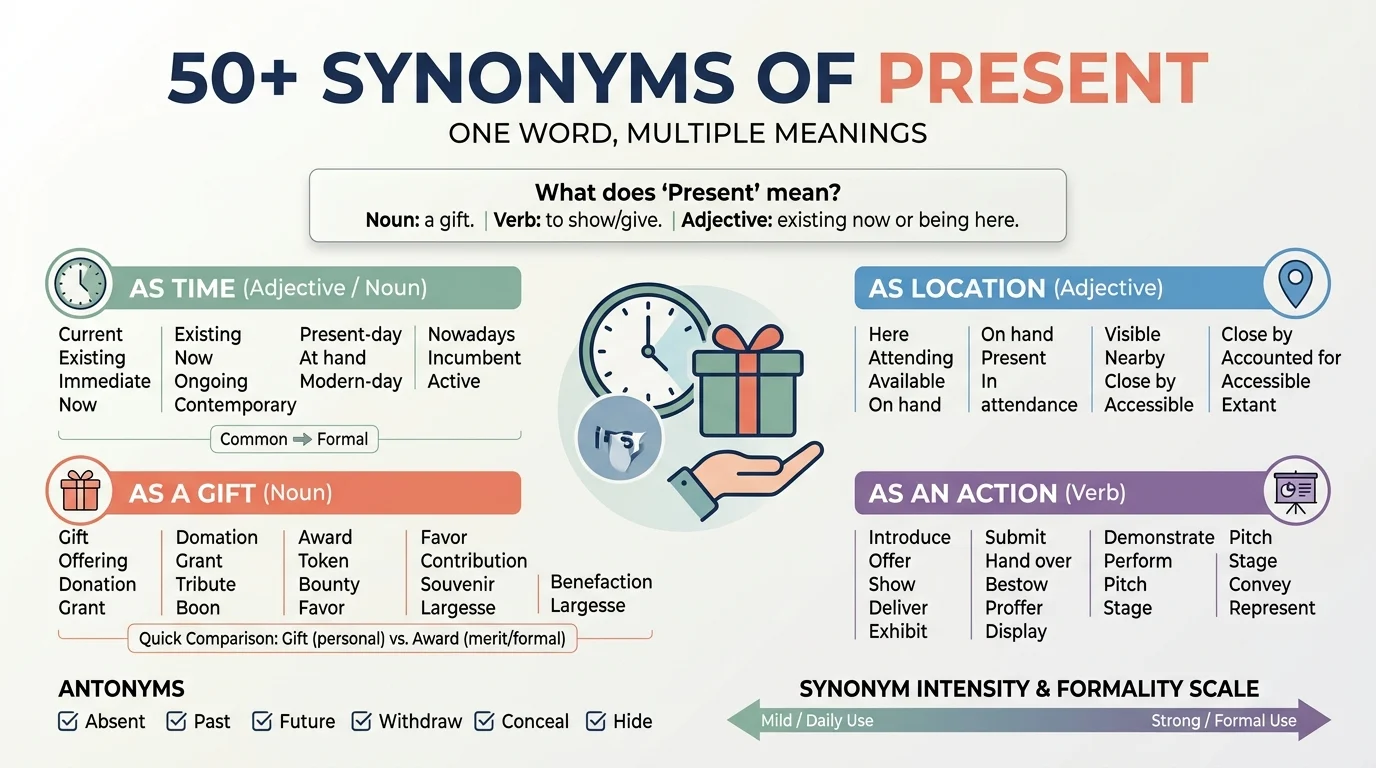
Have you ever needed to describe something that is happening right now, a gift you are giving, or the act of introducing someone, but felt that “here” or “gift” was too narrow? You want to capture the many meanings of “present,” and the word comes to mind. Choosing the right synonym for “present” can transform a vague statement into a precise description of time, location, or action. This guide explores the best synonyms of present, explaining exactly which word to use and when.
Quick Ans: “Present” has three main uses: existing or happening now, being in a particular place, or a gift. For time, use current or contemporary. For location, use attending or here. For a gift, use gift or offering. For the verb meaning to give or introduce, use offer, submit, or introduce.
Meaning, Tone, and Context
Understanding the core meaning of “present” is the first step to using it effectively.
Simple Definition: Existing or occurring now; being in a specified place; a gift; to give or introduce something formally.
Part of Speech: Adjective, noun, and verb.
Overall Tone: Neutral. It is a versatile word used across many contexts.
Formality Level: Neutral to formal. The word works in casual and professional settings.
Common Uses: Native English speakers use it to describe current situations (“the present moment”), attendance (“all members were present”), gifts (“a birthday present”), and formal actions (“present a proposal”).
Word Forms: Related words include the noun presence, the adverb presently, and the noun presentation.
When and How to Use “Present”
“Present” is the perfect choice when you want to describe current time, attendance, a gift, or a formal action. Here are seven realistic examples.
Describing Time: “The present situation requires immediate attention.”
And Describing Attendance: “All team members were present at the meeting.”
Describing a Gift: “She gave him a present for his birthday.”
Verb (To Give): “The CEO will present the award at the ceremony.”
Verb (To Introduce): “Let me present my colleague, Dr. Smith.”
Professional: “We need to present our findings to the board tomorrow.”
Social Media: “Living in the present is the key to happiness.”
Best Synonyms of “Present”
No synonym is identical in every situation. Here is your guide to the best replacement for “present” based on your writing context.
For Time (Existing Now)
Most Common: Current emphasizes what is happening now. “The current market conditions are favorable.”
Formal: Contemporary refers to the present time or modern era. “Contemporary art often challenges tradition.”
Immediate: Existing or prevailing describe what is currently in place. “The prevailing attitude is optimistic.”
At This Moment: Momentary or instantaneous describe something very brief.
For Location (Being There)
Formal: Attending is used for meetings and events. “All board members were attending the conference.”
Informal: Here is simple and direct. “Is everyone here?”
Available: On hand means ready and available. “Emergency supplies were on hand.”
For a Gift
Common: Gift is the most direct synonym. “He gave her a beautiful gift.”
Formal: Offering suggests something given as a contribution. “The offering was generous.”
Donation: Donation is for charitable giving. “The donation will help the community.”
For the Verb (To Give or Introduce)
To Give: Offer, submit, hand over are common synonyms. “She offered her resignation.”
To Introduce: Introduce, unveil, showcase are used for people or products. “The company will unveil its new product.”
To Perform: Deliver, give, stage are used for speeches and performances. “He delivered a powerful speech.”
When Not to Use “Present”
Using “present” can sound wrong or awkward in certain situations.
When You Mean “Gift” Informally: “Present” is fine, but “gift” is more common in casual conversation.
Better Choice: Gift. “Thanks for the gift!”
When You Mean “Here”: “Present” sounds formal during roll call.
Better Choice: Here. “Here!”
When You Mean “Now”: “Present” as an adjective can sound formal.
Better Choice: Now or currently. “We are currently working on it.”
Words Commonly Confused With “Present”
Several words are often mixed up with “present.” Here is how to keep them straight.
Word: Current
Difference: Refers to what is happening now. “Present” can also mean in attendance or a gift.
When to Use: Use it for trends and conditions.
Example: “The current situation is stable.”
Word: Gift
Difference: A noun for something given voluntarily. “Present” can also mean a gift.
When to Use: Use this for casual gift-giving.
Example: “She received a gift from her friend.”
Word: Attending
Difference: Means being at an event. “Present” is the adjective form.
When to Use: Use this in formal contexts.
Example: “All members were attending the meeting.”
Word: Contemporary
Difference: Refers to the present era or modern times. “Present” is more immediate.
When to Use: Use this for cultural or historical context.
Example: “Contemporary music is diverse.”
Word: Offer
Difference: To give or propose something. “Present” is more formal.
When to Use: Use this for suggestions.
Example: “She offered her help.”
Word: Introduce
Difference: To make someone known to others. “Present” is more formal.
When to Use: Use this for social situations.
Example: “Let me introduce you to my colleague.”
Best Synonyms of “Present” by Context
| Context | Best Synonym | Why It Works | Example |
|---|---|---|---|
| Time (Now) | Current | Common and clear | “The current situation is challenging.” |
| Time (Modern) | Contemporary | Formal and cultural | “Contemporary design is minimalist.” |
| Location (Formal) | Attending | Formal and precise | “All executives were attending.” |
| Location (Informal) | Here | Simple and direct | “Is everyone here?” |
| Gift | Gift | Most common and natural | “She gave him a gift.” |
| Gift (Formal) | Offering | Formal and ceremonial | “The offering was accepted.” |
| Verb (Give) | Offer | Common and versatile | “He offered his resignation.” |
| Verb (Introduce) | Introduce | Standard and social | “Let me introduce my friend.” |
| Verb (Show) | Showcase | Emphasizes display | “The gallery will showcase new artists.” |
How to Choose the Best Synonym of “Present”
Choosing the right word is a simple decision. Answer these questions.
What am I describing? For time, use current or contemporary. And for location, use attending or here. For a gift, use gift or offering. For the verb, use offer, introduce, or submit.
What is my audience? For a formal report, use contemporary or attending. For a friend, use here or gift.
What is my purpose? Are you describing time, place, object, or action? The correct synonym depends entirely on this.
What is the emotional strength? Offering is more formal. Gift is warmer. Pick the one that matches your message.
Real Life Examples of “Present”
To truly master the word, it helps to see how it behaves in the wild and how a stronger synonym can elevate the sentence.
School: Basic: “The present situation is difficult.” Improved: “The current situation is difficult.”
College: Basic: “She was present at the lecture.” Improved: “She was attending the lecture.”
Workplace: Basic: “I will present the report.” Improved: “I will submit the report.”
Business: Basic: “They presented a gift.” Improved: “They offered a gift.”
Email: Basic: “Please present your ideas.” Improved: “Please share your ideas.”
Conversation: Basic: “Thanks for the present.” Improved: “Thanks for the gift.”
Storytelling: Basic: “He presented the hero.” Improved: “He introduced the hero.”
Top 10 Synonyms of “Present”
| Synonym | Simple Meaning | Best Used For | Example Sentence |
|---|---|---|---|
| Current | Happening now | Time and trends | “The current market is volatile.” |
| Contemporary | Modern, of the present time | Culture and history | “Contemporary art is diverse.” |
| Attending | Being at an event | Formal meetings | “All members were attending.” |
| Here | In this place | Informal attendance | “Is everyone here?” |
| Gift | Something given voluntarily | Everyday gift-giving | “She received a gift.” |
| Offering | Something given as a contribution | Formal or ceremonial giving | “The offering was generous.” |
| Offer | To give or propose | Suggestions and proposals | “He offered his help.” |
| Introduce | To make known | Social and formal settings | “Let me introduce my colleague.” |
| Showcase | To display prominently | Products and talents | “The event will showcase new talent.” |
| Submit | To present for consideration | Reports and applications | “Submit your proposal by Friday.” |
Synonyms of “Present” by Usage
Professional vs. Personal Synonyms
In the workplace (professional), choose current, attending, submit, or showcase. These words convey professionalism. “The current strategy is effective” is more precise than “The present strategy is effective.”
With friends (personal), here, gift, or share keep the tone relaxed.
Formal vs. Conversational Synonyms
For formal writing (reports, essays, professional emails), use contemporary, attending, offering, or submit. For casual conversations, use here, gift, show, or give.
Academic Synonyms
For research and essays, choose contemporary, current, or existing. These words sound scholarly.
Professional and Business Synonyms
For business writing, choose submit, showcase, offer, or introduce. These words demonstrate confidence.
Creative and Literary Synonyms
To add flair to your writing, choose bestow, bequeath, or unveil. These create atmosphere.
Slang and Colloquial Synonyms
In modern American slang, gift and here are common. Show up is used for attendance. For example, “He showed up to the party.”
Strongest to Mildest Synonyms
Mild: here, gift, show
Moderate: present, current, offer
Strong: contemporary, attending, submit
Very Strong: bestow, bequeath, unveil
Emotional vs. Neutral Synonyms
Emotional Synonyms: Gift, offering, bestow. These words hint at generosity. Use them to evoke feeling.
Neutral Synonyms: Current, attending, submit. These words communicate factual information.
Antonyms of “Present”
| Antonym | Meaning | Example Sentence |
|---|---|---|
| Absent | Not in a place | “He was absent from the meeting.” |
| Past | Gone by in time | “The past cannot be changed.” |
| Future | Time yet to come | “The future is uncertain.” |
| Missing | Not found | “The file is missing.” |
| Gone | No longer there | “The guests are gone.” |
| Away | Not here | “She is away on vacation.” |
| Withhold | Refuse to give | “He withheld the information.” |
| Take | Receive or remove | “He took the gift back.” |
| Conceal | Hide from view | “The document was concealed.” |
| Withdraw | Remove from a place | “She withdrew her application.” |
| Hide | Put out of sight | “He hid the present.” |
| Deny | Refuse to give | “They denied the request.” |
| Refuse | Say no to | “She refused the offer.” |
| Reject | Dismiss as inadequate | “The proposal was rejected.” |
| Past | Bygone era | “The past is history.” |
Comparison: “Present” vs Similar Words
Present vs. Current
Main Difference: “Current” refers to what is happening now. “Present” can also mean in attendance or a gift.
Which Is Stronger? “Current” is more specific to time.
Which Is More Formal? Both are formal.
When to Use Each: Use “current” for trends. Use “present” for attendance or gifts.
Examples:
Present: “The present situation is stable.”
Current: “The current market is strong.”
Present vs. Gift
Main Difference: “Gift” is the noun for something given. “Present” is a broader word.
Which Is Stronger? Both are similar.
Which Is More Formal? “Gift” is more common in casual speech.
When to Use Each: Use “gift” for everyday giving. Use “present” in formal contexts.
Examples:
Present: “He presented the award.”
Gift: “She received a gift.”
Present vs. Attending
Main Difference: “Attending” means being at an event. “Present” is the adjective.
Which Is Stronger? “Attending” is more active.
Which Is More Formal? Both are formal.
When to Use Each: Use “attending” for events. Use “present” for roll call.
Examples:
Present: “All members were present.”
Attending: “All members were attending the conference.”
Present vs. Contemporary
Main Difference: “Contemporary” refers to the modern era. “Present” is more immediate.
Which Is Stronger? “Contemporary” is broader.
Which Is More Formal? “Contemporary” is more formal.
When to Use Each: Use “contemporary” for cultural context. Use “present” for now.
Examples:
Present: “The present moment is all we have.”
Contemporary: “Contemporary music is diverse.”
Present vs. Offer
Main Difference: “Offer” is a verb meaning to give. “Present” is more formal.
Which Is Stronger? Both are similar.
Which Is More Formal? “Present” is more formal.
When to Use Each: Use “offer” for suggestions. Use “present” for formal giving.
Examples:
Present: “She presented the proposal.”
Offer: “She offered her help.”
Present vs. Introduce
Main Difference: “Introduce” means to make known. “Present” is more formal.
Which Is Stronger? “Introduce” is more social.
Which Is More Formal? “Present” is more formal.
When to Use Each: Use “introduce” for people. Use “present” for formal occasions.
Examples:
Present: “Let me present Dr. Smith.”
Introduce: “Let me introduce my friend.”
Common Phrases and Expressions with “Present”
Phrase: At present
Meaning: Currently, now.
Example Sentence: “At present, we have no plans to expand.”
Phrase: Present tense
Meaning: The grammatical tense for current actions.
Example Sentence: “Use the present tense for facts.”
Phrase: All present and accounted for
Meaning: Everyone is here.
Example Sentence: “The team is all present and accounted for.”
Phrase: Present company excluded
Meaning: Not including the people here.
Example Sentence: “The food was bad, present company excluded.”
Phrase: Present a united front
Meaning: To appear united.
Example Sentence: “The party presented a united front.”
Common Mistakes to Avoid
Mistake 1: Using “present” when you mean “gift”.
Incorrect: “Thanks for the present.”
Better: “Thanks for the gift.”
Why: “Gift” is more common in casual conversation.
Mistake 2: Using “present” when you mean “here”.
Incorrect: “Present!” (as a response)
Better: “Here!”
Why: “Here” is the natural response during roll call.
Mistake 3: Using “present” when you mean “current”.
Incorrect: “The present economy is strong.”
Better: “The current economy is strong.”
Why: “Current” is more natural for trends.
Mistake 4: Using “present” when you mean “introduce”.
Incorrect: “I will present my friend.”
Better: “I will introduce my friend.”
Why: “Introduce” is for people.
Mistake 5: Using “present” when you mean “submit”.
Incorrect: “Please present your report.”
Better: “Please submit your report.”
Why: “Submit” is more precise for formal documents.
Frequently Asked Questions
1. What are the best synonyms of “present”?
The best synonyms depend on your context. For time, choose current or contemporary. And for location, use attending or here. For a gift, use gift or offering. For the verb, use offer, submit, or introduce.
2. What are the best formal synonyms of “present”?
The best formal synonyms are contemporary, attending, offering, and submit. These words are suitable for academic papers, professional reports, and business communications.
3. What are common informal synonyms of “present”?
For informal settings, use here, gift, show, or give. These alternatives sound more natural in everyday conversation.
4. What is another word for “present” in professional writing?
In professional writing, current or submit are excellent choices. Attending is also strong for formal meetings.
5. What is the difference between “present” and “current”?
“Present” can mean in attendance or a gift. “Current” specifically means happening now. Use “current” for trends and “present” for attendance.
6. What is the opposite of “present”?
The most direct opposites of “present” in the sense of time are past and future. For location, the opposite is absent. For the verb, the opposite is withhold or conceal.
Conclusion
“Present” is a versatile and essential word with multiple meanings across time, location, gifts, and actions. The best choice among the synonyms of present depends entirely on your audience, tone, and purpose. For a formal, precise effect, use contemporary or attending. And for a practical, business context, current or submit works perfectly. For casual conversation, choose gift or here. Remember, no single synonym works perfectly in every situation. Your goal is to choose the word that communicates your message with the most clarity and impact. A practical tip for your vocabulary growth is to pay attention to how writers describe time and presence and practice using different synonyms in your writing.