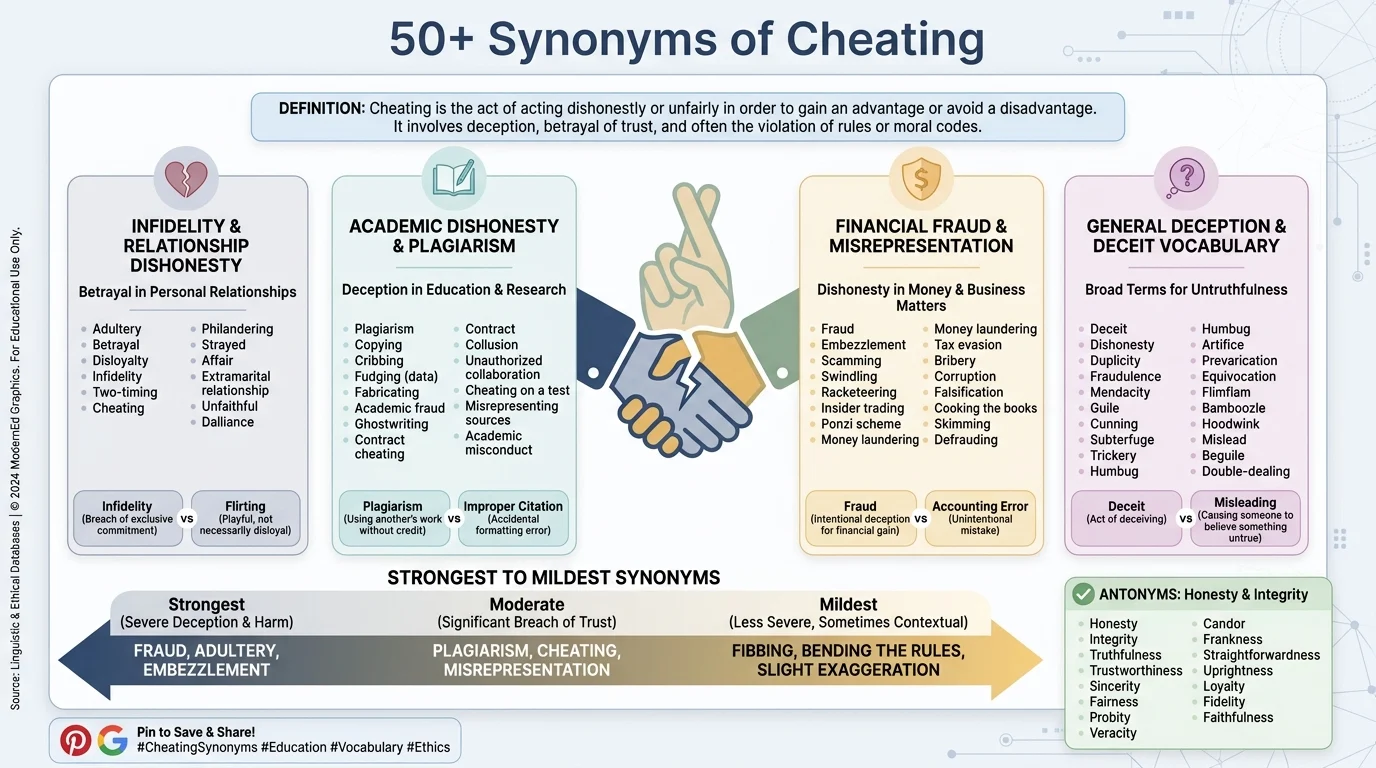
Have you ever needed to describe dishonest behavior, a broken promise, or an unfair advantage but felt that “cheating” was too general or informal? You want to capture the specific nature of the deception, whether it is in a relationship, in an exam, or in a business deal, and the word “cheating” comes to mind. Choosing the right synonym for “cheating” can transform a vague accusation into a precise description of the specific misconduct. This guide explores the best synonyms of cheating, explaining exactly which word to use and when.
Quick Ans: “Cheating” means acting dishonestly or unfairly to gain an advantage, or being unfaithful to a partner. For academic misconduct, use plagiarism or copying. For relationship infidelity, use adultery or unfaithfulness. For financial fraud, use swindling or defrauding. For general deception, use trickery or deceit.
Meaning, Tone, and Context
Understanding the core meaning of “cheating” is the first step to using it effectively.
Simple Definition: Acting dishonestly or unfairly to gain an advantage, or being unfaithful to a spouse or partner .
Part of Speech: Noun and verb.
Overall Tone: Negative. It indicates dishonesty, betrayal, or unfairness.
Formality Level: Neutral. The word is appropriate in most contexts, though more formal alternatives exist.
Common Uses: Native English speakers use it to describe infidelity (“He cheated on his wife”), academic dishonesty (“She cheated on the exam”), and financial fraud (“They cheated their investors”) . The word can also describe avoiding something undesirable (“He cheated death”) .
Word Forms: Related words include the verb cheat, the noun cheater, the adjective cheating, and the noun cheat meaning a person who cheats or a fraudulent act.
When and How to Use “Cheating”
“Cheating” is the perfect choice when you want to describe dishonest behavior for personal gain. Here are seven realistic examples.
Academic: “The student was expelled for cheating on the final exam.”
Relationship: “She discovered that her husband had been cheating on her for months” .
Business: “The company was investigated for cheating its investors out of millions” .
Professional: “Using insider information to trade stocks is a form of cheating.”
Legal: “He was arrested for cheating the tax system” .
Everyday: “He cheated at cards and was banned from the casino.”
Idiomatic: “The ambulance arrived just in time, helping him cheat death yet again” .
Best Synonyms of “Cheating”
No synonym is identical in every situation. Here is your guide to the best replacement for “cheating” based on your writing context.
For Infidelity and Betrayal
Strongest: Unfaithfulness is the most direct formal synonym for being untrue to a partner . “His unfaithfulness destroyed the marriage.”
Formal/Legal: Adultery specifically refers to sexual infidelity . “She filed for divorce on the grounds of adultery.”
Informal: Two-timing means being romantically involve with two people at once . “She discovered he was two-timing her.”
General: Infidelity is the broadest term for being unfaithful . “The relationship ended because of infidelity.”
For Academic Dishonesty
Specific: Plagiarism is the act of using someone else’s work without credit . “The student accused of plagiarism.”
General: Copying is a natural term for looking at another’s work . “He was caught copying during the exam.”
For Financial Fraud
Formal: Defrauding is the legal term for cheating someone out of money or rights . “He pleaded guilty to conspiracy to defraud the government” .
Strong: Swindling implies cheating someone out of money . “He swindled investors out of millions” .
Informal: Ripping off implies overcharging or stealing . “We ripped off by the souvenir shop.”
For General Deception
Formal: Deceit refers to dishonest behavior designed to mislead . “The scandal revealed a web of deceit.”
Strong: Trickery is the use of tricks to deceive . “They resorted to trickery to win the election.”
Formal: Fraud is deceptive conduct for personal gain . “He charged with fraud.”
Legal: Misrepresentation means giving false information . “The claim was based on misrepresentation.”
When Not to Use “Cheating”
Using “cheating” can sound wrong or awkward in certain situations.
When It Sounds Too Informal: In a formal legal document, “cheating” sounds casual.
Better Choice: Defrauding or misrepresentation. “The defendant is charged with defrauding investors.”
When It Sounds Too General: “Cheating” can be too vague for a specific act.
Better Choice: Plagiarism or adultery. “The student was expelled for plagiarism.”
When You Mean “Shoddy Work”: “Cheating” is not about quality.
Better Choice: Substandard or shoddy. “The contractor did shoddy work.”
Words Commonly Confused With “Cheating”
Word: Fraud
Difference: Usually involves financial deception and is a crime. “Cheating” is broader.
When to Use: Use it for criminal deception. “He was charged with fraud” .
Word: Deceit
Difference: The act of making someone believe something false. “Cheating” implies gaining an advantage.
When to Use: Use it for any misleading behavior. “The organization was built on a foundation of deceit” .
Word: Infidelity
Difference: Specific to sexual unfaithfulness. “Cheating” can be broader .
When to Use: Use it for relationship betrayal. “He confessed to infidelity.”
Word: Plagiarism
Difference: Specific to using someone else’s work. “Cheating” can refer to other dishonest acts .
When to Use: Use it for intellectual theft. “The professor found plagiarism in the essay.”
Word: Swindling
Difference: Specific to cheating someone out of money .
When to Use: Use it for financial crimes. “He was arrested for swindling older people.”
Best Synonyms of “Cheating” by Context
| Context | Best Synonym | Why It Works | Example |
|---|---|---|---|
| Relationship | Infidelity | Formal and precise. | “The therapist addressed the infidelity.” |
| Relationship (Informal) | Two-timing | Casual and conversational. | “I can’t believe he is two-timing you.” |
| Academic | Plagiarism | Specific and clear. | “Plagiarism can result in expulsion.” |
| Academic | Copying | Simple and natural. | “The teacher caught them copying.” |
| Financial | Fraud | Legal and formal. | “He was convicted of fraud” . |
| Financial | Swindling | Strong and legal. | “He swindled investors of millions” . |
| Financial (Informal) | Rip-off | Casual and conversational. | “The price is a complete rip-off” . |
| General Deception | Deceit | Formal and broad. | “The politician’s career was destroyed by deceit” . |
| Avoiding Danger | Cheat death | Idiomatic and literary. | “He cheated death by a matter of seconds” . |
How to Choose the Best Synonym of “Cheating”
Choosing the right word is a simple decision. Answer these questions.
What type of cheating am I describing? For relationship betrayal, use infidelity or adultery. And for academic misconduct, use plagiarism. For financial crimes, use fraud or swindling. For avoiding danger, use cheat death .
What is my audience? For a legal document, use defraud or misrepresentation . And for a friend, use two-timing or rip-off. For an academic, use plagiarism or deceit.
What is my purpose? Are you trying to accuse, describe, or warn? The correct synonym depends entirely on this.
What is the emotional strength? Swindling and defrauding are strong. Copying and misleading are milder. Pick the one that matches your message.
Top 15 Synonyms of “Cheating”
| Synonym | Simple Meaning | Best Used For | Example Sentence |
|---|---|---|---|
| Fraud | Financial deception for profit | Legal and financial contexts . | “He was found guilty of tax fraud.” |
| Deceit | Dishonest behavior to mislead | Formal and general contexts . | “The company’s success was built on deceit.” |
| Infidelity | Sexual unfaithfulness | Relationship contexts . | “The marriage crumbled due to infidelity.” |
| Plagiarism | Using someone else’s work | Academic and creative contexts . | “The author was accused of plagiarism.” |
| Adultery | Voluntarily sexual infidelity | Legal, formal, and religious contexts . | “Adultery was grounds for divorce.” |
| Swindling | Cheating someone out of money | Financial contexts . | “The swindling operation targeted retirees.” |
| Defrauding | Illegally depriving someone of money or rights | Legal contexts . | “He was charged with defrauding investors.” |
| Trickery | Use of tricks to deceive | Descriptive and literary contexts . | “They won the election through trickery.” |
| Two-timing | Being unfaithful | Casual and conversational contexts . | “She discovered his two-timing behavior.” |
| Misrepresentation | Giving false information | Legal and formal contexts . | “The contract was voided for misrepresentation.” |
| Copying | Using someone else’s work | Academic and educational contexts . | “The student was caught copying.” |
| Bilking | Cheating especially out of money | Informal contexts . | “The scam artist bilked pensioners.” |
| Hoodwinking | Deceiving or tricking | Literary and descriptive contexts . | “The public was hoodwinked by the campaign.” |
| Deception | The act of deceiving | General and formal contexts . | “The spy ring was built on deception.” |
| Imposture | Pretending to be someone else | Formal contexts . | “The imposture was eventually uncovered.” |
Synonyms of “Cheating” by Usage
Professional vs. Personal Synonyms
In the workplace (professional), choose fraud, misrepresentation, defrauding, or plagiarism to describe specific misconduct. These words convey professionalism and precision. “He terminated for fraud” is more precise than “He was fired for cheating.”
With friends (personal), two-timing, rip-off, copying, or lying keep the tone relaxed and relatable.
Formal vs. Conversational Synonyms
For formal writing (reports, essays, professional emails), use infidelity, plagiarism, fraud, misrepresentation, or defrauding . These choices maintain the sophisticated tone expected in professional documents.
For casual conversations and texting, use two-timing, ripping off, copying, or deception. These options sound more natural.
Academic Synonyms
For research and essays, choose precise, authoritative words. Plagiarism is great for academic misconduct, fraud for financial crime, and infidelity for relationship breaches. These words sound considered and scholarly.
Professional and Business Synonyms
For maximum impact in business writing, choose fraud for financial misconduct, misrepresentation for contracts, and defrauding for illegal activity . These words demonstrate precision and professional awareness.
Creative and Literary Synonyms
To add emotion and imagery to your writing, choose trickery, deceit, hoodwinking, chicanery, or artifice . These words create atmosphere and reveal character.
Slang or Modern Synonyms
In modern American slang, rip-off, hustle, screw over, con, and pull a fast one are commonly used . For example, “We got totally ripped off,” or “He tried to pull a fast one on me.” These are acceptable in casual contexts but should be avoided in professional or academic writing .
Strongest to Mildest Synonyms
Mild: copying, misleading, tricking
Moderate: cheating, deceiving, deception
Strong: fraud, swindling, defrauding, fraud
Very Strong: adultery, perjury, embezzlement
Emotional vs. Neutral Synonyms
Emotional Synonyms: Betrayal, deceit, infidelity. These words often hint at profound disappointment. Use them when you want to evoke feeling.
Neutral Synonyms: Fraud, misrepresentation, plagiarism. These words simply communicate factual information. Use them when you want to inform without emotional coloring.
Antonyms of “Cheating”
Here are 15 genuine opposites of “cheating.”
| Antonym | Meaning | Example Sentence |
|---|---|---|
| Honesty | The quality of being truthful | “Her honesty was appreciated.” |
| Integrity | Moral uprightness | “He is a man of integrity.” |
| Fairness | Impartial and just treatment | “Fairness is important in competition.” |
| Fidelity | Faithfulness to a partner | “He vowed fidelity to his wife.” |
| Loyalty | Faithfulness and devotion | “Her loyalty was unquestionable.” |
| Trustworthiness | Being worthy of trust | “The company is known for its trustworthiness.” |
| Truthfulness | Telling the truth | “Her truthfulness was respected.” |
| Principled | Following moral principles | “She is a principled professional.” |
| Sincerity | Honesty in expression | “His sincerity won people over.” |
| Openness | Being open and honest | “There was great openness in their dealings.” |
| Decency | Proper, moral behavior | “The decision lacked decency.” |
| Reliability | Being dependable | “His reliability is unquestionable.” |
| Probity | Complete honesty | “The judge was known for probity.” |
| Honor | Adherence to what is right | “He is a man of honor.” |
| Uprightness | Morally good | “He was known for his uprightness.” |
Comparison: “Cheating” vs Similar Words
Cheating vs. Fraud
Main Difference: “Fraud” is a specific crime involving financial deception and often uses the legal system. “Cheating” can be use for academic, relationship, or general dishonesty .
Which Is Stronger? “Fraud” is a legal term. “Cheating” is more general.
Which Is More Formal? “Fraud” is formal and legal. “Cheating” is neutral.
When to Use Each: Use “fraud” for financial crimes. Use “cheating” for everyday dishonesty.
Examples:
Cheating: “He cheated on the exam.”
Fraud: “He was convicted of fraud” .
Cheating vs. Deceit
Main Difference: “Deceit” is about making someone believe something false . “Cheating” is about gaining an unfair advantage.
Which Is Stronger? They are similar in strength. “Deceit” is more formal.
Which Is More Formal? “Deceit” is more formal.
When to Use Each: Use “deceit” for general misleading. Use “cheating” for gaining an advantage.
Examples:
Cheating: “He cheated on his taxes.”
Deceit: “The company’s deceit was exposed” .
Cheating vs. Infidelity
Main Difference: “Infidelity” specifically means being unfaithful to a sexual partner. “Cheating” can be used for infidelity but also for other forms of dishonesty .
Which Is Stronger? “Infidelity” is more formal and carries a heavier weight.
Which Is More Formal? “Infidelity” is more formal.
When to Use Each: Use “infidelity” for relationship breaches. Use “cheating” for general dishonesty.
Examples:
Cheating: “He cheated on the test.”
Infidelity: “The marriage ended due to infidelity” .
Cheating vs. Plagiarism
Main Difference: “Plagiarism” specifically means using someone else’s words or ideas without credit . “Cheating” can also involve copying, but plagiarism is the specific term for intellectual theft.
Which Is Stronger? “Plagiarism” is more specific.
Which Is More Formal? “Plagiarism” is more formal and academic.
When to Use Each: Use “plagiarism” for intellectual theft. Use “cheating” for general dishonesty.
Examples:
Cheating: “He cheated on the exam.”
Plagiarism: “The student accused of plagiarism” .
Cheating vs. Swindling
Main Difference: “Swindling” specifically means cheating someone out of money . “Cheating” is broader.
Which Is Stronger? “Swindling” is more specific and legal.
Which Is More Formal? “Swindling” is more formal.
When to Use Each: Use “swindling” for financial cheating. Use “cheating” for general dishonesty.
Examples:
Cheating: “He cheated on his taxes.”
Swindling: “He swindled investors out of millions” .
Common Phrases and Expressions with “Cheating”
Phrase: Cheat on someone
Meaning: To be sexually unfaithful to a partner.
Example Sentence: “She discovered he had been cheating on her.”
Phrase: Cheat death
Meaning: To avoid death by luck or skill.
Example Sentence: “He cheated death in the car accident” .
Phrase: Cheat at cards
Meaning: To use dishonest methods in gambling.
Example Sentence: “He banned from the casino for cheating at cards.”
Phrase: Cheat sheet
Meaning: A set of notes used surreptitiously during an exam.
Example Sentence: “The student caught with a cheat sheet” .
Phrase: Cheat on taxes
Meaning: To lie on a tax return to pay less.
Example Sentence: “The politician accused of cheating on his taxes.”
Phrase: Rip-off
Meaning: A product or service that overpriced or dishonest.
Example Sentence: “The designer bag was a complete rip-off” .
Common Mistakes to Avoid
Mistake 1: Using “cheating” when you mean “fraud”.
Incorrect: “The company was investigated for cheating.”
Better: “The company was investigated for fraud” .
Why: “Fraud” is a legal term for financial deception.
Mistake 2: Using “cheating” when you mean “infidelity”.
Incorrect: “He confessed to cheating.”
Better: “He confessed to infidelity” .
Why: “Infidelity” is more formal and specific for relationship betrayal.
Mistake 3: Using “cheating” when you mean “plagiarism”.
Incorrect: “The student accused of cheating.”
Better: “The student accused of plagiarism” .
Why: “Plagiarism” is the specific term for using another’s work.
Mistake 4: Overusing “cheating” in formal writing.
Incorrect: “The defendant charged with cheating.”
Better: “The defendant charged with defrauding investors” .
Why: Formal writing requires more precise legal terminology.
Mistake 5: Using “cheating” when you mean “deceit”.
Incorrect: “The campaign used cheating to win.”
Better: “The campaign used deceit to win” .
Why: “Deceit” is more formal and describes the behavior more accurately.
Frequently Asked Questions
1. What are the best synonyms of “cheating”?
The best synonyms depend on your context. For relationship betrayal, choose infidelity or adultery . And for academic misconduct, use plagiarism . For financial crimes, use fraud or swindling .
2. What are the best formal synonyms of “cheating”?
The best formal synonyms are fraud, defrauding, misrepresentation, and infidelity . These words are suitable for legal and academic contexts.
3. What are common informal synonyms of “cheating”?
For informal settings, use two-timing, ripping off, copying, conning, or deception. These alternatives sound more natural in everyday conversation.
4. What is another word for “cheating” in professional writing?
In professional writing, fraud is an excellent choice for financial misconduct. Misrepresentation is also strong for contracts.
5. What is the difference between “cheating” and “infidelity”?
“Infidelity” specifically means being unfaithful to a partner. “Cheating” can also mean being unfaithful, but it also applies to other forms of dishonesty .
6. What is the opposite of “cheating”?
The most direct opposites (antonyms) of cheating are honesty, integrity, and fairness.
Conclusion
“Cheating” is a powerful and versatile word for describing dishonesty, betrayal, and unfair advantage. The term is widely accept in most contexts, yet it can sound too general for specific misconduct or too informal for formal writing. The best choice among the synonyms of cheating depends entirely on your audience, tone, and purpose. Remember, no single synonym works perfectly in every situation. Your goal is to choose the word that communicates your message with the most clarity and impact. A practical tip for your vocabulary growth is to pay attention to how writers describe dishonest behavior and practice using different synonyms in your writing.










4 thoughts on “50+ Synonyms of Cheating: Meanings, Uses, Examples, and Best Alternatives 2026”