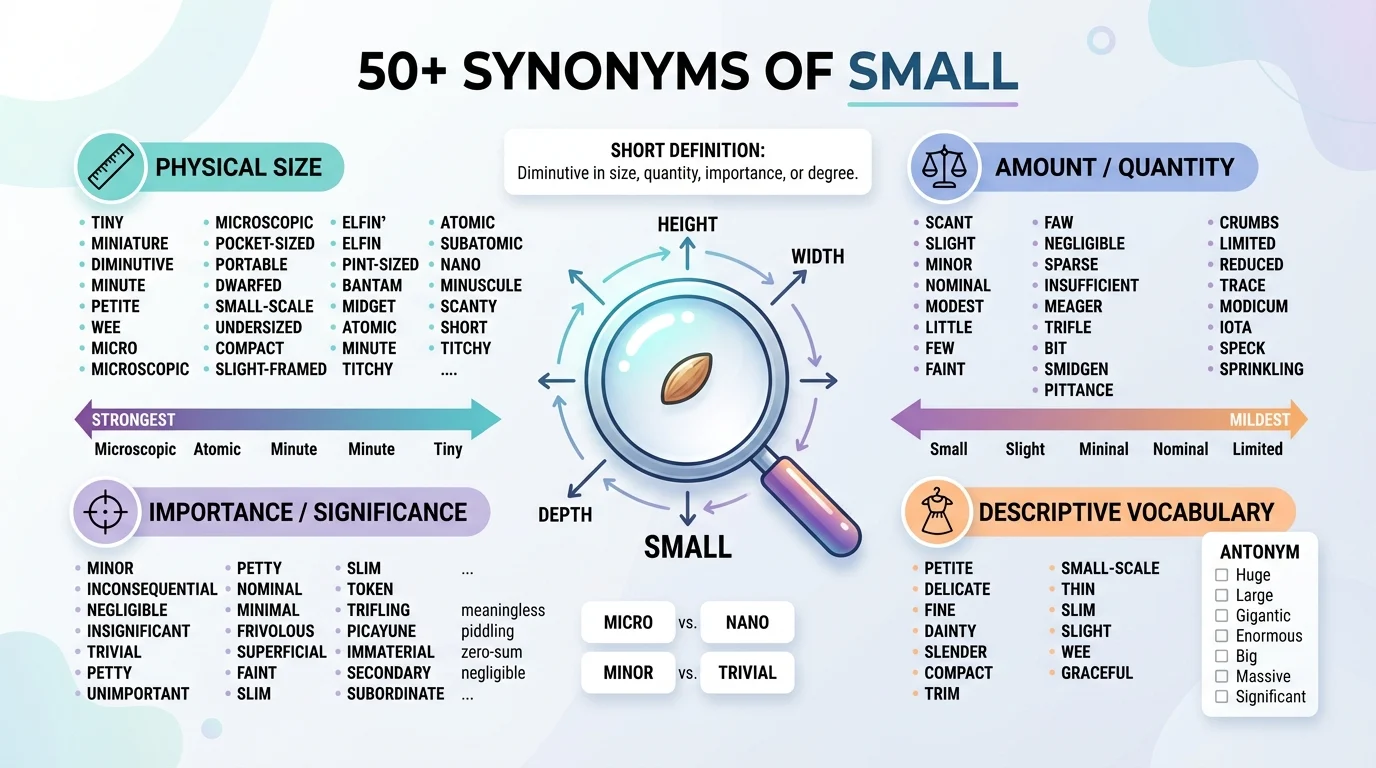
Have you ever described something as simply “small” but felt the word was too basic or vague for the situation? You want to capture the exact shade of meaning, whether it is a tiny detail, a slight difference, or an insignificant issue. Choosing the right synonym for “small” can transform a general description into a precise and powerful statement. This guide explores the best synonyms of small, explaining exactly which word to use and when.
Quick Ans: “Small” means not large in size, amount, or degree. For physical size, choose tiny or minuscule. For amount, use meager or negligible. For importance, select insignificant or trivial. To describe a person’s build, use petite or diminutive. For a more dramatic effect, choose infinitesimal or microscopic.
Meaning, Tone, and Context
Understanding the core meaning of “small” is the first step to using it effectively.
Simple Definition: Below average in size, amount, degree, or importance; not large.
Part of Speech: Adjective.
Overall Tone: Neutral. It is a basic descriptive word used across all contexts.
Formality Level: Neutral to informal. The word is widely used in both spoken and written English.
Common Uses: Native English speakers use it constantly. For example, “The dog is small,” “There is a small chance of rain,” “A small group of people,” or “The problem is small.”
Word Forms: Related words include the adverb small, the noun smallness, and the adjective smallish.
When and How to Use “Small”
“Small” is the most common and versatile word in its category. Here are seven realistic examples.
Professional: “We allocated a small budget for the initial phase.”
Academic: “The study had a small sample size that limits its generalizability.”
Workplace: “We are looking for a small but dedicated team to handle the project.”
Personal: “She lives in a small but comfortable house.”
Email: “We need a small adjustment to the timeline.”
Resume: “Managed a small team of five professionals.”
Social Media: “Celebrating the small victories that lead to big success.”
Best Synonyms of “Small”
No synonym is identical in every situation. Here is your guide to the best replacement for “small” based on your writing context.
Describing Physical Size (General): Tiny or Little. “Tiny” is more emphatic than “small.” “Little” is often used affectionately. “The tiny kitten was adorable” versus “The little party was a success”.
Describing Very Small Size: Minute. Pronounced “my-NOOT,” it means extremely small or tiny. “He asked for minute details.”
Describing the Smallest Possible Amount: Infinitesimal. It refers to something so small it is almost immeasurable. “There is an infinitesimal chance of error.”
Describing a Person’s Build: Petite. It means small and slim, usually for women. “She is a petite woman.”
Describing a Small Amount: Meager. It implies a quantity that is insufficient. “She survived on a meager allowance.”
Describing Insignificance: Insignificant. It describes something unimportant. “The detail was too insignificant to argue about.”
Describing a Trivial Matter: Petty. It suggests something of little importance, often used negatively. “Don’t worry me with petty matters.”
When Not to Use “Small”
Using “small” can sound weak or imprecise in certain situations.
When You Mean Very Tiny: “Small” is too generic for something extremely tiny.
Better Choice: Tiny or minute. “The minute details were hard to see.”
When You Mean Insufficient: “Small” is neutral. Meager implies lack.
Better Choice: Meager or scant. “The meager rations were not enough.”
When You Mean Unimportant: “Small” is about size. Trivial is about importance.
Better Choice: Trivial or insignificant. “The issue was trivial and easily resolved.”
When You Mean Young: “Small” is about size. Little is affectionate, and young is about age.
Better Choice: Little or young. “I remember when she was a little girl.”
Words Commonly Confused With “Small”
Several words are often mixed up with “small.” Here is how to keep them straight.
Word: Little
Difference: Often implies affection, small in size or amount. “Small” is more neutral.
When to Use: Use it for emotional or informal contexts.
Example: “He is a little boy with a big imagination.”
Word: Tiny
Difference: Much smaller than normal. “Small” is less extreme.
When to Use: Use it for things that are very small.
Example: “The tiny insect was barely visible.”
Word: Minute
Difference: Extremely small; means “very detailed” when referring to details.
When to Use: Use it for small, exact details.
Example: “The nurse inspected the wound with a minute attention.”
Word: Diminutive
Difference: Very small; often used for people or animals.
When to Use: Use this for someone’s physical stature.
Example: “The diminutive figure walked into the room.”
Word: Petite
Difference: Means small and slim, for women or clothing.
When to Use: Use this for people, usually women.
Example: “She bought a petite size dress.”
Word: Microscopic
Difference: So small it can only be seen with a microscope.
When to Use: Use this for very tiny things.
Example: “The sample contained microscopic particles.”
Best Synonyms of “Small” by Context
| Context | Best Synonym | Why It Works | Example |
|---|---|---|---|
| Physical Size | Tiny | More emphatic than ‘small’. | “The tiny flower bloomed in the garden.” |
| Physical Build | Petite | Describes a small, slim build. | “She has a petite frame.” |
| Amount | Meager | Suggests an insufficient quantity. | “He earned a meager living.” |
| Amount (Very Small) | Negligible | So small it can be ignored. | “The change in temperature was negligible.” |
| Importance | Trivial | Unimportant or minor. | “We argued about trivial matters.” |
| Importance | Petty | Unimportant, often implying meanness. | “It was a petty argument.” |
| Age | Little | Used affectionately for children. | “She is a little girl.” |
| Sound | Soft | Low in volume. | “She spoke in a soft voice.” |
| Dramatic Effect | Minuscule | Implies extremely small. | “The minuscule ant was strong.” |
| Very Precise | Minute | Extremely small or precise. | “They studied the minute details.” |
| Limited Scale | Small-scale | Limited in scope. | “It was a small-scale operation.” |
How to Choose the Best Synonym of “Small”
Choosing the right word is a simple decision. Answer these questions.
What is the nature of the “smallness”? Are you describing physical size, amount, importance, or a person? Use tiny for size, meager for amount, trivial for importance, and petite for people.
What is my audience? For a formal report, use negligible or minute. For a friend, use tiny or little.
What is my purpose? Are you trying to be precise, dramatic, or critical? Choose accordingly. Microscopic is dramatic, and petty is critical.
What is the emotional strength? Infinitesimal and microscopic are very strong and precise. Little and slight are mild and neutral.
Real Life Examples of “Small”
To truly master the word, it helps to see how it behaves in the wild and how a stronger synonym can elevate the sentence.
School: Basic: “The small child had trouble reaching the desk.” Improved: “The diminutive child had trouble reaching the desk.”
College: Basic: “There is a small chance of rain tomorrow.” Improved: “There is only a minute chance of rain tomorrow.”
Workplace: Basic: “We have a small budget for this project.” Improved: “We have a meager budget for this project.”
Business: Basic: “We noticed a small error in the report.” Improved: “We noticed a negligible error in the report.”
Email: Basic: “Please fix this small issue.” Improved: “Please fix this trivial issue when you have a moment.”
Conversation: Basic: “She is a small woman.” Improved: “She is a petite woman.”
Storytelling: Basic: “A small figure walked through the fog.” Improved: “A minuscule figure walked through the fog.”
Top 10 Synonyms of “Small”
| Synonym | Simple Meaning | Best Used For | Example Sentence |
|---|---|---|---|
| Tiny | Very little | Physical size | “The tiny kitten was adorable.” |
| Little | Small, often with affection | Physical size and age | “I want to tell you a little story.” |
| Minute | Extremely small or precise | Details and precision | “He noticed minute differences.” |
| Petite | Small and slim (for people) | Physical build | “She is a petite woman.” |
| Meager | Insufficient in amount | Amount and quantity | “He earned a meager salary.” |
| Negligible | So small it can be ignored | Amount and impact | “The risk is negligible.” |
| Diminutive | Very small | Physical stature | “The diminutive puppy was cute.” |
| Infinitesimal | Immeasurably small | The smallest possible | “The difference was infinitesimal.” |
| Insignificant | Unimportant | Importance | “The issue was insignificant.” |
| Petty | Trivial, often ungenerous | Importance | “They argued over petty things.” |
Synonyms of “Small” by Usage
Professional vs. Personal Synonyms
In the workplace (professional), choose minute, negligible, or insignificant to describe details or issues. These words convey precision and professionalism. “The error was negligible” is more effective than “The error was small.” With friends, tiny, little, or petite keep the tone relaxed.
Formal vs. Conversational Synonyms
For formal writing (reports, essays), use minute, negligible, or infinitesimal. For casual conversations, use tiny, little, or teensy.
Academic Synonyms
For research and essays, choose precise, authoritative words. Negligible is great for data, infinitesimal for amounts, and minute for details.
Professional and Business Synonyms
For maximum impact in business writing, choose negligible for small impact, meager for small amounts, and minute for small details.
Creative and Literary Synonyms
To add emotion and imagery to your writing, choose diminutive, minuscule, or microscopic. These words create vivid images.
Slang or Modern Synonyms
In modern American slang, teeny, teeny-weeny, itsy-bitsy, or titchy are used casually. For example, “I only have a teeny bit of money left,” or “Look at the itsy-bitsy spider.” These are acceptable in casual contexts but should be avoided in professional or academic writing.
Strongest to Mildest Synonyms
Mild: small, little, slight
Moderate: tiny, petite, diminutive
Strong: minute, minuscule, miniature
Very Strong: microscopic, infinitesimal, negligible
Emotional vs. Neutral Synonyms
Emotional Synonyms: Tiny, little, petite, diminutive. These can express affection or cuteness.
Neutral Synonyms: Small, insignificant, negligible. These communicate factual information without emotional coloring.
Antonyms of “Small”
Here are 15 genuine opposites of “small.”
| Antonym | Meaning | Example Sentence |
|---|---|---|
| Big | Large in size | “He owns a big house.” |
| Large | Bigger than average | “I need a large cup.” |
| Huge | Very large | “The dog is huge.” |
| Enormous | Exceptionally large | “The elephant is enormous.” |
| Massive | Very big and solid | “The massive building dominates the skyline.” |
| Colossal | Monumental | “It was a colossal achievement.” |
| Gigantic | Like a giant | “A gigantic spider scared her.” |
| Vast | Very large in area | “The vast desert stretches for miles.” |
| Immense | Extremely large | “The task was of immense importance.” |
| Substantial | Of considerable size | “She received a substantial salary.” |
| Tremendous | Very great in size | “The team showed tremendous improvement.” |
| Significant | Important and large | “It was a significant discovery.” |
| Considerable | Large in amount | “He had considerable influence.” |
| Grand | Impressive in size | “The grand staircase was beautiful.” |
| Mighty | Large and powerful | “The mighty ocean roared.” |
Comparison: “Small” vs Similar Words
Small vs. Tiny
Main Difference: “Tiny” is much smaller than “small.” “Small” is a general term.
Which Is Stronger? “Tiny” is stronger and more specific.
Which Is More Formal? Both are neutral.
When to Use Each: Use “small” for general references. Use “tiny” for things that are very little.
Examples:
Small: “We have a small house.”
Tiny: “We have a tiny garden.”
Small vs. Little
Main Difference: “Little” often has an emotional or affectionate quality. “Small” is neutral.
Which Is Stronger? “Small” is more objective. “Little” is more subjective.
Which Is More Formal? “Small” is more formal. “Little” is informal.
When to Use Each: Use “small” for facts. Use “little” for feelings.
Examples:
Small: “The town is small.”
Little: “She is a little girl.”
Small vs. Minute
Main Difference: “Minute” (pronounced my-NOOT) means extremely small and often implies attention to detail.
Which Is Stronger? “Minute” is much stronger.
Which Is More Formal? “Minute” is formal.
When to Use Each: Use “minute” for small details.
Examples:
Small: “There was a small change in the plan.”
Minute: “There were minute differences in the design.”
Small vs. Meager
Main Difference: “Meager” implies insufficiency. “Small” is neutral.
Which Is Stronger? “Meager” is stronger because it implies need.
Which Is More Formal? “Meager” is more formal.
When to Use Each: Use “meager” to emphasize lack.
Examples:
Small: “He earns a small salary.”
Meager: “He earns a meager salary.”
Small vs. Petite
Main Difference: “Petite” describes a small and slim build, usually for women. “Small” is general.
Which Is Stronger? “Petite” is more specific.
Which Is More Formal? Both are formal.
When to Use Each: Use “petite” for people.
Examples:
Small: “She is a small woman.”
Petite: “She is a petite woman.”
Common Phrases and Expressions with “Small”
Phrase: Small talk
Meaning: Light, informal conversation about unimportant matters.
Example Sentence: “He is terrible at making small talk at parties.”
Phrase: A small fortune
Meaning: A large amount of money.
Example Sentence: “That car cost a small fortune.”
Phrase: In a small way
Meaning: In a minor or limited manner.
Example Sentence: “I have helped him in a small way.”
Phrase: Small potatoes
Meaning: Something insignificant or unimportant.
Example Sentence: “His problems are small potatoes compared to mine.”
Phrase: It is a small world
Meaning: Used to express surprise when meeting someone unexpectedly.
Example Sentence: “What a small world! I never expected to see you here.”
Common Mistakes to Avoid
Mistake 1: Using “small” when you mean “tiny”.
Incorrect: “The small puppy was barely bigger than my hand.”
Better: “The tiny puppy was barely bigger than my hand.”
Why: “Tiny” better emphasizes the extreme size.
Mistake 2: Using “small” when you mean “insignificant”.
Incorrect: “The issue is small, do not worry.”
Better: “The issue is insignificant, do not worry.”
Why: “Insignificant” is more precise for importance.
Mistake 3: Using “small” when you mean “meager”.
Incorrect: “The small rations were not enough.”
Better: “The meager rations were not enough.”
Why: “Meager” implies insufficiency.
Mistake 4: Overusing “small” in a single paragraph.
Incorrect: “The small building was in a small town with a small population.”
Better: “The diminutive building was in a tiny town with a meager population.”
Why: Variation in vocabulary demonstrates writing sophistication.
Mistake 5: Using “petite” for men or objects.
Incorrect: “He is a petite man.”
Better: “He is a small man.”
Why: “Petite” is specifically used for women and women’s clothing.
Frequently Asked Questions
1. What are the best synonyms of “small”?
The best synonyms depend on your context. For physical size, choose tiny or minuscule. And for amount, use meager or negligible. For importance, select insignificant or trivial. To describe a person’s build, use petite or diminutive.
2. What are the best formal synonyms of “small”?
The best formal synonyms are minute, negligible, and infinitesimal. These words are suitable for academic papers and professional reports.
3. What are common informal synonyms of “small”?
For informal settings, use tiny, little, teensy, or itsy-bitsy. These alternatives sound more natural in everyday conversation.
4. What is another word for “small” in professional writing?
In professional writing, negligible is an excellent choice for impact, meager for amounts, and minute for details.
5. What is the difference between “small” and “petite”?
“Small” is a general term. “Petite” specifically describes a small and slim build, usually for women. Use “petite” for people’s physical descriptions.
6. What is the opposite of “small”?
The most direct opposites (antonyms) of small are big, large, huge, and enormous. These words describe things that are above average in size.
Conclusion
“Small” is a versatile and essential word for describing size, amount, and importance. The best choice among the synonyms of small depends entirely on your audience, tone, and purpose. Remember, no single synonym works perfectly in every situation. Your goal is to choose the word that communicates your message with the most clarity and impact. A practical tip for your vocabulary growth is to pay attention to the differences between these synonyms and practice using a new one each day in your writing.









