Have you ever needed to describe something that is an improvement over something else but felt that “good” or “great” did not fully capture the sense of superiority? You want to highlight progress, higher quality, or enhanced performance, and the word “better” comes to mind. But is it the best fit for your audience? Choosing the right synonym for “better” can transform a simple comparison into a powerful statement of improvement and excellence. This guide explores the best synonyms of better, explaining exactly which word to use and when.
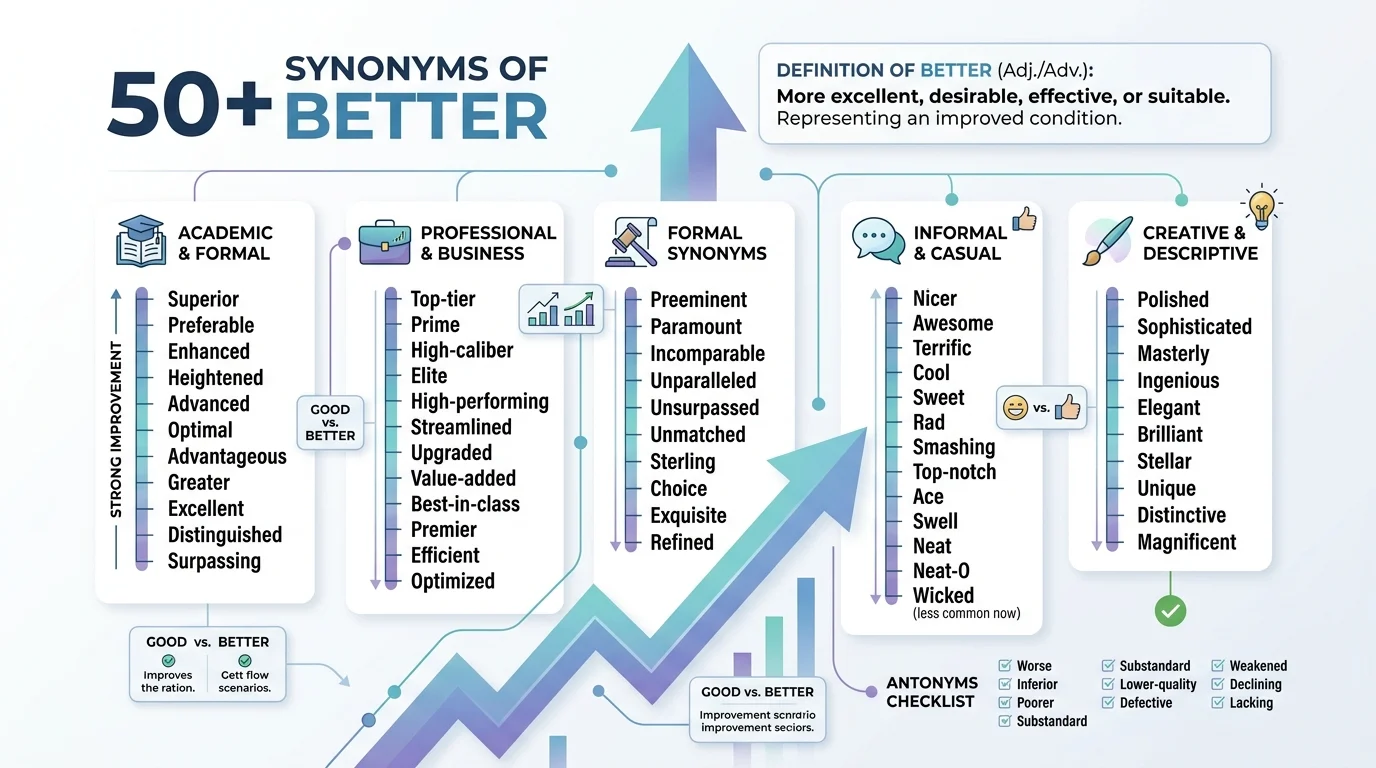
Quick Ans: “Better” means more desirable, satisfactory, or effective. It is a positive, comparative adjective that can describe quality, health, skill, or suitability. For formal writing, choose superior or more advantageous. For casual conversation, use improved or greater. In academic contexts, exceeding and preferable are strong choices. For a stronger, more dramatic impact, select transcendent or matchless.
Meaning, Tone, and Context
Understanding the core meaning of “better” is the first step to using it effectively.
Simple Definition: Of a more excellent or effective type or quality. Something that is superior to another.
Part of Speech: Adjective (comparative of “good”), adverb, and verb.
Overall Tone: Positive. It indicates improvement, excellence, and superiority.
Formality Level: Neutral. The word works in almost any context.
Common Uses: Native English speakers use it constantly to compare, recommend, and describe improvement. For example, “This is better than that,” or “She feels better today.”
Word Forms: Related words include the noun betterment, the adverb better, and the verb better (to improve).
When and How to Use “Better”
“Better” is the most common and versatile word for comparison and improvement. Here are seven realistic examples.
Professional: “This strategy is better for long-term growth.”
Academic: “The study provides a better understanding of the phenomenon.”
Workplace: “We need a better approach to customer service.”
Personal: “I hope you feel better soon.”
Email: “Please let me know if there is a better time to meet.”
Resume: “Delivered better results than any previous quarter.”
Social Media: “Today is already better than yesterday.”
Best Synonyms of “Better”
No synonym is identical in every situation. Here is your guide to the best replacement for “better” based on your writing context.
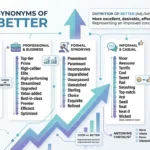
Professional Writing: Superior. It suggests a higher rank or quality. “Our product is superior to the competition.”
Academic Writing: Preferable. This is ideal when discussing the best choice among options. “The preferable outcome is a compromise.”
Business Communication: More advantageous. A practical choice for strategic comparisons. “This partnership is more advantageous.”
Casual Conversation: Improved. It tones down the formality and sounds natural. “My health is improved since last year.”
Emotional Writing: Transcendent. This word carries weight, suggesting something beyond the ordinary. “Her transcendent performance moved the audience.”
Creative Writing: Matchless. It implies something that has no equal. “His matchless skill was admired by all.”
Resume Writing: Enhanced. Use it to describe improved skills or experiences. “Enhanced ability to deliver results in complex environments.”
When Not to Use “Better”
Using “better” can sound weak or imprecise in certain situations.
When It Sounds Too Vague: “Better” can be general. You might need a word that conveys more specificity.
Better Choice: Superior or more effective. “This method is superior for our needs.”
When You Need a Superlative: “Better” compares two things. Best compares three or more.
Better Choice: Best. “This is the best option available.”
When It Sounds Too Modest: In some contexts, “better” is too modest.
Better Choice: Exceptional or outstanding. “Her exceptional skills were recognized.”
When Describing Health Improvement: “Better” works, but recovered is more precise.
Better Choice: Recovered or restored. “He is fully recovered from his illness.”
Words Commonly Confused With “Better”
Several words are often mixed up with “better.” Here is how to keep them straight.
Word: Superior
Difference: Means higher in quality or rank. “Better” is more general.
When to Use: Use it when comparing quality directly.
Example: “This product is superior to that one.”
Word: Improved
Difference: Means made better. “Better” can be a general state.
When to Use: Use this for things that have undergone improvement.
Example: “The improved version is now available.”
Word: Preferable
Difference: Means more desirable. “Better” is about quality.
When to Use: Use this when choosing between options.
Example: “Walking is preferable to driving.”
Word: Enhanced
Difference: Means increased in quality or value. “Better” is more general.
When to Use: Use this for things that have been upgraded.
Example: “The enhanced features are impressive.”
Word: Superlative
Difference: Means of the highest quality. “Better” is comparative.
When to Use: Use this for the very best.
Example: “She gave a superlative performance.”
Word: Exceeding
Difference: Means surpassing others. “Better” is about improvement.
When to Use: Use this for surpassing expectations.
Example: “Her exceeding dedication was admirable.”
Best Synonyms of “Better” by Context
| Context | Best Synonym | Why It Works | Example |
|---|---|---|---|
| Formal writing | Superior | Suggests higher rank or quality. | “The superior product won the award.” |
| Academic writing | Preferable | Indicates the best choice. | “The preferable approach is to experiment.” |
| Professional communication | More advantageous | Emphasizes strategic benefit. | “This plan is more advantageous.” |
| Business emails | Enhanced | Professional and clear. | “The enhanced features will improve sales.” |
| Resume writing | Exceptional | Highlights outstanding ability. | “Exceptional leadership skills.” |
| Workplace communication | Improved | Neutral and factual. | “We have seen improved results.” |
| Casual conversation | Greater | Simple and conversational. | “This is a greater challenge than expected.” |
| Creative writing | Matchless | Evokes uniqueness and excellence. | “Her matchless beauty was admired.” |
| Emotional writing | Transcendent | Suggests going beyond the ordinary. | “The transcendent moment was unforgettable.” |
| Strong emphasis | Superior | The most direct for quality. | “The superior quality is undeniable.” |
| Mild tone | Nicer | Simple and unassuming. | “This is a nicer option.” |
| Social media captions | Improved | Widely understood and relatable. | “Feeling improved and refreshed today.” |
How to Choose the Best Synonym of “Better”
Choosing the right word is a simple decision. Answer these questions.
What is my audience? For a professor or CEO, superior or preferable is powerful. For a friend, nicer or improved is more natural.
What is my purpose? Are you comparing, recommending, or describing improvement? Use superior for comparison, preferable for recommendation, and enhanced for improvement.
Am I comparing two things or more? For two things, better or superior works. For more than two, best or matchless are better.
What is the emotional strength? Transcendent and matchless are stronger. Nicer and improved are mild. Pick the one that matches your message.
Real Life Examples of “Better”
To truly master the word, it helps to see how it behaves in the wild and how a stronger synonym can elevate the sentence.
School: Basic: “The student did better on the test.” Improved: “The student showed improved performance on the test.”
College: Basic: “This theory is better than the others.” Improved: “This theory is superior to the others in explaining the data.”
Workplace: Basic: “We need a better system.” Improved: “We need a superior system to handle the volume.”
Business: Basic: “Better customer service is needed.” Improved: “Enhanced customer service is needed to retain clients.”
Email: Basic: “Is there a better time?” Improved: “Is there a more convenient time?”
Conversation: Basic: “I feel better today.” Improved: “I feel much improved today.”
Storytelling: Basic: “Her better nature prevailed.” Improved: “Her more compassionate nature prevailed in the end.”
Top 10 Synonyms of “Better”
| Synonym | Simple Meaning | Best Used For | Example Sentence |
|---|---|---|---|
| Superior | Higher in quality or rank | Formal, professional, and quality comparisons. | “The superior materials lasted longer.” |
| Improved | Made better or enhanced | Progress, skill, and performance contexts. | “The improved design won an award.” |
| Preferable | More desirable or suitable | Decision-making and recommendation contexts. | “Walking is preferable to driving.” |
| Enhanced | Increased in value or quality | Product, experience, and feature contexts. | “The enhanced version has more features.” |
| Exceptional | Unusually good or outstanding | Praise, recognition, and high-quality contexts. | “Her exceptional skills were recognized.” |
| Transcendent | Going beyond the ordinary | Emotional, spiritual, and creative contexts. | “The transcendent performance was unforgettable.” |
| Matchless | Having no equal | Unique and incomparable contexts. | “His matchless skill was admired by all.” |
| More advantageous | More beneficial or favorable | Strategic, business, and decision contexts. | “This plan is more advantageous.” |
| Greater | Larger or more significant | Comparisons of degree and scale. | “This is a greater challenge than expected.” |
| Nicer | More pleasant | Casual, everyday, and personal contexts. | “This is a nicer restaurant.” |
Synonyms of “Better” by Usage
Professional vs. Personal Synonyms
In the workplace (professional), choose superior, enhanced, or exceptional to describe quality and performance. These words convey professionalism and precision. “The superior product outperforms all competitors” is more precise than “The better product outperforms all competitors.”
With friends (personal), improved, nicer, or greater keep the tone relaxed and relatable. These alternatives sound natural in everyday conversation.
Formal vs. Conversational Synonyms
For formal writing (reports, essays, professional emails), use superior, preferable, or more advantageous. These choices maintain the sophisticated tone expected in professional documents.
For casual conversations and texting, use nicer, improved, or greater. These options sound more natural and less pretentious.
Academic Synonyms
For research and essays, choose precise, authoritative words. Preferable is great for choices, superior for quality, and exceeding for surpassing expectations. These words sound considered and scholarly.
Using precise academic vocabulary demonstrates expertise and careful thinking. Professors and reviewers expect this level of precision.
Professional and Business Synonyms
For maximum impact in business writing, choose superior for quality, enhanced for features, and more advantageous for strategy. These words demonstrate confidence and professional awareness.
Business leaders respond to language that conveys clarity and strength. These synonyms project authority.
Creative and Literary Synonyms
To add emotion and imagery to your writing, choose transcendent, matchless, or exceptional. These words create atmosphere and evoke admiration.
Literary writers use these alternatives to build character and theme. They transform ordinary descriptions into evocative prose.
Slang or Modern Synonyms
In modern American slang, better is often replaced with way better, a million times better, or simply superior for exaggeration. For example, “That is way better than before,” or “This is superior in every way.” These are acceptable in casual contexts. Avoid them in professional or academic writing.
Strongest to Mildest Synonyms
Mild: nicer, improved, greater
Moderate: better, preferable, enhanced
Strong: superior, exceptional, more advantageous
Very Strong: transcendent, matchless, outstanding
Emotional vs. Neutral Synonyms
Emotional Synonyms: Transcendent, matchless, exceptional. These words often hint at admiration, awe, or inspiration. Use them when you want to evoke feeling.
Neutral Synonyms: Better, improved, superior. These words simply communicate factual information. Use them when you want to inform without emotional coloring.
Antonyms of “Better”
Here are 15 genuine opposites of “better.”
| Antonym | Meaning | Example Sentence |
|---|---|---|
| Worse | Of lower quality or degree | “The worse product was recalled.” |
| Inferior | Lower in quality or rank | “The inferior materials failed the test.” |
| Worsened | Made worse or deteriorated | “The worsened condition required attention.” |
| Poorer | Not as good in quality | “The poorer design was rejected.” |
| Lesser | Smaller or of less importance | “The lesser option was not considered.” |
| Degraded | Reduced in quality | “The degraded system caused problems.” |
| Deteriorated | Made worse over time | “The deteriorated building was condemned.” |
| Disadvantageous | Not favorable or beneficial | “The disadvantageous position lost the deal.” |
| Inferior | Not as good | “The inferior product was cheaper.” |
| Unsatisfactory | Not meeting expectations | “The unsatisfactory results were discarded.” |
| Defective | Having faults or flaws | “The defective item was returned.” |
| Substandard | Below the required standard | “The substandard work was rejected.” |
| Second-rate | Not the best quality | “The second-rate performance was disappointing.” |
| Unsuitable | Not appropriate or fitting | “The unsuitable approach was abandoned.” |
| Inadequate | Not enough or sufficient | “The inadequate resources caused failure.” |
Comparison: “Better” vs Similar Words
Better vs. Superior
Main Difference: Better is general and versatile. Superior is more formal and implies higher rank.
Which Is Stronger? Superior is stronger and more definitive.
Which Is More Formal? Superior is more formal.
When to Use Each: Use better for general comparisons. Use superior for formal quality assessments.
Examples:
Better: “This is better than that.”
Superior: “This is superior in every way.”
Better vs. Improved
Main Difference: Better is a state of being. Improved suggests a process of change .
Which Is Stronger? They are similar. Improved emphasizes the change.
Which Is More Formal? Both are formal.
When to Use Each: Use better for comparison. Use improved for progress.
Examples:
Better: “This is better today.”
Improved: “This has improved significantly.”
Better vs. Preferable
Main Difference: Better is about quality. Preferable is about desirability .
Which Is Stronger? Preferable is about choice. Better is about quality.
Which Is More Formal? Both are formal.
When to Use Each: Use better for quality. Use preferable for choice.
Examples:
Better: “This is better quality.”
Preferable: “This is preferable to that.”
Better vs. Exceptional
Main Difference: Better is comparative. Exceptional is absolute and superlative.
Which Is Stronger? Exceptional is much stronger.
Which Is More Formal? Exceptional is formal.
When to Use Each: Use better for comparisons. Use exceptional for outstanding quality.
Examples:
Better: “She is better than average.”
Exceptional: “She has exceptional talent.”
Better vs. Transcendent
Main Difference: Better is about improvement. Transcendent is about going beyond the ordinary.
Which Is Stronger? Transcendent is much stronger.
Which Is More Formal? Transcendent is more literary.
When to Use Each: Use better for practical things. Use transcendent for profound excellence.
Examples:
Better: “This is a better result.”
Transcendent: “This is a transcendent achievement.”
Better vs. Matchless
Main Difference: Better implies a comparison. Matchless implies no comparison is possible.
Which Is Stronger? Matchless is the strongest.
Which Is More Formal? Matchless is formal.
When to Use Each: Use better when comparing two things. Use matchless when nothing compares.
Examples:
Better: “This is better than the rest.”
Matchless: “This is matchless in quality.”
Common Phrases and Expressions with “Better”
Phrase: Better than ever
Meaning: Improved to the highest standard.
Example Sentence: “After the renovations, the hotel is better than ever.”
Phrase: Better late than never
Meaning: It is better to do something late than not at all.
Example Sentence: “Sorry for the delay, but better late than never.”
Phrase: Better off
Meaning: In a more advantageous position.
Example Sentence: “We are better off now than we were a year ago.”
Phrase: For the better
Meaning: Resulting in improvement.
Example Sentence: “The changes were for the better.”
Phrase: Better half
Meaning: One’s spouse or partner.
Example Sentence: “I am going out with my better half tonight.”
Phrase: Better safe than sorry
Meaning: It is wise to be cautious.
Example Sentence: “Take an umbrella, better safe than sorry.”
Common Mistakes to Avoid
Mistake 1: Using “better” when you mean “best”.
Incorrect: “This is the better option of the three.”
Better: “This is the best option of the three.”
Why: Better compares two things. Best compares three or more.
Mistake 2: Using “better” for formal comparisons.
Incorrect: “The product is better to the competitor.”
Better: “The product is superior to the competitor.”
Why: Superior is more formal.
Mistake 3: Overusing “better” in professional writing.
Incorrect: “We need better results.”
Better: “We need improved results.”
Why: Improved sounds more professional.
Mistake 4: Using “better” when you mean “more preferable”.
Incorrect: “Walking is better to driving.”
Better: “Walking is preferable to driving.”
Why: Preferable is about choice, not just quality.
Mistake 5: Using “better” for exceptional things.
Incorrect: “Her better performance was outstanding.”
Better: “Her exceptional performance was outstanding.”
Why: Exceptional is stronger for outstanding quality.
Frequently Asked Questions
1. What are the best synonyms of “better”?
The best synonyms depend on your context. For formal writing, choose superior or preferable. And for casual conversation, improved or greater are ideal choices. For emotional writing, use transcendent or matchless.
2. What are the best formal synonyms of “better”?
The best formal synonyms are superior, preferable, and more advantageous. These words are suitable for academic papers, professional reports, and business communications.
3. What are common informal synonyms of “better”?
For informal settings, use improved, greater, or nicer. These alternatives sound more natural in everyday conversation.
4. What is another word for “better” in professional writing?
In professional writing, superior is an excellent choice. It conveys higher quality or rank. Enhanced is also strong for improvements.
5. What is the difference between “better” and “superior”?
While both indicate higher quality, better is a general comparative. Superior is a more formal word implying higher rank or status. Use superior for formal quality assessments.
6. What is the opposite of “better”?
The most direct opposites (antonyms) of better are worse and inferior. These words describe things that are of lower quality or degree.
Conclusion
“Better” is a versatile and essential word for describing improvement and superiority. The term is neutral and widely understood in most contexts, yet it can sound too vague for formal comparisons or too modest for exceptional qualities. The best choice among the synonyms of better depends entirely on your audience, tone, and purpose. Remember, no single synonym works perfectly in every situation. Your goal is to choose the word that communicates your message with the most clarity and impact. A practical tip for your vocabulary growth is to practice using different synonyms in your daily writing and notice how they affect the tone of your communication.
Discover More:
- 50+ Synonyms of Culture: Meanings, Uses, Examples, and Best Alternatives 2026
- 50+ Synonyms of Subtle: Meanings, Uses, Examples, and Best Alternatives 2026

Alexander Cole is a professional content writer and researcher who specializes in creating informative, reader-friendly, and well-researched articles. He is committed to publishing accurate, valuable, and engaging content that helps readers stay informed and make smarter decisions.