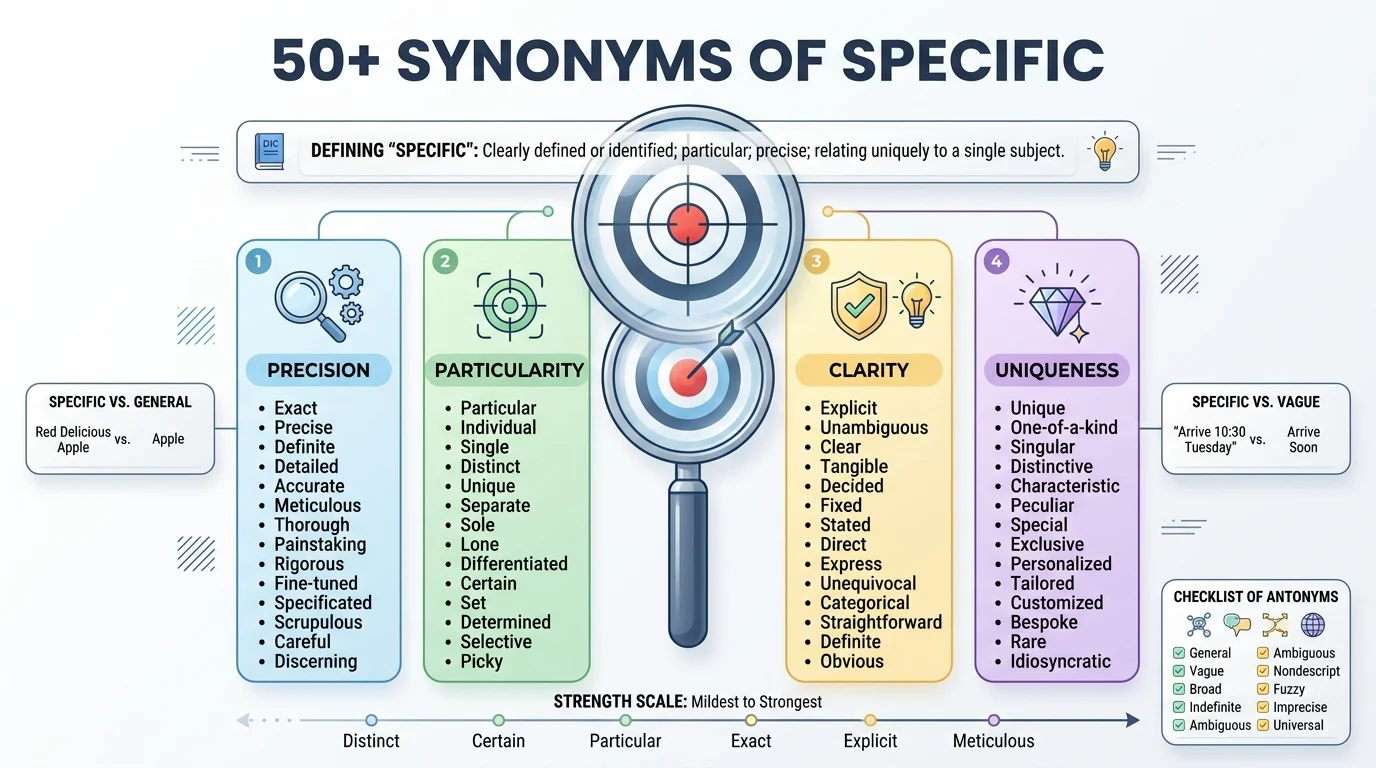
Have you ever struggled to describe something that is clearly defined and not general but felt that “exact” or “particular” didn’t fully capture the nuance? You want to highlight precision, clarity, or a focus on one thing, and the word “specific” comes to mind. Choosing the right synonym for “specific” can transform a vague statement into a precise and unmistakable description. This guide explores the best synonyms of specific, explaining exactly which word to use and when.
Quick Ans: “Specific” means clearly defined, precise, and relating to one particular thing . For describing precision, choose exact or precise . For indicating one particular thing, use particular or distinct . In professional and academic writing, explicit and concrete are strong choices . For a stronger emphasis on uniqueness, select distinctive or peculiar .
Meaning, Tone, and Context
Understanding the core meaning of “specific” is the first step to using it effectively.
Simple Definition: Clearly defined or identified; precise and exact; relating to one particular thing and not general .
Part of Speech: Adjective.
Overall Tone: Neutral. It indicates clarity, precision, and a focus on the particular.
Formality Level: Neutral. The word works in almost any context, from casual conversation to formal academic writing.
Common Uses: Native English speakers use it to describe details, instructions, examples, and preferences. For example, “Please give me a specific example,” or “The study addressed specific challenges” .
Word Forms: Related words include the adverb specifically, the noun specificity, the verb specify, and the noun specification.
When and How to Use “Specific”
“Specific” is the perfect choice when you want to emphasize clarity, precision, or a focus on one particular thing. Here are seven realistic examples.
Professional: “The manager gave specific instructions for the project.”
Academic: “The study addressed specific challenges in implementing the new policy” .
Workplace: “We need specific data to support our proposal.”
Personal: “I have a specific preference for Italian food.”
Email: “Please provide the specific details of the contract.”
Resume: “Implemented specific strategies that increased sales by 15%.”
Social Media: “Can you be more specific about what you liked?”
Best Synonyms of “Specific”
No synonym is identical in every situation. Here is your guide to the best replacement for “specific” based on your writing context.
Describing Precision: Precise. It emphasizes exactness and accuracy. “The tailor made precise measurements before cutting the fabric” .
Describing Exactness: Exact. It means completely correct and accurate. “I need the exact time of the meeting, not an approximate time” .
Describing One Thing: Particular. It refers to one specific thing, not all things in general. “I like this particular book more than others” .
Describing Clarity: Explicit. It means clearly and directly stated. “Let me be explicit about my expectations” .
Describing Certainty: Definite. It means clear, fixed, and certain without doubt . “We have a definite plan for the meeting tomorrow” .
Describing Uniqueness: Distinct. It means clearly separate or different . “The two designs are distinct.”
Professional Writing: Concrete. It means specific and real, not abstract. “We need concrete evidence to support the claim” .
Academic Writing: Detailed. It means including many exact facts. “The detailed report covered all aspects of the research” .
When Not to Use “Specific”
Using “specific” can sound wrong or awkward in certain situations.
When You Mean General or Vague: “Specific” is the opposite of vague.
Better Choice: General or broad. “I need a general overview.”
When You Lack Evidence: “Specific” implies clarity. Use suggested or proposed.
Better Choice: Proposed. “The proposed solution is a starting point.”
When It Sounds Too Demanding: In casual conversation, “specific” can sound demanding.
Better Choice: Certain or some. “Can you give me some details?”
Words Commonly Confused With “Specific”
Several words are often mixed up with “specific.” Here is how to keep them straight.
Word: Precise
Difference: Focuses on accuracy and exactness. “Specific” can also mean relating to one thing.
When to Use: Use it when you need to emphasize no margin for error.
Example: “The architect gave precise measurements” .
Word: Exact
Difference: Means completely correct and accurate. “Specific” focuses on being clearly defined.
When to Use: Use this when you want to emphasize that something is perfectly right.
Example: “What is your exact location?” .
Word: Particular
Difference: Means relating to one specific person or thing. “Specific” can also be about being well-defined.
When to Use: Use this when you are singling out one thing.
Example: “I like this particular design” .
Word: Definite
Difference: Means clear and certain. “Specific” is about being precise and particular.
When to Use: Use this when there is no doubt.
Example: “We have a definite plan” .
Word: Explicit
Difference: Means clearly stated in detail. “Specific” can mean precise or detailed.
When to Use: Use this when something is openly and clearly expressed.
Example: “Let me be explicit about the rules” .
Word: Concrete
Difference: Means specific and real, not abstract. “Specific” can be used for both.
When to Use: Use this when you want something tangible or practical.
Example: “We need concrete evidence, not theories” .
Best Synonyms of “Specific” by Context
| Context | Best Synonym | Why It Works | Example |
|---|---|---|---|
| Describing Precision | Precise | Emphasizes accuracy and exactness | “The engineer’s precise calculations ensured success.” |
| Describing Exactness | Exact | Means completely correct | “I need the exact number of attendees.” |
| Describing One Thing | Particular | Singles out one thing | “I want that particular book.” |
| Describing Clarity | Explicit | Clearly and directly stated | “The instructions were explicit and easy to follow.” |
| Describing Certainty | Definite | Clear and fixed without doubt | “She has a definite opinion on the matter.” |
| Describing Uniqueness | Distinct | Clearly separate or different | “The two species are distinct from each other.” |
| Describing Realness | Concrete | Specific and real, not abstract | “We need concrete evidence to make a decision.” |
| Describing Detail | Detailed | Including many exact facts | “The detailed report covered every aspect of the project.” |
How to Choose the Best Synonym of “Specific”
Choosing the right word is a simple decision. Answer these questions.
What is my audience? For a scientist or engineer, precise or exact is powerful. For a friend, particular or certain is more natural.
What is my purpose? Are you trying to describe precision, singling out one thing, or emphasizing clarity? Use precise for precision, particular for singling out, and explicit for clarity.
Am I describing a number, a choice, or a description? For numbers, exact is best. And for choices, particular works. For descriptions, detailed is appropriate.
What is the emotional strength? Explicit is stronger and more direct. Certain is mild. Pick the one that matches your message.
Real Life Examples of “Specific”
To truly master the word, it helps to see how it behaves in the wild and how a stronger synonym can elevate the sentence.
School: Basic: “The teacher gave specific instructions.” Improved: “The teacher gave precise instructions for the assignment.”
College: Basic: “The study had specific goals.” Improved: “The study had clearly defined goals that guided the research.”
Workplace: Basic: “We need specific data.” Improved: “We need concrete data to support our proposal.”
Business: Basic: “The plan had specific steps.” Improved: “The plan had explicit steps that everyone could follow.”
Email: Basic: “Please be more specific.” Improved: “Please provide the exact details of the contract.”
Conversation: Basic: “I like a specific type.” Improved: “I like that particular type of music.”
Storytelling: Basic: “He gave a specific answer.” Improved: “He gave a definite answer that left no room for doubt.”
Top 10 Synonyms of “Specific”
| Synonym | Simple Meaning | Best Used For | Example Sentence |
|---|---|---|---|
| Precise | Exact and accurate | Scientific, technical, and detail-oriented contexts. | “The surgeon made precise incisions during the operation.” |
| Exact | Completely correct | Numbers, time, and factual contexts. | “I need the exact time of the meeting” . |
| Particular | Relating to one specific thing | Preferences, choices, and singular references. | “I like this particular book more than the others” . |
| Definite | Clear and certain | Plans, opinions, and decisions. | “We have a definite plan for the weekend” . |
| Explicit | Clearly and directly stated | Instructions, rules, and direct communication. | “Let me be explicit about the company policy.” |
| Concrete | Specific and real, not abstract | Evidence, details, and practical contexts. | “We need concrete examples to support this theory.” |
| Detailed | Including many exact facts | Reports, descriptions, and thorough accounts. | “The detailed report covered every aspect of the research.” |
| Distinct | Clearly separate or different | Comparisons, categories, and clear differences. | “The two designs are visually distinct.” |
| Peculiar | Unique or special to something | Specific qualities or characteristics. | “This custom is peculiar to this region.” |
| Especial | Particular or special | Highlighting a specific importance. | “She has an especial interest in history.” |
Synonyms of “Specific” by Usage
Professional vs. Personal Synonyms
In the workplace (professional), choose concrete, explicit, or detailed to describe information and expectations. These words convey professionalism and clarity. “We need concrete evidence” is more professional than “We need specific evidence.”
With friends (personal), particular, certain, or exact keep the tone relaxed and relatable.
Formal vs. Conversational Synonyms
For formal writing (reports, essays, professional emails), use explicit, concrete, or precise. These choices maintain the sophisticated tone expected in professional documents .
For casual conversations and texting, use particular, exact, or definite. These options sound more natural.
Academic Synonyms
For research and essays, choose precise, authoritative words . Precise is great for methodology, concrete for evidence, and explicit for statements. These words sound considered and scholarly.
Professional and Business Synonyms
For maximum impact in business writing, choose concrete for evidence, explicit for instructions, and detailed for reports. These words demonstrate confidence and professional awareness.
Creative and Literary Synonyms
To add nuance to your writing, choose particular, distinct, or peculiar. These words create clarity and reveal character.
Strongest to Mildest Synonyms
Mild: certain, given, some
Moderate: specific, particular, definite
Strong: precise, exact, explicit, concrete
Very Strong: meticulous, scrupulous, pinpoint
Emotional vs. Neutral Synonyms
Emotional Synonyms: Especial, peculiar, distinctive . These words can hint at fondness, uniqueness, or a personal connection.
Neutral Synonyms: Precise, exact, definite. These words simply communicate factual information.
Antonyms of “Specific”
Here are 15 genuine opposites of “specific” .
| Antonym | Meaning | Example Sentence |
|---|---|---|
| Vague | Not clearly expressed | “His explanation was vague and confusing.” |
| General | Not specific or detailed | “I need a general overview of the project.” |
| Ambiguous | Open to more than one interpretation | “The ambiguous statement caused confusion.” |
| Inexact | Not completely correct | “His estimates were a little inexact” . |
| Broad | Covering a wide range | “The broad topic was difficult to research.” |
| Unclear | Not easy to understand | “The instructions were unclear.” |
| Non-specific | Not specific | “He gave a non-specific answer.” |
| Abstract | Not concrete or specific | “The abstract concept was hard to grasp.” |
| Indefinite | Not clearly defined | “The indefinite timeline was a problem.” |
| Hazy | Vague and unclear | “The hazy memory made it hard to recall.” |
| Imprecise | Not exact or accurate | “The imprecise measurements caused errors.” |
| Obscure | Not clearly understood | “The obscure reference was lost on the audience.” |
| Uncertain | Not known or definite | “The uncertain outcome worried everyone.” |
| Flexible | Capable of being changed | “The flexible schedule was easy to adjust.” |
| Generalized | Made general, not specific | “The generalized statement was not helpful.” |
Comparison: “Specific” vs Similar Words
Specific vs. Precise
Main Difference: “Precise” emphasizes exactness and accuracy. “Specific” is broader and can also mean particular .
Which Is Stronger? “Precise” is stronger for exactness.
Which Is More Formal? Both are formal.
When to Use Each: Use “specific” for particular details. Use “precise” for exact measurements.
Examples:
Specific: “The doctor gave specific instructions.”
Precise: “The tailor made precise measurements” .
Specific vs. Exact
Main Difference: “Exact” means completely correct and accurate. “Specific” can also mean particular .
Which Is Stronger? “Exact” is stronger for accuracy.
Which Is More Formal? Both are neutral.
When to Use Each: Use “exact” for numbers and time. Use “specific” for details and instructions.
Examples:
Specific: “Can you be more specific?”
Exact: “What is your exact location?” .
Specific vs. Particular
Main Difference: “Particular” emphasizes singling out one thing. “Specific” can also mean precise .
Which Is Stronger? They are similar in strength. “Particular” is more personal.
Which Is More Formal? Both are neutral.
When to Use Each: Use “particular” for preferences. Use “specific” for details.
Examples:
Specific: “The specific details are in the file.”
Particular: “I like this particular book” .
Specific vs. Definite
Main Difference: “Definite” means clear and certain. “Specific” can also mean precise or detailed .
Which Is Stronger? They are similar. “Definite” emphasizes certainty.
Which Is More Formal? Both are neutral.
When to Use Each: Use “definite” for plans and opinions. Use “specific” for instructions and examples.
Examples:
Specific: “Please give me a specific example.”
Definite: “We have a definite plan” .
Specific vs. Explicit
Main Difference: “Explicit” emphasizes clear, direct statement. “Specific” can mean precise or particular .
Which Is Stronger? “Explicit” is stronger for directness.
Which Is More Formal? Both are formal.
When to Use Each: Use “explicit” for rules and direct communication. Use “specific” for details.
Examples:
Specific: “The specific instructions were helpful.”
Explicit: “Let me be explicit about the deadline.”
Common Phrases and Expressions with “Specific”
Phrase: Specific example
Meaning: A precise example that illustrates a point.
Example Sentence: “Can you give me a specific example of the problem?” .
Phrase: Specific details
Meaning: Exact and precise information.
Example Sentence: “Please provide the specific details of the contract.”
Phrase: Specific instructions
Meaning: Clear and precise directions.
Example Sentence: “The doctor gave specific instructions for taking the medicine” .
Phrase: Specific to
Meaning: Belonging or relating exclusively to one thing.
Example Sentence: “This custom is specific to this region.”
Phrase: Specific challenge
Meaning: A particular, clearly defined problem.
Example Sentence: “The study addressed specific challenges in implementing the policy” .
Common Mistakes to Avoid
Mistake 1: Using “specific” when you mean “exact”.
Incorrect: “What is the specific time of the meeting?”
Better: “What is the exact time of the meeting?”
Why: “Exact” is more appropriate for time and numbers.
Mistake 2: Using “specific” when you mean “particular”.
Incorrect: “I like this specific book.”
Better: “I like this particular book.”
Why: “Particular” is used for singling out one thing.
Mistake 3: Overusing “specific” in conversation.
Incorrect: “I have a specific idea about that.”
Better: “I have a certain idea about that.”
Why: “Certain” sounds more natural in casual conversation.
Mistake 4: Using “specific” when you mean “precise”.
Incorrect: “The engineer made specific measurements.”
Better: “The engineer made precise measurements.”
Why: “Precise” is more appropriate for exact measurements .
Mistake 5: Using “specific” without an object.
Incorrect: “The specific was mentioned.”
Better: “The specific detail was mentioned.”
Why: “Specific” is an adjective and needs a noun.
Frequently Asked Questions
1. What are the best synonyms of “specific”?
The best synonyms depend on your context. For precision, choose precise or exact. And for singling out one thing, use particular. For clarity, use explicit or definite .
2. What are the best formal synonyms of “specific”?
The best formal synonyms are explicit, concrete, and precise. These words are suitable for academic papers, professional reports, and legal communications .
3. What are common informal synonyms of “specific”?
For informal settings, use particular, certain, or exact. These alternatives sound more natural in everyday conversation .
4. What is another word for “specific” in professional writing?
In professional writing, concrete is an excellent choice. It conveys something real and tangible. Explicit is also strong for clarity and directness.
5. What is the difference between “specific” and “precise”?
“Precise” emphasizes exactness and accuracy. “Specific” is broader and can mean relating to one particular thing. Use “precise” for measurements and “specific” for details .
6. What is the opposite of “specific”?
The most direct opposites (antonyms) of specific are vague, general, and ambiguous .
Conclusion
“Specific” is a versatile and essential word for describing precision, particularity, and clarity. The term is widely accepted in most contexts, yet it can sound too general for exact measurements or too demanding in casual conversation. The best choice among the synonyms of specific depends entirely on your audience, tone, and purpose. Remember, no single synonym works perfectly in every situation. Your goal is to choose the word that communicates your message with the most clarity and impact. A practical tip for your vocabulary growth is to pay attention to how precise communicators describe details and practice using different synonyms in your writing.










1 thought on “50+ Synonyms of Specific: Meanings, Uses, Examples, and Best Alternatives 2026”