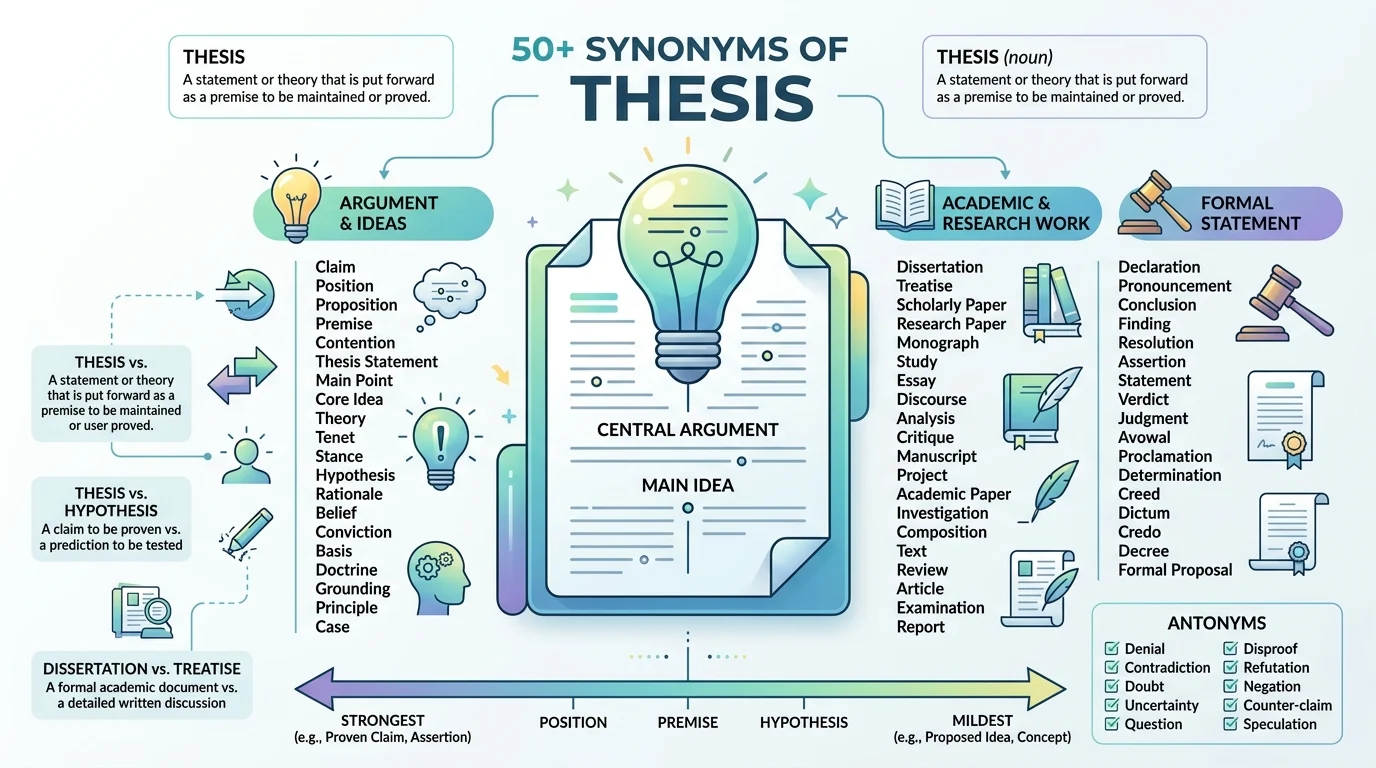
Have you ever needed to describe the central argument of an essay, a long research paper, or a proposition to be defended but felt that “main idea” or “point” was too vague? You want to capture the formal, structured nature of an academic argument, and the word “thesis” comes to mind. Choosing the right synonym for “thesis” can transform a simple statement into a precise declaration of purpose, argument, or position. This guide explores the best synonyms of thesis, explaining exactly which word to use and when.
Quick Ans: “Thesis” means a central argument, a proposition maintained by argument, or a long research paper for a degree. For the main argument, choose claim, argument, or proposition. For a dissertation, use dissertation or treatise. For a philosophical position, use contention or postulate. For a formal assertion, use assertion or declaration.
Meaning, Tone, and Context
Understanding the core meaning of “thesis” is the first step to using it effectively.
Simple Definition: A statement or theory that is put forward as a premise to be maintained or proved. A long essay or dissertation involving personal research, written for a university degree.
Part of Speech: Noun.
Overall Tone: Formal and academic. It indicates a structured, reasoned position.
Formality Level: Formal. The word is primarily used in academic, philosophical, and professional writing.
Common Uses: Native English speakers use it to describe the main argument of an essay, a doctoral dissertation, or a formal proposition. For example, “The thesis of her paper is that social media harms democracy,” or “He is writing his thesis on climate policy.”
Word Forms: Related words include the adjective thetical (rare) and the verb thesise (nonstandard). The plural is theses.
When and How to Use “Thesis”
“Thesis” is the perfect choice when you want to identify the central argument or a formal academic paper. Here are seven realistic examples.
Academic: “The thesis of the paper argues for stricter environmental regulations.”
Graduate School: “She is defending her doctoral thesis next month.”
Professional: “The report’s thesis is that remote work increases productivity.”
Philosophical: “His thesis challenges the nature of consciousness.”
Argumentative: “The central thesis of the book is that technology is neutral.”
Email: “The thesis of our proposal is that we need a new marketing strategy.”
Social Media: “The thesis of this video: small habits create big changes.”
Best Synonyms of “Thesis”
No synonym is identical in every situation. Here is your guide to the best replacement for “thesis” based on your writing context.
For the Central Argument
Most Direct: Claim means an assertion of truth. “The main claim of the essay is that education is a right.”
Formal: Argument means a reason or set of reasons. “Her argument is well-supported by evidence.”
Philosophical: Proposition means a statement to be considered. “The proposition was debated by the panel.”
Assertion: Assertion means a confident statement. “His assertion lacked evidence.”
Contention: Contention means a heated disagreement or argument. “The main contention is about funding.”
Postulate: Postulate means a hypothesis or assumption. “The postulate was tested in the experiment.”
For Academic Papers
Dissertation: Dissertation is a long essay for a degree. “He completed his dissertation on economic history.”
Treatise: Treatise is a formal written work. “The treatise covered all aspects of the subject.”
Paper: Paper is a general academic term. “She published a paper on climate change.”
Essay: Essay is a shorter academic work. “The essay explored themes of identity.”
For Formal Statements
Declaration: Declaration means a formal announcement. “The declaration of independence was historic.”
Manifesto: Manifesto means a public declaration of beliefs. “The manifesto outlined the party’s goals.”
Doctrine: Doctrine means a set of beliefs. “The doctrine was taught in all schools.”
When Not to Use “Thesis”
Using “thesis” can sound wrong or awkward in certain situations.
When You Mean “Topic”: “Thesis” is an argument. “Topic” is a subject.
Better Choice: Topic or subject. “The topic of the essay was friendship.”
When You Mean “Opinion”: “Thesis” is formal and structured. “Opinion” is personal.
Better Choice: Opinion or view. “In my opinion, the policy is flawed.”
When It Sounds Too Academic: In casual conversation, “thesis” can sound out of place.
Better Choice: Main idea or point. “The main idea is that we need to change.”
Words Commonly Confused With “Thesis”
| Word | Difference | When to Use | Example |
|---|---|---|---|
| Argument | Reasons for a position | General and formal | “Her argument is persuasive.” |
| Claim | An assertion of truth | General and direct | “The claim is unproven.” |
| Proposition | A statement to be considered | Philosophical and formal | “The proposition is debatable.” |
| Dissertation | A long academic paper | Graduate school | “He is writing his dissertation.” |
| Hypothesis | A proposed explanation | Scientific research | “The hypothesis was tested.” |
| Theme | A recurring idea | Literature and art | “The theme of the novel is loss.” |
Best Synonyms of “Thesis” by Context
| Context | Best Synonym | Why It Works | Example |
|---|---|---|---|
| Academic writing | Claim | Direct and precise | “The claim is well-supported.” |
| Argumentative essay | Argument | Standard term | “The argument is persuasive.” |
| Philosophy | Proposition | Formal and philosophical | “The proposition is debated.” |
| Graduate school | Dissertation | Specific to degree | “She finished her dissertation.” |
| Professional report | Contention | Formal and precise | “The main contention is about costs.” |
| Formal statement | Declaration | Formal and strong | “The declaration was signed.” |
| Casual conversation | Main point | Simple and natural | “The main point is clear.” |
How to Choose the Best Synonym of “Thesis”
Choosing the right word is a simple decision. Answer these questions.
What type of thesis am I describing? For an argument, use claim or argument. And For a paper, use dissertation or treatise. For a philosophical position, use proposition or postulate. For a formal statement, use declaration or manifesto.
What is my audience? For a professor, use argument or claim. For a friend, use main point or idea.
What is my purpose? Are you arguing, describing, or presenting? The correct synonym depends entirely on this.
What is the emotional strength? Manifesto and declaration are stronger. Claim and point are milder. Pick the one that matches your message.
Real Life Examples of “Thesis”
School: Basic: “The thesis is about climate change.” Improved: “The claim is that climate change requires immediate action.”
College: Basic: “She wrote her thesis.” Improved: “She completed her dissertation on economic policy.”
Workplace: Basic: “The thesis of the report is clear.” Improved: “The argument of the report is well-structured.”
Business: Basic: “The thesis is that we need to expand.” Improved: “The contention is that expansion is necessary.”
Email: Basic: “The thesis is simple.” Improved: “The main point is straightforward.”
Conversation: Basic: “What is the thesis?” Improved: “What is the main idea?”
Storytelling: Basic: “The thesis was powerful.” Improved: “The proposition was revolutionary.”
Top 10 Synonyms of “Thesis”
| Synonym | Simple Meaning | Best Used For | Example Sentence |
|---|---|---|---|
| Claim | An assertion of truth | General and academic | “The claim is supported by data.” |
| Argument | Reasons for a position | Essays and debates | “Her argument is persuasive.” |
| Proposition | A statement to be considered | Philosophy and logic | “The proposition is debatable.” |
| Contention | A point argued in a debate | Formal and professional | “The main contention is about funding.” |
| Assertion | A confident statement | Formal and direct | “His assertion was challenged.” |
| Postulate | A hypothesis or assumption | Scientific and philosophical | “The postulate was tested.” |
| Dissertation | A long academic paper | Graduate school | “She completed her dissertation.” |
| Treatise | A formal written work | Academic and legal | “The treatise covered all aspects.” |
| Declaration | A formal announcement | Formal and political | “The declaration was signed.” |
| Manifesto | A public declaration of beliefs | Political and artistic | “The manifesto outlined the goals.” |
Synonyms of “Thesis” by Usage
Professional vs. Personal Synonyms
In the workplace, choose argument, contention, or claim. With friends, use main point or idea.
Formal vs. Conversational Synonyms
For formal writing, use proposition, postulate, or declaration. For casual conversations, use main point or idea.
Academic Synonyms
For research and essays, choose claim for direct arguments, argument for structured reasoning, and dissertation for graduate work.
Professional and Business Synonyms
For maximum impact, choose contention for reports, argument for proposals, and claim for executive summaries.
Creative and Literary Synonyms
To add depth, choose manifesto, declaration, or proposition. These words create atmosphere.
Slang or Modern Synonyms
In modern American slang, main point, take, or angle are common. For example, “What is your take?” These are casual and should be avoided in formal writing.
Strongest to Mildest Synonyms
Mild: main point, idea, take
Moderate: thesis, claim, argument
Strong: proposition, contention, assertion
Very Strong: dissertation, manifesto, declaration
Emotional vs. Neutral Synonyms
Emotional Synonyms: Manifesto, declaration. These words hint at passion and conviction. Use them when you want to evoke feeling.
Neutral Synonyms: Thesis, claim, argument. These words communicate factual information about a position.
Antonyms of “Thesis”
| Antonym | Meaning | Example Sentence |
|---|---|---|
| Counterargument | An opposing argument | “The counterargument was strong.” |
| Refutation | Proof that something is false | “The refutation was convincing.” |
| Rebuttal | A reply to an argument | “His rebuttal was effective.” |
| Denial | Refusal to admit truth | “Her denial was firm.” |
| Contradiction | A statement that opposes | “The contradiction was obvious.” |
| Dissent | Disagreement with an opinion | “The dissent was noted.” |
| Objection | A reason against something | “The objection was overruled.” |
| Challenge | A call to prove something | “The challenge was accepted.” |
| Question | A doubt or uncertainty | “The question remains unanswered.” |
| Doubt | A feeling of uncertainty | “There is doubt about the claim.” |
| Disproof | Evidence that something is false | “The disproof was presented.” |
| Opposition | Resistance or disagreement | “The opposition was vocal.” |
| Rejection | Dismissal of an idea | “The rejection was unanimous.” |
| Dissension | Disagreement within a group | “The dissension was growing.” |
| Contrary view | An opposing perspective | “The contrary view was presented.” |
Comparison: “Thesis” vs Similar Words
Thesis vs. Claim
Main Difference: “Thesis” is the central argument. “Claim” is a specific assertion.
Which Is Stronger? “Thesis” is broader.
Which Is More Formal? Both are formal.
When to Use Each: Use “thesis” for the main argument. Use “claim” for specific points.
Examples:
Thesis: “The thesis of the paper is clear.”
Claim: “The claim is supported by evidence.”
Thesis vs. Argument
Main Difference: “Thesis” is the main idea. “Argument” is the reasoning.
Which Is Stronger? “Thesis” is more specific.
Which Is More Formal? Both are formal.
When to Use Each: Use “thesis” for the main point. Use “argument” for the reasoning.
Examples:
Thesis: “The thesis is that education is a right.”
Argument: “Her argument is persuasive.”
Thesis vs. Proposition
Main Difference: “Thesis” is an argument. “Proposition” is a statement to consider.
Which Is Stronger? “Thesis” is more argumentative.
Which Is More Formal? Both are formal.
When to Use Each: Use “proposition” in philosophy. Use “thesis” in essays.
Examples:
Thesis: “The thesis argues for change.”
Proposition: “The proposition was debated.”
Thesis vs. Dissertation
Main Difference: “Thesis” can be a main argument. “Dissertation” is a long academic paper.
Which Is Stronger? “Dissertation” is more specific.
Which Is More Formal? Both are formal.
When to Use Each: Use “dissertation” for graduate work. Use “thesis” for the main argument.
Examples:
Thesis: “The thesis is about identity.”
Dissertation: “She wrote her dissertation on identity.”
Thesis vs. Hypothesis
Main Difference: “Thesis” is an argument. “Hypothesis” is a proposed explanation.
Which Is Stronger? They serve different purposes.
Which Is More Formal? Both are formal.
When to Use Each: Use “hypothesis” in science. Use “thesis” in humanities.
Examples:
Thesis: “The thesis is that technology is neutral.”
Hypothesis: “The hypothesis was tested.”
Thesis vs. Theme
Main Difference: “Thesis” is an argument. “Theme” is a recurring idea.
Which Is Stronger? They are different.
Which Is More Formal? Both are formal.
When to Use Each: Use “theme” in literature. Use “thesis” in essays.
Examples:
Thesis: “The thesis is that love conquers all.”
Theme: “The theme of the novel is love.”
Common Phrases and Expressions with “Thesis”
Phrase: Thesis statement
Meaning: A sentence that states the main argument.
Example Sentence: “The thesis statement is at the end of the introduction.”
Phrase: Central thesis
Meaning: The main argument.
Example Sentence: “The central thesis is clearly stated.”
Phrase: Doctoral thesis
Meaning: A thesis for a PhD.
Example Sentence: “He is writing his doctoral thesis.”
Phrase: Master’s thesis
Meaning: A thesis for a master’s degree.
Example Sentence: “She completed her master’s thesis.”
Phrase: Defend a thesis
Meaning: To argue for a thesis.
Example Sentence: “He will defend his thesis next week.”
Common Mistakes to Avoid
Mistake 1: Using “thesis” when you mean “topic”.
Incorrect: “The thesis is climate change.”
Better: “The topic is climate change.”
Why: “Thesis” is an argument. “Topic” is a subject.
Mistake 2: Using “thesis” in casual conversation.
Incorrect: “My thesis is that pizza is great.”
Better: “My point is that pizza is great.”
Why: “Point” sounds more natural.
Mistake 3: Using “thesis” when you mean “opinion”.
Incorrect: “My thesis is that the movie was good.”
Better: “My opinion is that the movie was good.”
Why: “Opinion” is personal.
Mistake 4: Using “thesis” when you mean “hypothesis”.
Incorrect: “The thesis was tested in the lab.”
Better: “The hypothesis was tested in the lab.”
Why: “Hypothesis” is scientific.
Mistake 5: Using “thesis” when you mean “dissertation”.
Incorrect: “She wrote a thesis for her PhD.”
Better: “She wrote a dissertation for her PhD.”
Why: “Dissertation” is the term for a PhD paper.
Frequently Asked Questions
1. What are the best synonyms of “thesis”?
The best synonyms depend on your context. For an argument, choose claim or argument. And For a paper, use dissertation or treatise. For a philosophical position, use proposition or postulate.
2. What are the best formal synonyms of “thesis”?
The best formal synonyms are proposition, contention, and assertion. These words are suitable for academic papers, professional reports, and philosophical writing.
3. What are common informal synonyms of “thesis”?
For informal settings, use main point, idea, or take. These alternatives sound more natural in everyday conversation.
4. What is another word for “thesis” in professional writing?
In professional writing, argument is an excellent choice. It conveys structured reasoning. Contention is also strong for reports.
5. What is the difference between “thesis” and “claim”?
“Thesis” is the central argument. “Claim” is a specific assertion. Use “thesis” for the main idea and “claim” for supporting points.
6. What is the opposite of “thesis”?
The most direct opposites (antonyms) of thesis are counterargument, refutation, and rebuttal. These words describe opposing positions.
Conclusion
“Thesis” is a formal, powerful, and essential word for describing the central argument of an essay, a research paper, or a formal proposition. The term is academic and widely accepted in scholarly contexts, yet it can sound too formal for casual conversation or too specific for general ideas. The best choice among the synonyms of thesis depends entirely on your audience, tone, and purpose. Remember, no single synonym works perfectly in every situation. Your goal is to choose the word that communicates your message with the most clarity and impact. A practical tip for your vocabulary growth is to pay attention to how writers structure arguments and practice using different synonyms in your writing.









