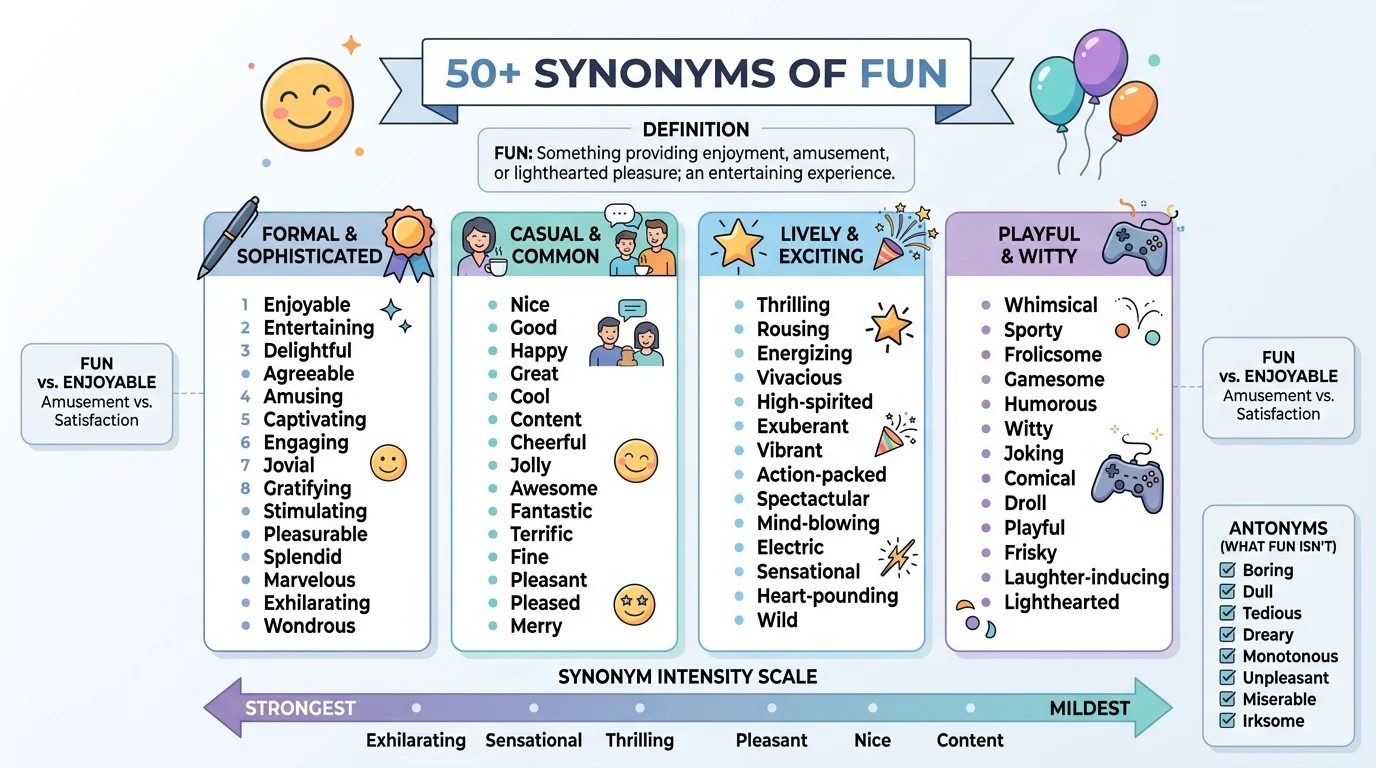
Have you ever needed to describe something enjoyable, entertaining, or amusing but felt that “fun” was too simple or repetitive? You want to capture the joy, excitement, or pleasure of an experience, and the word “fun” comes to mind. Choosing the right synonym for “fun” can transform a basic statement into a precise expression of enjoyment, amusement, or delight. This guide explores the best synonyms of fun, explaining exactly which word to use and when.
Quick Ans: “Fun” means enjoyment, amusement, or lighthearted pleasure. For formal writing, choose enjoyable or pleasurable. For casual conversation, use awesome or cool. For lively events, use entertaining or lively. For playful activities, use amusing or delightful. For a thrilling experience, use exciting or thrilling.
Meaning, Tone, and Context
Understanding the core meaning of “fun” is the first step to using it effectively.
Simple Definition: Enjoyment, amusement, or lighthearted pleasure. Something that provides entertainment or joy.
Part of Speech: Noun and adjective.
Overall Tone: Positive and lighthearted. It indicates pleasure, enjoyment, and amusement.
Formality Level: Informal to neutral. The word is most common in casual contexts.
Common Uses: Native English speakers use it to describe activities, events, people, and experiences. For example, “We had so much fun at the party,” or “That was a fun movie.”
Word Forms: Related words include the adverb funnily, the noun funness, and the adjective funny (which has a different meaning).
When and How to Use “Fun”
“Fun” is the perfect choice when you want to describe enjoyment and lighthearted pleasure. Here are seven realistic examples.
Professional: “The team-building event was both productive and fun.”
Academic: “The study examined how fun activities enhance learning.”
Workplace: “We try to make the workplace fun and engaging.”
Personal: “We had a fun day at the beach.”
Email: “Thanks for a fun meeting yesterday.”
Resume: (Rarely used) “Organized fun team events to boost morale.”
Social Media: “Had a fun time with friends last night!”
Best Synonyms of “Fun”
No synonym is identical in every situation. Here is your guide to the best replacement for “fun” based on your writing context.
For Formal and Professional Contexts
Most Formal: Enjoyable means giving pleasure. “The event was enjoyable for all attendees.”
Pleasurable: Pleasurable means giving pleasure. “It was a pleasurable experience.”
Entertaining: Entertaining means providing amusement. “The speaker was entertaining.”
Engaging: Engaging means interesting and absorbing. “The activity was engaging.”
For Casual and Social Contexts
Awesome: Awesome means extremely good. “That was an awesome party.”
Cool: Cool means fashionable or excellent. “That is a cool idea.”
Great: Great means very good. “We had a great time.”
Amazing: Amazing means causing great wonder. “The concert was amazing.”
For Lively and Exciting Contexts
Lively: Lively means full of energy. “The party was lively.”
Exciting: Exciting means causing excitement. “The game was exciting.”
Thrilling: Thrilling means causing excitement and adrenaline. “The roller coaster was thrilling.”
Exhilarating: Exhilarating means invigorating and exciting. “The hike was exhilarating.”
For Playful and Amusing Contexts
Amusing: Amusing means causing laughter. “His story was amusing.”
Delightful: Delightful means causing delight. “The children were delightful.”
Playful: Playful means fond of games and amusement. “The puppy was playful.”
Joyful: Joyful means feeling great happiness. “The celebration was joyful.”
When Not to Use “Fun”
Using “fun” can sound wrong or awkward in certain situations.
When You Mean “Funny”: “Fun” is enjoyment. “Funny” is humor.
Better Choice: Funny or hilarious. “The joke was funny.”
When It Sounds Too Casual: In formal writing, “fun” can sound too informal.
Better Choice: Enjoyable or pleasurable. “The experience was enjoyable.”
When You Mean “Interesting”: “Fun” is about enjoyment. “Interesting” is about curiosity.
Better Choice: Interesting or fascinating. “The lecture was fascinating.”
Words Commonly Confused With “Fun”
| Word | Difference | When to Use | Example |
|---|---|---|---|
| Funny | Causes laughter | Humor and jokes | “The comedian was funny.” |
| Enjoyable | Gives pleasure | Formal and general | “The trip was enjoyable.” |
| Entertaining | Provides amusement | Performances and events | “The show was entertaining.” |
| Interesting | Arouses curiosity | Learning and discovery | “The book was interesting.” |
| Amusing | Causes light laughter | Mild humor | “His comment was amusing.” |
| Delightful | Causes great pleasure | Charming experiences | “The garden was delightful.” |
Best Synonyms of “Fun” by Context
| Context | Best Synonym | Why It Works | Example |
|---|---|---|---|
| Formal writing | Enjoyable | Formal and precise | “The event was enjoyable.” |
| Professional | Engaging | Professional and positive | “The workshop was engaging.” |
| Casual conversation | Awesome | Simple and natural | “That was awesome!” |
| Lively event | Entertaining | Emphasizes amusement | “The performance was entertaining.” |
| Exciting activity | Thrilling | Emphasizes excitement | “The ride was thrilling.” |
| Playful activity | Amusing | Emphasizes laughter | “The game was amusing.” |
| Emotional | Joyful | Emphasizes happiness | “The celebration was joyful.” |
How to Choose the Best Synonym of “Fun”
Choosing the right word is a simple decision. Answer these questions.
What type of fun am I describing? For formal, use enjoyable. And For casual, use awesome. For lively, use entertaining. And For exciting, use thrilling. For playful, use amusing.
What is my audience? For a formal report, use enjoyable or engaging. For a friend, use awesome or cool.
What is my purpose? Are you describing an event, a person, or an activity? The correct synonym depends entirely on this.
What is the emotional strength? Thrilling and exhilarating are stronger. Nice and pleasant are milder. Pick the one that matches your message.
Real Life Examples of “Fun”
School: Basic: “The field trip was fun.” Improved: “The field trip was enjoyable and educational.”
College: Basic: “The party was fun.” Improved: “The party was lively and entertaining.”
Workplace: Basic: “The team event was fun.” Improved: “The team event was engaging and enjoyable.”
Business: Basic: “The conference was fun.” Improved: “The conference was engaging and well-organized.”
Email: Basic: “Thanks for a fun time.” Improved: “Thanks for a delightful evening.”
Conversation: Basic: “That was fun.” Improved: “That was awesome.”
Storytelling: Basic: “The festival was fun.” Improved: “The festival was joyful and full of laughter.”
Top 10 Synonyms of “Fun”
| Synonym | Simple Meaning | Best Used For | Example Sentence |
|---|---|---|---|
| Enjoyable | Giving pleasure | Formal and general | “The trip was enjoyable.” |
| Entertaining | Providing amusement | Performances and events | “The show was entertaining.” |
| Amusing | Causing light laughter | Mild humor | “His story was amusing.” |
| Delightful | Causing great pleasure | Charming experiences | “The garden was delightful.” |
| Lively | Full of energy | Parties and events | “The party was lively.” |
| Exciting | Causing excitement | Thrilling activities | “The game was exciting.” |
| Thrilling | Causing excitement and adrenaline | Adventures and rides | “The roller coaster was thrilling.” |
| Engaging | Interesting and absorbing | Professional and academic | “The workshop was engaging.” |
| Awesome | Extremely good | Casual and social | “That was awesome!” |
| Joyful | Feeling great happiness | Emotional and celebratory | “The celebration was joyful.” |
Synonyms of “Fun” by Usage
Professional vs. Personal Synonyms
In the workplace, choose engaging, enjoyable, or entertaining. With friends, use awesome, cool, or great.
Formal vs. Conversational Synonyms
For formal writing, use enjoyable, pleasurable, or engaging. For casual conversations, use awesome, cool, or amazing.
Academic Synonyms
For research and essays, choose engaging for activities, enjoyable for experiences, and playful for developmental contexts.
Professional and Business Synonyms
For maximum impact, choose engaging for workshops, enjoyable for events, and entertaining for presentations.
Creative and Literary Synonyms
To add emotion and imagery, choose joyful, delightful, or exhilarating. These words create atmosphere.
Slang or Modern Synonyms
In modern American slang, awesome, cool, lit, epic, or a blast are common. For example, “That party was lit,” or “We had a blast.” These are casual and should be avoided in formal writing.
Strongest to Mildest Synonyms
Mild: nice, pleasant, okay
Moderate: fun, enjoyable, amusing
Strong: entertaining, lively, exciting
Very Strong: thrilling, exhilarating, awesome, joyful
Emotional vs. Neutral Synonyms
Emotional Synonyms: Joyful, thrilling, exhilarating. These words hint at strong positive emotion. Use them when you want to evoke feeling.
Neutral Synonyms: Enjoyable, pleasant, nice. These words communicate factual information about enjoyment.
Antonyms of “Fun”
| Antonym | Meaning | Example Sentence |
|---|---|---|
| Boring | Not interesting | “The lecture was boring.” |
| Dull | Lacking interest | “The party was dull.” |
| Tedious | Too long and tiresome | “The task was tedious.” |
| Monotonous | Repetitive and boring | “The work was monotonous.” |
| Tiresome | Causing fatigue | “The journey was tiresome.” |
| Unpleasant | Not enjoyable | “The experience was unpleasant.” |
| Miserable | Very unhappy | “The weather was miserable.” |
| Depressing | Causing sadness | “The news was depressing.” |
| Gloomy | Dark and sad | “The atmosphere was gloomy.” |
| Serious | Not playful | “The meeting was serious.” |
| Solemn | Formal and dignified | “The ceremony was solemn.” |
| Grave | Very serious | “The situation was grave.” |
| Laborious | Requiring much effort | “The process was laborious.” |
| Arduous | Difficult and tiring | “The climb was arduous.” |
| Wearisome | Causing tiredness | “The delay was wearisome.” |
Comparison: “Fun” vs Similar Words
Fun vs. Funny
Main Difference: “Fun” is enjoyment. “Funny” is humor.
Which Is Stronger? They are different. “Fun” is about pleasure. “Funny” is about laughter.
Which Is More Formal? Both are informal.
When to Use Each: Use “fun” for enjoyable activities. Use “funny” for jokes.
Examples:
Fun: “The party was fun.”
Funny: “The joke was funny.”
Fun vs. Enjoyable
Main Difference: “Enjoyable” is more formal. “Fun” is casual.
Which Is Stronger? They are similar. “Enjoyable” is more formal.
Which Is More Formal? “Enjoyable” is more formal.
When to Use Each: Use “enjoyable” in formal writing. Use “fun” in casual conversation.
Examples:
Fun: “We had fun.”
Enjoyable: “The experience was enjoyable.”
Fun vs. Entertaining
Main Difference: “Entertaining” is about amusement. “Fun” is broader.
Which Is Stronger? “Entertaining” is more specific.
Which Is More Formal? “Entertaining” is more formal.
When to Use Each: Use “entertaining” for performances. Use “fun” for general enjoyment.
Examples:
Fun: “The game was fun.”
Entertaining: “The show was entertaining.”
Fun vs. Amusing
Main Difference: “Amusing” causes light laughter. “Fun” is broader enjoyment.
Which Is Stronger? “Amusing” is more specific to humor.
Which Is More Formal? “Amusing” is more formal.
When to Use Each: Use “amusing” for humor. Use “fun” for enjoyment.
Examples:
Fun: “The activity was fun.”
Amusing: “The story was amusing.”
Fun vs. Thrilling
Main Difference: “Thrilling” is exciting and intense. “Fun” is lighter.
Which Is Stronger? “Thrilling” is stronger.
Which Is More Formal? Both are neutral.
When to Use Each: Use “thrilling” for adventure. Use “fun” for general enjoyment.
Examples:
Fun: “The ride was fun.”
Thrilling: “The ride was thrilling.”
Fun vs. Joyful
Main Difference: “Joyful” is deep happiness. “Fun” is lighthearted.
Which Is Stronger? “Joyful” is stronger for emotion.
Which Is More Formal? “Joyful” is more formal.
When to Use Each: Use “joyful” for celebrations. Use “fun” for activities.
Examples:
Fun: “The party was fun.”
Joyful: “The celebration was joyful.”
Common Phrases and Expressions with “Fun”
Phrase: Have fun
Meaning: Enjoy yourself.
Example Sentence: “Have fun at the party!”
Phrase: For fun
Meaning: For enjoyment, not seriously.
Example Sentence: “I paint for fun.”
Phrase: Fun and games
Meaning: Enjoyable activities.
Example Sentence: “It is not all fun and games.”
Phrase: Make fun of
Meaning: Tease or mock.
Example Sentence: “Do not make fun of him.”
Phrase: A lot of fun
Meaning: Very enjoyable.
Example Sentence: “We had a lot of fun.”
Phrase: Fun-loving
Meaning: Enjoying good times.
Example Sentence: “She is a fun-loving person.”
Common Mistakes to Avoid
Mistake 1: Using “fun” when you mean “funny”.
Incorrect: “The comedian was fun.”
Better: “The comedian was funny.”
Why: “Fun” is enjoyment. “Funny” is humor.
Mistake 2: Using “fun” in formal writing.
Incorrect: “The conference was fun.”
Better: “The conference was enjoyable.”
Why: “Enjoyable” is more formal.
Mistake 3: Overusing “fun” in conversation.
Incorrect: “That was fun.”
Better: “That was awesome.”
Why: “Awesome” adds variety.
Mistake 4: Using “fun” when you mean “interesting”.
Incorrect: “The lecture was fun.”
Better: “The lecture was interesting.”
Why: “Interesting” is for learning.
Mistake 5: Using “fun” when you mean “thrilling”.
Incorrect: “The roller coaster was fun.”
Better: “The roller coaster was thrilling.”
Why: “Thrilling” is stronger for excitement.
Frequently Asked Questions
1. What are the best synonyms of “fun”?
The best synonyms depend on your context. For formal writing, choose enjoyable or engaging. And For casual conversation, use awesome or cool. For lively events, use entertaining or lively.
2. What are the best formal synonyms of “fun”?
The best formal synonyms are enjoyable, pleasurable, and engaging. These words are suitable for academic papers, professional reports, and business communications.
3. What are common informal synonyms of “fun”?
For informal settings, use awesome, cool, great, or amazing. These alternatives sound more natural in everyday conversation.
4. What is another word for “fun” in professional writing?
In professional writing, engaging is an excellent choice. It conveys enjoyment and interest. Enjoyable is also strong for events.
5. What is the difference between “fun” and “funny”?
“Fun” means enjoyable. “Funny” means causing laughter. Use “fun” for activities and “funny” for humor.
6. What is the opposite of “fun”?
The most direct opposites (antonyms) of fun are boring, dull, and tedious. These words describe things that are not enjoyable.
Conclusion
“Fun” is a simple, versatile, and universally understood word for describing enjoyment and lighthearted pleasure. The term is informal and widely accepted in casual contexts, yet it can sound too simple for formal writing or too vague for specific descriptions. The best choice among the synonyms of fun depends entirely on your audience, tone, and purpose. Remember, no single synonym works perfectly in every situation. Your goal is to choose the word that communicates your message with the most clarity and impact. A practical tip for your vocabulary growth is to pay attention to how writers express enjoyment and practice using different synonyms in your writing.










2 thoughts on “50+ Synonyms of Fun: Meanings, Uses, Examples, and Best Alternatives 2026”