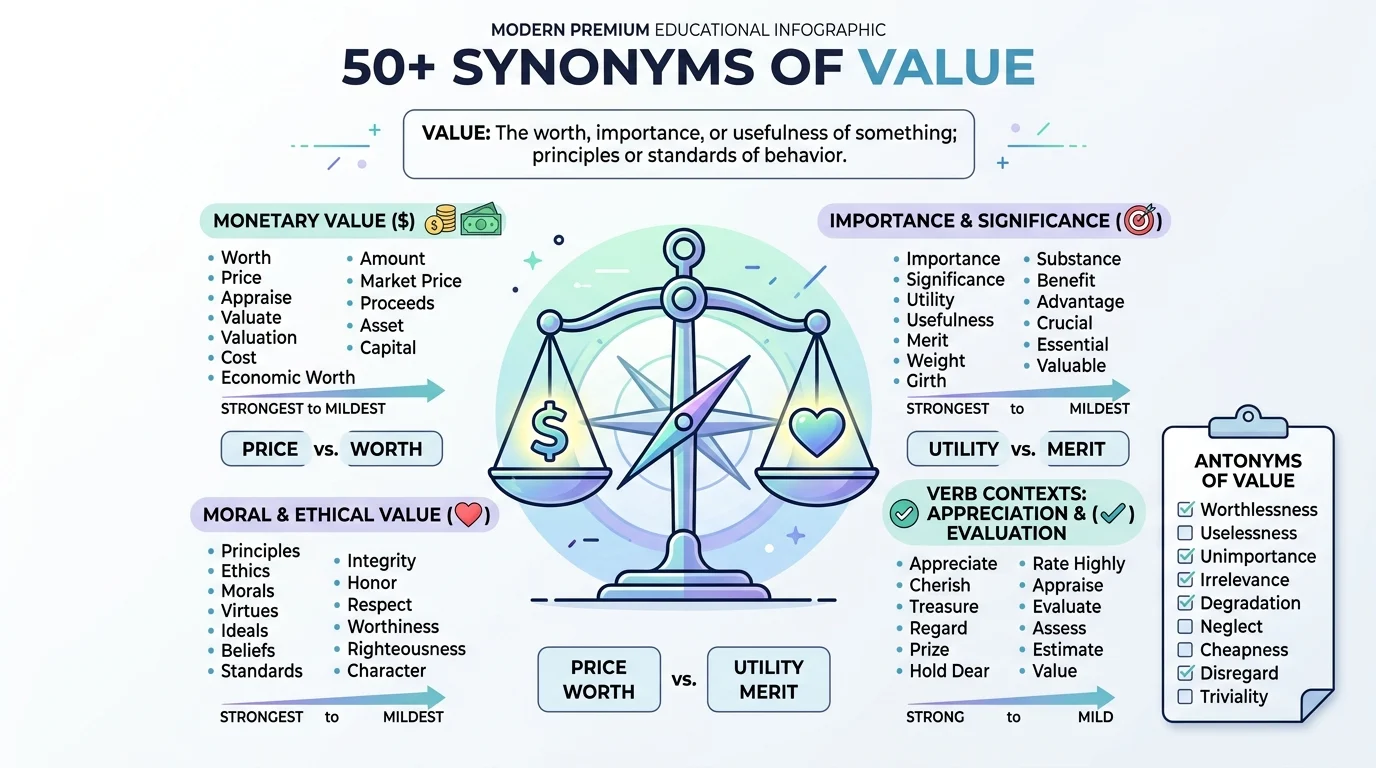
Have you ever tried to describe the worth of something, the importance of an idea, or the moral principles you live by but found yourself repeating the same word? You want to express cost, significance, or personal belief, and the word “value” comes to mind. Choosing the right synonym for “value” can transform a vague statement into a precise expression of worth, principle, or estimation. This guide explores the best synonyms of value, explaining exactly which word to use and when.
Quick Ans: “Value” can mean the monetary worth of something, its importance or usefulness, or a person’s moral principles . For monetary worth, choose price or cost . For importance, use significance or merit . For moral principles, use ethics or standards . As a verb, appreciate, prize, or treasure convey holding something in high regard . For assessing worth, use appraise or evaluate .
Meaning, Tone, and Context
Understanding the core meaning of “value” is the first step to using it effectively.
Simple Definition: The worth, importance, or usefulness of something; a person’s moral principles or standards; the amount of money something is worth .
Part of Speech: Noun and verb.
Overall Tone: Neutral to positive. It can describe practical worth, emotional significance, or moral conviction.
Formality Level: Neutral. The word works in almost any context, from casual conversation to formal academic writing.
Common Uses: Native English speakers use it to discuss money, importance, personal principles, and estimation. For example, “The value of the house has increased,” “She places great value on education,” “His values guide his decisions,” or “He values honesty above all else.”
Word Forms: Related words include the adjective valuable, the noun valuation, the verb valuate, and the adverb valuably.
When and How to Use “Value”
“Value” is the perfect choice when you want to express worth, importance, or personal conviction. Here are seven realistic examples.
Professional: “The company’s core values are integrity and innovation.”
Academic: “The study has significant value for future research in this field.”
Workplace: “We need to value the contributions of every team member.”
Personal: “I value honesty above all other qualities in a friend.”
Email: “Please provide a valuation for the equipment in the proposal.”
Resume: “Strong leadership skills and a commitment to professional values.”
Social Media: “Real value comes from the connections we make, not the things we buy.”
Best Synonyms of “Value”
No synonym is identical in every situation. Here is your guide to the best replacement for “value” based on your writing context.
For Monetary Worth (Noun)
Professional: Price is the most direct synonym for how much something costs . “The price of the property has doubled.”
Formal: Worth emphasizes intrinsic or personal value . “He has a personal net worth of $10 million” .
Business: Cost focuses on what is paid to acquire something . “We need to reduce production costs.”
Valuation: Estimation or appraisal are used for formal assessments . “The appraisal set the value at $500,000.”
For Importance or Usefulness (Noun)
Professional: Significance suggests importance or meaning . “The discovery has great significance for medical research.”
Academic: Merit implies worth based on quality . “The proposal has considerable merit.”
General: Usefulness is simple and direct . “The usefulness of the tool is undeniable.”
Formal: Utility suggests practical benefits . “The utility of the software is clear.”
For Moral Principles or Beliefs (Noun)
Professional: Ethics describes professional or moral standards . “The company has a strong code of ethics.”
Personal: Principles suggests fundamental beliefs guiding behavior . “She is a woman of strong principles.”
General: Standards are acceptable levels of behavior . “We must uphold our moral standards.”
Inspirational: Ideals implies lofty, aspirational goals . “He lives by democratic ideals.”
For Holding in High Regard (Verb)
Professional: Appreciate suggests recognizing worth and expressing gratitude . “I appreciate your hard work on this project.”
Personal: Prize implies great value and affection . “I prize these old photographs.”
Emotional: Treasure suggests deep sentimental attachment . “She treasures the memories of her childhood.”
Formal: Esteem implies great respect . “He was highly esteemed by his colleagues.”
For Assessing Worth (Verb)
Formal: Appraise suggests professional assessment . “The property was appraised at $750,000.”
Professional: Evaluate suggests careful assessment . “We need to evaluate all assets.”
General: Assess is widely used and understood . “The damages were assessed at $10,000.”
When Not to Use “Value”
Using “value” can sound wrong or awkward in certain situations.
When You Mean the Exact Cost: “Value” is not a precise number. Use the actual price.
Better Choice: Price. “The price is $100.”
When It Sounds Too Abstract: “Value” can be vague. Use a more specific word for concrete situations.
Better Choice: Worth. “What is the worth of the painting?”
When You Lack Conviction: “Value” implies deep regard. Use like or prefer for mild feelings.
Better Choice: Prefer. “I prefer this option.”
When It Is Too Formal: In casual conversation, “value” can sound stiff.
Better Choice: Like or enjoy. “I enjoy spending time with you.”
Words Commonly Confused With “Value”
Several words are often mixed up with “value.” Here is how to keep them straight.
Word: Price
Difference: “Price” is the exact monetary cost. “Value” is broader and more subjective .
When to Use: Use it for what you pay.
Example: “The price of the new car is $30,000.”
Word: Worth
Difference: “Worth” is intrinsic or personal value. “Value” can be monetary or moral .
When to Use: Use this for personal or emotional significance.
Example: “Her advice is worth more than gold.”
Word: Cost
Difference: “Cost” is what is given up to acquire something. “Value” is what something is worth .
When to Use: Use this for expenses or sacrifices.
Example: “The cost of the project exceeded the budget.”
Word: Importance
Difference: “Importance” is about significance. “Value” can be monetary or moral .
When to Use: Use this for how much something matters.
Example: “The importance of education cannot be overstated.”
Word: Ethics
Difference: “Ethics” are professional or moral standards. “Value” can also be a moral principle .
When to Use: Use this for professional codes of conduct.
Example: “The ethics of the situation were clear.”
Word: Appraise
Difference: “Appraise” is the professional assessment. “Value” can be the verb or the noun .
When to Use: Use this for formal estimation.
Example: “The ring was appraised at $10,000.”
Best Synonyms of “Value” by Context
| Context | Best Synonym | Why It Works | Example |
|---|---|---|---|
| Monetary worth | Price | Direct and widely understood . | “The market price of oil continues to rise.” |
| Personal worth | Worth | Emphasizes intrinsic value . | “His worth to the team goes beyond his salary.” |
| Significance | Importance | Clear and universal . | “The importance of this decision cannot be overstated.” |
| Quality | Merit | Suggests worth based on excellence . | “The idea has real merit.” |
| Usefulness | Utility | Formal for practical benefits . | “The utility of the new software is clear.” |
| Moral principles | Ethics | Professional and precise . | “The company operates on strong ethics.” |
| Core beliefs | Principles | Personal and guiding . | “She never compromises her principles.” |
| To hold in high regard | Cherish | Emotional and affectionate . | “I cherish our friendship.” |
| To assess worth | Evaluate | Professional and careful . | “We need to evaluate all assets.” |
| Casual conversation | Like | Simple, natural, and conversational. | “I like your approach.” |
How to Choose the Best Synonym of “Value”
Choosing the right word is a simple decision. Answer these questions.
What kind of value am I describing? Is it monetary, practical, moral, or emotional? Use price for money, utility for practicality, ethics for morality, and cherish for emotion.
What is my audience? For a business leader, use appraisal or evaluation. And for a friend, use like or enjoy. For a moral discussion, use principles or ideals.
What is my purpose? Are you describing cost, expressing gratitude, or stating a belief? The correct synonym depends entirely on this.
What is the emotional strength? Prize and treasure are stronger and warmer. Appreciate is milder and more professional. Pick the one that matches your message.
Real Life Examples of “Value”
To truly master the word, it helps to see how it behaves in the wild and how a stronger synonym can elevate the sentence.
School: Basic: “The teacher values honesty.” Improved: “The teacher cherishes honesty as the most important virtue.”
College: Basic: “The value of the research is high.” Improved: “The significance of the research cannot be overstated.”
Workplace: Basic: “We need to value our employees.” Improved: “We need to appreciate and treasure the contributions of our employees.”
Business: Basic: “The value of the company has grown.” Improved: “The valuation of the company has increased substantially.”
Email: Basic: “I value your feedback.” Improved: “I appreciate your thoughtful feedback.”
Conversation: Basic: “I value your friendship.” Improved: “I treasure your friendship more than you know.”
Storytelling: Basic: “The ring was of great value.” Improved: “The ring was priceless, an heirloom of immeasurable worth.”
Top 10 Synonyms of “Value” (Noun)
| Synonym | Simple Meaning | Best Used For | Example Sentence |
|---|---|---|---|
| Price | The monetary cost | Business and shopping contexts. | “The price of this jacket is too high.” |
| Worth | Intrinsic or personal value | Personal and emotional contexts. | “Her advice is worth more than gold.” |
| Cost | What is paid to acquire something | Business and expense contexts. | “The cost of the project was significant.” |
| Importance | Significance and relevance | Academic and general contexts. | “The importance of family cannot be overstated.” |
| Merit | Quality and excellence | Academic and professional contexts. | “The proposal has merit.” |
| Significance | Meaning and impact | Academic and formal contexts. | “The discovery is of immense significance.” |
| Utility | Practical usefulness | Technical and functional contexts. | “The utility of the new tool is clear.” |
| Benefit | Advantage or gain | Business and personal contexts. | “There are many benefits to this approach.” |
| Ethics | Moral principles | Professional and moral contexts. | “The company is committed to high ethics.” |
| Principles | Guiding beliefs | Personal and moral contexts. | “She stands by her principles.” |
Top 10 Synonyms of “Value” (Verb)
| Synonym | Simple Meaning | Best Used For | Example Sentence |
|---|---|---|---|
| Appreciate | Recognize worth and gratitude | Professional and personal contexts. | “I appreciate your help.” |
| Prize | Hold in high regard | Personal and emotional contexts. | “I prize your friendship.” |
| Treasure | Deeply cherish | Sentimental and family contexts. | “She treasures that necklace.” |
| Esteem | Hold in high respect | Professional and formal contexts. | “He is highly esteemed in the community.” |
| Cherish | Protect and care for lovingly | Emotional and personal contexts. | “We cherish our memories together.” |
| Appraise | Assess monetary worth | Business and legal contexts. | “The property was appraised.” |
| Evaluate | Assess overall worth | Professional and academic contexts. | “We need to evaluate the situation.” |
| Assess | Judge or determine worth | Professional and general contexts. | “The damages were assessed at $10,000.” |
| Respect | Hold in high regard | Professional and personal contexts. | “I respect her opinion.” |
| Admire | Regard with approval | Personal and casual contexts. | “I admire her dedication.” |
Synonyms of “Value” by Usage
Professional vs. Personal Synonyms
In the workplace (professional), choose price, cost, appraise, or evaluate for monetary contexts. Use appreciate and respect for professional regard. “We must evaluate the project’s utility before proceeding” is more precise than “We must value the project before proceeding” .
With friends (personal), prize, treasure, or cherish convey deep emotional regard. These alternatives sound warm and natural.
Formal vs. Conversational Synonyms
For formal writing (reports, essays, professional emails), use significance, utility, appraise, or esteem . For casual conversations and texting, use like, enjoy, or price. These options sound more natural and less pretentious.
Academic Synonyms
For research and essays, choose precise, authoritative words. Significance is strong for importance. Merit is great for quality-based worth. Utility is useful for functional contexts . These words sound considered and scholarly.
Professional and Business Synonyms
For maximum impact in business writing, choose price for cost, cost for expenses, appraise for assessment, and evaluate for careful judgment. These words demonstrate confidence and professional awareness .
Creative and Literary Synonyms
To add emotion and imagery to your writing, choose treasure, cherish, or prize. These words create warmth and evoke deep feeling .
Strongest to Mildest Synonyms (Verb)
Mild: like, enjoy, prefer
Moderate: appreciate, respect, regard
Strong: prize, esteem, value
Very Strong: treasure, cherish
Emotional vs. Neutral Synonyms
Emotional Synonyms: Treasure, cherish, prize. These words often hint at love, deep affection, or nostalgia . Use them when you want to evoke feeling.
Neutral Synonyms: Appraise, evaluate, assess. These words simply communicate factual information. Use them when you want to inform without emotional coloring .
Antonyms of “Value”
| Antonym | Meaning | Example Sentence |
|---|---|---|
| Worthlessness | Having no value | “The gem was worthless.” |
| Inutility | Being useless | “The tool was inutile.” |
| Triviality | Being unimportant | “The issue was trivial.” |
| Contempt | Lack of respect | “He felt contempt for the act.” |
| Disregard | Paying no attention | “She showed disregard for the rules.” |
| Discard | To throw away | “They decided to discard the old equipment.” |
| Neglect | To fail to care for | “He neglected his duties.” |
| Dishonor | Loss of respect | “The act was a dishonor to his family.” |
| Disdain | Intense dislike | “She treated him with disdain.” |
| Rejection | Refusal to accept | “The proposal faced rejection.” |
Comparison: “Value” vs Similar Words
Value vs. Price
Main Difference: “Value” is subjective and broad. “Price” is the exact monetary cost .
Which Is Stronger? “Price” is more specific. “Value” is more meaningful in many contexts.
Which Is More Formal? Both are neutral.
When to Use Each: Use “price” for exact cost. Use “value” for worth beyond cost.
Examples:
Value: “The value of this necklace is sentimental, not financial.”
Price: “The price of this necklace is $500.”
Value vs. Worth
Main Difference: “Worth” is often intrinsic. “Value” can be monetary or moral .
Which Is Stronger? “Worth” is often more personal.
Which Is More Formal? Both are formal.
When to Use Each: Use “worth” for personal or intrinsic value. Use “value” for monetary or broad contexts.
Examples:
Value: “The value of the property has increased.”
Worth: “His worth as a leader is immense.”
Value vs. Importance
Main Difference: “Importance” is about significance. “Value” can also be monetary .
Which Is Stronger? “Importance” is stronger for significance.
Which Is More Formal? Both are formal.
When to Use Each: Use “importance” when you mean “how much something matters.” Use “value” for a broader range of meanings.
Examples:
Value: “The value of education is clear.”
Importance: “The importance of education cannot be overstated.”
Value vs. Benefit
Main Difference: “Benefit” is a positive advantage. “Value” is broader .
Which Is Stronger? “Benefit” is more specific to advantages.
Which Is More Formal? Both are neutral.
When to Use Each: Use “benefit” when talking about advantages. Use “value” for broader worth.
Examples:
Value: “The value of the course is in its content.”
Benefit: “The benefit of the course is career advancement.”
Appreciate vs. Value (Verb)
Main Difference: “Appreciate” often implies gratitude. “Value” implies worth .
Which Is Stronger? “Value” is stronger for belief. “Appreciate” is warmer.
Which Is More Formal? “Appreciate” is professional. “Value” is neutral.
When to Use Each: Use “appreciate” for gratitude. Use “value” for deep regard.
Examples:
Value: “I value your opinion.”
Appreciate: “I appreciate your help.”
Common Phrases and Expressions with “Value”
Phrase: Value for money
Meaning: Good worth relative to the cost.
Example Sentence: “The dinner was good value for money.”
Phrase: Core values
Meaning: The fundamental principles guiding behavior.
Example Sentence: “Integrity is one of our core values.”
Phrase: Value judgment
Meaning: A judgment based on personal beliefs.
Example Sentence: “I cannot make a value judgment on this issue.”
Phrase: Place value on
Meaning: To consider something important.
Example Sentence: “She places great value on education.”
Phrase: Value-added
Meaning: Something that increases worth.
Example Sentence: “The feature is a value-added service.”
Phrase: Of value
Meaning: Important or useful.
Example Sentence: “The information was of great value.”
Phrase: Set a value on
Meaning: To assess worth.
Example Sentence: “We need to set a value on the property.”
Common Mistakes to Avoid
Mistake 1: Using “value” when you mean “price”.
Incorrect: “What is the value of this shirt?”
Better: “What is the price of this shirt?”
Why: “Price” is more specific to what you pay.
Mistake 2: Using “value” when you mean “prefer”.
Incorrect: “I value pizza over pasta.”
Better: “I prefer pizza over pasta.”
Why: “Value” implies deep regard, not mild preference.
Mistake 3: Using “value” without context.
Incorrect: “The value is high.”
Better: “The monetary value of the property is high.”
Why: “Value” is ambiguous. Specify the type of value.
Mistake 4: Confusing “appraise” with “appreciate”.
Incorrect: “I appraise your hard work.”
Better: “I appreciate your hard work.”
Why: “Appraise” means to assess worth. “Appreciate” means to be grateful.
Mistake 5: Using “value” for small matters.
Incorrect: “I value this pen.”
Better: “I like this pen.”
Why: “Value” sounds too formal and deep for trivial things.
Frequently Asked Questions
1. What are the best synonyms of “value”?
The best synonyms depend on your context. For monetary worth, choose price or cost. And for importance, choose significance or merit. For moral principles, use ethics or standards.
2. What are the best formal synonyms of “value” for business?
The best formal synonyms are price, cost, appraisal, evaluation, and utility. These words are suitable for professional reports and communications .
3. What are common informal synonyms of “value” as a verb?
For informal settings, use like, enjoy, or prefer. These alternatives sound more natural in everyday conversation.
4. What is the difference between “value” and “price”?
“Value” is a broader and more subjective concept. “Price” is the exact monetary cost . Use “price” when you mean cost and “value” for deeper worth.
5. What is the difference between “value” and “worth” as nouns?
“Worth” emphasizes intrinsic value. “Value” can be monetary, practical, or moral . Use “worth” for personal or emotional significance.
6. What is the opposite of “value”?
The most direct opposites of “value” are worthlessness, inutility, and contempt. These words describe something with no value or regard.
Conclusion
“Value” is a powerful and versatile word for describing worth, significance, and principle. The term is widely accepted in most contexts, yet it can sound too vague for precise monetary discussions or too formal for casual opinions. The best choice among the synonyms of value depends entirely on your audience, tone, and purpose. Remember, no single synonym works perfectly in every situation. Your goal is to choose the word that communicates your message with the most clarity and impact. A practical tip for your vocabulary growth is to pay attention to how others describe worth and practice using different synonyms in your writing.









