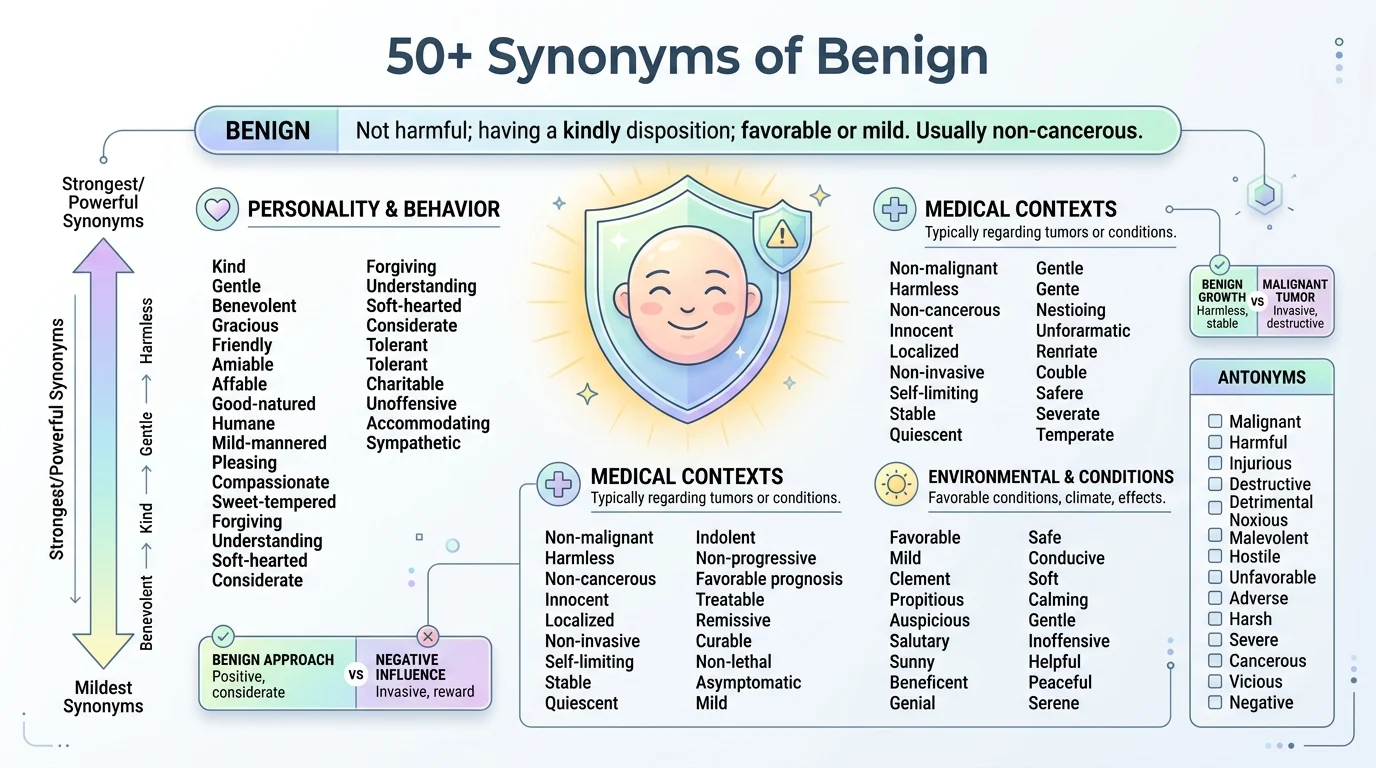
Have you ever needed to describe something as gentle, harmless, or simply not dangerous but felt that “safe” or “kind” did not fully capture the nuance? You want to highlight a lack of threat, a mild nature, or even a favorable condition, and the word “benign” comes to mind. Choosing the right synonym for “benign” can transform a simple description into a precise characterization of safety, gentleness, or good fortune. This guide explores the best synonyms of benign, explaining exactly which word to use and when.
Quick Ans: “Benign” means gentle, kind, mild, or not harmful . It is a neutral-to-positive adjective. For describing personality, choose benevolent, kind, or gentle . For medical contexts, use non-cancerous or harmless . For describing conditions or environments, favorable or mild works well .
Meaning, Tone, and Context
Understanding the core meaning of “benign” is the first step to using it effectively.
Simple Definition: Gentle, kind, and not harmful. In medicine, it refers to a tumor or condition that is not cancerous and does not threaten life or health .
Part of Speech: Adjective.
Overall Tone: Positive to neutral. It indicates a lack of threat, harmlessness, and often a pleasant or gentle quality.
Formality Level: Formal to neutral. The word is appropriate in professional, medical, and personal contexts.
Common Uses: Native English speakers use it to describe people (“a benign ruler”), tumors (“the tumor is benign”), substances (“benign chemicals”), and conditions (“benign weather”) . For example, “The doctor confirmed the tumor was benign,” or “He has a benign smile that puts everyone at ease.”
Word Forms: Related words include the noun benignity, the adverb benignly, and the adjective benignant (a less common synonym).
When and How to Use “Benign”
“Benign” is the perfect choice when you want to emphasize gentleness, harmlessness, or a favorable quality. Here are seven realistic examples.
Medical: “The test results confirmed that the tumor is benign and requires no immediate treatment” .
Professional: “The company’s benign culture fosters creativity and collaboration.”
Academic: “The study examined the benign effects of the compound on the environment.”
Workplace: “His benign management style has earned him the respect of his team.”
Personal: “The benign climate of the region makes it an ideal place to retire” .
Email: “We can confirm that the sample contains benign substances and poses no risk to users.”
Social Media: “This charming, benign little creature is completely harmless—and adorable!”
Best Synonyms of “Benign”
No synonym is identical in every situation. Here is your guide to the best replacement for “benign” based on your writing context.
Describing Personality (Kindness): Benevolent. It emphasizes kindness and goodwill. “She is a benevolent leader who always puts her team first” .
Describing Personality (Gentleness): Gentle. It emphasizes a soft, mild, and non-threatening nature. “His gentle manner made everyone feel comfortable” .
Describing Personality (General): Kind or Kindly. The most straightforward synonyms. “He was a very kind man” .
Medical Contexts: Non-cancerous or Harmless. Clear and precise alternatives. “The lump was non-cancerous” .
Describing Substances or Effects: Innocuous. It implies complete harmlessness. “The chemical is innocuous and safe for the environment” .
Describing Conditions or Weather: Favorable or Mild. Emphasizes pleasantness. “We are expecting favorable weather conditions” .
When Not to Use “Benign”
Using “benign” can sound wrong or awkward in certain situations.
When It Sounds Too Medical: In casual conversation, “benign” can sound overly technical.
Better Choice: Harmless or safe. “It is a harmless substance.”
When You Mean “Innocent”: “Benign” is about harmlessness, while “innocent” implies lack of guilt.
Better Choice: Innocent. “He was innocent of the charges” .
When It Sounds Too Formal: In casual conversation, “benign” can sound stiff.
Better Choice: Gentle or kind. “He is a kind person.”
When Describing a Person in a Negative Context: “Benign” is positive. Use neglectful or indifferent for neutral description.
Better Choice: Neglectful. “His neglectful management caused issues.”
Words Commonly Confused With “Benign”
Several words are often mixed up with “benign.” Here is how to keep them straight.
Word: Benevolent
Difference: Emphasizes kindness and goodwill, often with an active desire to help. “Benign” simply means not harmful or gentle.
When to Use: Use it for people or organizations that actively do good.
Example: “The benevolent foundation donates millions to charity.”
Word: Gentle
Difference: Emphasizes a soft, mild, and non-aggressive nature. “Benign” can also mean favorable conditions.
When to Use: Use this for physical touch, manner, or demeanor.
Example: “The nurse had a gentle touch.”
Word: Harmless
Difference: The most direct synonym for the “not harmful” sense. “Benign” can also mean kind or favorable.
When to Use: Use this when you want to emphasize safety.
Example: “The snake is harmless.”
Word: Innocuous
Difference: Means completely harmless and often bland. “Benign” can have a positive connotation.
When to Use: Use this for substances, comments, or actions that are inoffensive.
Example: “His comment was innocuous.”
Word: Favorable
Difference: Emphasizes advantageous or beneficial conditions. “Benign” can also mean mild and pleasant.
When to Use: Use this for conditions, circumstances, or opinions.
Example: “The weather is favorable for the event.”
Word: Malign
Difference: The direct opposite. Means harmful, evil, or (in medicine) cancerous .
When to Use: Use this for harmful things or medical conditions.
Example: “The tumor was malign and required immediate treatment.”
Best Synonyms of “Benign” by Context
| Context | Best Synonym | Why It Works | Example |
|---|---|---|---|
| Medical | Harmless | Clear and precise. | “The doctor confirmed the tumor was harmless.” |
| Medical | Non-cancerous | Unambiguous medical term. | “The lump was non-cancerous and required no treatment.” |
| Describing personality | Benevolent | Emphasizes kindness and goodwill. | “He is a benevolent leader who cares for his people.” |
| Describing personality | Gentle | Emphasizes a mild and soft nature. | “Her gentle nature makes her an excellent teacher.” |
| Describing personality | Kind | The most straightforward synonym. | “She is a kind person.” |
| Describing substances | Innocuous | Emphasizes complete harmlessness. | “The chemical is innocuous and safe.” |
| Describing conditions | Favorable | Emphasizes advantageous conditions. | “We are operating under favorable market conditions.” |
| Describing weather | Mild | Emphasizes pleasant, not extreme weather. | “The mild climate is perfect for agriculture.” |
| Describing a habit | Harmless | Neutral and clear. | “His habit of tapping his fingers is harmless.” |
| Formal writing | Benignant | A less common but formal synonym. | “His benignant influence on the community was widely recognized.” |
How to Choose the Best Synonym of “Benign”
Choosing the right word is a simple decision. Answer these questions.
What am I describing? A person, a tumor, a substance, or a condition? Use benevolent or kind for people, non-cancerous for tumors, innocuous for substances, and favorable for conditions.
What is my audience? For a doctor or scientist, non-cancerous or harmless is clear. For a friend, gentle or kind is more natural.
What is my purpose? Are you trying to reassure, describe character, or note favorable conditions? Use harmless for reassurance, benevolent for character, and favorable for conditions.
What is the emotional strength? Benevolent is stronger for kindness. Mild and gentle are softer. Pick the one that matches your message.
Real Life Examples of “Benign”
To truly master the word, it helps to see how it behaves in the wild and how a stronger synonym can elevate the sentence.
Medical: Basic: “The doctor said the tumor is benign.” Improved: “The doctor confirmed the tumor is harmless and requires no further treatment” .
Personality: Basic: “He is a benign boss.” Improved: “He is a benevolent boss who always supports his employees” .
Substances: Basic: “The chemical is benign.” Improved: “The chemical is innocuous and safe for the environment” .
Weather: Basic: “The climate is benign.” Improved: “The mild climate is perfect for growing citrus.”
Habit: Basic: “His habit is benign.” Improved: “His habit of whistling is completely harmless.”
Conversation: Basic: “He is a benign person.” Improved: “He is a gentle person who would never hurt anyone.”
Storytelling: Basic: “The creature was benign.” Improved: “The creature was gentle, its large eyes filled with innocent curiosity.”
Top 10 Synonyms of “Benign”
| Synonym | Simple Meaning | Best Used For | Example Sentence |
|---|---|---|---|
| Benevolent | Kind and generous | Describing people or organizations. | “The benevolent organization donated millions to the cause” . |
| Gentle | Soft and mild | Personality, touch, or manner. | “Her gentle touch calmed the frightened child” . |
| Kind | Caring and considerate | Personality and everyday contexts. | “He was a kind man who helped everyone” . |
| Harmless | Not dangerous | Medical, substances, and habits. | “The snake is harmless to humans” . |
| Innocuous | Completely harmless and inoffensive | Substances, comments, and actions. | “His innocuous comment was taken out of context” . |
| Favorable | Advantageous and beneficial | Conditions, circumstances, and weather. | “The favorable market conditions boosted profits” . |
| Mild | Not severe or extreme | Weather, climate, and flavors. | “The mild climate is ideal for retirees” . |
| Non-cancerous | Not cancerous | Medical contexts. | “The biopsy confirmed the tumor was non-cancerous” . |
| Compassionate | Feeling or showing sympathy | Personality and actions. | “Her compassionate response was deeply appreciated” . |
| Amiable | Friendly and pleasant | Personality and demeanor. | “His amiable nature made him popular” . |
Synonyms of “Benign” by Usage
Professional vs. Personal Synonyms
In the workplace (professional), choose benevolent for leadership, innocuous for effects, and favorable for conditions. These words convey professionalism and precision. “The benevolent leadership style” is more precise than “The benign leadership style.”
With friends (personal), kind, gentle, or harmless keep the tone relaxed and relatable.
Formal vs. Conversational Synonyms
For formal writing (reports, essays, professional emails), use benevolent, innocuous, or favorable. These choices maintain the sophisticated tone expected in professional documents.
For casual conversations and texting, use kind, gentle, or harmless. These options sound more natural.
Academic Synonyms
For research and essays, choose precise, authoritative words. Innocuous is great for substances and effects, benevolent for character, and favorable for conditions.
Professional and Business Synonyms
For maximum impact in business writing, choose benevolent for company culture, innocuous for product safety, and favorable for market conditions.
Creative and Literary Synonyms
To add emotion and imagery to your writing, choose gentle, compassionate, or amiable. These words create atmosphere and reveal character .
Strongest to Mildest Synonyms
Mild: harmless, mild, safe
Moderate: benign, gentle, kind
Strong: benevolent, compassionate, innocent
Very Strong: benignant, humane, gracious
Emotional vs. Neutral Synonyms
Emotional Synonyms: Benevolent, compassionate, gracious. These words often hint at warmth and generosity. Use them when you want to evoke feeling .
Neutral Synonyms: Harmless, innocuous, mild. These words simply communicate factual information. Use them when you want to inform without emotional coloring.
Antonyms of “Benign”
Here are 15 genuine opposites of “benign.”
| Antonym | Meaning | Example Sentence |
|---|---|---|
| Malignant | Harmful or cancerous | “The tumor was malignant and required immediate treatment” . |
| Harmful | Causing or capable of causing harm | “The harmful chemicals were banned” . |
| Malign | Evil or harmful | “His malign intentions were obvious” . |
| Dangerous | Able or likely to cause harm | “The dangerous substance was disposed of properly.” |
| Unkind | Lacking kindness | “His unkind remarks hurt her feelings.” |
| Harsh | Unpleasantly severe | “The harsh climate made farming difficult.” |
| Sinister | Giving the impression of evil | “The sinister figure lurked in the shadows.” |
| Vicious | Deliberately cruel | “His vicious behavior was unacceptable.” |
| Cruel | Wilfully causing pain | “The cruel treatment of animals was exposed.” |
| Toxic | Poisonous or harmful | “The toxic waste contaminated the water supply.” |
| Menacing | Threatening | “The menacing storm approached the coast.” |
| Maleficent | Harmful or evil | “The maleficent force was defeated” . |
| Injurious | Causing injury or harm | “The injurious substance was banned.” |
| Damaging | Causing damage | “The damaging winds destroyed the crops.” |
| Unfavorable | Not conducive to success | “The unfavorable weather conditions forced a delay.” |
Comparison: “Benign” vs Similar Words
Benign vs. Benevolent
Main Difference: “Benevolent” implies active goodwill and generosity. “Benign” implies harmlessness and a gentle nature .
Which Is Stronger? “Benevolent” is stronger for kindness and generosity.
Which Is More Formal? Both are formal.
When to Use Each: Use “benign” for harmlessness. Use “benevolent” for active kindness.
Examples:
Benign: “The benign creature was harmless.”
Benevolent: “The benevolent organization donated millions.”
Benign vs. Harmless
Main Difference: “Harmless” is the most direct synonym for the medical and safety sense. “Benign” also means kind and pleasant .
Which Is Stronger? They are similar in strength. “Harmless” is more straightforward.
Which Is More Formal? Both are neutral.
When to Use Each: Use “harmless” for safety. Use “benign” for kindness and favorable conditions.
Examples:
Benign: “His benign smile put everyone at ease.”
Harmless: “The harmless substance was safe.”
Benign vs. Gentle
Main Difference: “Gentle” emphasizes softness and a mild nature. “Benign” emphasizes harmlessness and kindness .
Which Is Stronger? They are similar. “Gentle” is more about physical softness.
Which Is More Formal? Both are neutral.
When to Use Each: Use “gentle” for physical touch or demeanor. Use “benign” for a positive, harmless nature.
Examples:
Benign: “The benign climate is perfect for farming.”
Gentle: “The nurse had a gentle touch.”
Benign vs. Innocuous
Main Difference: “Innocuous” emphasizes complete harmlessness and inoffensiveness. “Benign” can also imply kindness .
Which Is Stronger? They are similar. “Innocuous” is more specific to inoffensiveness.
Which Is More Formal? Both are formal.
When to Use Each: Use “innocuous” for substances, comments, or actions. Use “benign” for people and conditions.
Examples:
Benign: “He has a benign disposition.”
Innocuous: “The innocuous comment was misunderstood.”
Benign vs. Favorable
Main Difference: “Favorable” emphasizes advantage and benefit. “Benign” emphasizes mildness and harmlessness .
Which Is Stronger? “Favorable” is stronger for positive conditions.
Which Is More Formal? Both are formal.
When to Use Each: Use “favorable” for conditions, circumstances, and opinions. Use “benign” for harmlessness and kindness.
Examples:
Benign: “The benign tumor was not dangerous.”
Favorable: “The favorable weather conditions allowed the event to proceed.”
Benign vs. Mild
Main Difference: “Mild” emphasizes not severe or extreme. “Benign” emphasizes not harmful or kind .
Which Is Stronger? They are similar. “Mild” is more about intensity.
Which Is More Formal? Both are neutral.
When to Use Each: Use “mild” for weather, flavors, and symptoms. Use “benign” for harmlessness and kindness.
Examples:
Benign: “The benign creature was harmless.”
Mild: “The mild climate is enjoyable.”
Common Phrases and Expressions with “Benign”
Phrase: Benign tumor
Meaning: A tumor that is not cancerous and does not threaten health .
Example Sentence: “The doctor confirmed the tumor was benign and required no treatment” .
Phrase: Benign neglect
Meaning: A policy of non-intervention.
Example Sentence: “The island benefited from benign neglect.”
Phrase: Benign climate
Meaning: A mild and pleasant climate .
Example Sentence: “The benign climate makes the region an agricultural hub.”
Phrase: Benign effects
Meaning: Not harmful or dangerous effects.
Example Sentence: “The compound had benign effects on the environment.”
Phrase: Benign influence
Meaning: A positive, harmless influence.
Example Sentence: “Her benign influence on the community is widely recognized.”
Phrase: Benign smile
Meaning: A gentle, kind smile.
Example Sentence: “He greeted us with a benign smile” .
Phrase: Benign conditions
Meaning: Favorable or mild conditions .
Example Sentence: “The benign conditions facilitated the growth of the crops.”
Common Mistakes to Avoid
Mistake 1: Using “benign” when you mean “innocent”.
Incorrect: “He was found benign of the crime.”
Better: “He was found innocent of the crime.”
Why: “Benign” means harmless, not guiltless.
Mistake 2: Using “benign” when you mean “favorable”.
Incorrect: “The benign market conditions helped us succeed.”
Better: “The favorable market conditions helped us succeed” .
Why: “Favorable” is more appropriate for advantageous conditions.
Mistake 3: Overusing “benign” in casual conversation.
Incorrect: “That is a benign sandwich.”
Better: “That is a good sandwich.”
Why: “Benign” is too formal for trivial descriptions.
Mistake 4: Using “benign” when you mean “gentle”.
Incorrect: “The benign breeze was refreshing.”
Better: “The gentle breeze was refreshing” .
Why: “Gentle” is better for describing soft physical phenomena.
Mistake 5: Confusing “benign” with “malign”.
Incorrect: “The benign tumor was cancerous.”
Better: “The malignant tumor was cancerous” .
Why: “Malign” or “malignant” means harmful or cancerous.
Frequently Asked Questions
1. What are the best synonyms of “benign”?
The best synonyms depend on your context. For personality, choose benevolent, kind, or gentle . And for medical contexts, use harmless or non-cancerous . For conditions, use favorable or mild .
2. What are the best formal synonyms of “benign”?
The best formal synonyms are benevolent, innocuous, and favorable. These words are suitable for academic papers, professional reports, and medical communications .
3. What are common informal synonyms of “benign”?
For informal settings, use harmless, kind, or gentle. These alternatives sound more natural in everyday conversation .
4. What is another word for “benign” in professional writing?
In professional writing, benevolent is an excellent choice for describing people or organizations. Innocuous is also strong for describing substances or effects .
5. What is the difference between “benign” and “malignant”?
“Benign” means not harmful, gentle, or (in medicine) non-cancerous. “Malignant” means harmful, evil, or (in medicine) cancerous. They are direct opposites .
6. What is the opposite of “benign”?
The most direct opposites (antonyms) of benign are malignant, harmful, and malign . These words describe things that are dangerous or cancerous.
Conclusion
“Benign” is a versatile and valuable word for describing gentleness, harmlessness, and favorable conditions. The term is widely accepted in most contexts, yet it can sound too medical for casual conversation or too vague for specific character traits. The best choice among the synonyms of benign depends entirely on your audience, tone, and purpose. Remember, no single synonym works perfectly in every situation. Your goal is to choose the word that communicates your message with the most clarity and impact. A practical tip for your vocabulary growth is to pay attention to how writers describe harmlessness and kindness and practice using different synonyms in your writing.