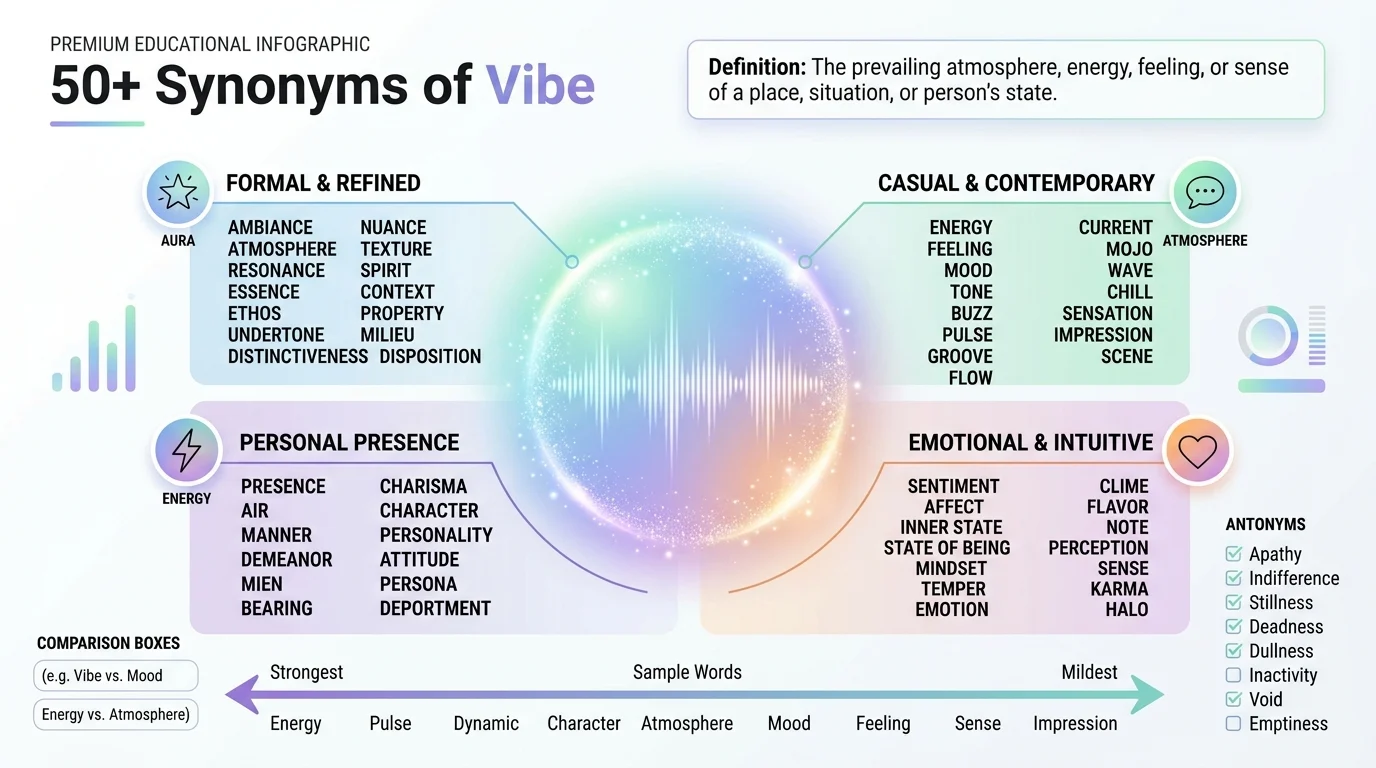
Have you ever walked into a room and instantly felt a certain energy, or met someone and sensed an unspoken connection but felt that “feeling” or “atmosphere” was too vague? You want to capture that intangible, emotional quality of a place, person, or situation, and the word “vibe” comes to mind. Choosing the right synonym for “vibe” can transform a basic observation into a precise expression of mood, energy, or atmosphere. This guide explores the best synonyms of vibe, explaining exactly which word to use and when.
Quick Answer: “Vibe” means a distinctive emotional atmosphere or feeling that a person, place, or thing gives off. For formal writing, choose atmosphere, ambience, or aura. For casual conversation, use energy, feeling, or vibes. For emotional contexts, use mood or tone. For a person’s character, use presence or essence.
Meaning, Tone, and Context
Understanding the core meaning of “vibe” is the first step to using it effectively.
Simple Definition: A person’s emotional state or the atmosphere of a place as communicated to and felt by others; an intuitive feeling or energy.
Part of Speech: Noun (informal).
Overall Tone: Informal and modern. It is casual and conversational.
Formality Level: Informal. The word is most common in casual conversation and social media.
Common Uses: Native English speakers use it to describe places (“This cafe has a cozy vibe”), people (“He gives off a friendly vibe”), and situations (“The meeting had a tense vibe”).
Word Forms: Related words include the plural vibes and the verb vibe (to get along well with someone).
When and How to Use “Vibe”
“Vibe” is the perfect choice when you want to describe an emotional atmosphere or intuitive feeling. Here are seven realistic examples.
Describing a Place: “This restaurant has a great vibe.”
Describing a Person: “She gives off a confident vibe.”
And Describing an Event: “The party had a fun vibe.”
Describing Music: “The song has a chill vibe.”
And Describing a Situation: “The meeting had a tense vibe.”
Describing a Connection: “We really vibed at the party.”
Social Media: “Loving the aesthetic vibes of this cafe.”
Best Synonyms of “Vibe”
No synonym is identical in every situation. Here is your guide to the best replacement for “vibe” based on your writing context.
For Formal and Professional Contexts
Atmosphere: Atmosphere means the pervading tone or mood. “The atmosphere was professional.”
Ambience: Ambience means the character and atmosphere of a place. “The restaurant has a romantic ambience.”
Aura: Aura means a distinctive atmosphere surrounding a person or thing. “She has an aura of confidence.”
Tone: Tone means the general character or attitude. “The tone of the meeting was serious.”
Mood: Mood means the prevailing feeling. “The mood was celebratory.”
For Casual and Social Contexts
Energy: Energy means the atmosphere or feeling. “The energy in the room was electric.”
Feeling: Feeling means an emotional impression. “I got a good feeling from the place.”
Vibes: Vibes is the plural of vibe, often used casually. “Good vibes only.”
Essence: Essence means the intrinsic nature. “The essence of the city is vibrant.”
For Emotional and Personal Contexts
Presence: Presence means the impressive manner of a person. “He has a commanding presence.”
Character: Character means the distinctive nature. “The neighborhood has a lot of character.”
Spirit: Spirit means the prevailing mood. “The team showed great spirit.”
Charm: Charm means an attractive quality. “The old town has a unique charm.”
When Not to Use “Vibe”
Using “vibe” can sound wrong or awkward in certain situations.
When You Mean “Atmosphere”: “Vibe” is informal. “Atmosphere” is more formal.
Better Choice: Atmosphere or ambience. “The atmosphere was elegant.”
When You Mean “Mood”: “Vibe” is casual. “Mood” is more standard.
Better Choice: Mood or tone. “The mood was somber.”
When It Sounds Too Casual: In formal writing, “vibe” can sound unprofessional.
Better Choice: Ambience or aura. “The ambience was sophisticated.”
Words Commonly Confused With “Vibe”
| Word | Difference | When to Use | Example |
|---|---|---|---|
| Atmosphere | Pervading tone or mood | Formal and descriptive | “The atmosphere was tense.” |
| Ambience | Character of a place | Descriptive and formal | “The ambience was relaxing.” |
| Aura | Distinctive surrounding feeling | Personal and mystical | “She had an aura of mystery.” |
| Mood | Prevailing emotional state | General and psychological | “The mood was optimistic.” |
| Energy | Atmosphere or feeling | Casual and dynamic | “The energy was positive.” |
| Tone | General character or attitude | Formal and literary | “The tone was informal.” |
Best Synonyms of “Vibe” by Context
| Context | Best Synonym | Why It Works | Example |
|---|---|---|---|
| Formal writing | Atmosphere | Formal and precise | “The atmosphere was professional.” |
| Descriptive | Ambience | Evocative and specific | “The ambience was romantic.” |
| Personal | Aura | Personal and distinctive | “He has an aura of confidence.” |
| Casual conversation | Energy | Simple and dynamic | “The energy was amazing.” |
| Emotional | Mood | Emotional and general | “The mood was joyful.” |
| Literary | Tone | Literary and precise | “The tone was melancholic.” |
| Social media | Vibes | Trendy and casual | “Good vibes only.” |
How to Choose the Best Synonym of “Vibe”
Choosing the right word is a simple decision. Answer these questions.
What type of vibe am I describing? For formal, use atmosphere or ambience. And For personal, use aura or presence. For casual, use energy or feeling. For emotional, use mood or tone.
What is my audience? For a formal report, use atmosphere or tone. For a friend, use energy or vibes.
What is my purpose? Are you describing a place, a person, or a situation? The correct synonym depends entirely on this.
What is the emotional strength? Aura and presence are stronger for personal impact. Feeling is milder. Pick the one that matches your message.
Real Life Examples of “Vibe”
School: Basic: “The classroom vibe is good.” Improved: “The classroom atmosphere is positive.”
College: Basic: “The party vibe was fun.” Improved: “The party energy was incredible.”
Workplace: Basic: “The office vibe is relaxed.” Improved: “The office ambience is relaxed.”
Business: Basic: “The meeting vibe was tense.” Improved: “The meeting tone was tense.”
Email: Basic: “I like the vibe of the proposal.” Improved: “I like the tone of the proposal.”
Conversation: Basic: “I like your vibe.” Improved: “I like your energy.”
Storytelling: Basic: “The city has a unique vibe.” Improved: “The city has a unique character.”
Top 10 Synonyms of “Vibe”
| Synonym | Simple Meaning | Best Used For | Example Sentence |
|---|---|---|---|
| Atmosphere | Pervading tone or mood | Formal and descriptive | “The atmosphere was elegant.” |
| Ambience | Character of a place | Descriptive and formal | “The ambience was cozy.” |
| Aura | Distinctive surrounding feeling | Personal and mystical | “She had a calming aura.” |
| Energy | Atmosphere or feeling | Casual and dynamic | “The energy was electric.” |
| Mood | Prevailing emotional state | General and psychological | “The mood was festive.” |
| Tone | General character or attitude | Formal and literary | “The tone was serious.” |
| Feeling | Emotional impression | Casual and intuitive | “I got a good feeling.” |
| Presence | Impressive manner | Personal and commanding | “He has a strong presence.” |
| Character | Distinctive nature | Descriptive and literary | “The town has character.” |
| Essence | Intrinsic nature | Philosophical and descriptive | “The essence of the place is calm.” |
Synonyms of “Vibe” by Usage
Professional vs. Personal Synonyms
In the workplace, choose atmosphere, tone, or ambience. With friends, use energy, feeling, or vibes.
Formal vs. Conversational Synonyms
For formal writing, use atmosphere, ambience, or aura. For casual conversations, use energy, feeling, or vibes.
Academic Synonyms
For research and essays, choose atmosphere for settings, tone for literature, and mood for psychology.
Professional and Business Synonyms
For maximum impact, choose atmosphere for workplaces, tone for meetings, and presence for leadership.
Creative and Literary Synonyms
To add emotion and imagery, choose aura, essence, or character. These words create atmosphere.
Slang or Modern Synonyms
In modern American slang, vibes, energy, or frequency are common. For example, “Good vibes only,” or “We are on the same frequency.” These are casual and should be avoided in formal writing.
Strongest to Mildest Synonyms
Mild: feeling, mood, tone
Moderate: vibe, energy, atmosphere
Strong: ambience, aura, presence
Very Strong: essence, character, spirit
Emotional vs. Neutral Synonyms
Emotional Synonyms: Aura, presence, essence. These words hint at deep personal impact. Use them when you want to evoke feeling.
Neutral Synonyms: Atmosphere, tone, mood. These words communicate factual information about a setting.
Antonyms of “Vibe”
| Antonym | Meaning | Example Sentence |
|---|---|---|
| Dissonance | Lack of harmony | “The dissonance was unsettling.” |
| Discord | Lack of agreement | “The discord was palpable.” |
| Tension | Nervous strain | “The tension was thick.” |
| Coldness | Lack of warmth | “The coldness was unwelcoming.” |
| Hostility | Unfriendliness | “The hostility was obvious.” |
| Unpleasantness | State of being unpleasant | “The unpleasantness was unavoidable.” |
| Discomfort | Lack of ease | “The discomfort was evident.” |
| Awkwardness | Lack of ease | “The awkwardness was painful.” |
| Gloom | Darkness and sadness | “The gloom was oppressive.” |
| Dullness | Lack of interest | “The dullness was boring.” |
| Stiffness | Lack of ease | “The stiffness was formal.” |
| Aloofness | Emotional distance | “The aloofness was noticeable.” |
| Indifference | Lack of interest | “The indifference was disappointing.” |
| Apathy | Lack of emotion | “The apathy was concerning.” |
| Sterility | Lack of warmth | “The sterility was clinical.” |
Comparison: “Vibe” vs Similar Words
Vibe vs. Atmosphere
Main Difference: “Atmosphere” is more formal. “Vibe” is informal and trendy.
Which Is Stronger? “Atmosphere” is more descriptive.
Which Is More Formal? “Atmosphere” is more formal.
When to Use Each: Use “atmosphere” in formal writing. Use “vibe” in casual conversation.
Examples:
Vibe: “This place has a cool vibe.”
Atmosphere: “The atmosphere was sophisticated.”
Vibe vs. Ambience
Main Difference: “Ambience” is about the character of a place. “Vibe” is broader.
Which Is Stronger? “Ambience” is more specific.
Which Is More Formal? “Ambience” is more formal.
When to Use Each: Use “ambience” for restaurants and venues. Use “vibe” for general contexts.
Examples:
Vibe: “The party had a fun vibe.”
Ambience: “The restaurant had a romantic ambience.”
Vibe vs. Energy
Main Difference: “Energy” is dynamic and active. “Vibe” is more about feeling.
Which Is Stronger? “Energy” is more active.
Which Is More Formal? Both are casual.
When to Use Each: Use “energy” for active situations. Use “vibe” for general feelings.
Examples:
Vibe: “The room had a good vibe.”
Energy: “The crowd’s energy was electric.”
Vibe vs. Aura
Main Difference: “Aura” is personal and often mystical. “Vibe” is general.
Which Is Stronger? “Aura” is more personal and powerful.
Which Is More Formal? “Aura” is more formal.
When to Use Each: Use “aura” for people. Use “vibe” for places and situations.
Examples:
Vibe: “The cafe has a cozy vibe.”
Aura: “She has a mysterious aura.”
Vibe vs. Mood
Main Difference: “Mood” is psychological. “Vibe” is atmospheric.
Which Is Stronger? “Mood” is more specific.
Which Is More Formal? “Mood” is more formal.
When to Use Each: Use “mood” for emotional states. Use “vibe” for general feelings.
Examples:
Vibe: “The party had a happy vibe.”
Mood: “Her mood was melancholy.”
Vibe vs. Tone
Main Difference: “Tone” is about attitude or character. “Vibe” is about feeling.
Which Is Stronger? “Tone” is more precise.
Which Is More Formal? “Tone” is more formal.
When to Use Each: Use “tone” for writing and speech. Use “vibe” for atmosphere.
Examples:
Vibe: “The meeting had a tense vibe.”
Tone: “The tone of the email was professional.”
Common Phrases and Expressions with “Vibe”
Phrase: Good vibes
Meaning: Positive energy or feelings.
Example Sentence: “Sending good vibes your way.”
Phrase: Bad vibes
Meaning: Negative energy or feelings.
Example Sentence: “I got bad vibes from that place.”
Phrase: Vibe with
Meaning: To get along well with someone.
Example Sentence: “We really vibe with each other.”
Phrase: On the same wavelength
Meaning: Having a similar vibe or understanding.
Example Sentence: “We are on the same wavelength.”
Phrase: Catch a vibe
Meaning: To experience or enjoy an atmosphere.
Example Sentence: “Let’s go catch a vibe at the beach.”
Phrase: Vibe check
Meaning: An assessment of someone’s energy or attitude.
Example Sentence: “He passed the vibe check.”
Common Mistakes to Avoid
Mistake 1: Using “vibe” in formal writing.
Incorrect: “The office vibe was professional.”
Better: “The office atmosphere was professional.”
Why: “Atmosphere” is more formal.
Mistake 2: Using “vibe” when you mean “mood”.
Incorrect: “Her vibe was sad.”
Better: “Her mood was sad.”
Why: “Mood” is for emotional states.
Mistake 3: Overusing “vibe” in conversation.
Incorrect: “The vibe is good.”
Better: “The energy is good.”
Why: “Energy” adds variety.
Mistake 4: Using “vibe” when you mean “aura”.
Incorrect: “She has a strong vibe.”
Better: “She has a strong aura.”
Why: “Aura” is for personal presence.
Mistake 5: Using “vibe” when you mean “tone”.
Incorrect: “The vibe of the email was formal.”
Better: “The tone of the email was formal.”
Why: “Tone” is for writing and speech.
Frequently Asked Questions
1. What are the best synonyms of “vibe”?
The best synonyms depend on your context. For formal writing, choose atmosphere or ambience. And For casual conversation, use energy or feeling. For personal, use aura or presence.
2. What are the best formal synonyms of “vibe”?
The best formal synonyms are atmosphere, ambience, and aura. These words are suitable for academic papers, professional reports, and business communications.
3. What are common informal synonyms of “vibe”?
For informal settings, use energy, feeling, or vibes. These alternatives sound more natural in everyday conversation.
4. What is another word for “vibe” in professional writing?
In professional writing, atmosphere is an excellent choice. It conveys the mood of a place. Tone is also strong for meetings and emails.
5. What is the difference between “vibe” and “atmosphere”?
“Vibe” is informal and trendy. “Atmosphere” is formal and descriptive. Use “atmosphere” in professional writing and “vibe” in casual conversation.
6. What is the opposite of “vibe”?
The most direct opposites (antonyms) of vibe are dissonance, discord, and tension. These words describe a lack of harmony or positive feeling.
Conclusion
“Vibe” is a modern, versatile, and expressive word for describing the emotional atmosphere of a place, person, or situation. The term is informal and widely used in casual conversation and social media, yet it can sound unprofessional in formal writing. The best choice among the synonyms of vibe depends entirely on your audience, tone, and purpose. Remember, no single synonym works perfectly in every situation. Your goal is to choose the word that communicates your message with the most clarity and impact. A practical tip for your vocabulary growth is to pay attention to how writers describe atmosphere and mood and practice using different synonyms in your writing.









