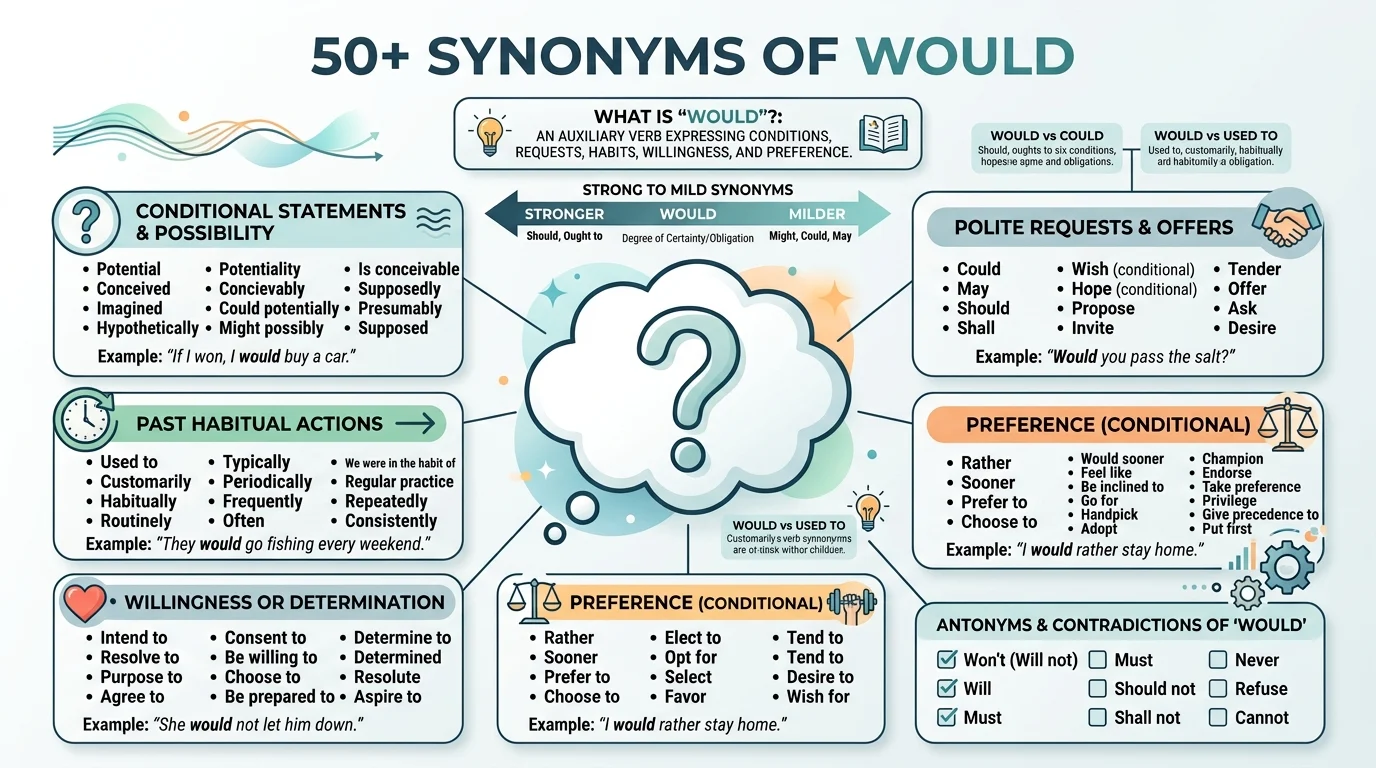
Have you ever needed to express a conditional situation, a past habit, or a polite request but felt that “would” was too repetitive? You want to capture the nuance of willingness, possibility, or habitual action, and the word “would” comes to mind. Choosing the right synonym for “would” can transform a basic sentence into a precise expression of condition, habit, or politeness. This guide explores the best synonyms of would, explaining exactly which word to use and when.
Quick Ans: “Would” is a modal verb used for conditional statements, polite requests, past habits, and expressing willingness or possibility. For conditional statements, use could or might. For polite requests, use could or will. For past habits, use used to. For willingness, use wanted to or wished to. For hypothetical situations, use were to or should.
Meaning, Tone, and Context
Understanding the core meaning of “would” is the first step to using it effectively.
Simple Definition: A modal verb used to express conditional situations, polite requests, past habits, willingness, or future in the past.
Part of Speech: Modal verb.
Overall Tone: Neutral. It is a functional word used in various grammatical structures.
Formality Level: Neutral. The word works in casual and formal contexts.
Common Uses: Native English speakers use it for conditionals (“I would go if I could”), polite requests (“Would you help me?”), past habits (“We would visit every summer”), and willingness (“He said he would come”).
Word Forms: Related words include will (the present form), should (conditional), and could (past ability).
When and How to Use “Would”
“Would” is the perfect choice when you want to express conditionality, politeness, habit, or willingness. Here are seven realistic examples.
Conditional: “I would travel the world if I had more money.”
Polite Request: “Would you please pass the salt?”
Past Habit: “When we were kids, we would play in the park every day.”
Willingness: “She said she would help with the project.”
Hypothetical: “What would you do in my situation?”
Preference: “I would rather stay home tonight.”
Future in the Past: “He promised he would call.”
Best Synonyms of “Would”
No synonym is identical in every situation. Here is your guide to the best replacement for “would” based on your writing context.
For Conditional Statements
Could: Could expresses possibility or ability. “I could go if I had time.”
Might: Might expresses possibility. “I might go if it does not rain.”
Should: Should expresses obligation or expectation. “I should go if I want to succeed.”
Were to: Were to expresses hypothetical condition. “If I were to go, I would tell you.”
For Polite Requests
Could: Could is a polite alternative. “Could you help me?”
Will: Will is direct but polite. “Will you help me?”
Can: Can is casual. “Can you help me?”
For Past Habits
Used to: Used to expresses past habitual action. “We used to play in the park.”
Always: Always with past tense indicates habit. “We always played in the park.”
For Willingness
Wanted to: Wanted to expresses desire. “He wanted to help.”
Wished to: Wished to is formal for desire. “She wished to attend.”
Intended to: Intended to expresses plan. “I intended to call.”
For Preference
Rather: Rather expresses preference. “I would rather stay.”
Prefer: Prefer expresses preference. “I prefer to stay.”
When Not to Use “Would”
Using “would” can sound wrong or awkward in certain situations.
When You Mean “Will”: “Would” is conditional. “Will” is definite future.
Better Choice: Will. “I will go tomorrow.”
When You Mean “Used to”: “Would” can express past habit, but “used to” is clearer.
Better Choice: Used to. “We used to play there.”
When It Sounds Too Formal: In casual conversation, “would” can sound stiff for requests.
Better Choice: Can or could. “Can you help?”
Words Commonly Confused With “Would”
| Word | Difference | When to Use | Example |
|---|---|---|---|
| Will | Definite future | Future actions | “I will call you.” |
| Could | Past ability or possibility | Polite requests and conditionals | “Could you help?” |
| Should | Obligation or expectation | Advice and expectations | “You should rest.” |
| Might | Possibility | Uncertain situations | “It might rain.” |
| Used to | Past habit | Past routines | “We used to swim.” |
| Can | Ability or permission | Present ability | “I can swim.” |
Best Synonyms of “Would” by Context
| Context | Best Synonym | Why It Works | Example |
|---|---|---|---|
| Conditional | Could | Expresses possibility | “I could go if I had time.” |
| Polite request | Could | Polite and common | “Could you help me?” |
| Past habit | Used to | Clear and specific | “We used to play there.” |
| Willingness | Wanted to | Expresses desire | “He wanted to help.” |
| Preference | Rather | Expresses choice | “I would rather stay.” |
| Hypothetical | Were to | Formal conditional | “If I were to go…” |
| Future in past | Promised to | Expresses commitment | “He promised to call.” |
How to Choose the Best Synonym of “Would”
Choosing the right word is a simple decision. Answer these questions.
What type of meaning am I expressing? For conditional, use could or might. And For polite requests, use could or will. For past habits, use used to. And For willingness, use wanted to. For preference, use rather.
What is my audience? For a formal report, use would or were to. For a friend, use could or can.
What is my purpose? Are you requesting, describing habit, or expressing condition? The correct synonym depends entirely on this.
What is the emotional strength? Would is neutral. Could is softer. Will is more direct. Pick the one that matches your message.
Real Life Examples of “Would”
School: Basic: “I would study if I had time.” Improved: “I could study if I had time.”
College: Basic: “We would meet every week.” Improved: “We used to meet every week.”
Workplace: Basic: “Would you send the report?” Improved: “Could you send the report?”
Business: Basic: “He said he would attend.” Improved: “He promised to attend.”
Email: Basic: “I would like to meet.” Improved: “I would like to meet.” (No change, but consider “I am interested in meeting.”)
Conversation: Basic: “I would rather stay.” Improved: “I prefer to stay.”
Storytelling: Basic: “She would sing every night.” Improved: “She used to sing every night.”
Top 10 Synonyms of “Would”
| Synonym | Simple Meaning | Best Used For | Example Sentence |
|---|---|---|---|
| Could | Past ability or possibility | Polite requests and conditionals | “Could you help me?” |
| Might | Possibility | Uncertain situations | “It might rain.” |
| Should | Obligation or expectation | Advice and expectations | “You should rest.” |
| Used to | Past habit | Past routines | “We used to swim.” |
| Will | Definite future | Future actions | “I will call you.” |
| Can | Ability or permission | Present ability | “I can swim.” |
| Rather | Preference | Choices | “I would rather stay.” |
| Wanted to | Desire | Willingness | “He wanted to help.” |
| Were to | Hypothetical condition | Formal conditionals | “If I were to go…” |
| Promised to | Commitment | Future in past | “He promised to call.” |
Synonyms of “Would” by Usage
Professional vs. Personal Synonyms
In the workplace, choose would, could, or were to. With friends, use could, can, or will.
Formal vs. Conversational Synonyms
For formal writing, use would, were to, or should. For casual conversations, use could, can, or will.
Academic Synonyms
For research and essays, choose would for conditionals, could for possibilities, and should for recommendations.
Professional and Business Synonyms
For maximum impact, choose would for polite requests, could for softer requests, and will for definite commitments.
Creative and Literary Synonyms
To add emotion and imagery, choose used to, would, or promised to. These words create atmosphere.
Slang or Modern Synonyms
In modern American slang, would is often shortened to ‘d (“I’d go”) or replaced with gonna for future (“I’m gonna go”). These are casual and should be avoided in formal writing.
Strongest to Mildest Synonyms
Mild: might, could
Moderate: would, should
Strong: will, can
Very Strong: must, have to
Emotional vs. Neutral Synonyms
Emotional Synonyms: Wanted to, wished to, promised to. These words hint at desire and commitment. Use them when you want to evoke feeling.
Neutral Synonyms: Would, could, might. These words communicate factual information about possibility.
Antonyms of “Would”
| Antonym | Meaning | Example Sentence |
|---|---|---|
| Would not | Refusal or negative condition | “I would not go.” |
| Will not | Definite refusal | “I will not go.” |
| Cannot | Inability | “I cannot go.” |
| Refuse | Decline to do | “He refused to go.” |
| Decline | Politely refuse | “She declined the offer.” |
| Reject | Dismiss | “He rejected the idea.” |
| Avoid | Keep away from | “I avoid that place.” |
| Prevent | Stop from happening | “The rain prevented us.” |
| Hinder | Obstruct | “The delay hindered us.” |
| Block | Obstruct | “The road was blocked.” |
| Deny | Refuse to give | “He denied the request.” |
| Forbid | Order not to do | “I forbid you to go.” |
| Prohibit | Officially forbid | “Smoking is prohibited.” |
| Ban | Officially prohibit | “The book was banned.” |
| Veto | Reject formally | “The president vetoed the bill.” |
Comparison: “Would” vs Similar Words
Would vs. Will
Main Difference: “Would” is conditional. “Will” is definite future.
Which Is Stronger? “Will” is stronger for certainty.
Which Is More Formal? Both are neutral.
When to Use Each: Use “would” for conditionals. Use “will” for definite future.
Examples:
Would: “I would go if I could.”
Will: “I will go tomorrow.”
Would vs. Could
Main Difference: “Could” expresses ability or possibility. “Would” expresses condition or willingness.
Which Is Stronger? “Could” is about ability. “Would” is about willingness.
Which Is More Formal? Both are neutral.
When to Use Each: Use “could” for ability. Use “would” for condition.
Examples:
Would: “I would help if I could.”
Could: “I could help you.”
Would vs. Should
Main Difference: “Should” expresses obligation or advice. “Would” expresses condition or habit.
Which Is Stronger? “Should” is stronger for obligation.
Which Is More Formal? Both are neutral.
When to Use Each: Use “should” for advice. Use “would” for conditions.
Examples:
Would: “I would go if I had time.”
Should: “You should go.”
Would vs. Used to
Main Difference: “Used to” is specific to past habits. “Would” can also express past habits but is less clear.
Which Is Stronger? “Used to” is clearer for past habits.
Which Is More Formal? Both are neutral.
When to Use Each: Use “used to” for past habits. Use “would” for conditions.
Examples:
Would: “We would play there.”
Used to: “We used to play there.”
Would vs. Might
Main Difference: “Might” expresses possibility. “Would” expresses condition or willingness.
Which Is Stronger? “Might” is weaker for certainty.
Which Is More Formal? Both are neutral.
When to Use Each: Use “might” for possibility. Use “would” for conditions.
Examples:
Would: “I would go if I could.”
Might: “I might go.”
Would vs. Can
Main Difference: “Can” expresses present ability or permission. “Would” expresses condition or politeness.
Which Is Stronger? “Can” is more direct.
Which Is More Formal? “Would” is more formal for requests.
When to Use Each: Use “can” for casual requests. Use “would” for polite requests.
Examples:
Would: “Would you help me?”
Can: “Can you help me?”
Common Phrases and Expressions with “Would”
Phrase: Would like
Meaning: Want politely.
Example Sentence: “I would like a coffee.”
Phrase: Would rather
Meaning: Prefer.
Example Sentence: “I would rather stay home.”
Phrase: Would you mind
Meaning: Polite request.
Example Sentence: “Would you mind closing the door?”
Phrase: Would have
Meaning: Past conditional.
Example Sentence: “I would have gone if I had known.”
Phrase: Would that
Meaning: Wish (literary).
Example Sentence: “Would that it were true.”
Common Mistakes to Avoid
Mistake 1: Using “would” when you mean “will”.
Incorrect: “I would go tomorrow.”
Better: “I will go tomorrow.”
Why: “Would” is conditional. “Will” is definite future.
Mistake 2: Using “would” when you mean “used to”.
Incorrect: “We would play there every summer.”
Better: “We used to play there every summer.”
Why: “Used to” is clearer for past habits.
Mistake 3: Overusing “would” in requests.
Incorrect: “Would you help me?”
Better: “Could you help me?”
Why: “Could” is softer and more common.
Mistake 4: Using “would” when you mean “could”.
Incorrect: “I would swim when I was young.”
Better: “I could swim when I was young.”
Why: “Could” is for past ability.
Mistake 5: Using “would” in place of “should”.
Incorrect: “You would see a doctor.”
Better: “You should see a doctor.”
Why: “Should” is for advice.
Frequently Asked Questions
1. What are the best synonyms of “would”?
The best synonyms depend on your context. For conditionals, use could or might. And For polite requests, use could or will. For past habits, use used to. For willingness, use wanted to.
2. What are the best formal synonyms of “would”?
The best formal synonyms are were to, should, and could. These words are suitable for academic papers, professional reports, and business communications.
3. What are common informal synonyms of “would”?
For informal settings, use could, can, or will. These alternatives sound more natural in everyday conversation.
4. What is another word for “would” in professional writing?
In professional writing, would is often the best choice for polite requests and conditionals. Could is also strong for softer requests.
5. What is the difference between “would” and “used to”?
“Would” can express past habits but is less clear. “Used to” is specific to past habits. Use “used to” for clarity.
6. What is the opposite of “would”?
The most direct opposites of “would” are would not, will not, and cannot. These words express refusal or inability.
Conclusion
“Would” is a versatile and essential modal verb for expressing conditionality, politeness, habit, and willingness. The term is neutral and widely accepted in all contexts, yet it can be confusing for learners due to its multiple uses. The best choice among the synonyms of would depends entirely on your audience, tone, and purpose. Remember, no single synonym works perfectly in every situation. Your goal is to choose the word that communicates your message with the most clarity and impact. A practical tip for your vocabulary growth is to pay attention to how writers and speakers use modal verbs and practice using different synonyms in your writing.










2 thoughts on “50+ Synonyms of Would: Meanings, Uses, Examples, and Best Alternatives 2026”