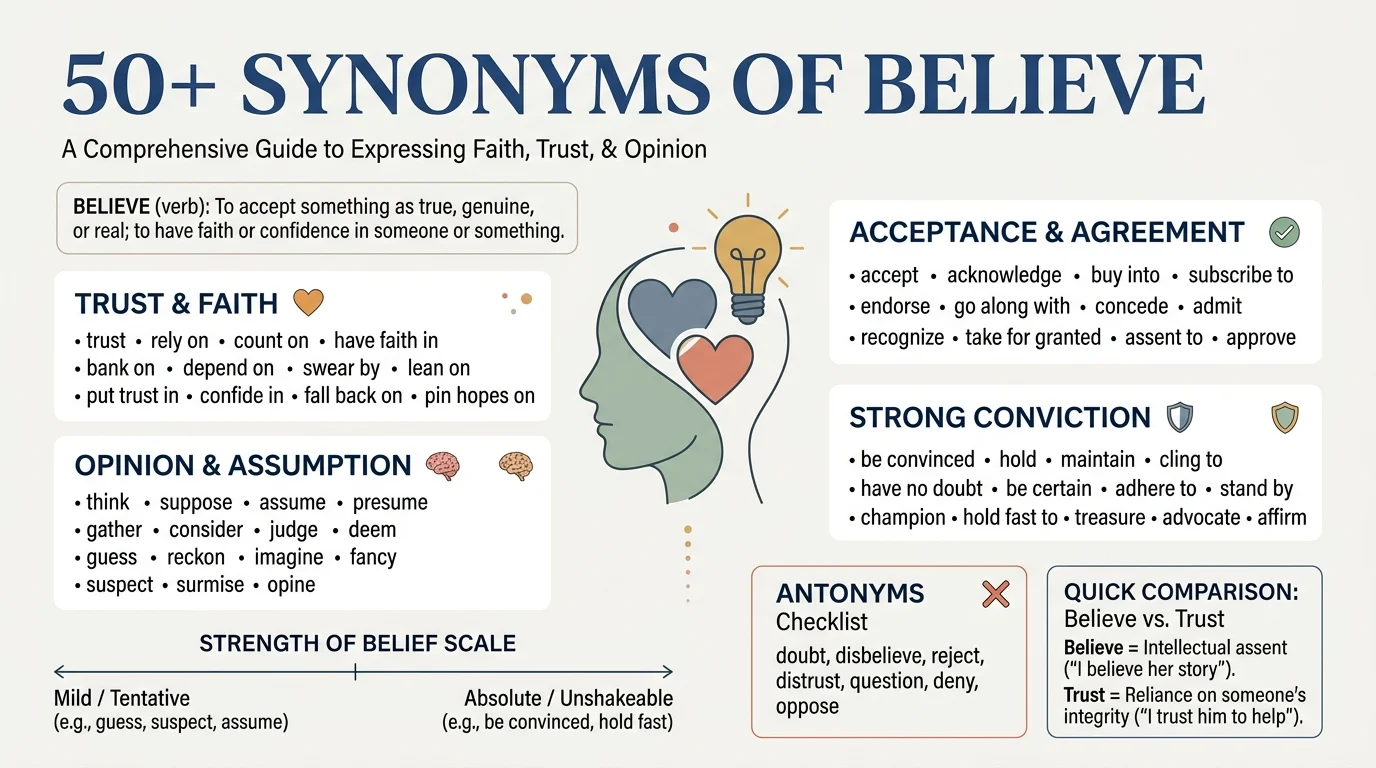
Have you ever needed to express acceptance of something as true, trust in a person, or a strong conviction but felt that “believe” was too simple or repetitive? You want to capture the specific nature of faith, confidence, or opinion, and the word “believe” comes to mind. Choosing the right synonym for “believe” can transform a basic statement into a precise expression of trust, conviction, or acceptance. This guide explores the best synonyms of believe, explaining exactly which word to use and when.
Quick Answer: “Believe” means to accept something as true, to have faith or trust in someone or something, or to hold an opinion. For formal writing, choose trust or accept. For strong conviction, use affirm or maintain. For casual conversation, use think or feel. For religious or spiritual contexts, use have faith or worship.
Meaning, Tone, and Context
Understanding the core meaning of “believe” is the first step to using it effectively.
Simple Definition: To accept that something is true or real; to have confidence or trust in someone or something; to hold a particular opinion.
Part of Speech: Verb.
Overall Tone: Neutral. It can indicate certainty, faith, or mere opinion depending on context.
Formality Level: Neutral. The word works in casual and formal contexts.
Common Uses: Native English speakers use it in everyday conversation (“I believe you”), professional contexts (“We believe in transparency”), religious contexts (“I believe in God”), and academic contexts (“The evidence supports the belief”).
Word Forms: Related words include the noun belief, the adjective believable, the adverb believably, and the noun believer.
When and How to Use “Believe”
“Believe” is the perfect choice when you want to express acceptance of truth, trust, or opinion. Here are seven realistic examples.
Personal: “I believe in your ability to succeed.”
Professional: “We believe that transparency builds trust.”
Religious: “She believes in a higher power.”
Academic: “The researchers believe the findings are significant.”
Everyday: “I believe it will rain tomorrow.”
Workplace: “The team believes in the new strategy.”
Social Media: “Believe in yourself and anything is possible.”
Best Synonyms of “Believe”
No synonym is identical in every situation. Here is your guide to the best replacement for “believe” based on your writing context.
For Trust and Confidence
Most Direct: Trust means to have confidence in. “I trust your judgment.”
Rely on: Rely on means to depend on. “You can rely on her.”
Have faith in: Have faith in means to trust completely. “I have faith in your abilities.”
Confide in: Confide in means to trust with secrets. “She confides in her best friend.”
For Acceptance of Truth
Accept: Accept means to agree to. “I accept that the situation is difficult.”
Acknowledge: Acknowledge means to admit or recognize. “He acknowledged the truth.”
Recognize: Recognize means to accept as valid. “She recognized the importance of the issue.”
Concede: Concede means to admit reluctantly. “He conceded that he was wrong.”
For Opinion and View
Think: Think means to have an opinion. “I think it will rain.”
Feel: Feel means to have a belief based on emotion. “I feel that this is the right choice.”
Hold: Hold means to maintain an opinion. “He holds that the policy is flawed.”
Maintain: Maintain means to assert firmly. “She maintains her innocence.”
For Strong Conviction
Affirm: Affirm means to state firmly. “He affirmed his support for the cause.”
Assert: Assert means to state confidently. “She asserted her belief in justice.”
Avow: Avow means to declare openly. “He avowed his commitment to the project.”
Profess: Profess means to claim openly. “She professed her faith in the system.”
For Religious and Spiritual Contexts
Have faith: Have faith means to believe without proof. “They have faith in God.”
Worship: Worship means to show reverence. “They worship at the temple.”
Adhere to: Adhere to means to follow a belief. “He adheres to Buddhist teachings.”
When Not to Use “Believe”
Using “believe” can sound wrong or awkward in certain situations.
When You Mean “Know”: “Believe” implies uncertainty. “Know” implies certainty.
Better Choice: Know or am certain. “I know it is true.”
When You Mean “Think”: “Believe” is stronger than “think.”
Better Choice: Think or guess. “I think it will rain.”
When It Sounds Too Strong: “Believe” can imply strong conviction.
Better Choice: Suppose or imagine. “I suppose you are right.”
Words Commonly Confused With “Believe”
| Word | Difference | When to Use | Example |
|---|---|---|---|
| Think | Weaker opinion | Casual and uncertain | “I think it will rain.” |
| Know | Certainty | Facts and strong knowledge | “I know it is true.” |
| Trust | Confidence in a person | Relationships and reliance | “I trust you.” |
| Accept | Agree to | General and formal | “I accept the offer.” |
| Affirm | State firmly | Formal and assertive | “She affirmed her support.” |
| Profess | Claim openly | Formal and religious | “He professed his faith.” |
Best Synonyms of “Believe” by Context
| Context | Best Synonym | Why It Works | Example |
|---|---|---|---|
| Formal writing | Affirm | Formal and assertive | “He affirmed his commitment.” |
| Academic writing | Maintain | Standard in research | “The authors maintain that the theory holds.” |
| Professional | Trust | Professional and clear | “We trust the data.” |
| Business | Accept | Business and agreements | “We accept the terms.” |
| Emotional | Have faith in | Emotional and personal | “I have faith in you.” |
| Religious | Profess | Formal and spiritual | “She professed her belief.” |
| Casual | Think | Simple and natural | “I think you are right.” |
How to Choose the Best Synonym of “Believe”
Choosing the right word is a simple decision. Answer these questions.
What type of belief am I describing? For trust, use trust or rely on. For acceptance, use accept or acknowledge. And for opinion, use think or feel. Also for strong conviction, use affirm or maintain.
What is my audience? For a formal report, use affirm or maintain. For a friend, use think or feel.
What is my purpose? Are you describing trust, acceptance, or opinion? The correct synonym depends entirely on this.
What is the emotional strength? Affirm and assert are stronger. Think is milder. Pick the one that matches your message.
Real Life Examples of “Believe”
School: Basic: “I believe in you.” Improved: “I have faith in your abilities.”
College: Basic: “The researchers believe the theory.” Improved: “The researchers maintain the theory.”
Workplace: Basic: “We believe in transparency.” Improved: “We are committed to transparency.”
Business: Basic: “I believe the deal will close.” Improved: “I trust the deal will close.”
Email: Basic: “I believe you are correct.” Improved: “I accept that you are correct.”
Conversation: Basic: “I believe it will rain.” Improved: “I think it will rain.”
Storytelling: Basic: “She believed in magic.” Improved: “She had faith in magic.”
Top 10 Synonyms of “Believe”
| Synonym | Simple Meaning | Best Used For | Example Sentence |
|---|---|---|---|
| Trust | Have confidence in | Relationships and reliance | “I trust your judgment.” |
| Think | Have an opinion | Casual and uncertain | “I think it will rain.” |
| Accept | Agree to | General and formal | “I accept the offer.” |
| Affirm | State firmly | Formal and assertive | “He affirmed his support.” |
| Maintain | Assert firmly | Academic and formal | “She maintains her position.” |
| Have faith in | Trust completely | Religious and emotional | “I have faith in you.” |
| Acknowledge | Admit or recognize | Formal and general | “He acknowledged the truth.” |
| Feel | Have a belief based on emotion | Personal and intuitive | “I feel this is right.” |
| Assert | State confidently | Formal and strong | “She asserted her belief.” |
| Profess | Claim openly | Religious and formal | “He professed his faith.” |
Synonyms of “Believe” by Usage
Professional vs. Personal Synonyms
In the workplace, choose trust, accept, or maintain. With friends, use think, feel, or have faith in.
Formal vs. Conversational Synonyms
For formal writing, use affirm, maintain, or assert. For casual conversations, use think, feel, or guess.
Academic Synonyms
For research and essays, choose maintain for arguments, affirm for conclusions, and acknowledge for evidence.
Professional and Business Synonyms
For maximum impact, choose trust for data, accept for terms, and affirm for commitment.
Creative and Literary Synonyms
To add emotion and imagery, choose have faith in, profess, or avow. These words create atmosphere.
Slang or Modern Synonyms
In modern American slang, think, feel, or bet are common. For example, “I bet it will rain.” These are casual and should be avoided in formal writing.
Strongest to Mildest Synonyms
Mild: think, suppose, guess
Moderate: believe, feel, accept
Strong: trust, maintain, acknowledge
Very Strong: affirm, assert, profess, have faith in
Emotional vs. Neutral Synonyms
Emotional Synonyms: Have faith in, trust, profess. These words hint at deep conviction. Use them when you want to evoke feeling.
Neutral Synonyms: Believe, think, accept. These words communicate factual information.
Antonyms of “Believe”
| Antonym | Meaning | Example Sentence |
|---|---|---|
| Doubt | Feel uncertain | “I doubt his story.” |
| Disbelieve | Not believe | “She disbelieved the rumor.” |
| Reject | Refuse to accept | “He rejected the idea.” |
| Deny | Refuse to admit | “She denied the accusation.” |
| Question | Express uncertainty | “I question the validity.” |
| Distrust | Lack of trust | “I distrust his motives.” |
| Suspect | Believe something is wrong | “I suspect he is lying.” |
| Mistrust | Lack of confidence | “She mistrusted the offer.” |
| Dispute | Argue against | “They disputed the claim.” |
| Refute | Prove to be false | “The evidence refutes the theory.” |
| Contradict | Assert the opposite | “His actions contradict his words.” |
| Challenge | Question the truth | “She challenged the assumption.” |
| Discredit | Harm the reputation | “The scandal discredited him.” |
| Dismiss | Decide something is not important | “He dismissed the idea.” |
| Repudiate | Refuse to accept | “She repudiated the claim.” |
Comparison: “Believe” vs Similar Words
Believe vs. Think
Main Difference: “Believe” is stronger. “Think” is an opinion.
Which Is Stronger? “Believe” is stronger.
Which Is More Formal? Both are neutral.
When to Use Each: Use “think” for casual opinions. Use “believe” for stronger conviction.
Examples:
Believe: “I believe in you.”
Think: “I think it will rain.”
Believe vs. Know
Main Difference: “Believe” implies uncertainty. “Know” implies certainty.
Which Is Stronger? “Know” is much stronger.
Which Is More Formal? Both are neutral.
When to Use Each: Use “know” for facts. Use “believe” for opinions.
Examples:
Believe: “I believe it is true.”
Know: “I know it is true.”
Believe vs. Trust
Main Difference: “Believe” is about truth. “Trust” is about confidence.
Which Is Stronger? “Trust” is stronger for relationships.
Which Is More Formal? Both are neutral.
When to Use Each: Use “trust” for people. Use “believe” for ideas.
Examples:
Believe: “I believe your story.”
Trust: “I trust you completely.”
Believe vs. Accept
Main Difference: “Believe” is about conviction. “Accept” is about agreement.
Which Is Stronger? “Believe” is stronger.
Which Is More Formal? Both are formal.
When to Use Each: Use “accept” for terms. Use “believe” for ideas.
Examples:
Believe: “I believe in the cause.”
Accept: “I accept the offer.”
Believe vs. Affirm
Main Difference: “Believe” is internal. “Affirm” is external.
Which Is Stronger? “Affirm” is stronger for assertion.
Which Is More Formal? “Affirm” is more formal.
When to Use Each: Use “affirm” for public statements. Use “believe” for personal conviction.
Examples:
Believe: “I believe in equality.”
Affirm: “He affirmed his commitment.”
Believe vs. Have faith in
Main Difference: “Believe” is broader. “Have faith in” is spiritual.
Which Is Stronger? “Have faith in” is stronger emotionally.
Which Is More Formal? Both are formal.
When to Use Each: Use “have faith in” for religion. Use “believe” for general contexts.
Examples:
Believe: “I believe you can do it.”
Have faith in: “I have faith in God.”
Common Phrases and Expressions with “Believe”
Phrase: Believe in yourself
Meaning: Have confidence in your abilities.
Example Sentence: “Believe in yourself and you will succeed.”
Phrase: Believe it or not
Meaning: Whether you accept it or not.
Example Sentence: “Believe it or not, he won the race.”
Phrase: Make believe
Meaning: Pretend.
Example Sentence: “The children made believe they were pirates.”
Phrase: Hard to believe
Meaning: Difficult to accept as true.
Example Sentence: “It is hard to believe he is gone.”
Phrase: Believe you me
Meaning: Emphasizing truth.
Example Sentence: “Believe you me, it was not easy.”
Common Mistakes to Avoid
Mistake 1: Using “believe” when you mean “know”.
Incorrect: “I believe the answer is 42.”
Better: “I know the answer is 42.”
Why: “Know” implies certainty.
Mistake 2: Using “believe” when you mean “think”.
Incorrect: “I believe it will rain.”
Better: “I think it will rain.”
Why: “Think” is more natural for opinions.
Mistake 3: Overusing “believe” in conversation.
Incorrect: “I believe you are right.”
Better: “I think you are right.”
Why: “Think” sounds more natural.
Mistake 4: Using “believe” when you mean “trust”.
Incorrect: “I believe you with my secrets.”
Better: “I trust you with my secrets.”
Why: “Trust” is for confidence in people.
Mistake 5: Using “believe” when you mean “accept”.
Incorrect: “I believe the terms of the contract.”
Better: “I accept the terms of the contract.”
Why: “Accept” is for agreements.
Frequently Asked Questions
1. What are the best synonyms of “believe”?
The best synonyms depend on your context. For trust, choose trust or rely on. For acceptance, use accept or acknowledge. And for opinion, use think or feel. Also for strong conviction, use affirm or maintain.
2. What are the best formal synonyms of “believe”?
The best formal synonyms are affirm, maintain, and assert. These words are suitable for academic papers, professional reports, and business communications.
3. What are common informal synonyms of “believe”?
For informal settings, use think, feel, or guess. These alternatives sound more natural in everyday conversation.
4. What is another word for “believe” in professional writing?
In professional writing, affirm is an excellent choice. It conveys strong commitment. Maintain is also strong for arguments.
5. What is the difference between “believe” and “think”?
“Believe” is stronger and implies conviction. “Think” is weaker and implies opinion. Use “believe” for strong conviction.
6. What is the opposite of “believe”?
The most direct opposites (antonyms) of believe are doubt, disbelieve, and reject. These words describe a lack of belief.
Conclusion
“Believe” is a fundamental and versatile word for describing trust, acceptance, and opinion. The term is neutral and widely accepted in all contexts, yet it can sound too simple for formal writing or too strong for casual opinions. The best choice among the synonyms of believe depends entirely on your audience, tone, and purpose. For a formal, assertive effect, use affirm or maintain. For a practical, everyday context, think or feel works perfectly. And for trust, choose trust or rely on. Also for religious contexts, use have faith in or profess. Remember, no single synonym works perfectly in every situation. Your goal is to choose the word that communicates your message with the most clarity and impact. A practical tip for your vocabulary growth is to pay attention to how writers express belief and conviction and practice using different synonyms in your writing.










1 thought on “40+ Synonyms of Believe: Meanings, Uses, Examples, and Best Alternatives”