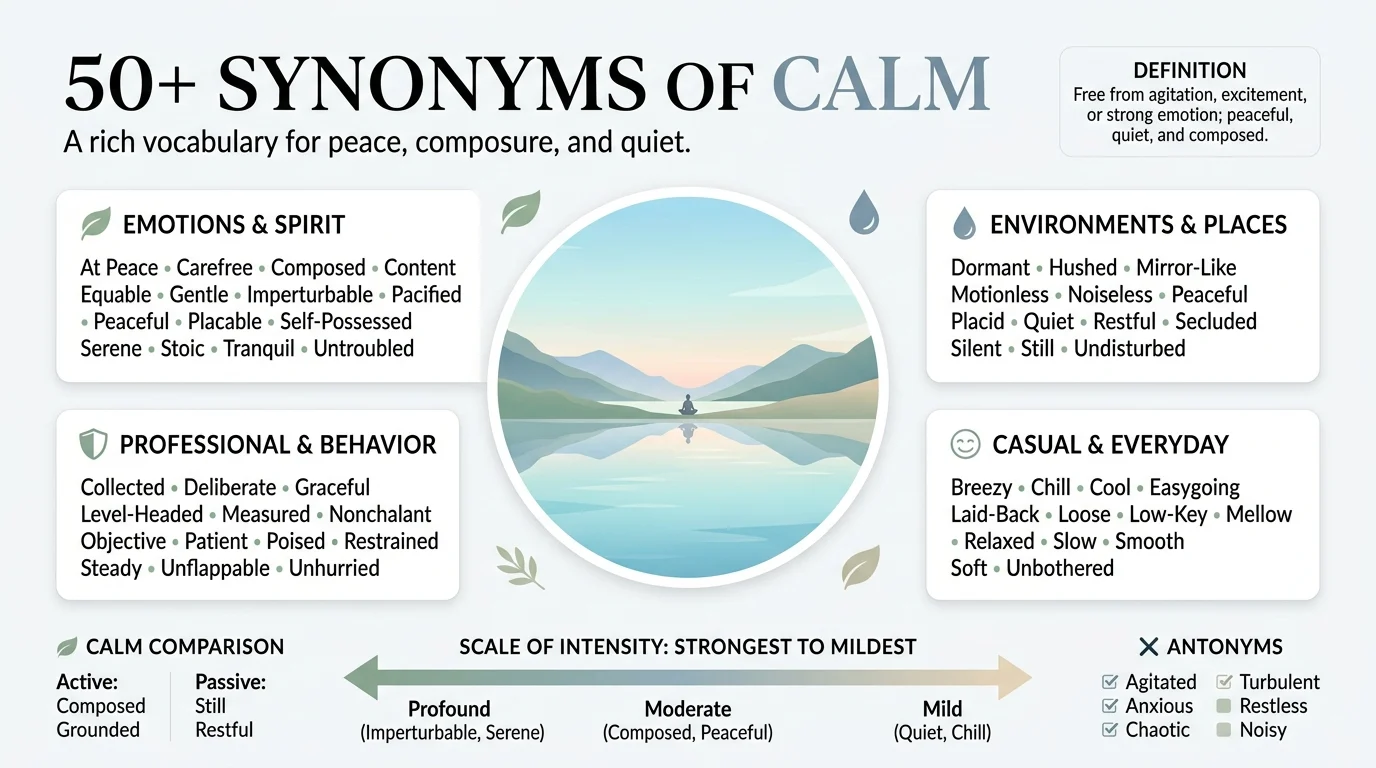
Have you ever needed to describe a peaceful person, a quiet environment, or a steady emotional state but felt that “calm” was too simple or repetitive? You want to capture the specific kind of tranquility, composure, or stillness, and the word “calm” comes to mind. Choosing the right synonym for “calm” can transform a basic statement into a precise expression of serenity, composure, or peace. This guide explores the best synonyms of calm, explaining exactly which word to use and when.
Quick Answer: “Calm” means peaceful, free from disturbance or emotion, or a state of quietness. For people and emotions, choose composed, serene, or tranquil. For environments and weather, use still, peaceful, or placid. For a professional tone, use collected or unflappable. For casual conversation, use chill or relaxed.
Meaning, Tone, and Context
Understanding the core meaning of “calm” is the first step to using it effectively.
Simple Definition: Free from agitation, excitement, or disturbance; peaceful and quiet; showing self-control.
Part of Speech: Adjective, noun, and verb.
Overall Tone: Positive and neutral. It indicates peace, stability, and self-control.
Formality Level: Neutral. The word works in almost any context.
Common Uses: Native English speakers use it to describe people (“she stayed calm”), weather (“the sea is calm”), situations (“the calm after the storm”), and moods (“a calm atmosphere”).
Word Forms: Related words include the noun calmness, the adverb calmly, and the verb calm (to soothe).
When and How to Use “Calm”
“Calm” is the perfect choice when you want to describe peace, steadiness, or lack of agitation. Here are seven realistic examples.
Emotional: “She remained calm during the emergency.”
Environmental: “The lake was calm in the early morning.”
Professional: “He gave a calm response to the criticism.”
Personal: “I feel calmer after a walk in nature.”
Academic: “The study examined how calm environments affect learning.”
Weather: “The calm weather allowed the boats to leave the harbor.”
Social Media: “Stay calm and carry on.”
Best Synonyms of “Calm”
No synonym is identical in every situation. Here is your guide to the best replacement for “calm” based on your writing context.
For People and Emotions
Most Formal: Composed means having control over emotions. “She was composed during the interview.”
Serene: Serene means peaceful and untroubled. “He had a serene expression.”
Collected: Collected means calm and in control. “She stayed collected under pressure.”
Unflappable: Unflappable means hard to upset. “He is unflappable in a crisis.”
For Environments and Weather
Still: Still means without movement. “The air was still.”
Peaceful: Peaceful means free from disturbance. “The village was peaceful.”
Placid: Placid means calm and quiet. “The placid lake reflected the sky.”
Tranquil: Tranquil means free from disturbance. “The garden was tranquil.”
For a Professional Tone
Poised: Poised means confident and composed. “She was poised during the presentation.”
Steady: Steady means stable and controlled. “His voice was steady.”
Even-tempered: Even-tempered means not easily angered. “He is even-tempered and fair.”
Level-headed: Level-headed means sensible under pressure. “She is level-headed in emergencies.”
For Casual Conversation
Chill: Chill means relaxed. “He is pretty chill about everything.”
Relaxed: Relaxed means free from tension. “I feel relaxed after the massage.”
Easygoing: Easygoing means relaxed and tolerant. “She has an easygoing personality.”
Mellow: Mellow means calm and relaxed. “The music was mellow.”
When Not to Use “Calm”
Using “calm” can sound wrong or awkward in certain situations.
When You Mean “Boring”: “Calm” is positive. “Boring” is negative.
Better Choice: Quiet or uneventful. “The evening was quiet.”
When You Mean “Indifferent”: “Calm” is about peace. “Indifferent” is about lack of interest.
Better Choice: Indifferent or unconcerned. “He was unconcerned about the outcome.”
When It Sounds Too Simple: In formal writing, “calm” can sound basic.
Better Choice: Composed or serene. “She was composed during the hearing.”
Words Commonly Confused With “Calm”
| Word | Difference | When to Use | Example |
|---|---|---|---|
| Composed | Control over emotions | Formal and professional | “She was composed.” |
| Serene | Peaceful and untroubled | Emotional and descriptive | “A serene expression.” |
| Tranquil | Free from disturbance | Environments and scenes | “A tranquil garden.” |
| Peaceful | Free from conflict | General and social | “A peaceful protest.” |
| Relaxed | Free from tension | Casual and personal | “I feel relaxed.” |
| Still | Without movement | Physical and weather | “The air was still.” |
Best Synonyms of “Calm” by Context
| Context | Best Synonym | Why It Works | Example |
|---|---|---|---|
| Formal writing | Composed | Formal and precise | “She was composed throughout.” |
| Academic writing | Tranquil | Descriptive and precise | “The tranquil setting aided focus.” |
| Professional | Poised | Professional and confident | “He remained poised under pressure.” |
| Business | Collected | Business and steady | “She stayed collected during the crisis.” |
| Emotional | Serene | Emotional and peaceful | “A serene smile crossed her face.” |
| Environment | Placid | Descriptive and visual | “The placid water mirrored the trees.” |
| Casual | Chill | Simple and natural | “He is chill about it.” |
How to Choose the Best Synonym of “Calm”
Choosing the right word is a simple decision. Answer these questions.
What type of calm am I describing? For people, use composed or serene. For environments, use tranquil or placid. And for professional contexts, use poised or collected. Also for casual talk, use chill or relaxed.
What is my audience? For a formal report, use composed or poised. For a friend, use chill or relaxed.
What is my purpose? Are you describing a person, a place, or a mood? The correct synonym depends entirely on this.
What is the emotional strength? Serene and tranquil are more evocative. Chill is casual. Pick the one that matches your message.
Real Life Examples of “Calm”
School: Basic: “The teacher was calm.” Improved: “The teacher was composed during the disruption.”
College: Basic: “The library was calm.” Improved: “The library was tranquil and quiet.”
Workplace: Basic: “She stayed calm.” Improved: “She stayed collected under pressure.”
Business: Basic: “The market is calm.” Improved: “The market is steady and stable.”
Email: Basic: “Please remain calm.” Improved: “Please remain composed.”
Conversation: Basic: “I am calm.” Improved: “I am relaxed.”
Storytelling: Basic: “The sea was calm.” Improved: “The sea was placid and glassy.”
Top 10 Synonyms of “Calm”
| Synonym | Simple Meaning | Best Used For | Example Sentence |
|---|---|---|---|
| Composed | Having control over emotions | Formal and professional | “She was composed during the interview.” |
| Serene | Peaceful and untroubled | Emotional and descriptive | “He had a serene expression.” |
| Tranquil | Free from disturbance | Environments and scenes | “The garden was tranquil.” |
| Placid | Calm and quiet | Water and landscapes | “The placid lake reflected the sky.” |
| Poised | Confident and composed | Professional and formal | “She was poised during the presentation.” |
| Collected | Calm and in control | Business and professional | “He stayed collected under pressure.” |
| Still | Without movement | Weather and physical | “The air was still.” |
| Peaceful | Free from disturbance | General and social | “The village was peaceful.” |
| Relaxed | Free from tension | Casual and personal | “I feel relaxed after the massage.” |
| Chill | Relaxed and easygoing | Casual and conversational | “He is chill about everything.” |
Synonyms of “Calm” by Usage
Professional vs. Personal Synonyms
In the workplace, choose composed, poised, or collected. With friends, use chill, relaxed, or easygoing.
Formal vs. Conversational Synonyms
For formal writing, use composed, serene, or poised. For casual conversations, use chill, relaxed, or mellow.
Academic Synonyms
For research and essays, choose tranquil for environments, composed for behavior, and steady for processes.
Professional and Business Synonyms
For maximum impact, choose poised for presentations, collected for crises, and steady for markets.
Creative and Literary Synonyms
To add emotion and imagery, choose serene, placid, or tranquil. These words create atmosphere.
Slang or Modern Synonyms
In modern American slang, chill, mellow, or zen are common. For example, “He is so zen.” These are casual and should be avoided in formal writing.
Strongest to Mildest Synonyms
Mild: quiet, still, relaxed
Moderate: calm, peaceful, collected
Strong: composed, poised, serene
Very Strong: tranquil, placid, unflappable
Emotional vs. Neutral Synonyms
Emotional Synonyms: Serene, tranquil, poised. These words hint at inner peace and control. Use them when you want to evoke feeling.
Neutral Synonyms: Calm, still, steady. These words communicate factual information.
Antonyms of “Calm”
| Antonym | Meaning | Example Sentence |
|---|---|---|
| Agitated | Troubled and restless | “He was agitated by the news.” |
| Anxious | Worried and uneasy | “She felt anxious before the exam.” |
| Frantic | Wild with worry | “The frantic search continued.” |
| Nervous | Easily frightened | “He was nervous about the interview.” |
| Restless | Unable to rest | “The restless crowd grew louder.” |
| Turbulent | Full of conflict | “The turbulent sea tossed the boat.” |
| Stormy | Characterized by storms | “The stormy weather delayed the flight.” |
| Chaotic | Completely disordered | “The chaotic scene was frightening.” |
| Tense | Stretched tight | “The tense atmosphere was palpable.” |
| Excited | Highly energetic | “The excited fans cheered loudly.” |
| Upset | Unhappy and worried | “She was upset by the news.” |
| Furious | Extremely angry | “He was furious about the delay.” |
| Frantic | Uncontrollably emotional | “She became frantic.” |
| Violent | Using force | “The violent storm caused damage.” |
| Wild | Uncontrolled | “The wild party got out of hand.” |
Comparison: “Calm” vs Similar Words
Calm vs. Composed
Main Difference: “Calm” is broader. “Composed” is about emotional control.
Which Is Stronger? “Composed” is more specific to self-control.
Which Is More Formal? “Composed” is more formal.
When to Use Each: Use “composed” in professional settings. Use “calm” for general contexts.
Examples:
Calm: “The sea was calm.”
Composed: “She was composed during the interview.”
Calm vs. Serene
Main Difference: “Calm” is broader. “Serene” is more peaceful and untroubled.
Which Is Stronger? “Serene” is more evocative.
Which Is More Formal? Both are neutral.
When to Use Each: Use “serene” for expressions and scenes. Use “calm” for general contexts.
Examples:
Calm: “He stayed calm.”
Serene: “She had a serene expression.”
Calm vs. Tranquil
Main Difference: “Calm” is broader. “Tranquil” is about environments.
Which Is Stronger? “Tranquil” is more descriptive.
Which Is More Formal? Both are formal.
When to Use Each: Use “tranquil” for places. Use “calm” for people and situations.
Examples:
Calm: “She remained calm.”
Tranquil: “The garden was tranquil.”
Calm vs. Peaceful
Main Difference: “Calm” is about steadiness. “Peaceful” is about absence of conflict.
Which Is Stronger? “Peaceful” is stronger for conflict.
Which Is More Formal? Both are neutral.
When to Use Each: Use “peaceful” for social contexts. Use “calm” for emotional contexts.
Examples:
Calm: “He gave a calm response.”
Peaceful: “The protest was peaceful.”
Calm vs. Still
Main Difference: “Calm” is broader. “Still” is about lack of movement.
Which Is Stronger? “Still” is more physical.
Which Is More Formal? Both are neutral.
When to Use Each: Use “still” for air and water. Use “calm” for general contexts.
Examples:
Calm: “The situation was calm.”
Still: “The air was still.”
Calm vs. Chill
Main Difference: “Calm” is neutral. “Chill” is casual.
Which Is Stronger? “Calm” is more formal.
Which Is More Formal? “Calm” is more formal.
When to Use Each: Use “chill” in casual conversation. Use “calm” in formal writing.
Examples:
Calm: “She remained calm.”
Chill: “He is chill about it.”
Common Phrases and Expressions with “Calm”
Phrase: Calm before the storm
Meaning: A quiet period before trouble.
Example Sentence: “The office was quiet, the calm before the storm.”
Phrase: Calm down
Meaning: Become less agitated.
Example Sentence: “Please calm down and tell me what happened.”
Phrase: Keep calm
Meaning: Stay composed.
Example Sentence: “Keep calm and carry on.”
Phrase: Calm and collected
Meaning: Completely composed.
Example Sentence: “She was calm and collected during the crisis.”
Phrase: Calm waters
Meaning: A peaceful situation.
Example Sentence: “The negotiations were in calm waters.”
Phrase: Calm demeanor
Meaning: A peaceful manner.
Example Sentence: “His calm demeanor reassured everyone.”
Common Mistakes to Avoid
Mistake 1: Using “calm” when you mean “boring”.
Incorrect: “The party was calm.”
Better: “The party was quiet.”
Why: “Calm” is positive. “Quiet” is neutral.
Mistake 2: Using “calm” when you mean “indifferent”.
Incorrect: “He was calm about the loss.”
Better: “He was indifferent about the loss.”
Why: “Indifferent” is about lack of interest.
Mistake 3: Overusing “calm” in conversation.
Incorrect: “I am calm.”
Better: “I am relaxed.”
Why: “Relaxed” adds variety.
Mistake 4: Using “calm” when you mean “composed”.
Incorrect: “She was calm during the interview.”
Better: “She was composed during the interview.”
Why: “Composed” is more formal.
Mistake 5: Using “calm” when you mean “tranquil”.
Incorrect: “The garden was calm.”
Better: “The garden was tranquil.”
Why: “Tranquil” is more descriptive.
Frequently Asked Questions
1. What are the best synonyms of “calm”?
The best synonyms depend on your context. For people, choose composed or serene. For environments, use tranquil or placid. And for professional contexts, use poised or collected.
2. What are the best formal synonyms of “calm”?
The best formal synonyms are composed, poised, and collected. These words are suitable for academic papers, professional reports, and business communications.
3. What are common informal synonyms of “calm”?
For informal settings, use chill, relaxed, or easygoing. These alternatives sound more natural in everyday conversation.
4. What is another word for “calm” in professional writing?
In professional writing, composed is an excellent choice. It conveys emotional control. Poised is also strong for confidence.
5. What is the difference between “calm” and “composed”?
“Calm” is broader. “Composed” is about emotional control. Use “composed” for professional settings and “calm” for general contexts.
6. What is the opposite of “calm”?
The most direct opposites (antonyms) of calm are agitated, anxious, and frantic. These words describe a lack of peace.
Conclusion
“Calm” is a versatile and positive word for describing peace, steadiness, and self-control. The term is neutral and widely accepted in all contexts, yet it can sound too simple for formal writing or too broad for specific descriptions. The best choice among the synonyms of calm depends entirely on your audience, tone, and purpose. For a formal, professional effect, use composed or poised. For a descriptive, emotional context, serene or tranquil works perfectly. And for environments, choose placid or still. Also for casual conversation, use chill or relaxed. Remember, no single synonym works perfectly in every situation. Your goal is to choose the word that communicates your message with the most clarity and impact. A practical tip for your vocabulary growth is to pay attention to how writers describe peace and composure and practice using different synonyms in your writing.










1 thought on “50+ Synonyms of Calm: Meanings, Uses, Examples, and Best Alternatives 2026”