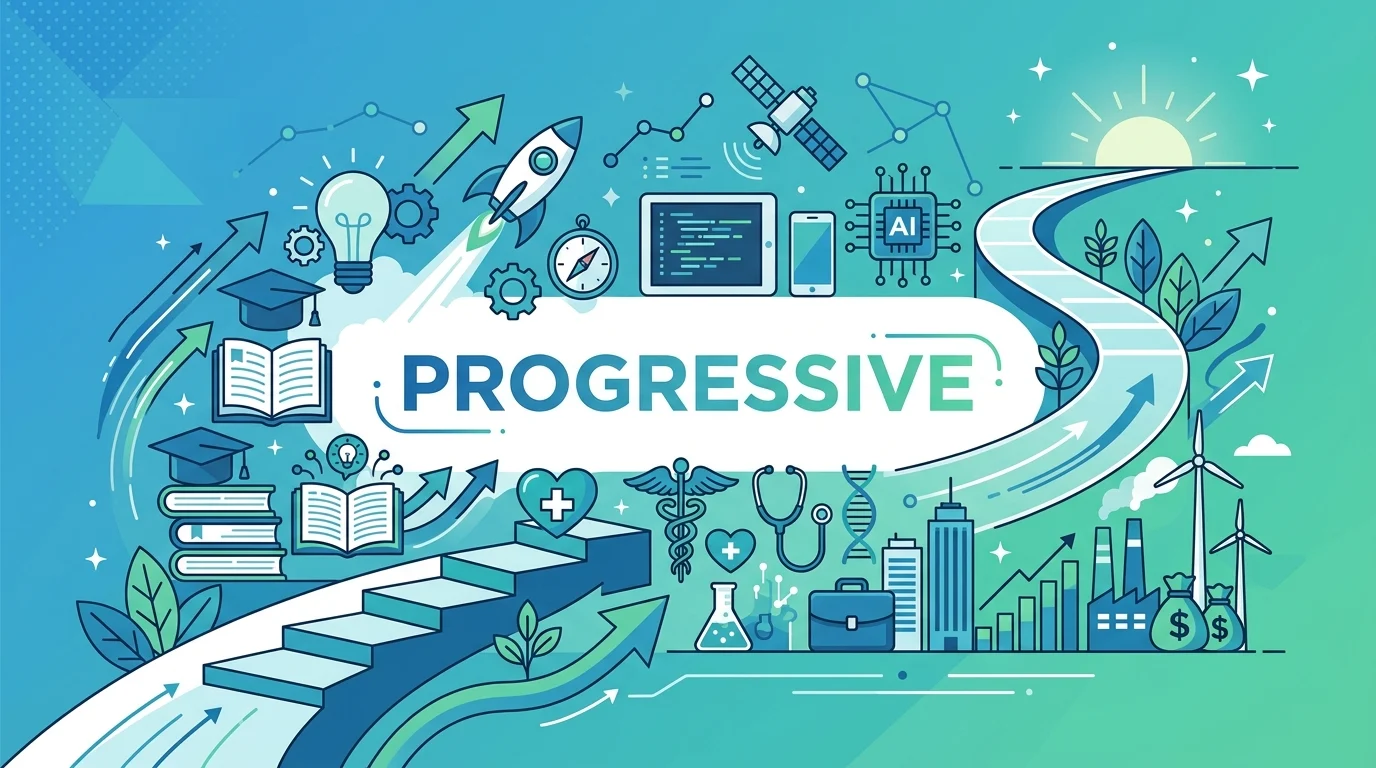
Quick Ans: Progressive generally means moving forward, improving over time, or developing gradually. The word is commonly used to describe people, ideas, policies, education, technology, healthcare, and grammar that emphasize growth, advancement, or positive change.
The word progressive is widely used in everyday English, but its meaning can vary depending on the context. You may hear it in conversations about politics, education, healthcare, technology, grammar, business, or personal development.
At its core, progressive refers to something that advances, develops, or changes over time rather than remaining the same. It often carries a positive meaning, suggesting improvement, innovation, or forward thinking.
Because the word appears in many different situations, understanding its context is important. This guide explains the complete progressive meaning, including definitions, examples, common uses, alternative meanings, related terms, practical examples, and frequently asked questions.
Quick Answer Box
| Topic | Answer |
|---|---|
| Meaning | Moving forward, developing, or improving gradually |
| Part of Speech | Adjective |
| Common Uses | Politics, education, healthcare, technology, grammar, business |
| Tone | Neutral to positive |
| Opposite | Conservative, traditional, static, outdated (depending on context) |
| Example | “The company introduced progressive workplace policies.” |
What Does Progressive Mean?
The word progressive describes something that supports growth, improvement, innovation, or gradual development.
In simple words, if something is progressive, it is moving forward instead of remaining unchanged.
Examples include:
- Progressive education
- Progressive technology
- Progressive thinking
- Progressive healthcare
- Progressive policies
- Progressive businesses
The exact meaning depends on the subject being discussed.
Full Definition
According to standard English usage, progressive means:
- Advancing gradually.
- Favoring improvement or reform.
- Supporting new ideas and innovation.
- Developing step by step.
- Becoming better over time.
Unlike sudden change, a progressive approach often involves continuous improvement through gradual development.
Context and Usage
The meaning of progressive changes slightly depending on where it is used.
Everyday Conversations
People often describe someone as progressive if they are open-minded and willing to accept new ideas.
Example:
“She’s very progressive in her thinking.”
Workplace
Businesses may introduce progressive policies that improve employee satisfaction.
Example:
“Our company offers progressive workplace benefits.”
Personal Growth
Someone may adopt a progressive mindset by continuously learning new skills.
Example:
“He takes a progressive approach to self-improvement.”
Community Development
Cities may implement progressive transportation or environmental programs.
Example:
“The city invested in progressive public transportation.”
Real-Life Examples
Conversation Example 1
Emma: Your company has flexible work hours?
Olivia: Yes, they’re very progressive.
Conversation Example 2
Jake: Their school encourages creative learning.
Ryan: That’s a progressive education system.
Conversation Example 3
Sophia: My doctor recommended a new treatment plan.
Liam: It’s part of a progressive healthcare approach.
Conversation Example 4
Sarah: The company uses AI to improve customer service.
Lucas: That’s a progressive use of technology.
Conversation Example 5
Noah: They’re always looking for better solutions.
Ethan: That’s what makes them progressive.
Progressive Meaning in Different Contexts
Politics
In politics, progressive often refers to policies that support social reform, economic changes, expanded public services, environmental protection, or equal rights.
The exact meaning varies between countries and political systems.
Education
Progressive education focuses on:
- Critical thinking
- Problem solving
- Collaboration
- Student-centered learning
- Practical experiences
Instead of relying only on memorization, students actively participate in learning.
Technology
Progressive technology refers to innovative tools and solutions that improve efficiency and everyday life.
Examples include:
- Artificial intelligence
- Cloud computing
- Electric vehicles
- Renewable energy
- Smart devices
Healthcare
Progressive healthcare emphasizes:
- Modern treatments
- Preventive care
- Patient-centered services
- Medical innovation
Business
A progressive business may offer:
- Remote work
- Flexible schedules
- Employee wellness programs
- Diversity initiatives
- Sustainable practices
Progressive in English Grammar
In grammar, progressive tense describes an action that is happening now or was continuing over a period of time.
Examples:
- I am studying.
- They are working.
- She was reading.
- We were traveling.
Progressive tenses use a form of “to be” plus a verb ending in -ing.
Synonyms of Progressive
Depending on the context, similar words include:
- Advanced
- Modern
- Innovative
- Forward-thinking
- Evolving
- Developing
- Improving
- Reform-minded
- Contemporary
- Dynamic
Each synonym has a slightly different nuance, but they all relate to movement or improvement.
Opposite Meaning of Progressive
Common opposites include:
- Conservative
- Traditional
- Static
- Unchanging
- Conventional
- Old-fashioned
- Outdated
- Resistant to change
The best opposite depends on the sentence and context.
How to Use Progressive Correctly
Here are a few examples:
- The company has progressive leadership.
- She supports progressive education.
- Our town adopted progressive environmental policies.
- Progressive technology continues to transform healthcare.
- His progressive attitude helped solve the problem.
Using the word appropriately depends on what is improving or changing.
Common Misinterpretations
People sometimes assume progressive always refers to politics.
While it is frequently used in political discussions, the word has many other meanings.
For example:
- Progressive teaching methods
- Progressive businesses
- Progressive technology
- Progressive medical care
- Progressive muscle disease
- Progressive grammar tenses
Always consider the surrounding context before deciding which meaning applies.
When Not to Use Progressive
Avoid using progressive if:
- No improvement or development is taking place.
- The subject is completely unchanged.
- A more precise adjective better fits the situation.
For example, calling an outdated process “progressive” would be inaccurate.
Usage Tips
To use progressive naturally:
- Think about whether something is improving over time.
- Match the meaning to the context.
- Don’t assume it always refers to politics.
- Use it when describing innovation or gradual development.
- Consider whether another adjective would be more specific.
Frequently Asked Questions
What does progressive mean?
Progressive generally means moving forward, improving, or developing gradually.
Is progressive always political?
No. It is also used in education, healthcare, technology, grammar, business, and everyday conversations.
What is a progressive person?
A progressive person is often someone who supports new ideas, innovation, or gradual improvements.
What is progressive education?
It is an educational approach that emphasizes critical thinking, creativity, collaboration, and practical learning.
What is the progressive tense?
It is a verb tense describing ongoing actions, such as “I am reading.”
Is progressive a positive word?
Usually yes, although its interpretation depends on context and personal perspective.
What is the opposite of progressive?
Common opposites include traditional, conservative, static, or outdated, depending on the situation.
Can a business be progressive?
Yes. Businesses often describe themselves as progressive when adopting innovative workplace practices.
Can technology be progressive?
Absolutely. New technologies that improve efficiency and solve problems are often described as progressive.
Why is context important?
Because the meaning changes depending on whether you’re discussing politics, education, grammar, healthcare, technology, or everyday life.
Conclusion
The progressive meaning centers on the idea of growth, advancement, and continuous improvement. Whether describing a person, organization, educational method, healthcare system, technology, or grammatical structure, the word generally suggests moving forward instead of remaining the same.
Although many people associate progressive with politics, its use extends far beyond that field. Understanding the surrounding context helps determine the intended meaning and allows you to use the word accurately in both spoken and written English. As language evolves, progressive remains one of the most versatile words for describing positive development and forward-thinking ideas.
Discover More:-
- BY Meaning in Text Slang: What It Means, How to Use It, Examples & More 2026
- What Does EPO Mean in Health Insurance? Complete Guide 2026

Ella Parker is a professional content writer with a passion for creating clear, engaging, and well-researched articles. She focuses on delivering valuable insights and practical information across business, technology, and lifestyle topics.