Quick Ans: CRPG stands for Computer Role-Playing Game. It refers to a genre of video games where players create or control characters, make decisions, complete quests, develop skills, and experience story-driven adventures. Today, the term also includes many modern role-playing games available on both PC and consoles.
If you’ve been reading game reviews, browsing Steam, watching YouTube gaming channels, or participating in Reddit discussions, you’ve probably encountered the term CRPG. While many gamers recognize it immediately, newcomers often wonder what CRPG actually means and how it differs from other RPG genres.
Originally, CRPG stood for Computer Role-Playing Game, distinguishing digital role-playing games from traditional tabletop RPGs like Dungeons & Dragons. Over time, the meaning evolved to describe a specific style of role-playing game focused on deep storytelling, character customization, meaningful choices, tactical combat, and immersive worlds.
In this guide, you’ll learn everything about the CRPG meaning, including its history, gameplay features, examples, popular titles, differences from other RPGs, related terms, and frequently asked questions.
Quick Answer Box
| Topic | Answer |
|---|---|
| Meaning | Computer Role-Playing Game |
| Category | Video game genre |
| Common Platforms | PC, PlayStation, Xbox, Nintendo Switch |
| Focus | Story, choices, character progression |
| Popular Games | Baldur’s Gate 3, Divinity: Original Sin 2, Pathfinder: Wrath of the Righteous, Pillars of Eternity |
| Audience | RPG and strategy fans |
What Does CRPG Mean?
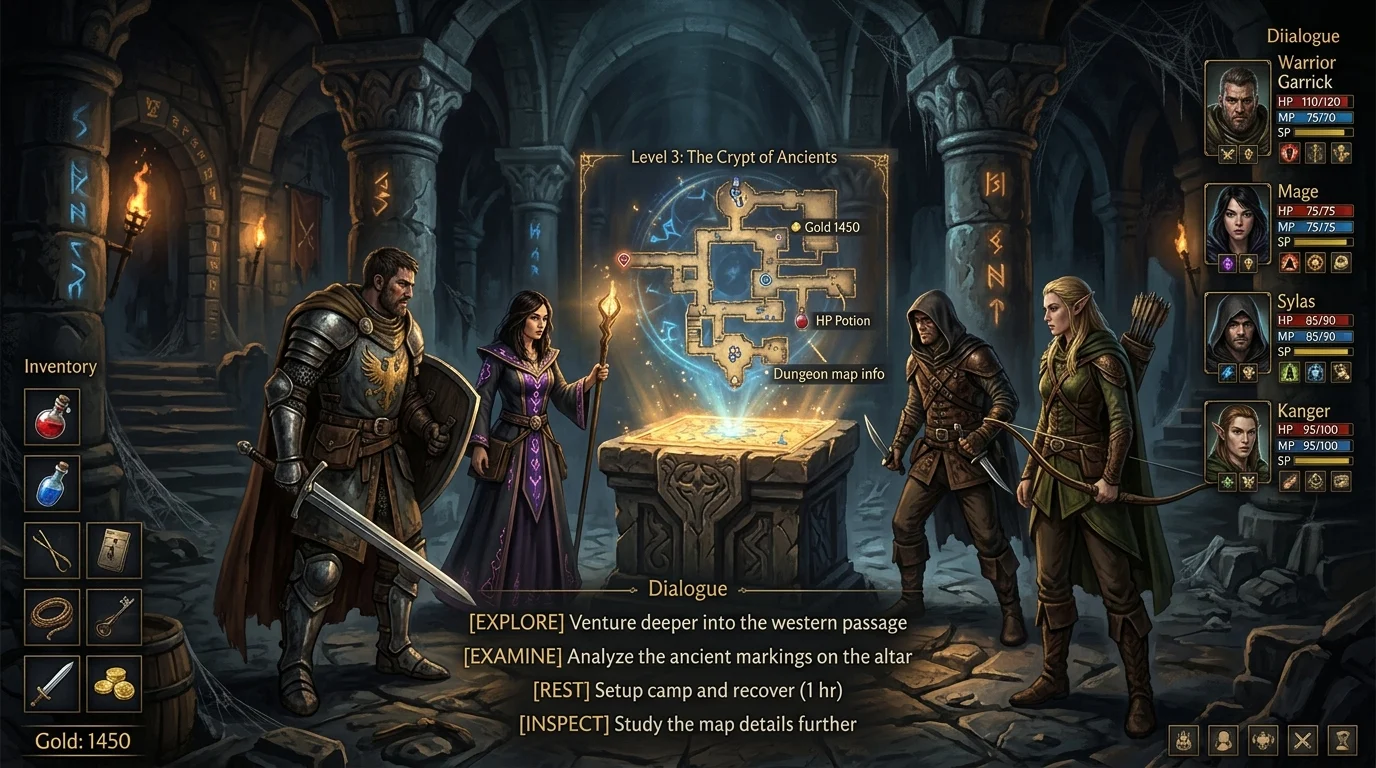
A CRPG is a Computer Role-Playing Game, a genre that emphasizes player choice, character development, exploration, dialogue, and strategic gameplay.
Unlike many action games, CRPGs encourage players to shape the story through their decisions. Your choices often affect characters, quests, endings, and even the world itself.
Although the genre started on computers, modern CRPGs are now available on consoles as well.
Full Definition
The abbreviation CRPG stands for:
Computer + Role-Playing + Game
Originally, the “C” highlighted that these games were played on computers rather than around a tabletop with dice and rulebooks.
Today, gamers use CRPG to describe games that feature:
- Deep role-playing mechanics
- Rich storytelling
- Branching dialogue
- Tactical or turn-based combat
- Character customization
- Large fantasy or science fiction worlds
- Multiple endings
- Party management
These elements combine to create highly immersive experiences where players have significant control over how the adventure unfolds.
History of CRPGs
Early Beginnings
CRPGs first appeared during the late 1970s and early 1980s as developers adapted tabletop role-playing mechanics into computer games.
Many early titles featured:
- Grid-based movement
- Text-heavy storytelling
- Turn-based combat
- Character statistics
- Dungeon exploration
These games laid the foundation for modern RPG design.
The Golden Age
During the late 1990s and early 2000s, CRPGs became extremely popular thanks to games that offered:
- Complex companions
- Moral choices
- Expansive worlds
- Memorable stories
- Strategic combat
Many classic titles from this era continue to influence modern game developers.
Modern Revival
In recent years, CRPGs have enjoyed a major resurgence. Advances in technology allow developers to create:
- Fully voiced characters
- Cinematic dialogue
- Massive open environments
- Detailed quest systems
- Highly reactive worlds
Modern CRPGs blend classic mechanics with improved graphics and accessibility.
Core Features of a CRPG
Character Creation
Most CRPGs begin by letting players create a unique character.
You may choose:
- Race
- Class
- Appearance
- Skills
- Background
- Attributes
These choices influence gameplay and dialogue throughout the adventure.
Story-Driven Gameplay
Storytelling is one of the biggest strengths of CRPGs.
Players often experience:
- Main storylines
- Side quests
- Companion stories
- Moral dilemmas
- Political conflicts
- World-changing decisions
Tactical Combat
Combat usually rewards planning rather than quick reflexes.
Depending on the game, battles may be:
- Turn-based
- Real-time with pause
- Grid-based
- Party-focused
Strategic thinking is often more important than button mashing.
Player Choice
One defining feature of CRPGs is meaningful decision-making.
Players can:
- Help or betray allies
- Negotiate instead of fighting
- Join different factions
- Solve quests in multiple ways
- Unlock different endings
This replay value is one reason the genre remains so popular.
Popular CRPG Games
Some of the best-known CRPGs include:
- Baldur’s Gate 3
- Divinity: Original Sin 2
- Pathfinder: Wrath of the Righteous
- Pillars of Eternity
- Baldur’s Gate II
- Planescape: Torment
- Wasteland 3
- Disco Elysium
- Tyranny
- Solasta: Crown of the Magister
These games are praised for their storytelling, world-building, and role-playing depth.
CRPG vs RPG
Although every CRPG is an RPG, not every RPG is considered a CRPG.
CRPG
Typically includes:
- Tactical gameplay
- Complex dialogue
- Multiple story outcomes
- Party management
- Deep character builds
Action RPG
Usually focuses more on:
- Fast combat
- Real-time action
- Simpler dialogue
- Continuous gameplay
Examples include games where combat takes priority over tactical planning.
JRPG
Japanese role-playing games often feature:
- Linear storytelling
- Anime-inspired visuals
- Fixed protagonists
- Turn-based battles
While JRPGs are RPGs, they generally differ from CRPGs in structure and design philosophy.
Real-Life Gaming Examples
Example 1
Player A:
“I spent three hours creating my character.”
Player B:
“Sounds like a CRPG.”
Example 2
“I restarted because I wanted different story choices.”
This is common in CRPGs where decisions have lasting consequences.
Example 3
“My companion left because of my choices.”
Companion relationships are a hallmark of many CRPGs.
Example 4
“There are six possible endings.”
Branching endings are another feature frequently found in CRPGs.
Example 5
“I solved the quest without fighting.”
Many CRPGs reward diplomacy, stealth, or creative problem-solving instead of combat.
Why Gamers Love CRPGs
Players enjoy CRPGs because they offer:
- Rich storytelling
- Freedom of choice
- Memorable companions
- Deep lore
- Tactical gameplay
- Character progression
- High replay value
- Immersive worlds
Every playthrough can feel different depending on the player’s decisions.
Related Gaming Terms
If you’re learning gaming terminology, you may also encounter:
- RPG — Role-Playing Game
- JRPG — Japanese Role-Playing Game
- ARPG — Action Role-Playing Game
- MMORPG — Massively Multiplayer Online Role-Playing Game
- Roguelike
- Roguelite
- Turn-Based Strategy
- Sandbox
- Open World
- Dungeon Crawler
Understanding these genres helps gamers choose titles that match their preferred play style.
Common Misunderstandings
Many people assume CRPG simply means “RPG played on a computer.”
While that’s historically true, today’s gamers usually use CRPG to describe a specific style of role-playing game known for tactical gameplay, complex narratives, and meaningful choices.
Similarly, not every fantasy game qualifies as a CRPG. The defining features are role-playing depth, player agency, and strategic mechanics.
When Should You Play a CRPG?
CRPGs are ideal if you enjoy:
- Reading dialogue
- Making meaningful decisions
- Exploring detailed worlds
- Building unique characters
- Strategic combat
- Long adventures
- Rich storytelling
If you prefer fast-paced action with minimal dialogue, another RPG subgenre may be a better fit.
Frequently Asked Questions
What does CRPG stand for?
CRPG stands for Computer Role-Playing Game.
Are CRPGs only available on PC?
No. While the genre originated on computers, many modern CRPGs are available on consoles as well.
What makes a game a CRPG?
Deep storytelling, character customization, player choice, tactical combat, and role-playing systems.
Is Baldur’s Gate 3 a CRPG?
Yes. It is widely considered one of the best modern CRPGs.
Are CRPGs difficult?
Some can be challenging because they emphasize strategy and decision-making rather than quick reflexes.
What’s the difference between CRPG and RPG?
CRPG is a subgenre of RPG focused on computer-style role-playing mechanics, tactical gameplay, and branching narratives.
Do CRPGs have multiplayer?
Some do, but many are designed primarily as single-player experiences.
Are CRPGs story-focused?
Yes. Storytelling is one of the defining characteristics of the genre.
Why are CRPGs popular again?
Modern graphics, improved accessibility, and highly acclaimed releases have introduced the genre to a new generation of players.
Is a CRPG good for beginners?
Yes. Many modern titles include tutorials and adjustable difficulty settings, making them accessible to newcomers.
Conclusion
The CRPG meaning is Computer Role-Playing Game, a genre celebrated for its immersive storytelling, meaningful player choices, character development, and tactical gameplay. From classic titles that shaped the RPG industry to modern masterpieces that push the genre forward, CRPGs continue to attract players who enjoy deep narratives and strategic decision-making.
Whether you’re creating a hero, assembling a party, exploring vast fantasy worlds, or determining the fate of entire kingdoms, CRPGs provide an experience where your choices truly matter. If you’re looking for games that reward creativity, planning, and role-playing, the CRPG genre is one of the richest and most rewarding in gaming.
Discover More:-
- Catalyst Meaning: Definition, Examples, Types & Uses Explained 2026
- Avid Meaning: Definition, Examples, Synonyms & Usage Guide 2026

Ella Parker is a professional content writer with a passion for creating clear, engaging, and well-researched articles. She focuses on delivering valuable insights and practical information across business, technology, and lifestyle topics.