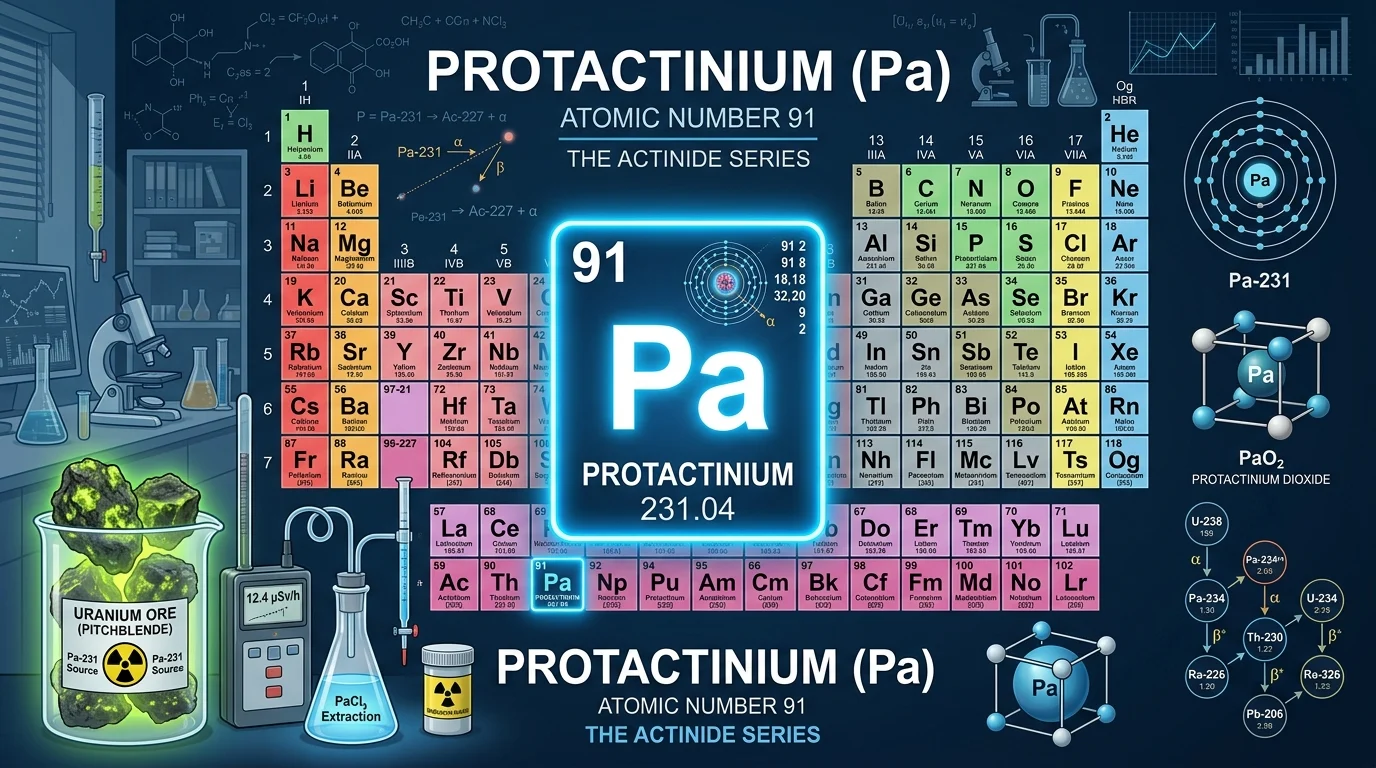
Quick Ans: Protactinium is a rare, naturally occurring radioactive chemical element with the symbol Pa and atomic number 91. It belongs to the actinide series on the periodic table and is primarily used in scientific research due to its rarity, radioactivity, and high cost.
If you’ve searched for “protactinium meaning,” you’re likely looking for a simple explanation of this unusual chemical element. Although protactinium is one of the least-known elements on the periodic table, it plays an important role in nuclear chemistry, geology, and scientific research.
Unlike common elements such as oxygen or iron, protactinium is extremely rare and highly radioactive. Because of its scarcity and hazardous nature, it has very few commercial applications. Instead, scientists study it to better understand radioactive decay, Earth’s geological history, and the behavior of heavy elements.
This guide explains everything you need to know about the meaning of protactinium, including its definition, pronunciation, history, discovery, properties, uses, interesting facts, comparisons with similar elements, and answers to frequently asked questions.
Quick Answer Box
| Topic | Answer |
|---|---|
| Element Name | Protactinium |
| Chemical Symbol | Pa |
| Atomic Number | 91 |
| Element Family | Actinide |
| State at Room Temperature | Solid |
| Naturally Occurring | Yes |
| Radioactive | Yes |
| Color | Silvery-gray |
| Main Use | Scientific research |
What Does Protactinium Mean?
Protactinium is the name of a naturally occurring radioactive metallic element found in very small amounts within uranium ores.
Its name comes from the Greek word “protos,” meaning “first,” and the word actinium, because one of its radioactive isotopes eventually decays into actinium.
In simple terms, protactinium is:
- A naturally occurring chemical element
- A radioactive metal
- Part of the actinide series
- One of the rarest naturally occurring elements on Earth
Full Definition
Protactinium is a chemical element represented by the symbol Pa and atomic number 91 on the periodic table.
It belongs to the actinide family, which includes several radioactive elements such as:
- Thorium
- Uranium
- Neptunium
- Plutonium
Protactinium occurs naturally but only in extremely small quantities because it forms during the radioactive decay of uranium and thorium.
Pronunciation
Protactinium is pronounced:
pro-tak-TIN-ee-um
Phonetic spelling:
/ˌproʊˌtækˈtɪniəm/
History of Protactinium
The history of protactinium is fascinating because scientists discovered it gradually rather than all at once.
Early Discovery
In 1913, scientists identified one isotope of the element while studying radioactive decay.
Official Identification
The element was officially discovered in 1917–1918 by independent research teams led by:
- Lise Meitner
- Otto Hahn
- Frederick Soddy
- John Cranston
Their work helped establish protactinium as a unique chemical element.
Naming the Element
Originally, the element was called Brevium because of the short half-life of one isotope.
Later, scientists renamed it Protactinium, reflecting its relationship to actinium in radioactive decay chains.
Position on the Periodic Table
Protactinium is located in:
- Group: Actinides
- Period: 7
- Atomic Number: 91
- Symbol: Pa
It sits between thorium and uranium in the periodic table.
Physical Properties
Protactinium has several distinctive physical characteristics.
Appearance
- Bright silvery-gray metal
- Metallic luster
- Dense structure
State
At room temperature, protactinium exists as a solid metal.
Density
It is significantly denser than many common metals due to its heavy atomic structure.
Radioactivity
Protactinium is naturally radioactive, meaning its atoms gradually decay and release radiation.
Chemical Properties
Protactinium reacts with oxygen and moisture over time.
Important characteristics include:
- Forms several oxidation states
- Reacts with halogens
- Oxidizes in air
- Dissolves in certain acids
Because it is radioactive, handling requires specialized laboratory procedures.
Where Is Protactinium Found?
Protactinium occurs naturally in tiny amounts inside uranium-containing minerals.
It may be found in:
- Uraninite
- Pitchblende
- Uranium ores
- Certain mineral deposits
However, the concentration is extremely low.
Scientists often extract microscopic quantities during nuclear research rather than mining it directly.
Uses of Protactinium
Because protactinium is rare, radioactive, and expensive, it has very limited practical uses.
Scientific Research
Its primary application is laboratory research.
Scientists study protactinium to understand:
- Nuclear reactions
- Radioactive decay
- Heavy elements
- Atomic behavior
Geology
Researchers use certain isotopes in geological dating techniques.
These studies help estimate:
- Ocean sediment ages
- Ancient climate changes
- Geological formations
Nuclear Science
Protactinium contributes to research involving advanced nuclear materials and radioactive processes.
Why Is Protactinium So Rare?
Protactinium is one of the rarest naturally occurring elements because:
- It forms slowly through radioactive decay.
- It continues decaying into other elements.
- Only tiny amounts exist in natural uranium ores.
- Extraction is difficult and expensive.
In fact, obtaining even a few grams requires processing enormous quantities of uranium ore.
Is Protactinium Dangerous?
Yes.
Protactinium is considered hazardous because it is radioactive.
Potential risks include:
- Radiation exposure
- Internal contamination
- Long-term health hazards if improperly handled
For this reason, it is handled only by trained professionals using specialized protective equipment and strict laboratory safety procedures.
Interesting Facts About Protactinium
- Protactinium’s symbol is Pa.
- It has atomic number 91.
- It belongs to the actinide series.
- It is one of the rarest natural elements.
- It is radioactive.
- It has very few commercial applications.
- It is mainly used for scientific research.
- It is extremely expensive due to its rarity.
- It slowly decays into other radioactive elements.
- Most people will never encounter pure protactinium in everyday life.
Protactinium vs Uranium
Although both elements belong to the actinide family, they have several differences.
| Feature | Protactinium | Uranium |
|---|---|---|
| Symbol | Pa | U |
| Atomic Number | 91 | 92 |
| Natural Abundance | Extremely rare | Relatively more abundant |
| Commercial Use | Research | Nuclear fuel |
| Radioactive | Yes | Yes |
Common Misunderstandings
Many people mistakenly believe protactinium is:
- A synthetic element
- Widely used in nuclear reactors
- Commonly found in nature
In reality:
- It occurs naturally.
- It is exceptionally rare.
- Most of its use is limited to scientific research.
Why Is Protactinium Important?
Despite its rarity, protactinium helps scientists better understand:
- Radioactive decay chains
- Nuclear chemistry
- Earth’s geological history
- Heavy element behavior
- Atomic structure
Without studying rare elements like protactinium, our understanding of nuclear science would be much more limited.
Frequently Asked Questions
What does protactinium mean?
Protactinium is a naturally occurring radioactive chemical element with the symbol Pa and atomic number 91.
Is protactinium radioactive?
Yes. It is naturally radioactive.
Where is protactinium found?
It occurs in very small amounts within uranium and thorium ores.
What is the symbol for protactinium?
Its chemical symbol is Pa.
What is the atomic number of protactinium?
The atomic number is 91.
Is protactinium used commercially?
Very little. Most uses are limited to scientific research.
Why is protactinium expensive?
Its rarity, difficult extraction process, and radioactive nature make it costly.
Who discovered protactinium?
Scientists including Lise Meitner, Otto Hahn, Frederick Soddy, and John Cranston contributed to its discovery during the early twentieth century.
Is protactinium naturally occurring?
Yes. Although rare, it occurs naturally.
What family does protactinium belong to?
It belongs to the actinide series on the periodic table.
Conclusion
The meaning of protactinium extends far beyond simply being another element on the periodic table. As the chemical element Pa (atomic number 91), protactinium is one of the rarest naturally occurring radioactive metals known to science. Although it has few commercial applications, it plays a significant role in nuclear chemistry, geological dating, and scientific research.
Its fascinating discovery, unique radioactive properties, and position within the actinide family make protactinium an important subject for researchers around the world. While most people will never encounter this rare element outside textbooks or laboratories, understanding its definition and significance provides valuable insight into the complex world of chemistry and the periodic table.
Discover More:-
- Catalyst Meaning: Definition, Examples, Types & Uses Explained 2026
- Avid Meaning: Definition, Examples, Synonyms & Usage Guide 2026

Alexander Cole is a professional content writer and researcher who specializes in creating informative, reader-friendly, and well-researched articles. He is committed to publishing accurate, valuable, and engaging content that helps readers stay informed and make smarter decisions.