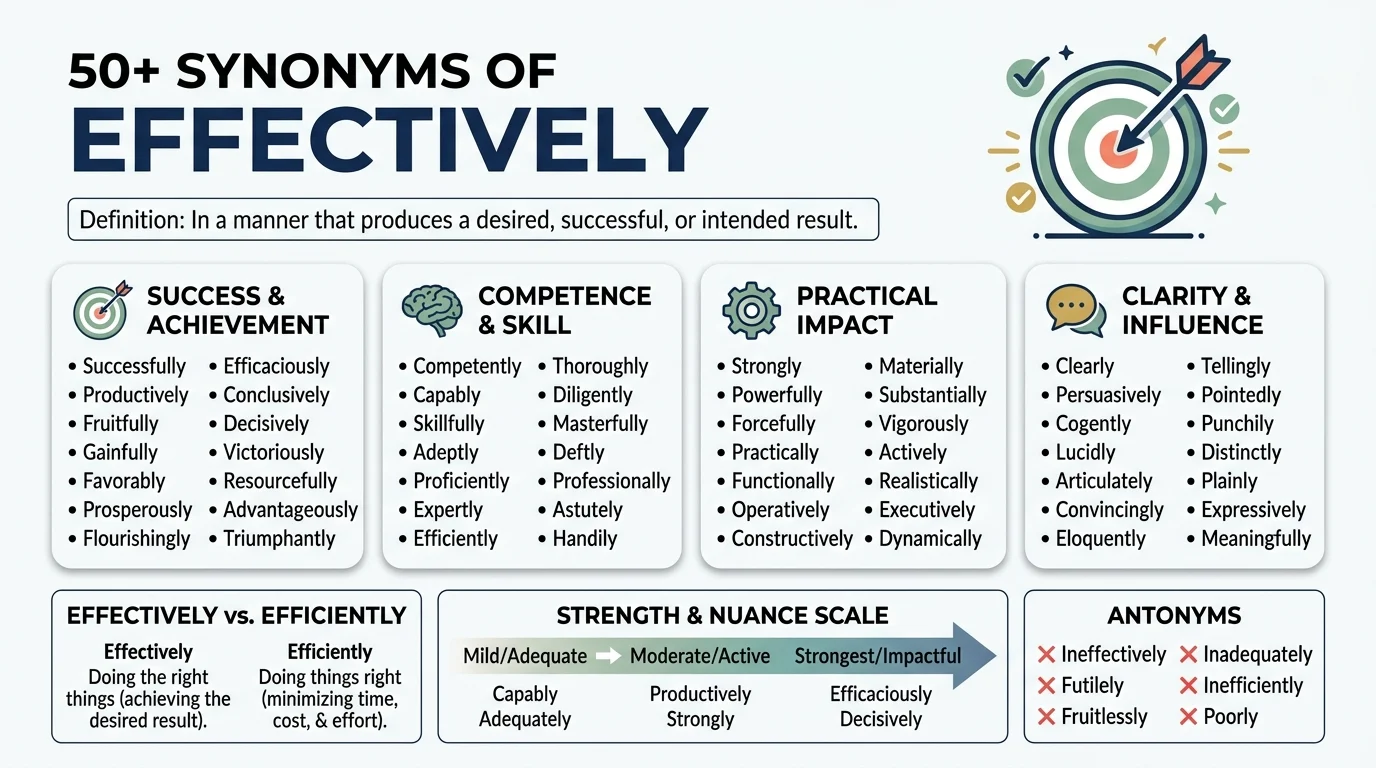
Have you ever needed to describe how well something is done or the actual result of an action but felt that “effectively” was too common or slightly vague? You want to capture the sense of success, efficiency, or practical impact, and the word “effectively” comes to mind. Choosing the right synonym for “effectively” can transform a basic statement into a precise expression of success, competence, or real-world impact. This guide explores the best synonyms of effectively, explaining exactly which word to use and when.
Quick Answer: “Effectively” means in a way that produces a desired result or in actual fact. For success and results, choose successfully or efficiently. For practical impact, use practically or in effect. For competence, use competently or capably. For clarity and precision, use productively or purposefully.
Meaning, Tone, and Context
Understanding the core meaning of “effectively” is the first step to using it effectively.
Simple Definition: In a way that produces a desired result; in actual fact, though not formally acknowledged.
Part of Speech: Adverb.
Overall Tone: Neutral to positive. It can indicate success, practicality, or reality.
Formality Level: Neutral to formal. The word works in most contexts.
Common Uses: Native English speakers use it in business (“communicate effectively”), science (“effectively treat the disease”), and general contexts (“effectively, the project is finished”).
Word Forms: Related words include the adjective effective, the noun effectiveness, and the adjective effectual.
When and How to Use “Effectively”
“Effectively” is the perfect choice when you want to describe successful or practical action. Here are seven realistic examples.
Business: “The manager communicated the changes effectively.”
Academic: “The treatment effectively reduced symptoms in most patients.”
Professional: “We need to work more effectively as a team.”
Technology: “The software effectively automates repetitive tasks.”
Personal: “She effectively balanced work and family life.”
Email: “Please respond effectively to customer complaints.”
Social Media: “This campaign effectively reached the target audience.”
Best Synonyms of “Effectively”
No synonym is identical in every situation. Here is your guide to the best replacement for “effectively” based on your writing context.
For Success and Results
Most Direct: Successfully means achieving the desired result. “The team successfully completed the project.”
*Efficiently means achieving with minimal waste. “The system efficiently processes data.”
Productively means producing good results. “We worked productively all morning.”
Effectively itself is often the best choice. “She effectively managed the crisis.”
For Practical Impact and Reality
Practically means in practice. “Practically, the plan is impossible.”
In effect means in reality. “The policy is, in effect, a ban.”
Essentially means fundamentally. “The two systems are essentially the same.”
Virtually means almost. “The project is virtually complete.”
For Competence and Skill
Competently means with skill. “He competently handled the negotiation.”
Capably means with ability. “She capably led the team.”
Skillfully means with expertise. “He skillfully navigated the complex issue.”
Adeptly means with skill. “She adeptly solved the problem.”
For Clarity and Purpose
Clearly means in a clear way. “He clearly explained the process.”
Purposefully means with purpose. “She purposefully directed the meeting.”
Precisely means exactly. “The instructions were precisely followed.”
Focused means with concentration. “The team worked in a focused manner.”
When Not to Use “Effectively”
Using “effectively” can sound wrong or awkward in certain situations.
When You Mean “Actually”: “Effectively” can imply reality. “Actually” is more direct.
Better Choice: Actually or in fact. “The project is actually finished.”
When You Mean “Successfully”: “Effectively” is broader. “Successfully” is clearer.
Better Choice: Successfully. “She successfully completed the task.”
When It Sounds Too Formal: In casual conversation, “effectively” can sound stiff.
Better Choice: Well or right. “She did it well.”
Words Commonly Confused With “Effectively”
| Word | Difference | When to Use | Example |
|---|---|---|---|
| Efficiently | With minimal waste | Time and resources | “Efficiently run meeting.” |
| Successfully | Achieving the goal | Results and outcomes | “Successfully completed.” |
| Practically | In practice | Reality vs. theory | “Practically speaking.” |
| Essentially | Fundamentally | Core meaning | “Essentially the same.” |
| Competently | With skill | Professional contexts | “Competently handled.” |
| Clearly | In a clear way | Communication | “Clearly explained.” |
Best Synonyms of “Effectively” by Context
| Context | Best Synonym | Why It Works | Example |
|---|---|---|---|
| Formal writing | Successfully | Formal and precise | “The initiative was successfully implemented.” |
| Academic writing | Significantly | Standard in research | “The treatment significantly reduced symptoms.” |
| Professional | Efficiently | Professional and clear | “The team worked efficiently.” |
| Business | Productively | Business and results | “The meeting was productive.” |
| Technology | Automatically | Technical and specific | “The system automatically updates.” |
| Casual | Well | Simple and natural | “She did well.” |
| Emotional | Powerfully | Evokes impact | “The speech powerfully moved the audience.” |
How to Choose the Best Synonym of “Effectively”
Choosing the right word is a simple decision. Answer these questions.
What type of effectiveness am I describing? For success, use successfully or efficiently. For practical impact, use practically or in effect. And for competence, use competently or skillfully.
What is my audience? For a formal report, use successfully or significantly. For a friend, use well or right.
What is my purpose? Are you describing results, reality, or skill? The correct synonym depends entirely on this.
What is the emotional strength? Powerfully is stronger. Well is milder. Pick the one that matches your message.
Real Life Examples of “Effectively”
School: Basic: “She studied effectively.” Improved: “She studied efficiently and passed the exam.”
College: Basic: “The treatment worked effectively.” Improved: “The treatment significantly reduced symptoms.”
Workplace: Basic: “We need to work effectively.” Improved: “We need to work productively.”
Business: Basic: “The manager communicated effectively.” Improved: “The manager communicated clearly.”
Email: Basic: “Respond effectively.” Improved: “Respond promptly.”
Conversation: Basic: “It worked effectively.” Improved: “It worked well.”
Storytelling: Basic: “She effectively led the team.” Improved: “She skillfully led the team.”
Top 10 Synonyms of “Effectively”
| Synonym | Simple Meaning | Best Used For | Example Sentence |
|---|---|---|---|
| Successfully | Achieving the desired result | Results and outcomes | “The team successfully completed the project.” |
| Efficiently | With minimal waste | Time and resources | “The system efficiently processes data.” |
| Productively | Producing good results | Work and meetings | “We worked productively all morning.” |
| Practically | In practice | Reality vs. theory | “Practically, the plan is impossible.” |
| Essentially | Fundamentally | Core meaning | “The two systems are essentially the same.” |
| Competently | With skill | Professional contexts | “He competently handled the negotiation.” |
| Capably | With ability | Leadership and tasks | “She capably led the team.” |
| Skillfully | With expertise | Complex tasks | “He skillfully navigated the issue.” |
| Clearly | In a clear way | Communication | “He clearly explained the process.” |
| Precisely | Exactly | Instructions and details | “The instructions were precisely followed.” |
Synonyms of “Effectively” by Usage
Professional vs. Personal Synonyms
In the workplace, choose successfully, efficiently, or productively. With friends, use well, right, or properly.
Formal vs. Conversational Synonyms
For formal writing, use successfully, significantly, or competently. For casual conversations, use well, right, or properly.
Academic Synonyms
For research and essays, choose significantly for results, effectively for interventions, and precisely for methods.
Professional and Business Synonyms
For maximum impact, choose efficiently for processes, productively for meetings, and successfully for projects.
Creative and Literary Synonyms
To add emotion and imagery, choose powerfully, skillfully, or masterfully. These words create atmosphere.
Slang or Modern Synonyms
In modern American slang, well, right, or smoothly are common. For example, “It went smoothly.” These are casual and should be avoided in formal writing.
Strongest to Mildest Synonyms
Mild: well, right, properly
Moderate: effectively, successfully, efficiently
Strong: productively, competently, skillfully
Very Strong: powerfully, masterfully, significantly
Emotional vs. Neutral Synonyms
Emotional Synonyms: Powerfully, masterfully. These words hint at strong impact. Use them when you want to evoke feeling.
Neutral Synonyms: Effectively, successfully, efficiently. These words communicate factual information.
Antonyms of “Effectively”
| Antonym | Meaning | Example Sentence |
|---|---|---|
| Ineffectively | Without producing results | “The treatment was ineffectively applied.” |
| Inefficiently | With wasted effort | “The process was inefficiently run.” |
| Poorly | Badly | “The task was poorly completed.” |
| Incompetently | Without skill | “He incompetently handled the situation.” |
| Unsuccessfully | Without success | “The team unsuccessfully attempted the task.” |
| Ineffectually | Without effect | “The policy was ineffectually implemented.” |
| Weakly | Without strength | “The argument was weakly presented.” |
| Clumsily | Without grace | “He clumsily handled the equipment.” |
| Wastefully | With waste | “The resources were wastefully used.” |
| Carelessly | Without care | “The report was carelessly written.” |
| Halfheartedly | Without enthusiasm | “He halfheartedly joined the effort.” |
| Inadequately | Not sufficiently | “The plan was inadequately prepared.” |
| Fruitlessly | Without results | “They fruitlessly searched for the keys.” |
| Vainly | Without success | “She vainly tried to convince him.” |
| Unproductively | Without productivity | “The meeting was unproductively long.” |
Comparison: “Effectively” vs Similar Words
Effectively vs. Efficiently
Main Difference: “Effectively” is about results. “Efficiently” is about minimal waste.
Which Is Stronger? They are different.
Which Is More Formal? Both are formal.
When to Use Each: Use “efficiently” for time and resources. Use “effectively” for results.
Examples:
Effectively: “The treatment effectively reduced pain.”
Efficiently: “The system efficiently processes data.”
Effectively vs. Successfully
Main Difference: “Effectively” is broader. “Successfully” is specific to achieving a goal.
Which Is Stronger? “Successfully” is clearer.
Which Is More Formal? Both are formal.
When to Use Each: Use “successfully” for goal completion. Use “effectively” for general results.
Examples:
Effectively: “She effectively managed the team.”
Successfully: “She successfully completed the project.”
Effectively vs. Practically
Main Difference: “Effectively” is about results. “Practically” is about reality.
Which Is Stronger? “Practically” is more specific to reality.
Which Is More Formal? Both are formal.
When to Use Each: Use “practically” for reality. Use “effectively” for general contexts.
Examples:
Effectively: “The method effectively works.”
Practically: “Practically, the plan is impossible.”
Effectively vs. Essentially
Main Difference: “Effectively” is about results. “Essentially” is about core meaning.
Which Is Stronger? “Essentially” is more specific.
Which Is More Formal? Both are formal.
When to Use Each: Use “essentially” for core meaning. Use “effectively” for general contexts.
Examples:
Effectively: “The policy effectively changed the system.”
Essentially: “The two systems are essentially the same.”
Effectively vs. Competently
Main Difference: “Effectively” is about results. “Competently” is about skill.
Which Is Stronger? “Competently” is more specific to skill.
Which Is More Formal? Both are formal.
When to Use Each: Use “competently” for skill. Use “effectively” for general contexts.
Examples:
Effectively: “She effectively solved the problem.”
Competently: “She competently handled the negotiation.”
Effectively vs. Clearly
Main Difference: “Effectively” is about results. “Clearly” is about clarity.
Which Is Stronger? “Clearly” is more specific to communication.
Which Is More Formal? Both are formal.
When to Use Each: Use “clearly” for communication. Use “effectively” for general contexts.
Examples:
Effectively: “He effectively explained the process.”
Clearly: “He clearly explained the process.”
Common Phrases and Expressions with “Effectively”
Phrase: Communicate effectively
Meaning: To convey information successfully.
Example Sentence: “Leaders must communicate effectively.”
Phrase: Work effectively
Meaning: To work successfully.
Example Sentence: “The team works effectively together.”
Phrase: Effectively manage
Meaning: To manage successfully.
Example Sentence: “She effectively manages the department.”
Phrase: Effectively treat
Meaning: To treat successfully.
Example Sentence: “The drug effectively treats the infection.”
Phrase: Effectively address
Meaning: To deal with successfully.
Example Sentence: “We need to effectively address the issue.”
Phrase: Effectively use
Meaning: To use successfully.
Example Sentence: “The company effectively uses its resources.”
Common Mistakes to Avoid
Mistake 1: Using “effectively” when you mean “actually”.
Incorrect: “The project is effectively finished.”
Better: “The project is actually finished.”
Why: “Actually” is more direct.
Mistake 2: Using “effectively” when you mean “successfully”.
Incorrect: “She effectively completed the task.”
Better: “She successfully completed the task.”
Why: “Successfully” is clearer.
Mistake 3: Overusing “effectively” in conversation.
Incorrect: “It worked effectively.”
Better: “It worked well.”
Why: “Well” sounds more natural.
Mistake 4: Using “effectively” when you mean “efficiently”.
Incorrect: “The system effectively processes data.”
Better: “The system efficiently processes data.”
Why: “Efficiently” is for minimal waste.
Mistake 5: Using “effectively” when you mean “competently”.
Incorrect: “He effectively handled the negotiation.”
Better: “He competently handled the negotiation.”
Why: “Competently” is for skill.
Frequently Asked Questions
1. What are the best synonyms of “effectively”?
The best synonyms depend on your context. For success, choose successfully or efficiently. For practical impact, use practically or in effect. And for competence, use competently or skillfully.
2. What are the best formal synonyms of “effectively”?
The best formal synonyms are successfully, significantly, and competently. These words are suitable for academic papers, professional reports, and business communications.
3. What are common informal synonyms of “effectively”?
For informal settings, use well, right, or properly. These alternatives sound more natural in everyday conversation.
4. What is another word for “effectively” in professional writing?
In professional writing, efficiently is an excellent choice. It conveys minimal waste. Successfully is also strong for results.
5. What is the difference between “effectively” and “efficiently”?
“Effectively” is about results. “Efficiently” is about minimal waste. Use “efficiently” for processes and “effectively” for outcomes.
6. What is the opposite of “effectively”?
The most direct opposites (antonyms) of effectively are ineffectively, inefficiently, and poorly. These words describe a lack of success or skill.
Conclusion
“Effectively” is a versatile and useful word for describing success, practicality, and competence. The term is neutral and widely accepted in most contexts, yet it can sound too formal for casual conversation or too vague for specific descriptions. The best choice among the synonyms of effectively depends entirely on your audience, tone, and purpose. For a formal, academic effect, use successfully or significantly. For a practical, business context, efficiently or productively works perfectly. And for competence, choose competently or skillfully. For casual conversation, use well or right. Remember, no single synonym works perfectly in every situation. Your goal is to choose the word that communicates your message with the most clarity and impact. A practical tip for your vocabulary growth is to pay attention to how writers describe success and efficiency and practice using different synonyms in your writing.









