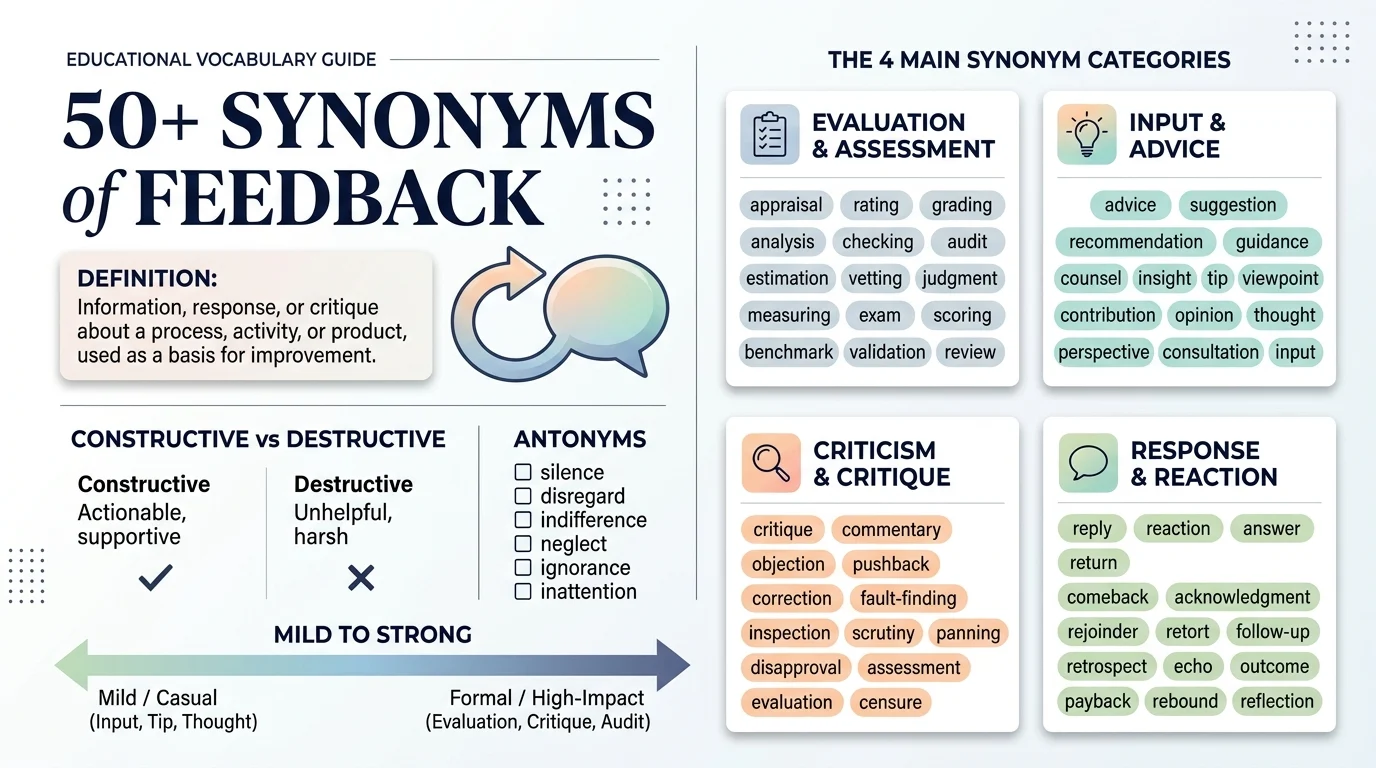
Have you ever needed to describe a response, an evaluation, or information about performance but felt that “feedback” was too corporate or repetitive? You want to capture the specific nature of the response, whether it is a critique, a reaction, or a suggestion, and the word “feedback” comes to mind. Choosing the right synonym for “feedback” can transform a basic statement into a precise expression of evaluation, response, or input. This guide explores the best synonyms of feedback, explaining exactly which word to use and when.
Quick Answer: “Feedback” means information about reactions to a product, a person’s performance, or a task, used as a basis for improvement. For formal writing, choose evaluation or assessment. For casual conversation, use input or comments. For criticism, use critique or criticism. For reactions, use response or reaction. For suggestions, use advice or recommendations.
Meaning, Tone, and Context
Understanding the core meaning of “feedback” is the first step to using it effectively.
Simple Definition: Information about reactions to a product, a person’s performance of a task, etc., used as a basis for improvement; the return of a portion of the output to the input.
Part of Speech: Noun.
Overall Tone: Neutral. It can indicate evaluation, response, or improvement.
Formality Level: Neutral to formal. The word is appropriate in professional, academic, and personal contexts.
Common Uses: Native English speakers use it in business (“customer feedback”), education (“teacher feedback”), technology (“system feedback”), and personal contexts (“feedback on a draft”).
Word Forms: Related words include the verb feed back and the noun feedback loop.
When and How to Use “Feedback”
“Feedback” is the perfect choice when you want to describe evaluation, response, or suggestions for improvement. Here are seven realistic examples.
Business: “We value customer feedback to improve our products.”
Academic: “The professor provided detailed feedback on the essay.”
Workplace: “The manager gave constructive feedback during the performance review.”
Technology: “The system provides real-time feedback to users.”
Personal: “I asked my friend for feedback on my presentation.”
Email: “Please provide your feedback by Friday.”
Social Media: “Thank you for all the positive feedback on my post.”
Best Synonyms of “Feedback”
No synonym is identical in every situation. Here is your guide to the best replacement for “feedback” based on your writing context.
For Evaluation and Assessment
Most Formal: Evaluation means a detailed assessment. “The evaluation of the project was positive.”
Assessment: Assessment means the act of judging. “The assessment of performance is ongoing.”
Appraisal: Appraisal means a formal evaluation. “The annual appraisal determines raises.”
Review: Review means a critical evaluation. “The review of the proposal was thorough.”
For Input and Suggestions
Input: Input means advice or ideas. “We welcome your input on the plan.”
Comments: Comments means remarks or observations. “Please leave your comments below.”
Suggestions: Suggestions means ideas for improvement. “We received many helpful suggestions.”
Advice: Advice means guidance. “She gave me good advice on the project.”
For Criticism and Critique
Critique: Critique means a detailed analysis. “The critique of the artwork was insightful.”
Criticism: Criticism means the expression of disapproval. “Constructive criticism helps us improve.”
Observations: Observations means remarks based on watching. “The observer’s observations were noted.”
Analysis: Analysis means a detailed examination. “The analysis of the results was revealing.”
For Response and Reaction
Response: Response means a reaction. “The response to the campaign was positive.”
Reaction: Reaction means an immediate response. “The reaction to the news was mixed.”
Reply: Reply means an answer. “I am waiting for your reply.”
Commentary: Commentary means a series of comments. “The commentary on the match was lively.”
When Not to Use “Feedback”
Using “feedback” can sound wrong or awkward in certain situations.
When You Mean “Answer”: “Feedback” is about evaluation. “Answer” is about response to a question.
Better Choice: Answer or reply. “I am waiting for your answer.”
When You Mean “Opinion”: “Feedback” is more specific. “Opinion” is general.
Better Choice: Opinion or view. “What is your opinion?”
When It Sounds Too Corporate: In casual conversation, “feedback” can sound businesslike.
Better Choice: Thoughts or comments. “Let me know your thoughts.”
Words Commonly Confused With “Feedback”
| Word | Difference | When to Use | Example |
|---|---|---|---|
| Evaluation | Detailed assessment | Formal and professional | “The evaluation was positive.” |
| Criticism | Expression of disapproval | Constructive or negative | “Constructive criticism helps.” |
| Input | Advice or ideas | Collaborative and general | “We welcome your input.” |
| Response | A reaction | General and communication | “The response was positive.” |
| Review | Critical evaluation | Products and performance | “The review was thorough.” |
| Advice | Guidance | Personal and professional | “She gave good advice.” |
Best Synonyms of “Feedback” by Context
| Context | Best Synonym | Why It Works | Example |
|---|---|---|---|
| Formal writing | Evaluation | Formal and precise | “The evaluation of the project was thorough.” |
| Academic writing | Assessment | Standard in research | “The assessment of performance is ongoing.” |
| Professional | Review | Professional and clear | “The annual review is next week.” |
| Business | Input | Business and collaborative | “We welcome your input.” |
| Education | Critique | Constructive and detailed | “The critique of the essay was helpful.” |
| Casual | Thoughts | Simple and natural | “Let me know your thoughts.” |
| Technology | Response | Technical and precise | “The system response was immediate.” |
How to Choose the Best Synonym of “Feedback”
Choosing the right word is a simple decision. Answer these questions.
What type of feedback am I describing? For evaluation, use evaluation or assessment. For suggestions, use input or suggestions. And for criticism, use critique or criticism. For reactions, use response or reaction.
What is my audience? For a formal report, use evaluation or assessment. For a friend, use thoughts or comments.
What is my purpose? Are you describing evaluation, suggestions, or reactions? The correct synonym depends entirely on this.
What is the emotional strength? Criticism can be negative. Input is neutral. Pick the one that matches your message.
Real Life Examples of “Feedback”
School: Basic: “The teacher gave feedback.” Improved: “The teacher provided constructive criticism.”
College: Basic: “The professor gave feedback on the paper.” Improved: “The professor provided a detailed critique of the paper.”
Workplace: Basic: “We need feedback on the project.” Improved: “We need an evaluation of the project.”
Business: Basic: “Customer feedback is important.” Improved: “Customer input is important.”
Email: Basic: “Please give feedback.” Improved: “Please provide your comments.”
Conversation: Basic: “What is your feedback?” Improved: “What are your thoughts?”
Storytelling: Basic: “The feedback was positive.” Improved: “The response was overwhelmingly positive.”
Top 10 Synonyms of “Feedback”
| Synonym | Simple Meaning | Best Used For | Example Sentence |
|---|---|---|---|
| Evaluation | A detailed assessment | Formal and professional | “The evaluation was positive.” |
| Assessment | The act of judging | Academic and professional | “The assessment of performance is ongoing.” |
| Input | Advice or ideas | Collaborative and general | “We welcome your input.” |
| Critique | A detailed analysis | Academic and artistic | “The critique was insightful.” |
| Review | A critical evaluation | Products and performance | “The review was thorough.” |
| Response | A reaction | General and communication | “The response was positive.” |
| Comments | Remarks or observations | Casual and online | “Please leave your comments.” |
| Suggestions | Ideas for improvement | Collaborative and general | “We received helpful suggestions.” |
| Advice | Guidance | Personal and professional | “She gave good advice.” |
| Criticism | Expression of disapproval | Constructive or negative | “Constructive criticism helps us improve.” |
Synonyms of “Feedback” by Usage
Professional vs. Personal Synonyms
In the workplace, choose evaluation, assessment, or review. With friends, use thoughts, comments, or advice.
Formal vs. Conversational Synonyms
For formal writing, use evaluation, assessment, or critique. For casual conversations, use thoughts, comments, or input.
Academic Synonyms
For research and essays, choose assessment for evaluation, critique for analysis, and review for literature.
Professional and Business Synonyms
For maximum impact, choose input for collaboration, evaluation for performance, and response for customers.
Creative and Literary Synonyms
To add variety, choose critique, commentary, or observations. These words create specificity.
Slang or Modern Synonyms
In modern American slang, thoughts, comments, or take are common. For example, “What is your take?” These are casual and should be avoided in formal writing.
Strongest to Mildest Synonyms
Mild: thoughts, comments, input
Moderate: feedback, response, suggestions
Strong: evaluation, assessment, review
Very Strong: critique, criticism, appraisal
Emotional vs. Neutral Synonyms
Emotional Synonyms: Criticism, praise. These words hint at positive or negative emotion. Use them when you want to evoke feeling.
Neutral Synonyms: Feedback, evaluation, input. These words communicate factual information.
Antonyms of “Feedback”
| Antonym | Meaning | Example Sentence |
|---|---|---|
| Silence | Absence of response | “The silence was deafening.” |
| Indifference | Lack of interest | “His indifference was frustrating.” |
| Neglect | Failure to respond | “The neglect of the issue was concerning.” |
| Apathy | Lack of emotion | “The apathy of the audience was disappointing.” |
| Disregard | Lack of attention | “Her disregard for the rules was punished.” |
| Ignoring | Paying no attention | “Ignoring feedback leads to stagnation.” |
| Withholding | Not giving | “The withholding of information was unethical.” |
| Concealment | Hiding | “The concealment of the truth was wrong.” |
| Suppression | Preventing from being known | “The suppression of feedback was criticized.” |
| Censorship | Restricting information | “Censorship limits feedback.” |
| Unresponsiveness | Not responding | “The unresponsiveness was noted.” |
| Passivity | Lack of action | “Passivity is not acceptable.” |
| Inaction | Lack of action | “Inaction led to problems.” |
| Detachment | Lack of involvement | “Detachment was evident.” |
| Noninterference | Not interfering | “The policy of noninterference was maintained.” |
Comparison: “Feedback” vs Similar Words
Feedback vs. Evaluation
Main Difference: “Feedback” is broader. “Evaluation” is a formal assessment.
Which Is Stronger? “Evaluation” is more formal.
Which Is More Formal? “Evaluation” is more formal.
When to Use Each: Use “feedback” for general contexts. Use “evaluation” for formal assessments.
Examples:
Feedback: “We welcome your feedback.”
Evaluation: “The evaluation was positive.”
Feedback vs. Criticism
Main Difference: “Feedback” is neutral. “Criticism” can be negative.
Which Is Stronger? “Criticism” is more negative.
Which Is More Formal? Both are formal.
When to Use Each: Use “feedback” for general responses. Use “criticism” for negative evaluation.
Examples:
Feedback: “The feedback was helpful.”
Criticism: “Constructive criticism helps.”
Feedback vs. Input
Main Difference: “Feedback” is about response. “Input” is about contribution.
Which Is Stronger? “Input” is more collaborative.
Which Is More Formal? Both are formal.
When to Use Each: Use “input” for suggestions. Use “feedback” for evaluation.
Examples:
Feedback: “The feedback was positive.”
Input: “We welcome your input.”
Feedback vs. Response
Main Difference: “Feedback” is about improvement. “Response” is about reaction.
Which Is Stronger? “Response” is more immediate.
Which Is More Formal? Both are formal.
When to Use Each: Use “response” for reactions. Use “feedback” for evaluation.
Examples:
Feedback: “The feedback will help us improve.”
Response: “The response was immediate.”
Feedback vs. Review
Main Difference: “Feedback” is ongoing. “Review” is a formal evaluation.
Which Is Stronger? “Review” is more formal.
Which Is More Formal? “Review” is more formal.
When to Use Each: Use “review” for performance. Use “feedback” for general contexts.
Examples:
Feedback: “The feedback was helpful.”
Review: “The annual review is next week.”
Feedback vs. Critique
Main Difference: “Feedback” is broader. “Critique” is a detailed analysis.
Which Is Stronger? “Critique” is more detailed.
Which Is More Formal? Both are formal.
When to Use Each: Use “critique” for art. Use “feedback” for general contexts.
Examples:
Feedback: “The feedback was constructive.”
Critique: “The critique was insightful.”
Common Phrases and Expressions with “Feedback”
Phrase: Constructive feedback
Meaning: Helpful criticism.
Example Sentence: “Constructive feedback helps us grow.”
Phrase: Positive feedback
Meaning: Praise or approval.
Example Sentence: “The positive feedback encouraged her.”
Phrase: Feedback loop
Meaning: A system of continuous improvement.
Example Sentence: “The feedback loop improves the product.”
Phrase: Provide feedback
Meaning: Give comments or evaluation.
Example Sentence: “Please provide feedback by Friday.”
Phrase: Feedback session
Meaning: A meeting for feedback.
Example Sentence: “The feedback session was productive.”
Phrase: Customer feedback
Meaning: Comments from customers.
Example Sentence: “Customer feedback is valuable.”
Common Mistakes to Avoid
Mistake 1: Using “feedback” when you mean “answer”.
Incorrect: “I am waiting for your feedback.”
Better: “I am waiting for your answer.”
Why: “Answer” is for questions.
Mistake 2: Using “feedback” when you mean “opinion”.
Incorrect: “What is your feedback on the issue?”
Better: “What is your opinion on the issue?”
Why: “Opinion” is more general.
Mistake 3: Overusing “feedback” in conversation.
Incorrect: “What is your feedback?”
Better: “What are your thoughts?”
Why: “Thoughts” sounds more natural.
Mistake 4: Using “feedback” when you mean “criticism”.
Incorrect: “The feedback was harsh.”
Better: “The criticism was harsh.”
Why: “Criticism” is for negative evaluation.
Mistake 5: Using “feedback” when you mean “input”.
Incorrect: “We need your feedback on the plan.”
Better: “We need your input on the plan.”
Why: “Input” is for collaboration.
Frequently Asked Questions
1. What are the best synonyms of “feedback”?
The best synonyms depend on your context. For evaluation, choose evaluation or assessment. For suggestions, use input or suggestions. And for criticism, use critique or criticism.
2. What are the best formal synonyms of “feedback”?
The best formal synonyms are evaluation, assessment, and review. These words are suitable for academic papers, professional reports, and business communications.
3. What are common informal synonyms of “feedback”?
For informal settings, use thoughts, comments, or input. These alternatives sound more natural in everyday conversation.
4. What is another word for “feedback” in professional writing?
In professional writing, evaluation is an excellent choice. It conveys detailed assessment. Review is also strong for performance.
5. What is the difference between “feedback” and “criticism”?
“Feedback” is neutral. “Criticism” can be negative. Use “feedback” for general responses and “criticism” for negative evaluation.
6. What is the opposite of “feedback”?
The most direct opposites (antonyms) of feedback are silence, indifference, and neglect. These words describe a lack of response.
Conclusion
“Feedback” is a valuable and versatile word for describing evaluation, response, and suggestions for improvement. The term is neutral and widely accepted in most contexts, yet it can sound too corporate for casual conversation or too broad for specific descriptions. The best choice among the synonyms of feedback depends entirely on your audience, tone, and purpose. For a formal, professional effect, use evaluation or assessment. For a practical, business context, input or review works perfectly. And for constructive criticism, choose critique. For casual conversation, use thoughts or comments. Remember, no single synonym works perfectly in every situation. Your goal is to choose the word that communicates your message with the most clarity and impact. A practical tip for your vocabulary growth is to pay attention to how writers describe evaluation and response and practice using different synonyms in your writing.










2 thoughts on “50+ Synonyms of Feedback: Meanings, Uses, Examples, and Best Alternatives”