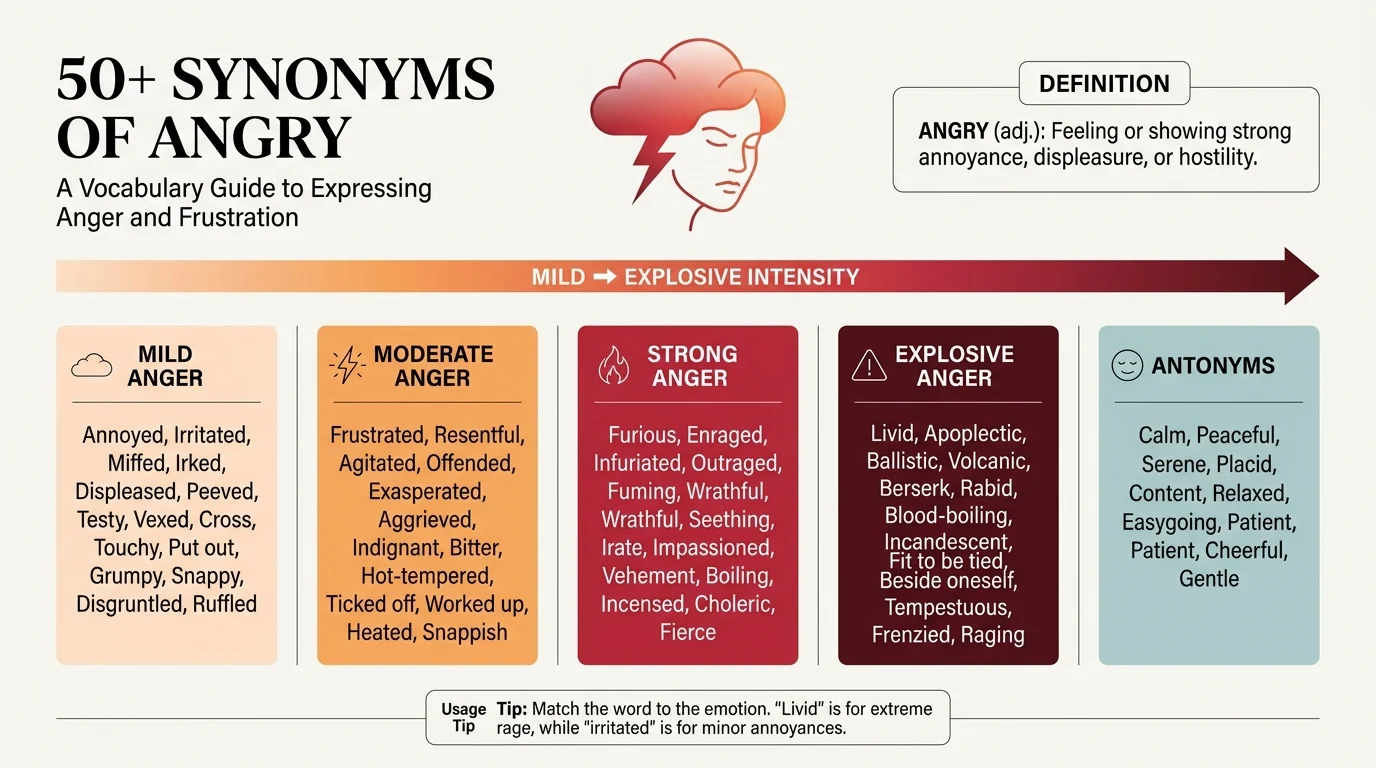
Have you ever needed to describe someone who is upset, irritated, or furious but felt that “angry” was too simple or repetitive? You want to capture the specific intensity of the emotion, whether it is mild annoyance or explosive rage, and the word “angry” comes to mind. Choosing the right synonym for “angry” can transform a basic statement into a precise expression of emotion, from slight irritation to full-blown fury. This guide explores the best synonyms of angry, explaining exactly which word to use and when.
Quick Answer: “Angry” means feeling or showing strong displeasure or hostility. For mild anger, choose annoyed or irritated. For moderate anger, use upset or cross. For strong anger, use furious or enraged. For explosive anger, use livid or incensed. For formal writing, use indignant or irate.
Meaning, Tone, and Context
Understanding the core meaning of “angry” is the first step to using it effectively.
Simple Definition: Feeling or showing strong displeasure, hostility, or annoyance; full of anger.
Part of Speech: Adjective.
Overall Tone: Negative. It indicates displeasure, hostility, or frustration.
Formality Level: Neutral. The word works in most contexts, with more formal alternatives for professional writing.
Common Uses: Native English speakers use it in personal relationships (“angry with someone”), professional contexts (“angry customers”), and general situations (“angry about the decision”).
Word Forms: Related words include the noun anger, the adverb angrily, and the noun angriness.
When and How to Use “Angry”
“Angry” is the perfect choice when you want to describe displeasure or hostility. Here are seven realistic examples.
Personal: “She was angry with her brother for breaking her phone.”
Professional: “The customer was angry about the delayed delivery.”
Workplace: “The manager was angry when the deadline was missed.”
Academic: “The article described an angry protest outside the courthouse.”
Email: “Please handle the angry client with care.”
Social Media: “The angry comments flooded the post.”
Storytelling: “He was angry at the betrayal.”
Best Synonyms of “Angry”
No synonym is identical in every situation. Here is your guide to the best replacement for “angry” based on your writing context.
For Mild Anger
Most Direct: Annoyed means slightly angry. “She was annoyed by the noise.”
Irritated: Irritated means slightly angry. “He was irritated by the delay.”
Cross: Cross means mildly angry. “She was cross with the children.”
Bothered: Bothered means troubled or annoyed. “He was bothered by the comment.”
For Moderate Anger
Upset: Upset means unhappy or worried. “She was upset about the news.”
Mad: Mad means angry. “He was mad at his friend.”
Indignant: Indignant means angry at unfairness. “She was indignant at the injustice.”
Displeased: Displeased means not satisfied. “The boss was displeased with the report.”
For Strong Anger
Furious: Furious means extremely angry. “She was furious about the betrayal.”
Enraged: Enraged means very angry. “He was enraged by the insult.”
Irate: Irate means very angry. “The irate customer demanded a refund.”
Outraged: Outraged means extremely angry. “The public was outraged by the decision.”
For Explosive Anger
Livid: Livid means extremely angry. “She was livid when she found out.”
Incensed: Incensed means very angry. “He was incensed by the accusation.”
Fuming: Fuming means very angry. “She was fuming after the meeting.”
Seething: Seething means very angry. “He was seething with rage.”
For Formal Contexts
Irritated: Irritated is formal and mild. “The customer was irritated by the delay.”
Indignant: Indignant is formal and moral. “She was indignant at the unfair treatment.”
Irate: Irate is formal and strong. “The irate shareholder demanded answers.”
Outraged: Outraged is formal and strong. “The community was outraged by the decision.”
When Not to Use “Angry”
Using “angry” can sound wrong or awkward in certain situations.
When You Mean “Annoyed”: “Angry” is stronger than “annoyed.”
Better Choice: Annoyed or irritated. “She was annoyed by the noise.”
When You Mean “Upset”: “Angry” is about hostility. “Upset” is about sadness.
Better Choice: Upset or hurt. “She was upset by the comment.”
When It Sounds Too Strong: For minor frustrations, “angry” is too intense.
Better Choice: Frustrated or bothered. “He was frustrated by the delay.”
Words Commonly Confused With “Angry”
| Word | Difference | When to Use | Example |
|---|---|---|---|
| Annoyed | Mild anger | Minor frustrations | “She was annoyed.” |
| Upset | Sad or worried | Emotional distress | “He was upset.” |
| Frustrated | Blocked from a goal | Obstacles | “She was frustrated.” |
| Furious | Extreme anger | Strong betrayal | “He was furious.” |
| Indignant | Anger at unfairness | Injustice | “She was indignant.” |
| Irate | Very angry | Formal and strong | “The irate customer.” |
Best Synonyms of “Angry” by Context
| Context | Best Synonym | Why It Works | Example |
|---|---|---|---|
| Formal writing | Indignant | Formal and moral | “She was indignant at the unfairness.” |
| Academic writing | Irate | Standard in research | “The irate crowd gathered.” |
| Professional | Displeased | Professional and clear | “The manager was displeased.” |
| Business | Irate | Business and customers | “The irate client demanded a refund.” |
| Casual conversation | Mad | Simple and natural | “He was mad.” |
| Emotional | Furious | Strong emotion | “She was furious.” |
| Descriptive | Fuming | Evokes visible anger | “He was fuming.” |
How to Choose the Best Synonym of “Angry”
Choosing the right word is a simple decision. Answer these questions.
What level of anger am I describing? For mild, use annoyed or irritated. And for moderate, use upset or cross. For strong, use furious or enraged. For explosive, use livid or incensed.
What is my audience? For a formal report, use indignant or irate. For a friend, use mad or annoyed.
What is the cause of the anger? For injustice, use indignant. And for betrayal, use furious. For minor issues, use annoyed.
What is the emotional strength? Livid and furious are stronger. Annoyed is milder. Pick the one that matches your message.
Real Life Examples of “Angry”
School: Basic: “The student was angry.” Improved: “The student was frustrated by the difficult assignment.”
College: Basic: “The professor was angry.” Improved: “The professor was indignant at the plagiarism.”
Workplace: Basic: “The boss was angry.” Improved: “The boss was displeased with the report.”
Business: Basic: “The customer was angry.” Improved: “The irate customer demanded a refund.”
Email: Basic: “Do not make him angry.” Better: “Do not make him furious.”
Conversation: Basic: “She is angry.” Improved: “She is mad.”
Storytelling: Basic: “He was angry.” Improved: “He was seething with rage.”
Top 10 Synonyms of “Angry”
| Synonym | Simple Meaning | Best Used For | Example Sentence |
|---|---|---|---|
| Annoyed | Slightly angry | Minor frustrations | “She was annoyed by the noise.” |
| Irritated | Slightly angry | Minor frustrations | “He was irritated by the delay.” |
| Frustrated | Blocked from a goal | Obstacles | “She was frustrated by the traffic.” |
| Upset | Unhappy or worried | Emotional distress | “He was upset about the news.” |
| Indignant | Angry at unfairness | Injustice | “She was indignant at the treatment.” |
| Furious | Extremely angry | Strong betrayal | “He was furious about the lie.” |
| Enraged | Very angry | Strong anger | “The crowd was enraged.” |
| Irate | Very angry | Formal and strong | “The irate customer demanded a refund.” |
| Livid | Extremely angry | Explosive anger | “She was livid when she found out.” |
| Outraged | Extremely angry | Moral outrage | “The public was outraged.” |
Synonyms of “Angry” by Usage
Professional vs. Personal Synonyms
In the workplace, choose displeased, indignant, or irate. With friends, use mad, annoyed, or upset.
Formal vs. Conversational Synonyms
For formal writing, use indignant, irate, or outraged. For casual conversations, use mad, annoyed, or upset.
Academic Synonyms
For research and essays, choose indignant for moral anger, irate for strong anger, and frustrated for blocked goals.
Professional and Business Synonyms
For maximum impact, choose displeased for managers, irate for customers, and indignant for injustice.
Creative and Literary Synonyms
To add emotion and imagery, choose seething, fuming, or livid. These words create atmosphere.
Slang or Modern Synonyms
In modern American slang, pissed, pissed off, or mad are common. For example, “He was pissed.” These are casual and should be avoided in formal writing.
Strongest to Mildest Synonyms
Mild: annoyed, irritated, bothered
Moderate: angry, upset, cross
Strong: furious, enraged, indignant
Very Strong: livid, incensed, seething, outraged
Emotional vs. Neutral Synonyms
Emotional Synonyms: Furious, enraged, seething. These words hint at strong emotion. Use them when you want to evoke feeling.
Neutral Synonyms: Angry, annoyed, displeased. These words communicate factual information.
Antonyms of “Angry”
| Antonym | Meaning | Example Sentence |
|---|---|---|
| Calm | Peaceful | “She remained calm.” |
| Pleased | Happy and satisfied | “He was pleased with the result.” |
| Content | Satisfied | “She was content with her life.” |
| Happy | Feeling joy | “They were happy together.” |
| Cheerful | Happy and optimistic | “His cheerful mood was contagious.” |
| Serene | Peaceful and calm | “The garden was serene.” |
| Relaxed | Free from tension | “She felt relaxed after the massage.” |
| Tranquil | Peaceful | “The lake was tranquil.” |
| Delighted | Very pleased | “She was delighted with the gift.” |
| Satisfied | Content | “He was satisfied with the outcome.” |
| Joyful | Full of joy | “The celebration was joyful.” |
| Composed | Calm and in control | “He remained composed.” |
| Placid | Calm and peaceful | “Her expression was placid.” |
| Good-natured | Friendly and easygoing | “He was good-natured about the delay.” |
| Easygoing | Relaxed and tolerant | “She has an easygoing personality.” |
Comparison: “Angry” vs Similar Words
Angry vs. Annoyed
Main Difference: “Angry” is stronger. “Annoyed” is mild.
Which Is Stronger? “Angry” is stronger.
Which Is More Formal? Both are neutral.
When to Use Each: Use “annoyed” for minor issues. Use “angry” for stronger feelings.
Examples:
Angry: “She was angry about the betrayal.”
Annoyed: “She was annoyed by the noise.”
Angry vs. Upset
Main Difference: “Angry” is about hostility. “Upset” is about sadness.
Which Is Stronger? They are different.
Which Is More Formal? Both are neutral.
When to Use Each: Use “upset” for sadness. Use “angry” for hostility.
Examples:
Angry: “He was angry at the decision.”
Upset: “She was upset by the news.”
Angry vs. Frustrated
Main Difference: “Angry” is about hostility. “Frustrated” is about blocked goals.
Which Is Stronger? “Angry” is stronger.
Which Is More Formal? Both are neutral.
When to Use Each: Use “frustrated” for obstacles. Use “angry” for hostility.
Examples:
Angry: “He was angry at his colleague.”
Frustrated: “She was frustrated by the delay.”
Angry vs. Furious
Main Difference: “Angry” is general. “Furious” is extreme.
Which Is Stronger? “Furious” is much stronger.
Which Is More Formal? Both are neutral.
When to Use Each: Use “furious” for extreme anger. Use “angry” for general anger.
Examples:
Angry: “She was angry about the mistake.”
Furious: “She was furious about the betrayal.”
Angry vs. Indignant
Main Difference: “Angry” is general. “Indignant” is about unfairness.
Which Is Stronger? “Indignant” is more specific.
Which Is More Formal? “Indignant” is more formal.
When to Use Each: Use “indignant” for injustice. Use “angry” for general contexts.
Examples:
Angry: “He was angry at the comment.”
Indignant: “She was indignant at the unfair treatment.”
Angry vs. Irate
Main Difference: “Angry” is general. “Irate” is very angry and formal.
Which Is Stronger? “Irate” is stronger.
Which Is More Formal? “Irate” is more formal.
When to Use Each: Use “irate” for customers. Use “angry” for general contexts.
Examples:
Angry: “The customer was angry.”
Irate: “The irate customer demanded a refund.”
Common Phrases and Expressions with “Angry”
Phrase: Angry with
Meaning: Feeling anger toward someone.
Example Sentence: “She was angry with her brother.”
Phrase: Angry about
Meaning: Feeling anger about something.
Example Sentence: “He was angry about the decision.”
Phrase: Angry at
Meaning: Feeling anger toward someone or something.
Example Sentence: “She was angry at the injustice.”
Phrase: Get angry
Meaning: Become angry.
Example Sentence: “He gets angry easily.”
Phrase: Angry outburst
Meaning: A sudden expression of anger.
Example Sentence: “The angry outburst shocked everyone.”
Phrase: Angry mob
Meaning: A crowd of angry people.
Example Sentence: “The angry mob gathered outside.”
Common Mistakes to Avoid
Mistake 1: Using “angry” when you mean “annoyed”.
Incorrect: “She was angry about the noise.”
Better: “She was annoyed by the noise.”
Why: “Angry” is too strong for minor issues.
Mistake 2: Using “angry” when you mean “upset”.
Incorrect: “He was angry about the sad news.”
Better: “He was upset by the sad news.”
Why: “Upset” is for sadness.
Mistake 3: Overusing “angry” in conversation.
Incorrect: “I am angry.”
Better: “I am frustrated.”
Why: “Frustrated” adds variety.
Mistake 4: Using “angry” when you mean “indignant”.
Incorrect: “She was angry at the unfairness.”
Better: “She was indignant at the unfairness.”
Why: “Indignant” is for injustice.
Mistake 5: Using “angry” when you mean “furious”.
Incorrect: “He was angry about the betrayal.”
Better: “He was furious about the betrayal.”
Why: “Furious” is stronger.
Frequently Asked Questions
1. What are the best synonyms of “angry”?
The best synonyms depend on your context. For mild anger, choose annoyed or irritated. For strong anger, use furious or enraged. And for formal contexts, use indignant or irate.
2. What are the best formal synonyms of “angry”?
The best formal synonyms are indignant, irate, and outraged. These words are suitable for academic papers, professional reports, and business communications.
3. What are common informal synonyms of “angry”?
For informal settings, use mad, annoyed, or upset. These alternatives sound more natural in everyday conversation.
4. What is another word for “angry” in professional writing?
In professional writing, displeased is an excellent choice. It conveys dissatisfaction. Indignant is also strong for injustice.
5. What is the difference between “angry” and “furious”?
“Angry” is general. “Furious” is extreme. Use “furious” for intense anger and “angry” for general contexts.
6. What is the opposite of “angry”?
The most direct opposites (antonyms) of angry are calm, pleased, and content. These words describe a peaceful state.
Conclusion
“Angry” is a fundamental and versatile word for describing displeasure, hostility, and frustration. The term is neutral and widely accepted in most contexts, yet it can sound too mild for extreme anger or too strong for minor frustrations. The best choice among the synonyms of angry depends entirely on your audience, tone, and purpose. For a formal, moral effect, use indignant or irate. For a practical, everyday context, annoyed or frustrated works perfectly. And for strong emotion, choose furious or enraged. For explosive anger, use livid or seething. Remember, no single synonym works perfectly in every situation. Your goal is to choose the word that communicates your message with the most clarity and impact. A practical tip for your vocabulary growth is to pay attention to how writers describe emotions and practice using different synonyms in your writing.










3 thoughts on “50+ Synonyms of Angry: Meanings, Uses, Examples, and Best Alternatives”