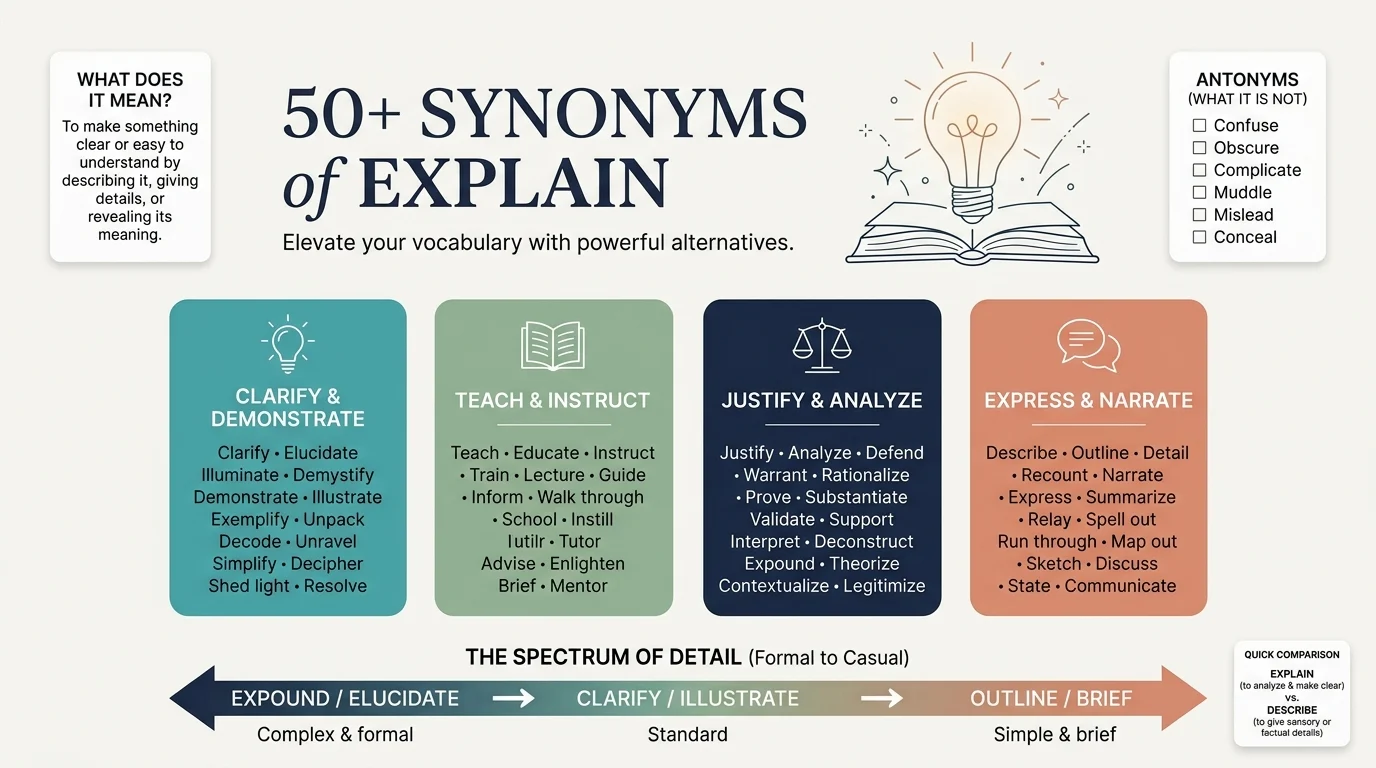
Have you ever needed to make something clear, describe how something works, or justify a decision but felt that “explain” was too simple or repetitive? You want to capture the specific way you are clarifying, teaching, or defending an idea, and the word “explain” comes to mind. Choosing the right synonym for “explain” can transform a basic statement into a precise expression of clarification, demonstration, or justification. This guide explores the best synonyms of explain, explaining exactly which word to use and when.
Quick Ans: “Explain” means to make an idea clear, describe how something works, or give reasons for something. For formal writing, choose clarify or elucidate. For teaching contexts, use describe or illustrate. For justifying decisions, use justify or account for. For casual conversation, use tell or walk through.
Meaning, Tone, and Context
Understanding the core meaning of “explain” is the first step to using it effectively.
Simple Definition: To make an idea, situation, or problem clear to someone by describing it in more detail or revealing relevant facts.
Part of Speech: Verb.
Overall Tone: Neutral. It is a functional word used across all contexts.
Formality Level: Neutral. The word works in casual and formal contexts, though more specific alternatives exist.
Common Uses: Native English speakers use it in teaching (“explain the concept”), business (“explain the strategy”), science (“explain the phenomenon”), and daily life (“explain what happened”).
Word Forms: Related words include the noun explanation, the adjective explanatory, and the adverb explanatorily.
When and How to Use “Explain”
“Explain” is the perfect choice when you want to make something clear or give reasons. Here are seven realistic examples.
Teaching: “The teacher explained the theory in simple terms.”
Professional: “Can you explain the reasoning behind this decision?”
Academic: “The study explains the correlation between the two variables.”
Technical: “The manual explains how to install the software.”
Personal: “He explained why he was late.”
Email: “Please explain the delay in the project timeline.”
Social Media: “Let me explain why this matters.”
Best Synonyms of “Explain”
No synonym is identical in every situation. Here is your guide to the best replacement for “explain” based on your writing context.
For Clarifying and Making Clear
Most Formal: Elucidate means to make clear. “The professor elucidated the complex theory.”
Clarify: Clarify means to make understandable. “Let me clarify my position.”
Illuminate: Illuminate means to light up or clarify. “The report illuminates the key issues.”
Simplify: Simplify means to make easier to understand. “He simplified the instructions.”
For Teaching and Describing
Describe: Describe means to give an account. “She described the process step by step.”
Illustrate: Illustrate means to explain with examples. “The diagram illustrates the concept.”
Demonstrate: Demonstrate means to show how something works. “He demonstrated the technique.”
Teach: Teach means to instruct. “She teaches mathematics.”
For Justifying and Accounting For
Justify: Justify means to show to be right. “He justified his decision.”
Account for: Account for means to explain the cause. “She accounted for the discrepancy.”
Rationalize: Rationalize means to justify with reason. “He rationalized his behavior.”
Defend: Defend means to support with arguments. “She defended her position.”
For Casual and Conversational
Tell: Tell means to inform. “Tell me what happened.”
Walk through: Walk through means to explain step by step. “Let me walk you through the process.”
Break down: Break down means to explain in parts. “He broke down the complex idea.”
Spell out: Spell out means to explain in detail. “She spelled out the requirements.”
When Not to Use “Explain”
Using “explain” can sound wrong or awkward in certain situations.
When You Mean “Tell”: “Explain” implies detail. “Tell” is simpler.
Better Choice: Tell or say. “Tell me the story.”
When You Mean “Show”: “Explain” is verbal. “Show” is visual.
Better Choice: Show or demonstrate. “Show me how to do it.”
When It Sounds Too Formal: In casual conversation, “explain” can sound stiff.
Better Choice: Tell or walk through. “Tell me what happened.”
Words Commonly Confused With “Explain”
| Word | Difference | When to Use | Example |
|---|---|---|---|
| Clarify | Make clear | Formal and precise | “Let me clarify.” |
| Describe | Give an account | General and detailed | “Describe the scene.” |
| Illustrate | Explain with examples | Teaching and visual | “Illustrate the point.” |
| Justify | Show to be right | Defense and reasoning | “Justify your decision.” |
| Teach | Instruct | Education | “Teach the lesson.” |
| Tell | Inform | Casual and general | “Tell me.” |
Best Synonyms of “Explain” by Context
| Context | Best Synonym | Why It Works | Example |
|---|---|---|---|
| Formal writing | Elucidate | Formal and precise | “The author elucidates the theory.” |
| Academic writing | Clarify | Standard in research | “The study clarifies the relationship.” |
| Professional | Justify | Professional and logical | “Justify the expense.” |
| Business | Account for | Business and finance | “Account for the discrepancy.” |
| Teaching | Illustrate | Teaching and visual | “Illustrate with a diagram.” |
| Technical | Demonstrate | Technical and practical | “Demonstrate the procedure.” |
| Casual | Tell | Simple and natural | “Tell me what happened.” |
How to Choose the Best Synonym of “Explain”
Choosing the right word is a simple decision. Answer these questions.
What type of explanation am I giving? For clarifying, use elucidate or clarify. And For teaching, use describe or illustrate. For justifying, use justify or account for.
What is my audience? For a formal report, use elucidate or clarify. For a friend, use tell or walk through.
What is my purpose? Are you clarifying, teaching, or justifying? The correct synonym depends entirely on this.
What is the emotional strength? Elucidate is formal. Tell is casual. Pick the one that matches your message.
Real Life Examples of “Explain”
School: Basic: “The teacher explained the lesson.” Improved: “The teacher illustrated the lesson with examples.”
College: Basic: “The professor explained the theory.” Improved: “The professor elucidated the complex theory.”
Workplace: Basic: “She explained the process.” Improved: “She walked through the process step by step.”
Business: Basic: “He explained the decision.” Improved: “He justified the decision with data.”
Email: Basic: “Please explain the delay.” Improved: “Please clarify the reason for the delay.”
Conversation: Basic: “Explain what happened.” Improved: “Tell me what happened.”
Storytelling: Basic: “She explained the mystery.” Improved: “She illuminated the mystery.”
Top 10 Synonyms of “Explain”
| Synonym | Simple Meaning | Best Used For | Example Sentence |
|---|---|---|---|
| Clarify | Make clear | Formal and precise | “Let me clarify my position.” |
| Elucidate | Make clear | Formal and academic | “The professor elucidated the theory.” |
| Describe | Give an account | General and detailed | “She described the process.” |
| Illustrate | Explain with examples | Teaching and visual | “The diagram illustrates the concept.” |
| Justify | Show to be right | Defense and reasoning | “He justified his decision.” |
| Demonstrate | Show how something works | Technical and practical | “He demonstrated the technique.” |
| Account for | Explain the cause | Business and finance | “She accounted for the discrepancy.” |
| Tell | Inform | Casual and general | “Tell me what happened.” |
| Walk through | Explain step by step | Casual and professional | “Let me walk you through it.” |
| Illuminate | Light up or clarify | Formal and literary | “The report illuminates the issues.” |
Synonyms of “Explain” by Usage
Professional vs. Personal Synonyms
In the workplace, choose clarify, justify, or account for. With friends, use tell, walk through, or break down.
Formal vs. Conversational Synonyms
For formal writing, use elucidate, clarify, or illustrate. For casual conversations, use tell, walk through, or break down.
Academic Synonyms
For research and essays, choose elucidate for theories, clarify for relationships, and illustrate for examples.
Professional and Business Synonyms
For maximum impact, choose justify for decisions, account for for finances, and clarify for communication.
Creative and Literary Synonyms
To add emotion and imagery, choose illuminate, elucidate, or illustrate. These words create depth.
Slang or Modern Synonyms
In modern American slang, break it down, spell it out, or walk through are common. For example, “Let me break it down for you.” These are casual and should be avoided in formal writing.
Strongest to Mildest Synonyms
Mild: tell, say, describe
Moderate: explain, clarify, illustrate
Strong: elucidate, demonstrate, justify
Very Strong: illuminate, account for, rationalize
Emotional vs. Neutral Synonyms
Emotional Synonyms: Illuminate, elucidate. These words hint at revelation. Use them when you want to evoke feeling.
Neutral Synonyms: Explain, clarify, describe. These words communicate factual information.
Antonyms of “Explain”
| Antonym | Meaning | Example Sentence |
|---|---|---|
| Confuse | Make unclear | “The instructions confused everyone.” |
| Obscure | Make difficult to understand | “The jargon obscured the meaning.” |
| Muddle | Make confused | “The error muddled the report.” |
| Complicate | Make more difficult | “He complicated the issue.” |
| Conceal | Hide | “She concealed the truth.” |
| Withhold | Refuse to give | “He withheld the information.” |
| Mislead | Give wrong information | “The sign misled us.” |
| Baffle | Totally confuse | “The puzzle baffled everyone.” |
| Bewilder | Confuse greatly | “The complex rules bewildered him.” |
| Perplex | Puzzle | “The question perplexed her.” |
| Mystify | Make mysterious | “The magician mystified the audience.” |
| Obfuscate | Make obscure | “The report obfuscated the issue.” |
| Cloud | Make unclear | “Emotion clouded his judgment.” |
| Blur | Make indistinct | “The tears blurred her vision.” |
| Hide | Keep out of sight | “He hid the evidence.” |
Comparison: “Explain” vs Similar Words
Explain vs. Clarify
Main Difference: “Clarify” is to make clear. “Explain” is broader.
Which Is Stronger? “Clarify” is more specific.
Which Is More Formal? Both are formal.
When to Use Each: Use “clarify” for misunderstandings. Use “explain” for general contexts.
Examples:
Explain: “Explain the process.”
Clarify: “Let me clarify my position.”
Explain vs. Describe
Main Difference: “Describe” is to give an account. “Explain” is to make clear.
Which Is Stronger? “Explain” is more analytical.
Which Is More Formal? Both are neutral.
When to Use Each: Use “describe” for scenes. Use “explain” for concepts.
Examples:
Explain: “Explain the theory.”
Describe: “Describe the scene.”
Explain vs. Justify
Main Difference: “Justify” is to show to be right. “Explain” is to make clear.
Which Is Stronger? “Justify” is more defensive.
Which Is More Formal? Both are formal.
When to Use Each: Use “justify” for decisions. Use “explain” for general contexts.
Examples:
Explain: “Explain your reasoning.”
Justify: “Justify your decision.”
Explain vs. Illustrate
Main Difference: “Illustrate” is to explain with examples. “Explain” is broader.
Which Is Stronger? “Illustrate” is more specific to examples.
Which Is More Formal? Both are formal.
When to Use Each: Use “illustrate” for examples. Use “explain” for general contexts.
Examples:
Explain: “Explain the concept.”
Illustrate: “Illustrate with a diagram.”
Explain vs. Elucidate
Main Difference: “Elucidate” is formal and literary. “Explain” is general.
Which Is Stronger? “Elucidate” is more formal.
Which Is More Formal? “Elucidate” is more formal.
When to Use Each: Use “elucidate” in formal writing. Use “explain” in general contexts.
Examples:
Explain: “Explain the rule.”
Elucidate: “The author elucidates the theory.”
Explain vs. Tell
Main Difference: “Tell” is casual. “Explain” is more detailed.
Which Is Stronger? “Explain” is more analytical.
Which Is More Formal? “Explain” is more formal.
When to Use Each: Use “tell” in casual conversation. Use “explain” in formal contexts.
Examples:
Explain: “Explain what happened.”
Tell: “Tell me what happened.”
Common Phrases and Expressions with “Explain”
Phrase: Explain away
Meaning: To minimize or dismiss by explanation.
Example Sentence: “He tried to explain away his mistake.”
Phrase: Explain yourself
Meaning: To justify your actions.
Example Sentence: “The teacher asked him to explain himself.”
Phrase: Explain the situation
Meaning: To describe what is happening.
Example Sentence: “She explained the situation to the police.”
Phrase: Explain in detail
Meaning: To give a thorough explanation.
Example Sentence: “Please explain in detail.”
Phrase: Explain the difference
Meaning: To clarify distinctions.
Example Sentence: “Can you explain the difference between the two?”
Common Mistakes to Avoid
Mistake 1: Using “explain” when you mean “tell”.
Incorrect: “Explain me the story.”
Better: “Tell me the story.”
Why: “Tell” is for stories.
Mistake 2: Using “explain” when you mean “show”.
Incorrect: “Explain me how to do it.”
Better: “Show me how to do it.”
Why: “Show” is visual.
Mistake 3: Overusing “explain” in conversation.
Incorrect: “Explain what happened.”
Better: “Tell me what happened.”
Why: “Tell” sounds more natural.
Mistake 4: Using “explain” when you mean “clarify”.
Incorrect: “Let me explain my position.”
Better: “Let me clarify my position.”
Why: “Clarify” is for misunderstandings.
Mistake 5: Using “explain” when you mean “justify”.
Incorrect: “Explain your decision.”
Better: “Justify your decision.”
Why: “Justify” is for defense.
Frequently Asked Questions
1. What are the best synonyms of “explain”?
The best synonyms depend on your context. For clarifying, choose clarify or elucidate. And For teaching, use describe or illustrate. For justifying, use justify or account for.
2. What are the best formal synonyms of “explain”?
The best formal synonyms are elucidate, clarify, and illustrate. These words are suitable for academic papers, professional reports, and business communications.
3. What are common informal synonyms of “explain”?
For informal settings, use tell, walk through, or break down. These alternatives sound more natural in everyday conversation.
4. What is another word for “explain” in professional writing?
In professional writing, clarify is an excellent choice. It conveys making clear. Justify is also strong for decisions.
5. What is the difference between “explain” and “clarify”?
“Clarify” is to make clear after confusion. “Explain” is broader. Use “clarify” for misunderstandings and “explain” for general contexts.
6. What is the opposite of “explain”?
The most direct opposites (antonyms) of explain are confuse, obscure, and muddle. These words describe making something unclear.
Conclusion
“Explain” is a fundamental and versatile word for describing clarification, teaching, and justification. The term is neutral and widely accepted in all contexts, yet it can sound too simple for formal writing or too broad for specific descriptions. The best choice among the synonyms of explain depends entirely on your audience, tone, and purpose. Remember, no single synonym works perfectly in every situation. Your goal is to choose the word that communicates your message with the most clarity and impact. A practical tip for your vocabulary growth is to pay attention to how writers clarify and justify ideas and practice using different synonyms in your writing.









