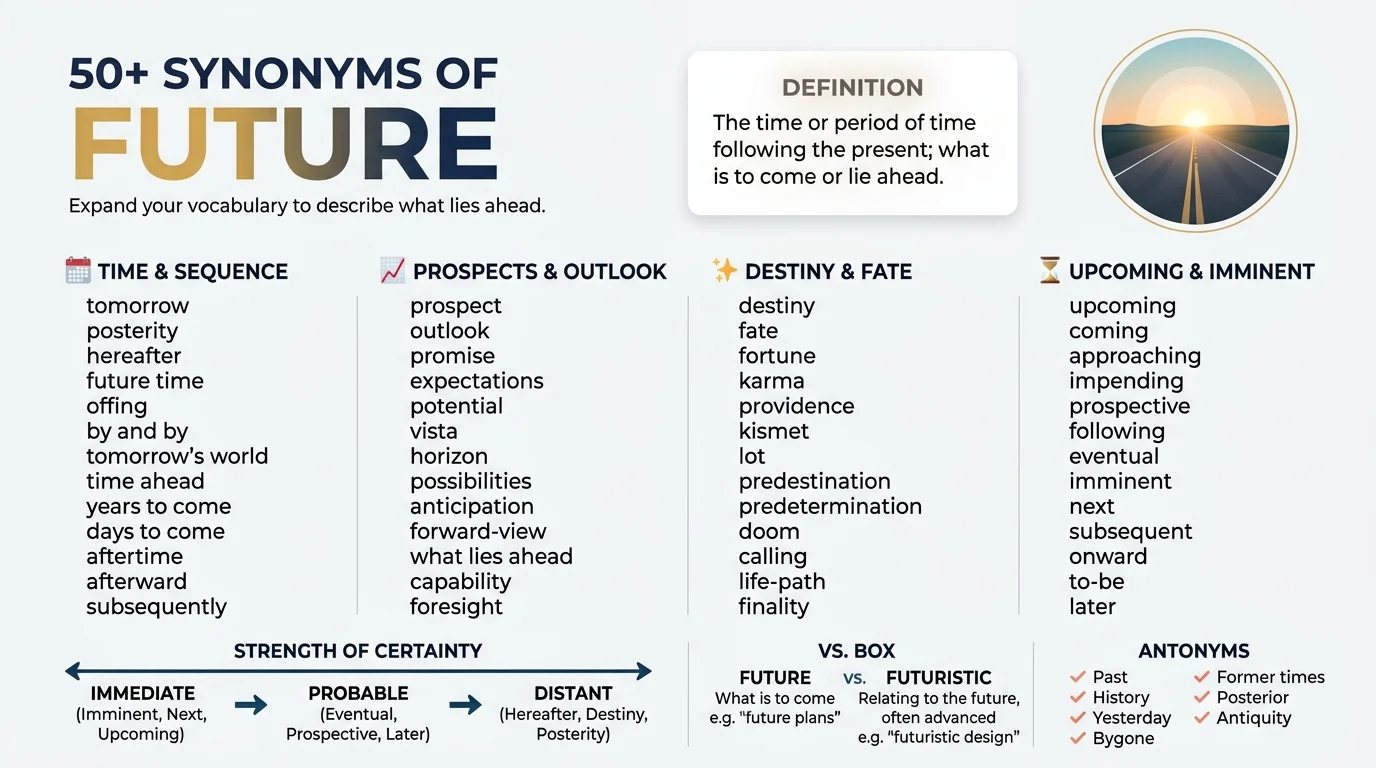
Have you ever needed to describe what lies ahead, upcoming events, or the time yet to come but felt that “future” was too broad or repetitive? You want to capture the sense of what is coming, the potential ahead, or the time after now, and the word “future” comes to mind. Choosing the right synonym for “future” can transform a basic statement into a precise expression of destiny, prospect, or time. This guide explores the best synonyms of future, explaining exactly which word to use and when.
Quick Ans: “Future” means the time yet to come or events that will happen after now. For time ahead, choose tomorrow or hereafter. For prospects and potential, use outlook, prospects, or potential. For destiny, use destiny or fate. For upcoming events, use forthcoming or approaching.
Meaning, Tone, and Context
Understanding the core meaning of “future” is the first step to using it effectively.
Simple Definition: The time or period of time following the moment of speaking or writing; events that will or are expected to happen; the prospect of success or survival.
Part of Speech: Noun and adjective.
Overall Tone: Neutral. It can indicate time, possibility, or destiny.
Formality Level: Neutral to formal. The word works in most contexts.
Common Uses: Native English speakers use it in planning (“future plans”), business (“future growth”), education (“future generations”), and personal contexts (“future goals”).
Word Forms: Related words include the adjective future (as in future plans), the noun futurity, and the adjective futuristic.
When and How to Use “Future”
“Future” is the perfect choice when you want to describe time ahead, potential, or destiny. Here are seven realistic examples.
Planning: “We need to plan for the future.”
Business: “The company’s future looks bright.”
Education: “We must invest in future generations.”
Personal: “She is excited about her future.”
Academic: “The study examines future trends in technology.”
Environmental: “The future of the planet depends on action now.”
Social Media: “The future belongs to those who believe in their dreams.”
Best Synonyms of “Future”
No synonym is identical in every situation. Here is your guide to the best replacement for “future” based on your writing context.
For Time Ahead
Most Direct: Tomorrow means the day after today or the near future. “Tomorrow will be better.”
Hereafter: Hereafter means from now on or the afterlife. “The hereafter is unknown.”
Time to come: Time to come means the future. “In the time to come, things will change.”
Coming days: Coming days means the near future. “The coming days will be crucial.”
For Prospects and Potential
Outlook: Outlook means the prospect for the future. “The economic outlook is positive.”
Prospects: Prospects means the possibilities for future success. “Her prospects are excellent.”
Potential: Potential means the capacity for future success. “He has great potential.”
Promise: Promise means the indication of future success. “The young athlete shows great promise.”
For Destiny and Fate
Destiny: Destiny means the events that will happen. “She believed in destiny.”
Fate: Fate means the development of events beyond control. “Fate brought them together.”
Fortune: Fortune means luck or destiny. “Fortune smiled on him.”
Doom: Doom means a terrible future. “The doom of the empire was inevitable.”
For Upcoming and Approaching
Forthcoming: Forthcoming means about to happen. “The forthcoming election is important.”
Approaching: Approaching means coming near. “The approaching deadline caused stress.”
Upcoming: Upcoming means about to happen. “The upcoming event is highly anticipated.”
Imminent: Imminent means about to happen. “The imminent storm required preparation.”
When Not to Use “Future”
Using “future” can sound wrong or awkward in certain situations.
When You Mean “Later”: “Future” is broader. “Later” is simpler.
Better Choice: Later or after. “We will discuss it later.”
When You Mean “Plan”: “Future” is about time. “Plan” is about intention.
Better Choice: Plan or goal. “My plan is to study abroad.”
When It Sounds Too Formal: In casual conversation, “future” can sound formal.
Better Choice: Later or tomorrow. “We will see what happens.”
Words Commonly Confused With “Future”
| Word | Difference | When to Use | Example |
|---|---|---|---|
| Present | Now | Current time | “The present situation.” |
| Past | Before now | Previous time | “The past is gone.” |
| Destiny | What will happen | Philosophical | “Her destiny was clear.” |
| Outlook | Prospect | Business and planning | “The outlook is positive.” |
| Prospects | Future success | Personal and business | “Her prospects are good.” |
| Potential | Capacity for success | Personal and general | “He has potential.” |
Best Synonyms of “Future” by Context
| Context | Best Synonym | Why It Works | Example |
|---|---|---|---|
| Formal writing | Outlook | Formal and precise | “The economic outlook is positive.” |
| Academic writing | Prospect | Standard in research | “The prospects for recovery are good.” |
| Professional | Potential | Professional and clear | “He has great potential.” |
| Business | Prospects | Business and growth | “The company’s prospects are bright.” |
| Personal | Destiny | Personal and emotional | “She felt her destiny calling.” |
| Casual | Tomorrow | Simple and natural | “Tomorrow is a new day.” |
| Dramatic | Doom | Dramatic and negative | “The doom of the city was near.” |
How to Choose the Best Synonym of “Future”
Choosing the right word is a simple decision. Answer these questions.
What type of future am I describing? For time, use tomorrow or time to come. And For prospects, use outlook or prospects. For destiny, use destiny or fate.
What is my audience? For a formal report, use outlook or prospect. For a friend, use tomorrow or later.
What is my purpose? Are you describing time, potential, or destiny? The correct synonym depends entirely on this.
What is the emotional strength? Destiny and doom are stronger. Tomorrow is milder. Pick the one that matches your message.
Real Life Examples of “Future”
School: Basic: “The future is important.” Improved: “The time to come is important.”
College: Basic: “The study examines future trends.” Improved: “The study examines forthcoming trends.”
Workplace: Basic: “We need to plan for the future.” Improved: “We need to plan for the time to come.”
Business: Basic: “The future looks bright.” Improved: “The outlook looks bright.”
Email: Basic: “Looking to the future.” Improved: “Looking to the time ahead.”
Conversation: Basic: “The future is unknown.” Improved: “Tomorrow is unknown.”
Storytelling: Basic: “His future was decided.” Improved: “His destiny was decided.”
Top 10 Synonyms of “Future”
| Synonym | Simple Meaning | Best Used For | Example Sentence |
|---|---|---|---|
| Outlook | Prospect for the future | Business and planning | “The economic outlook is positive.” |
| Prospects | Possibilities for future success | Personal and business | “Her prospects are excellent.” |
| Potential | Capacity for future success | Personal and general | “He has great potential.” |
| Destiny | Events that will happen | Philosophical and personal | “She believed in destiny.” |
| Fate | Development beyond control | Philosophical and dramatic | “Fate brought them together.” |
| Forthcoming | About to happen | Formal and professional | “The forthcoming election is important.” |
| Upcoming | About to happen | General and casual | “The upcoming event is exciting.” |
| Tomorrow | The day after today | Casual and hopeful | “Tomorrow will be better.” |
| Promise | Indication of future success | Personal and hopeful | “The young athlete shows promise.” |
| Hereafter | From now on | Formal and literary | “The hereafter is unknown.” |
Synonyms of “Future” by Usage
Professional vs. Personal Synonyms
In the workplace, choose outlook, prospects, or potential. With friends, use tomorrow, later, or ahead.
Formal vs. Conversational Synonyms
For formal writing, use outlook, prospect, or forthcoming. For casual conversations, use tomorrow, later, or ahead.
Academic Synonyms
For research and essays, choose prospect for possibilities, outlook for trends, and forthcoming for events.
Professional and Business Synonyms
For maximum impact, choose prospects for growth, potential for talent, and outlook for forecasts.
Creative and Literary Synonyms
To add emotion and imagery, choose destiny, fate, or hereafter. These words create atmosphere.
Slang or Modern Synonyms
In modern American slang, tomorrow, later, or what is next are common. For example, “What is next?” These are casual and should be avoided in formal writing.
Strongest to Mildest Synonyms
Mild: tomorrow, later, ahead
Moderate: future, outlook, prospects
Strong: potential, forthcoming, upcoming
Very Strong: destiny, fate, doom
Emotional vs. Neutral Synonyms
Emotional Synonyms: Destiny, fate, promise. These words hint at hope or fear. Use them when you want to evoke feeling.
Neutral Synonyms: Future, outlook, prospects. These words communicate factual information.
Antonyms of “Future”
| Antonym | Meaning | Example Sentence |
|---|---|---|
| Past | Time before now | “The past is behind us.” |
| Present | Now | “The present is what matters.” |
| History | Events of the past | “History teaches us lessons.” |
| Yesterday | The day before today | “Yesterday was difficult.” |
| Memory | Something remembered | “The memory remains.” |
| Yesterday | Time gone by | “Yesterday is gone.” |
| Past | What has happened | “The past cannot be changed.” |
| Retrospect | Looking back | “In retrospect, it was a mistake.” |
| Hindsight | Understanding after the fact | “Hindsight is 20/20.” |
| Bygone | Past | “The bygone era was romanticized.” |
| Former | Previous | “The former president.” |
| Previous | Before | “The previous meeting.” |
| Prior | Earlier | “The prior engagement.” |
| Old | Past | “The old days.” |
| Antique | From the past | “The antique furniture.” |
Comparison: “Future” vs Similar Words
Future vs. Outlook
Main Difference: “Future” is time. “Outlook” is prospect.
Which Is Stronger? “Outlook” is more specific.
Which Is More Formal? Both are formal.
When to Use Each: Use “outlook” for business. Use “future” for general contexts.
Examples:
Future: “The future is uncertain.”
Outlook: “The economic outlook is positive.”
Future vs. Prospects
Main Difference: “Future” is time. “Prospects” is potential for success.
Which Is Stronger? “Prospects” is more specific.
Which Is More Formal? Both are formal.
When to Use Each: Use “prospects” for success. Use “future” for general contexts.
Examples:
Future: “The future looks bright.”
Prospects: “Her prospects are excellent.”
Future vs. Destiny
Main Difference: “Future” is time. “Destiny” is what will happen.
Which Is Stronger? “Destiny” is stronger.
Which Is More Formal? Both are formal.
When to Use Each: Use “destiny” for philosophy. Use “future” for general contexts.
Examples:
Future: “The future is unknown.”
Destiny: “She believed in destiny.”
Future vs. Forthcoming
Main Difference: “Future” is broader. “Forthcoming” is about to happen.
Which Is Stronger? “Forthcoming” is more specific.
Which Is More Formal? Both are formal.
When to Use Each: Use “forthcoming” for events. Use “future” for general contexts.
Examples:
Future: “The future is uncertain.”
Forthcoming: “The forthcoming election is important.”
Future vs. Potential
Main Difference: “Future” is time. “Potential” is capacity.
Which Is Stronger? “Potential” is more specific.
Which Is More Formal? Both are formal.
When to Use Each: Use “potential” for talent. Use “future” for general contexts.
Examples:
Future: “The future is bright.”
Potential: “He has great potential.”
Future vs. Tomorrow
Main Difference: “Future” is broad. “Tomorrow” is near future.
Which Is Stronger? “Tomorrow” is more specific.
Which Is More Formal? “Future” is more formal.
When to Use Each: Use “tomorrow” for casual conversation. Use “future” for formal writing.
Examples:
Future: “The future is uncertain.”
Tomorrow: “Tomorrow will be better.”
Common Phrases and Expressions with “Future”
Phrase: In the future
Meaning: At a later time.
Example Sentence: “In the future, we will plan more carefully.”
Phrase: Future generations
Meaning: People who will live after us.
Example Sentence: “We must protect the planet for future generations.”
Phrase: Future tense
Meaning: A grammatical tense.
Example Sentence: “The future tense is used to describe future events.”
Phrase: Future plans
Meaning: Plans for the time ahead.
Example Sentence: “What are your future plans?”
Phrase: Bright future
Meaning: A promising future.
Example Sentence: “She has a bright future ahead.”
Phrase: Uncertain future
Meaning: An unknown future.
Example Sentence: “The company faces an uncertain future.”
Common Mistakes to Avoid
Mistake 1: Using “future” when you mean “later”.
Incorrect: “I will do it in the future.”
Better: “I will do it later.”
Why: “Later” is simpler.
Mistake 2: Using “future” when you mean “plan”.
Incorrect: “My future is to become a doctor.”
Better: “My plan is to become a doctor.”
Why: “Plan” is about intention.
Mistake 3: Overusing “future” in conversation.
Incorrect: “The future is unknown.”
Better: “Tomorrow is unknown.”
Why: “Tomorrow” sounds more natural.
Mistake 4: Using “future” when you mean “outlook”.
Incorrect: “The future is positive.”
Better: “The outlook is positive.”
Why: “Outlook” is for business.
Mistake 5: Using “future” when you mean “destiny”.
Incorrect: “His future was decided.”
Better: “His destiny was decided.”
Why: “Destiny” is for philosophy.
Frequently Asked Questions
1. What are the best synonyms of “future”?
The best synonyms depend on your context. For time, choose tomorrow or hereafter. And For prospects, use outlook or prospects. For destiny, use destiny or fate.
2. What are the best formal synonyms of “future”?
The best formal synonyms are outlook, prospect, and forthcoming. These words are suitable for academic papers, professional reports, and business communications.
3. What are common informal synonyms of “future”?
For informal settings, use tomorrow, later, or ahead. These alternatives sound more natural in everyday conversation.
4. What is another word for “future” in professional writing?
In professional writing, outlook is an excellent choice. It conveys prospects. Prospects is also strong for potential.
5. What is the difference between “future” and “outlook”?
“Future” is time. “Outlook” is prospect. Use “outlook” for business and “future” for general contexts.
6. What is the opposite of “future”?
The most direct opposites (antonyms) of future are past, present, and history. These words describe time that has already happened or is happening now.
Conclusion
“Future” is a fundamental and versatile word for describing time ahead, potential, and destiny. The term is neutral and widely accepted in all contexts, yet it can sound too broad for specific descriptions or too formal for casual conversation. The best choice among the synonyms of future depends entirely on your audience, tone, and purpose. Remember, no single synonym works perfectly in every situation. Your goal is to choose the word that communicates your message with the most clarity and impact. A practical tip for your vocabulary growth is to pay attention to how writers describe time and potential and practice using different synonyms in your writing.










1 thought on “50+ Synonyms of Future: Meanings, Uses, Examples, and Best Alternatives 2026”