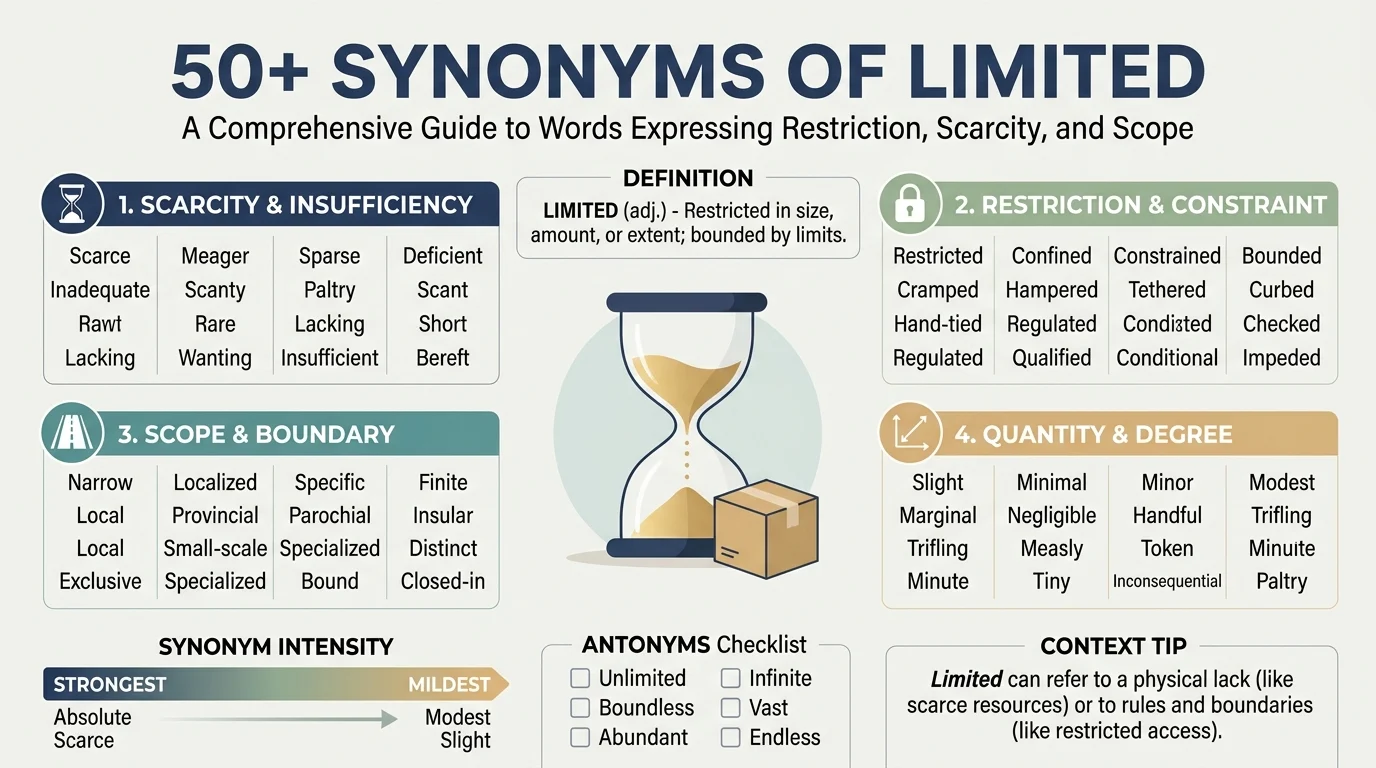
Have you ever needed to describe something that is restricted, scarce, or not extensive but felt that “limited” was too vague or repetitive? You want to capture the specific nature of the restriction, whether it is a small amount, a narrow scope, or a lack of freedom, and the word “limited” comes to mind. Choosing the right synonym for “limited” can transform a basic statement into a precise expression of scarcity, restriction, or constraint. This guide explores the best synonyms of limited, explaining exactly which word to use and when.
Quick Answer: “Limited” means restricted in size, amount, or extent; not extensive; confined within bounds. For scarcity, choose scarce, sparse, or insufficient. For restriction, use restricted, confined, or constrained. For scope, use narrow, narrow in scope, or bounded. For a formal tone, use finite or circumscribed.
Meaning, Tone, and Context
Understanding the core meaning of “limited” is the first step to using it effectively.
Simple Definition: Restricted in size, amount, or extent; not extensive; confined within limits.
Part of Speech: Adjective.
Overall Tone: Neutral to negative. It can indicate restriction, scarcity, or modesty.
Formality Level: Neutral to formal. The word is appropriate in most contexts.
Common Uses: Native English speakers use it in business (“limited resources”), travel (“limited time”), products (“limited edition”), and general contexts (“limited experience”).
Word Forms: Related words include the verb limit, the noun limitation, and the adjective limiting.
When and How to Use “Limited”
“Limited” is the perfect choice when you want to describe restriction, scarcity, or narrow scope. Here are seven realistic examples.
Business: “We have limited resources for this project.”
Travel: “The offer is available for a limited time.”
Products: “The limited edition sold out quickly.”
Professional: “He has limited experience in management.”
Academic: “The study has limited scope and needs expansion.”
Personal: “My free time is limited this week.”
Social Media: “Limited spots available for the workshop.”
Best Synonyms of “Limited”
No synonym is identical in every situation. Here is your guide to the best replacement for “limited” based on your writing context.
For Scarcity and Insufficiency
Most Direct: Scarce means insufficient for demand. “Water is scarce in the desert.”
Sparse: Sparse means thinly dispersed. “The vegetation was sparse.”
Insufficient: Insufficient means not enough. “The evidence was insufficient.”
Meager: Meager means lacking in quantity. “They survived on meager rations.”
For Restriction and Confinement
Restricted: Restricted means limited by rules. “Access is restricted to employees.”
Confined: Confined means kept within bounds. “The fire was confined to one room.”
Constrained: Constrained means restricted by circumstances. “The budget was constrained.”
Circumscribed: Circumscribed means limited in scope. “The powers were circumscribed by law.”
For Narrow Scope
Narrow: Narrow means limited in extent. “The discussion had a narrow focus.”
Bounded: Bounded means having limits. “The area bounded by the river.”
Finite: Finite means having limits. “Our resources are finite.”
Narrow in scope: Narrow in scope means not broad. “The study was narrow in scope.”
For Modest Quantity
Modest: Modest means not large. “The improvements were modest.”
Slight: Slight means small in degree. “There was a slight increase.”
Marginal: Marginal means minimal. “The effect was marginal.”
Minimal: Minimal means the smallest possible. “The damage was minimal.”
When Not to Use “Limited”
Using “limited” can sound wrong or awkward in certain situations.
When You Mean “Few”: “Limited” implies restriction. “Few” is about number.
Better Choice: Few or several. “Few people attended.”
When You Mean “Small”: “Limited” is about extent. “Small” is about size.
Better Choice: Small or little. “The room was small.”
When It Sounds Too Negative: “Limited” can imply inadequacy.
Better Choice: Focused or specialized. “The team is specialized.”
Words Commonly Confused With “Limited”
| Word | Difference | When to Use | Example |
|---|---|---|---|
| Scarce | Insufficient for demand | Resources and supply | “Scarce resources.” |
| Restricted | Limited by rules | Access and permissions | “Restricted area.” |
| Narrow | Limited in width or scope | Scope and width | “Narrow focus.” |
| Finite | Having limits | Resources and time | “Finite resources.” |
| Minimal | Smallest possible | Damage and impact | “Minimal damage.” |
| Modest | Not large | Improvements and amounts | “Modest gains.” |
Best Synonyms of “Limited” by Context
| Context | Best Synonym | Why It Works | Example |
|---|---|---|---|
| Formal writing | Circumscribed | Formal and precise | “The powers were circumscribed.” |
| Academic writing | Finite | Standard in research | “The study had finite scope.” |
| Professional | Restricted | Clear and professional | “Access is restricted.” |
| Business | Scarce | Business and resources | “Resources are scarce.” |
| Casual | Few | Simple and natural | “Few options are available.” |
| Technical | Constrained | Technical and precise | “The budget was constrained.” |
| Emotional | Meager | Evokes hardship | “They survived on meager supplies.” |
How to Choose the Best Synonym of “Limited”
Choosing the right word is a simple decision. Answer these questions.
What type of limitation am I describing? For scarcity, use scarce or insufficient. For restriction, use restricted or confined. And for scope, use narrow or circumscribed. For quantity, use modest or minimal.
What is my audience? For a formal report, use circumscribed or finite. For a friend, use few or small.
What is my purpose? Are you describing resources, access, or scope? The correct synonym depends entirely on this.
What is the emotional strength? Meager is stronger. Modest is milder. Pick the one that matches your message.
Real Life Examples of “Limited”
School: Basic: “The library has limited books.” Improved: “The library has few books on the subject.”
College: Basic: “The study has limited scope.” Improved: “The study has a narrow scope.”
Workplace: Basic: “We have limited resources.” Improved: “We have scarce resources.”
Business: Basic: “The offer is limited.” Improved: “The offer is available for a finite time.”
Email: Basic: “My availability is limited.” Improved: “My availability is restricted this week.”
Conversation: Basic: “Time is limited.” Improved: “Time is short.”
Storytelling: Basic: “They had limited food.” Improved: “They survived on meager rations.”
Top 10 Synonyms of “Limited”
| Synonym | Simple Meaning | Best Used For | Example Sentence |
|---|---|---|---|
| Restricted | Limited by rules | Access and permissions | “Access is restricted to employees.” |
| Scarce | Insufficient for demand | Resources and supply | “Water is scarce in the desert.” |
| Finite | Having limits | Resources and time | “Our resources are finite.” |
| Narrow | Limited in scope | Focus and width | “The discussion had a narrow focus.” |
| Confined | Kept within bounds | Physical and abstract | “The fire was confined to one room.” |
| Insufficient | Not enough | Evidence and resources | “The evidence was insufficient.” |
| Meager | Lacking in quantity | Food and resources | “They survived on meager rations.” |
| Constrained | Restricted by circumstances | Budget and freedom | “The budget was constrained.” |
| Modest | Not large | Improvements and amounts | “The improvements were modest.” |
| Circumscribed | Limited in scope | Formal and legal | “The powers were circumscribed.” |
Synonyms of “Limited” by Usage
Professional vs. Personal Synonyms
In the workplace, choose restricted, scarce, or constrained. With friends, use few, short, or small.
Formal vs. Conversational Synonyms
For formal writing, use circumscribed, finite, or constrained. For casual conversations, use few, short, or small.
Academic Synonyms
For research and essays, choose finite for resources, narrow for scope, and insufficient for evidence.
Professional and Business Synonyms
For maximum impact, choose restricted for access, scarce for resources, and finite for time.
Creative and Literary Synonyms
To add emotion and imagery, choose meager, sparse, or bounded. These words create atmosphere.
Slang or Modern Synonyms
In modern American slang, few, short, or tight are common. For example, “Time is tight.” These are casual and should be avoided in formal writing.
Strongest to Mildest Synonyms
Mild: modest, slight, minimal
Moderate: limited, restricted, narrow
Strong: scarce, confined, insufficient
Very Strong: meager, constrained, circumscribed
Emotional vs. Neutral Synonyms
Emotional Synonyms: Meager, scarce, confined. These words hint at hardship. Use them when you want to evoke feeling.
Neutral Synonyms: Limited, finite, restricted. These words communicate factual information.
Antonyms of “Limited”
| Antonym | Meaning | Example Sentence |
|---|---|---|
| Unlimited | Without limits | “The possibilities are unlimited.” |
| Abundant | Existing in large quantities | “The resources are abundant.” |
| Plentiful | Existing in large amounts | “The harvest was plentiful.” |
| Extensive | Covering a large area | “The estate is extensive.” |
| Boundless | Without limits | “The boundless ocean stretched ahead.” |
| Infinite | Without end | “The universe is infinite.” |
| Unrestricted | Not limited | “Access is unrestricted.” |
| Open | Not closed or limited | “The competition is open to all.” |
| Broad | Wide in scope | “The discussion was broad.” |
| Comprehensive | Including everything | “The report is comprehensive.” |
| Generous | Large in amount | “The portion was generous.” |
| Ample | More than enough | “We have ample time.” |
| Copious | Abundant | “She took copious notes.” |
| Profuse | Plentiful | “The flowers were profuse.” |
| Inexhaustible | Unable to be used up | “The supply is inexhaustible.” |
Comparison: “Limited” vs Similar Words
Limited vs. Restricted
Main Difference: “Limited” is about extent. “Restricted” is about rules.
Which Is Stronger? “Restricted” is more specific.
Which Is More Formal? Both are formal.
When to Use Each: Use “restricted” for access. Use “limited” for general contexts.
Examples:
Limited: “We have limited time.”
Restricted: “Access is restricted.”
Limited vs. Scarce
Main Difference: “Limited” is broader. “Scarce” is about supply.
Which Is Stronger? “Scarce” is stronger for shortage.
Which Is More Formal? Both are formal.
When to Use Each: Use “scarce” for resources. Use “limited” for general contexts.
Examples:
Limited: “The options are limited.”
Scarce: “Water is scarce.”
Limited vs. Narrow
Main Difference: “Limited” is broader. “Narrow” is about width or scope.
Which Is Stronger? “Narrow” is more specific.
Which Is More Formal? Both are formal.
When to Use Each: Use “narrow” for scope. Use “limited” for general contexts.
Examples:
Limited: “The study has limited scope.”
Narrow: “The discussion had a narrow focus.”
Limited vs. Finite
Main Difference: “Limited” is broader. “Finite” is about limits.
Which Is Stronger? “Finite” is more formal.
Which Is More Formal? “Finite” is more formal.
When to Use Each: Use “finite” for resources. Use “limited” for general contexts.
Examples:
Limited: “The time is limited.”
Finite: “The resources are finite.”
Limited vs. Confined
Main Difference: “Limited” is broader. “Confined” is about being kept within bounds.
Which Is Stronger? “Confined” is more specific.
Which Is More Formal? Both are formal.
When to Use Each: Use “confined” for physical spaces. Use “limited” for general contexts.
Examples:
Limited: “The space is limited.”
Confined: “The fire was confined to one room.”
Limited vs. Meager
Main Difference: “Limited” is neutral. “Meager” is negative.
Which Is Stronger? “Meager” is stronger emotionally.
Which Is More Formal? Both are formal.
When to Use Each: Use “meager” for hardship. Use “limited” for general contexts.
Examples:
Limited: “They had limited supplies.”
Meager: “They survived on meager rations.”
Common Phrases and Expressions with “Limited”
Phrase: Limited edition
Meaning: A special version produced in small quantities.
Example Sentence: “The limited edition sold out quickly.”
Phrase: Limited time
Meaning: A short period.
Example Sentence: “The offer is available for a limited time.”
Phrase: Limited resources
Meaning: Not enough resources.
Example Sentence: “We have limited resources for this project.”
Phrase: Limited experience
Meaning: Not much experience.
Example Sentence: “He has limited experience in management.”
Phrase: Limited scope
Meaning: A narrow range.
Example Sentence: “The study has limited scope.”
Phrase: Limited access
Meaning: Restricted entry.
Example Sentence: “Limited access is granted to authorized personnel.”
Common Mistakes to Avoid
Mistake 1: Using “limited” when you mean “few”.
Incorrect: “There are limited people here.”
Better: “There are few people here.”
Why: “Few” is about number.
Mistake 2: Using “limited” when you mean “small”.
Incorrect: “The limited room was cozy.”
Better: “The small room was cozy.”
Why: “Small” is about size.
Mistake 3: Overusing “limited” in conversation.
Incorrect: “My time is limited.”
Better: “My time is short.”
Why: “Short” sounds more natural.
Mistake 4: Using “limited” when you mean “restricted”.
Incorrect: “The limited area is off-limits.”
Better: “The restricted area is off-limits.”
Why: “Restricted” is for access.
Mistake 5: Using “limited” when you mean “scarce”.
Incorrect: “Water is limited in the desert.”
Better: “Water is scarce in the desert.”
Why: “Scarce” is for supply.
Frequently Asked Questions
1. What are the best synonyms of “limited”?
The best synonyms depend on your context. For scarcity, choose scarce or insufficient. For restriction, use restricted or confined. And for scope, use narrow or circumscribed.
2. What are the best formal synonyms of “limited”?
The best formal synonyms are circumscribed, finite, and constrained. These words are suitable for academic papers, professional reports, and business communications.
3. What are common informal synonyms of “limited”?
For informal settings, use few, short, or small. These alternatives sound more natural in everyday conversation.
4. What is another word for “limited” in professional writing?
In professional writing, restricted is an excellent choice. It conveys access limitations. Finite is also strong for resources.
5. What is the difference between “limited” and “restricted”?
“Limited” is about extent. “Restricted” is about rules. Use “restricted” for access and “limited” for general contexts.
6. What is the opposite of “limited”?
The most direct opposites (antonyms) of limited are unlimited, abundant, and extensive. These words describe things without limits.
Conclusion
“Limited” is a versatile and essential word for describing restriction, scarcity, and narrow scope. The term is neutral and widely accepted in most contexts, yet it can sound too negative for modest quantities or too vague for specific descriptions. The best choice among the synonyms of limited depends entirely on your audience, tone, and purpose. For a formal, academic effect, use circumscribed or finite. For a practical, business context, restricted or scarce works perfectly. And for scope, choose narrow or confined. For emotional emphasis, use meager or sparse. Remember, no single synonym works perfectly in every situation. Your goal is to choose the word that communicates your message with the most clarity and impact. A practical tip for your vocabulary growth is to pay attention to how writers describe restriction and scarcity and practice using different synonyms in your writing.










3 thoughts on “50+ Synonyms of Limited: Meanings, Uses, Examples, and Best Alternatives”