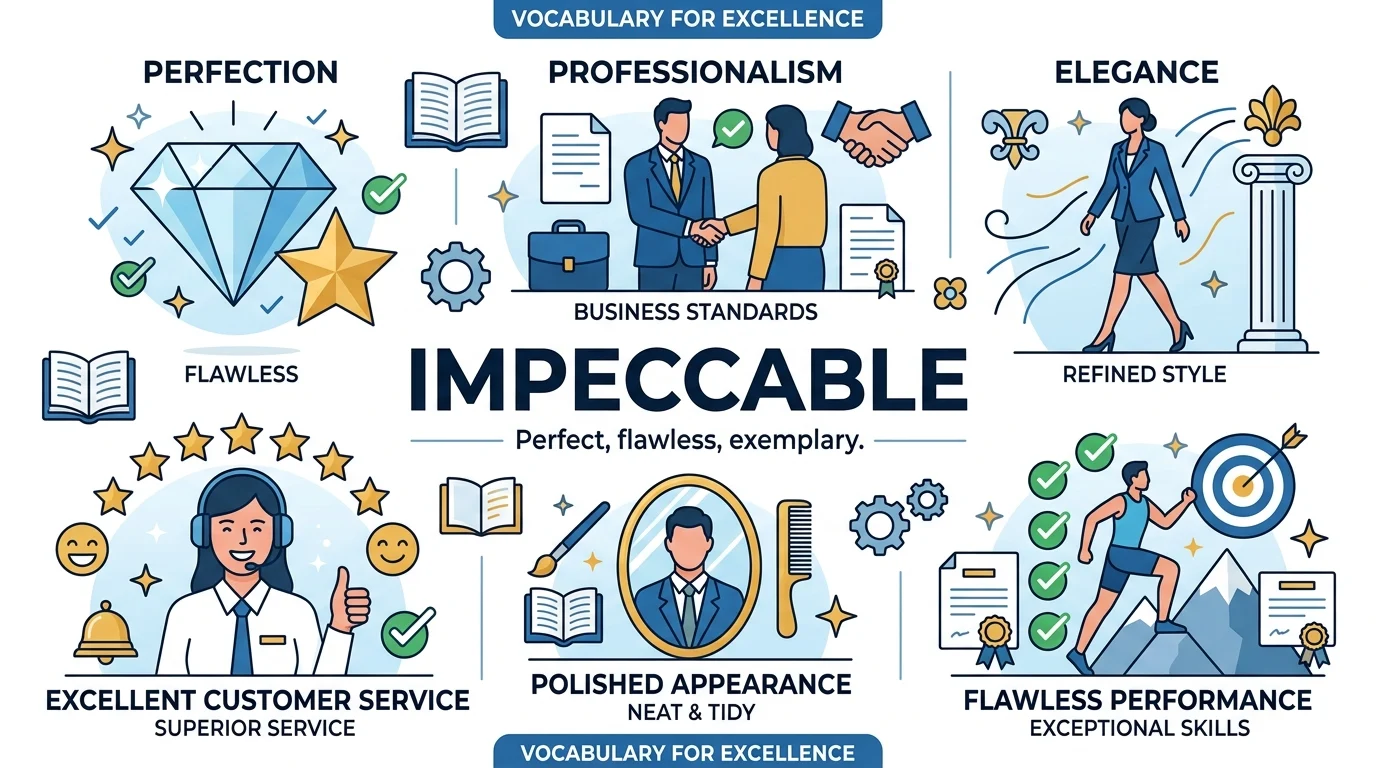
Quick Ans: Impeccable means perfect, flawless, or without any mistakes or faults. It is commonly used to describe someone’s behavior, appearance, work, manners, reputation, or quality when they meet an exceptionally high standard.
The word impeccable is one of the strongest compliments in the English language. Whether you’re praising someone’s professionalism, describing excellent customer service, complimenting a person’s fashion sense, or talking about outstanding work, impeccable conveys the idea of near perfection.
Although the word sounds formal, it is widely used in everyday conversations, business communication, reviews, academic writing, and professional settings. Understanding its meaning and knowing when to use it can help improve both your spoken and written English.
In this guide, you’ll learn the complete impeccable meaning, pronunciation, synonyms, antonyms, sentence examples, common phrases, usage tips, and frequently asked questions.
Quick Answer Box
| Topic | Answer |
|---|---|
| Word | Impeccable |
| Meaning | Perfect, flawless, without mistakes |
| Part of Speech | Adjective |
| Tone | Positive |
| Common Uses | Appearance, behavior, work, manners, quality, reputation |
| Example | Her presentation was impeccable. |
What Does Impeccable Mean?
Impeccable means completely free from mistakes, faults, or imperfections.
It describes something or someone that meets an extremely high standard of excellence.
Examples include:
- Impeccable manners
- Impeccable taste
- Impeccable service
- Impeccable timing
- Impeccable appearance
- Impeccable performance
Whenever something is described as impeccable, it suggests that there is little or nothing to criticize.
Full Definition
According to standard English usage, impeccable is an adjective used to describe someone or something that is flawless or perfect in quality.
People often use it when referring to:
- Professional performance
- Personal appearance
- Customer service
- Grammar or writing
- Cleanliness
- Honesty
- Character
- Organization
- Attention to detail
Because the word carries a very positive meaning, it is commonly used as a compliment.
Pronunciation
Impeccable is pronounced:
im-PEK-uh-buhl
Phonetic spelling:
/ɪmˈpek.ə.bəl/
The stress falls on the second syllable.
Origin of the Word
The word impeccable comes from the Latin word impeccabilis, meaning unable to sin or incapable of making mistakes.
Over time, its meaning evolved into describing anything that is flawless, faultless, or perfect in quality.
Today, it is widely used in modern English across both formal and informal situations.
Context and Usage
The meaning of impeccable becomes clearer when seen in different situations.
Professional Settings
Managers often praise employees by saying:
“Your work has been impeccable.”
This means the employee consistently produces excellent work without errors.
Customer Service
Businesses frequently receive reviews such as:
“The hotel’s service was impeccable.”
This compliments the quality of service.
Personal Appearance
Someone might say:
“She looked impeccable at the wedding.”
This means she looked elegant, neat, and perfectly dressed.
Academic Writing
Teachers may describe a student’s grammar as impeccable.
This means there were virtually no mistakes.
Sports
Commentators sometimes say:
“His timing was impeccable.”
Meaning his actions were perfectly timed.
Real-Life Examples
Example 1
“The restaurant provided impeccable customer service from beginning to end.”
Example 2
“Her impeccable fashion sense impressed everyone.”
Example 3
“His impeccable honesty earned the trust of the entire team.”
Example 4
“The lawyer presented an impeccable argument in court.”
Example 5
“The wedding decorations were absolutely impeccable.”
Common Phrases Using Impeccable
Many expressions regularly include the word impeccable.
Examples include:
- Impeccable manners
- Impeccable taste
- Impeccable style
- Impeccable reputation
- Impeccable record
- Impeccable service
- Impeccable credentials
- Impeccable timing
- Impeccable performance
- Impeccable grammar
These phrases emphasize excellence in different aspects of life.
Synonyms of Impeccable
Depending on the context, similar words include:
- Flawless
- Perfect
- Excellent
- Outstanding
- Exceptional
- Superb
- Immaculate
- Spotless
- Faultless
- First-class
- Exemplary
- Polished
- Refined
- Superior
- Remarkable
Although these words are similar, impeccable often implies an even higher level of perfection.
Antonyms of Impeccable
Opposite words include:
- Imperfect
- Flawed
- Poor
- Careless
- Faulty
- Defective
- Messy
- Untidy
- Mediocre
- Inadequate
- Unsatisfactory
These words describe work or qualities that fall below expected standards.
Impeccable vs Perfect
Many learners wonder whether impeccable and perfect mean exactly the same thing.
While they’re closely related, there is a subtle difference.
Perfect generally means something has no flaws at all.
Impeccable usually emphasizes exceptionally high quality, excellent standards, or faultless behavior.
For example:
“The cake was perfect.”
“The chef’s presentation was impeccable.”
Both are compliments, but impeccable often sounds more sophisticated and formal.
When to Use Impeccable
Use impeccable when describing:
- Excellent work
- Professional behavior
- Outstanding customer service
- Beautiful appearance
- High-quality products
- Elegant design
- Strong reputation
- Accurate writing
- Outstanding organization
- Exceptional performance
It is particularly effective in reviews, recommendations, speeches, and professional communication.
When Not to Use Impeccable
Avoid using impeccable when describing something that clearly contains noticeable mistakes.
For example:
❌ “The essay had several grammar mistakes but was impeccable.”
This is contradictory.
Instead, use words like:
- Good
- Very good
- Strong
- Well-written
Reserve impeccable for situations that genuinely deserve the compliment.
Usage Tips
To use impeccable naturally:
- Use it as a positive adjective.
- Pair it with nouns like service, manners, appearance, or performance.
- Avoid overusing it in casual conversations.
- Save it for situations where excellence is truly deserved.
- Remember that it is stronger than words like “good” or “great.”
Using impeccable appropriately can make your English sound more polished and professional.
Frequently Asked Questions
What does impeccable mean?
Impeccable means flawless, faultless, or without mistakes.
Is impeccable a compliment?
Yes. It is a very strong compliment.
Is impeccable formal?
It is slightly formal but commonly used in both professional and everyday English.
Can impeccable describe a person?
Yes. It can describe a person’s manners, appearance, reputation, honesty, or behavior.
Can impeccable describe work?
Absolutely. It is often used to praise high-quality work.
What’s the difference between impeccable and perfect?
Perfect means completely without flaws, while impeccable emphasizes exceptionally high standards and excellence.
Is impeccable positive?
Yes. It always has a positive meaning.
Can impeccable describe clothing?
Yes. People often say someone has impeccable style or impeccable fashion sense.
Is impeccable commonly used?
Yes. It appears frequently in reviews, business communication, books, interviews, and everyday English.
How can I remember the meaning of impeccable?
Think of impeccable as meaning so good that almost nothing can be criticized.
Conclusion
The impeccable meaning is flawless, faultless, or of exceptionally high quality. It is one of the strongest positive adjectives in English and is commonly used to praise outstanding work, excellent service, elegant appearance, professional behavior, and remarkable performance.
Whether you’re writing professionally, speaking in everyday conversations, or improving your vocabulary, using impeccable correctly can make your communication more expressive and sophisticated. By understanding its meaning, synonyms, examples, and proper usage, you’ll be able to use this powerful word with confidence whenever you want to describe something that truly stands out for its excellence.
Discover More:-
- BY Meaning in Text Slang: What It Means, How to Use It, Examples & More 2026
- What Does EPO Mean in Health Insurance? Complete Guide 2026

Amelia Brooks is a professional content writer and digital publishing specialist with a passion for creating clear, engaging, and informative content. She has extensive experience writing about technology, business, lifestyle, and online services.