Quick Ans: Deluge means a severe flood or an overwhelming amount of something arriving all at once. It can describe heavy rainfall that causes flooding or a large number of things, such as emails, messages, or requests, that come in quickly.
If you’ve encountered the word deluge while reading the news, a novel, or even social media posts, you may be wondering exactly what it means. Although it originally referred to a massive flood, the word is now commonly used in both literal and figurative contexts.
Today, people use deluge to describe everything from torrential rain to an overwhelming number of emails, phone calls, applications, or messages. Because of its versatility, it has become a popular word in journalism, business, education, and everyday conversation.
This guide explains the deluge meaning, pronunciation, definitions, examples, synonyms, antonyms, real-life usage, common mistakes, and frequently asked questions to help you confidently understand and use the word.
Quick Answer Box
| Topic | Answer |
|---|---|
| Word | Deluge |
| Part of Speech | Noun and Verb |
| Primary Meaning | A great flood or an overwhelming quantity of something |
| Common Contexts | Weather, news, business, communication, literature |
| Tone | Neutral to formal |
| Example | “The company received a deluge of customer inquiries.” |
What Does Deluge Mean?
The word deluge has two primary meanings.
As a noun, it refers to:
- A severe flood caused by heavy rain.
- A huge quantity of something arriving at once.
As a verb, it means:
- To flood or overwhelm someone with a large amount of something.
In modern English, the figurative meaning is often more common than the literal one.
Full Definition
According to standard English usage, deluge can describe either water or an overwhelming volume of something else.
Literal Meaning
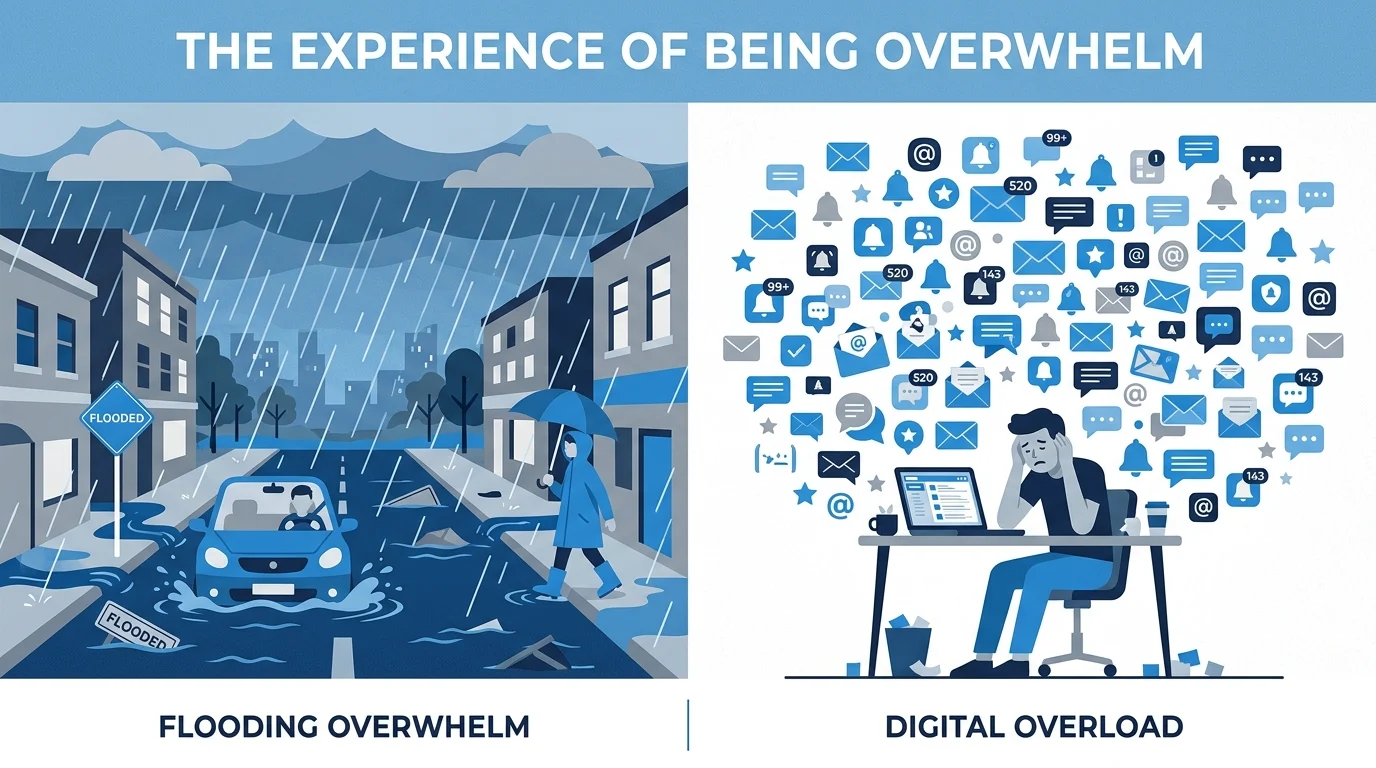
A deluge is an exceptionally heavy flood or a large amount of rain that causes widespread flooding.
Example:
“The town experienced a deluge after two days of nonstop rain.”
Figurative Meaning
The word can also describe an overwhelming number of items or events.
Examples include:
- A deluge of emails
- A deluge of phone calls
- A deluge of complaints
- A deluge of applications
- A deluge of messages
- A deluge of information
In these situations, there is no actual flood of water. Instead, the word emphasizes that something arrived in extremely large quantities.
Context and Usage
The meaning of deluge depends on the surrounding sentence.
Weather
Meteorologists may use the word when describing extreme rainfall.
Example:
“The region faced a deluge that flooded several roads.”
Business
Companies often experience a deluge of customer inquiries after launching a new product.
Education
Universities may receive a deluge of scholarship applications.
Social Media
A viral post can generate a deluge of comments within hours.
Daily Conversation
People sometimes exaggerate for emphasis.
Example:
“I woke up to a deluge of notifications.”
Real-Life Examples
Example 1
“The city experienced a deluge after the tropical storm moved inland.”
Example 2
“Our support team received a deluge of emails following the software update.”
Example 3
“She faced a deluge of interview requests after winning the award.”
Example 4
“The teacher received a deluge of homework submissions before the deadline.”
Example 5
“His announcement triggered a deluge of comments on social media.”
Deluge as a Verb
Although less common, deluge can also function as a verb.
Examples:
- Fans deluged the singer with messages.
- Customers deluged the company with complaints.
- Journalists deluged the spokesperson with questions.
- Volunteers were deluged by donation requests.
In each example, someone is being overwhelmed by a large number of things.
Common Situations Where Deluge Is Used
News Reports
Journalists often describe floods or overwhelming public reactions using the word.
Example:
“A deluge of rain caused widespread travel disruptions.”
Business and Marketing
Companies use the word when discussing customer activity.
Example:
“The promotion resulted in a deluge of online orders.”
Technology
Tech companies frequently describe:
- A deluge of bug reports
- A deluge of user feedback
- A deluge of downloads
Healthcare
Hospitals may experience a deluge of patients during emergencies.
Entertainment
Celebrities often receive a deluge of fan messages after major announcements.
Synonyms of Deluge
Depending on the context, similar words include:
- Flood
- Overflow
- Torrent
- Downpour
- Avalanche
- Wave
- Surge
- Overflowing amount
- Influx
- Barrage
Each synonym carries a slightly different nuance, but all suggest abundance or overwhelming quantity.
Antonyms of Deluge
Words opposite in meaning include:
- Drought
- Scarcity
- Shortage
- Lack
- Few
- Decline
- Reduction
- Trickle
These describe situations involving little or no supply instead of abundance.
Deluge vs Flood
Although these words are related, they are not always interchangeable.
Deluge
- Often implies something overwhelming.
- Can be literal or figurative.
- Frequently used in formal writing.
Flood
- Usually refers to water.
- Can also describe large quantities.
- More common in everyday speech.
Example:
“There was a flood of emails.”
“There was a deluge of emails.”
Both are correct, but deluge creates a stronger sense of being overwhelmed.
Common Mistakes
Many learners misuse the word by applying it to small quantities.
Incorrect:
“We received a deluge of two emails.”
Correct:
“We received a deluge of hundreds of emails.”
Because the word suggests an overwhelming amount, it should only be used when something is abundant.
Usage Tips
To use deluge naturally:
- Reserve it for large quantities.
- Use it in formal and semi-formal writing.
- Avoid using it for small numbers.
- Consider whether “flood” or “surge” might sound more natural in casual speech.
- Remember that it works as both a noun and a verb.
Frequently Asked Questions
What does deluge mean?
It means a severe flood or an overwhelming amount of something.
Is deluge always about rain?
No. It is often used figuratively to describe a very large quantity of something.
Can deluge be used as a verb?
Yes. It means to overwhelm someone with a large amount of something.
Is deluge a formal word?
It is more formal than “flood,” but it is commonly used in news articles, books, and professional writing.
What is a deluge of emails?
It means receiving an overwhelming number of emails in a short period.
Is deluge positive or negative?
It depends on the context. A deluge of support may be positive, while a deluge of complaints is negative.
What is the difference between flood and deluge?
Both can describe large quantities, but deluge usually emphasizes something overwhelming.
Can deluge describe social media activity?
Yes. For example, a celebrity might receive a deluge of comments after posting online.
What is the pronunciation of deluge?
It is commonly pronounced “DEH-looj” (/ˈdeljuːdʒ/).
How can I remember the meaning of deluge?
Think of a powerful flood that overwhelms everything in its path. The same idea applies when describing a huge amount of emails, messages, or requests.
Conclusion
The deluge meaning extends far beyond heavy rainfall. While the word originally referred to a great flood, it is now widely used to describe any overwhelming quantity of something, including emails, applications, phone calls, comments, messages, or information.
Whether you’re reading the news, writing professionally, or expanding your vocabulary, understanding deluge helps you express situations involving abundance with greater precision. By learning its definitions, synonyms, examples, and proper usage, you’ll be able to use this versatile English word confidently in both literal and figurative contexts.
Discover More:-
- BY Meaning in Text Slang: What It Means, How to Use It, Examples & More 2026
- What Does EPO Mean in Health Insurance? Complete Guide 2026

Alexander Cole is a professional content writer and researcher who specializes in creating informative, reader-friendly, and well-researched articles. He is committed to publishing accurate, valuable, and engaging content that helps readers stay informed and make smarter decisions.