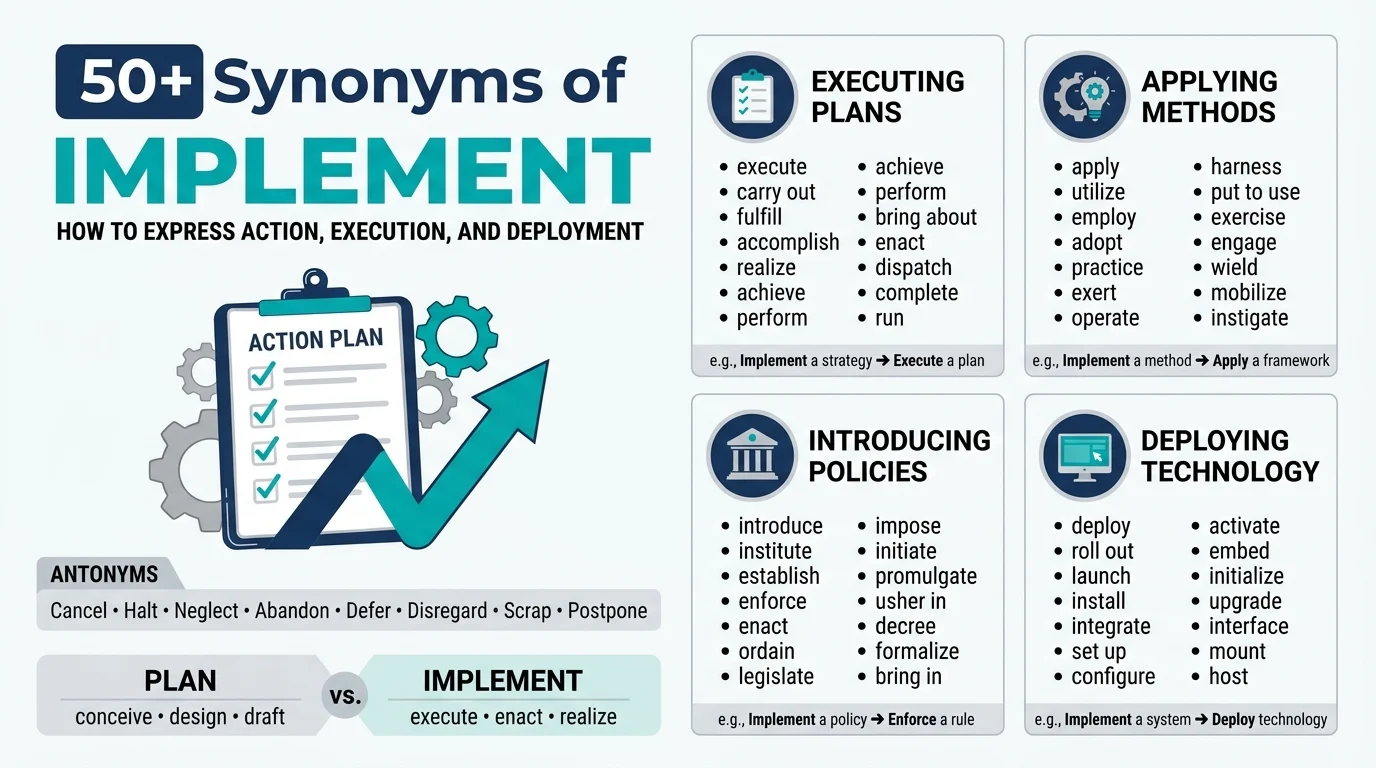
Have you ever needed to describe putting a plan into action, carrying out a decision, or introducing a new system but felt that the word “implement” was too formal or repetitive? Choosing the right synonym for “implement” can make your writing clearer, more natural, and more precise. Whether you are writing an academic paper, preparing a business report, explaining a technical process, or having a casual conversation, the right alternative can help you communicate your message effectively. This guide explores the best synonyms of implement, explaining their meanings, uses, and examples.
Quick Answer: “Implement” means to put a plan, decision, policy, or system into effect. The best synonyms include execute, carry out, apply, enact, enforce, perform, introduce, deploy, establish, and put into practice.
For carrying out a plan, choose execute or carry out. For policies and laws, use enact or enforce. And for technology and software, consider deploy or install. Also for practical applications, apply or put into practice may be more suitable. The best synonym depends on your context and the action you want to describe.
Meaning, Tone, and Context
Understanding the meaning of “implement” is the first step to using it correctly.
Simple Definition: To put a plan, decision, policy, method, or system into action.
Part of Speech: Verb.
Overall Tone: Neutral to formal. It is commonly associated with practical action, planning, and execution.
Formality Level: Formal to neutral. The word is especially common in professional, academic, governmental, and technical writing.
Common Uses: Implement is frequently used in business (“implement a strategy”), education (“implement a new curriculum”), government (“implement a policy”), and technology (“implement a software feature”).
Word Forms: Related words include the noun implementation, the adjective implementable, and the noun implementer, which refers to a person or organization responsible for putting something into effect.
When and How to Use “Implement”
“Implement” is an appropriate choice when describing the process of turning an idea, plan, or decision into action. Here are seven realistic examples.
Academic: “The researchers implemented a new method for collecting data.”
Professional: “Our team will implement the recommendations next month.”
Legal: “The government implemented new regulations.”
Business: “The company implemented a strategy to increase sales.”
Education: “The school implemented a new learning program.”
Technology: “The developers implemented additional security features.”
Everyday Life: “I implemented a new routine to manage my time better.”
Best Synonyms of “Implement”
No synonym works perfectly in every situation. Here is a guide to choosing the most appropriate replacement for “implement.”
For Carrying Out Plans and Decisions
Execute: Means to carry out a plan, order, or task. It is useful in professional and strategic contexts. “The team executed the project plan successfully.”
Carry Out: Means to perform or complete an intended action. It is a natural alternative in everyday and professional English. “The staff carried out the manager’s instructions.”
Perform: Means to do or complete an action or task. “The technician performed the required procedures.”
Conduct: Means to organize or carry out an activity, investigation, or process. “The researchers conducted the experiment.”
Undertake: Means to take responsibility for a task or project. “The organization undertook a major improvement project.”
Complete: Means to finish a task or process. “The team completed the implementation process.”
For Applying Ideas and Methods
Apply: Means to use a rule, method, or principle in a particular situation. “Teachers applied the new learning method.”
Practice: Means to use or follow a method repeatedly. “The team practiced the new procedure before launch.”
Utilize: Means to make practical use of something. “The company utilized the new system to improve efficiency.”
Put Into Practice: Means to turn a theory, idea, or plan into real action. “The students put the lessons into practice.”
Adopt: Means to accept and begin using a method, policy, or system. “The company adopted a new management approach.”
Use: Means to employ something for a specific purpose. “The department used a new process to handle requests.”
For Policies, Rules, and Laws
Enact: Means to make a law or formal measure officially valid. “The legislature enacted new environmental laws.”
Enforce: Means to ensure that a rule or law is obeyed. “The authorities enforced the updated safety regulations.”
Institute: Means to establish or introduce a formal system, practice, or policy. “The university instituted a new attendance policy.”
Establish: Means to create or set up something intended to continue. “The organization established new procedures.”
Introduce: Means to bring a new policy, method, or system into use. “The company introduced a flexible working policy.”
Administer: Means to manage or oversee the application of a program, policy, or system. “The agency administered the new assistance program.”
For Technology and Software
Deploy: Means to put software, technology, or a system into operation. “The developers deployed the latest application update.”
Install: Means to set up software, equipment, or a system so it can be used. “The IT team installed the new security software.”
Integrate: Means to combine a component or system with another. “The engineers integrated the new payment feature.”
Configure: Means to arrange settings so a system works as required. “The technician configured the new server.”
Activate: Means to make a system, feature, or service operational. “The administrator activated the new account feature.”
Operationalize: Means to turn a concept, strategy, or plan into a practical, workable process. “The team operationalized its strategic goals through measurable procedures.”
For Achieving Results and Making Changes
Accomplish: Means to achieve or complete something through effort. “The team accomplished its objectives.”
Fulfill: Means to satisfy a requirement, promise, or obligation. “The organization fulfilled its commitments.”
Realize: Means to make an idea, ambition, or plan become real. “The company realized its long-term vision.”
Actualize: Means to make an idea or potential a reality. “The project actualized the organization’s development goals.”
Bring About: Means to cause something to happen. “The reforms brought about significant improvements.”
Effect: Means to bring about or cause a result, especially through deliberate action. “The committee effected several organizational changes.”
Additional Useful Alternatives
Other alternatives may fit specific contexts, although their meanings are not identical to “implement.”
- Initiate: Begin a process or action.
- Launch: Introduce a product, program, or initiative.
- Set Up: Create or arrange something so it can operate.
- Put Into Effect: Make a plan, decision, or rule active.
- Follow Through: Continue an action until it is completed.
- Execute: Carry out a defined plan or instruction.
- Manage: Organize and oversee a process.
- Facilitate: Make an action or process easier.
- Deliver: Provide a planned service, outcome, or result.
- Apply: Use a method or principle in practice.
- Introduce: Bring something new into use.
- Establish: Create a system or procedure.
- Adopt: Choose and begin using an approach.
- Enforce: Ensure compliance with a rule.
- Administer: Manage the operation of a program.
- Carry Through: Complete an intended action despite difficulties.
When Not to Use “Implement”
Although “implement” is useful in formal writing, it can sound unnecessarily technical or awkward in some situations.
When You Mean “Start”: Implement suggests putting something into action, not simply beginning it.
Better Choice: Begin or initiate. “We will begin the meeting at nine.”
When You Mean “Create”: Implement usually refers to putting an existing plan or idea into action rather than inventing it.
Better Choice: Develop or create. “The team developed a new marketing strategy.”
When You Mean “Enforce”: Implementing a policy and enforcing it are related but different activities.
Better Choice: Enforce when the focus is ensuring compliance. “The school enforced its attendance rules.”
When You Mean “Install”: In technical contexts, implement can refer to developing functionality, whereas install means setting up software or equipment.
Better Choice: Install when describing software setup. “Please install the application on your computer.”
When It Sounds Too Formal: In casual conversation, implement may sound corporate or technical.
Better Choice: Use, start, or put into practice. “Let’s put the new plan into practice.”
Words Commonly Confused With “Implement”
| Word | Difference | When to Use | Example |
|---|---|---|---|
| Execute | Focuses on carrying out a plan or instruction | Projects and strategies | “We executed the plan.” |
| Apply | Focuses on using a method or principle | Practical situations | “She applied the new method.” |
| Enact | Focuses on officially making a law or measure valid | Government and legislation | “The legislature enacted the law.” |
| Enforce | Focuses on ensuring compliance | Rules and regulations | “The agency enforced the rules.” |
| Deploy | Focuses on putting technology into operation | Software and IT | “The team deployed the update.” |
| Adopt | Focuses on choosing and beginning to use something | Policies and methods | “The company adopted the policy.” |
| Establish | Focuses on creating a lasting system or procedure | Organizations and processes | “They established new procedures.” |
| Introduce | Focuses on bringing something new into use | Programs and initiatives | “The school introduced a new course.” |
Best Synonyms of “Implement” by Context
| Context | Best Synonym | Why It Works | Example |
|---|---|---|---|
| Formal writing | Execute | Clear and professional | “The team executed the strategy.” |
| Academic writing | Apply | Suitable for methods and theories | “The researchers applied the model.” |
| Business | Carry out | Direct and natural | “We carried out the action plan.” |
| Government | Enact | Appropriate for laws and formal measures | “The legislature enacted the policy.” |
| Legal compliance | Enforce | Emphasizes obedience to rules | “The agency enforced the regulations.” |
| Technology | Deploy | Describes putting systems into operation | “The developers deployed the software.” |
| Education | Introduce | Suitable for new courses and programs | “The school introduced a new curriculum.” |
| Casual conversation | Use | Simple and conversational | “We used the new approach.” |
| Project management | Execute | Emphasizes delivery of a planned task | “The team executed the project plan.” |
| Organizational change | Establish | Emphasizes creating a lasting process | “The firm established new procedures.” |
How to Choose the Best Synonym of “Implement”
Choosing the right synonym depends on your purpose, audience, and context.
What Are You Describing? For carrying out a plan, use execute or carry out. For introducing a policy, consider enact or introduce. And for technology, choose deploy or install when appropriate.
Who Is Your Audience? In formal reports, execute, establish, or implement may be suitable. In everyday conversation, use, start, or put into practice sounds more natural.
What Is Your Intended Meaning? Are you describing the start of a process, the application of an idea, or the enforcement of a rule? Select a word that reflects the exact action.
How Formal Should Your Writing Be? Utilize, operationalize, and execute can suit technical or professional contexts. Use and carry out are often clearer alternatives.
What Result Do You Want to Emphasize? Use accomplish for achieving an objective, deploy for making technology operational, and bring about for causing a change.
Real-Life Examples of “Implement”
Here are examples showing how to replace “implement” with a more specific word.
School
Basic: “The school implemented a new teaching method.”
Improved: “The school introduced a new teaching method.”
College
Basic: “The researchers implemented a new research technique.”
Improved: “The researchers applied a new research technique.”
Workplace
Basic: “We implemented the manager’s recommendations.”
Improved: “We carried out the manager’s recommendations.”
Business
Basic: “The company implemented a marketing strategy.”
Improved: “The company executed a marketing strategy.”
Government
Basic: “The government implemented new legislation.”
Improved: “The government enacted new legislation.”
Technology
Basic: “The development team implemented a new feature.”
Improved: “The development team developed and integrated a new feature.”
Everyday Conversation
Basic: “We need to implement this plan.”
Improved: “We need to put this plan into practice.”
Top 10 Synonyms of “Implement”
| Synonym | Simple Meaning | Best Used For | Example Sentence |
|---|---|---|---|
| Execute | Carry out a plan | Business and projects | “We executed the plan.” |
| Carry Out | Perform an action | General and professional use | “They carried out the task.” |
| Apply | Use a method | Academic and practical contexts | “She applied the technique.” |
| Enact | Make a law official | Government and legislation | “The legislature enacted the law.” |
| Enforce | Ensure compliance | Rules and regulations | “The agency enforced the policy.” |
| Deploy | Put into operation | Technology and IT | “The team deployed the system.” |
| Introduce | Bring into use | Programs and policies | “The school introduced a new program.” |
| Establish | Create a system | Organizations and procedures | “They established new guidelines.” |
| Adopt | Begin using an approach | Business and education | “The company adopted the method.” |
| Put Into Practice | Turn an idea into action | Everyday and academic writing | “They put the strategy into practice.” |
Synonyms of “Implement” by Usage
Professional vs. Personal Synonyms
In professional settings, execute, carry out, and apply are effective choices. In personal situations, use, start, and put into practice are often more natural.
Formal vs. Conversational Synonyms
For formal documents, consider execute, establish, enact, or operationalize. For everyday conversations, use use, start, or carry out.
Academic Synonyms
In research papers and essays, apply works well for methods and theories. Use conduct for research activities and operationalize when turning an abstract concept into measurable procedures.
Professional and Business Synonyms
For business writing, choose execute for strategies, carry out for tasks, adopt for new approaches, and deploy for systems.
Creative and Literary Synonyms
For creative writing, alternatives such as bring to life, realize, and put into action can make a sentence more engaging. For example, “The artist brought her vision to life.”
Technical and Modern Synonyms
In technology, deploy, integrate, configure, and install can describe specific stages of making a system usable. Choose the term that accurately describes the technical action.
Strongest to Mildest Alternatives
The strength of a synonym depends on its meaning and context rather than a universal ranking.
Direct and General: Use, apply, carry out.
Action-Oriented: Execute, perform, undertake.
Formal and Official: Enact, institute, establish.
Technical and Specific: Deploy, integrate, operationalize.
Action-Oriented vs. Neutral Synonyms
Action-Oriented Alternatives: Execute, carry out, and put into action emphasize doing something.
Neutral Alternatives: Apply, use, and introduce describe practical actions without necessarily suggesting urgency or intensity.
Antonyms of “Implement”
An antonym of “implement” describes the opposite action, such as stopping, rejecting, delaying, or reversing a plan. The best opposite depends on the original sentence.
| Antonym | Meaning | Example Sentence |
|---|---|---|
| Abandon | Give up a plan | “The company abandoned the proposal.” |
| Cancel | Decide that something will not proceed | “The team canceled the project.” |
| Reject | Refuse to accept an idea or proposal | “The board rejected the plan.” |
| Prevent | Stop something from happening | “The restrictions prevented the change.” |
| Halt | Stop an activity or process | “The manager halted implementation.” |
| Suspend | Temporarily stop an activity | “The agency suspended the program.” |
| Delay | Make something happen later | “The team delayed the rollout.” |
| Postpone | Arrange for something to happen later | “The launch was postponed.” |
| Reverse | Undo or change a previous decision | “The company reversed its policy.” |
| Withdraw | Remove a proposal or decision | “The organization withdrew its proposal.” |
| Discontinue | Stop providing or using something | “The company discontinued the service.” |
| Neglect | Fail to carry out a responsibility | “The team neglected the required procedures.” |
| Ignore | Pay no attention to instructions or plans | “The department ignored the recommendations.” |
| Abrogate | Formally repeal or abolish a law or agreement | “The government abrogated the agreement.” |
| Rescind | Officially revoke a decision or order | “The organization rescinded the directive.” |
Comparison: “Implement” vs. Similar Words
Implement vs. Execute
Main Difference: “Implement” emphasizes putting a plan or system into effect. “Execute” emphasizes carrying out a defined plan or action.
Which Is More Formal? Both are appropriate in professional writing.
When to Use Each: Use “implement” for policies, systems, and procedures. Use “execute” for strategies, instructions, and project plans.
Examples:
Implement: “The company implemented a new security policy.”
Execute: “The team executed the security plan.”
Implement vs. Apply
Main Difference: “Implement” puts a plan or system into operation. “Apply” uses a method, rule, or principle in a particular situation.
Which Is More Specific? “Apply” is more appropriate when the focus is using an existing method.
When to Use Each: Use “implement” for introducing a process. Use “apply” for using a technique or principle.
Examples:
Implement: “The school implemented a new assessment system.”
Apply: “The teacher applied a new assessment technique.”
Implement vs. Enact
Main Difference: “Implement” means putting a plan or policy into effect. “Enact” commonly refers to making a law or formal measure officially valid.
Which Is More Appropriate for Legislation? “Enact” is generally the better choice when describing the formal passage of legislation.
When to Use Each: Use “enact” for making laws official and “implement” for putting policies into practice.
Examples:
Implement: “The agency implemented the new requirements.”
Enact: “The legislature enacted a new law.”
Implement vs. Enforce
Main Difference: “Implement” means putting something into operation. “Enforce” means ensuring that people follow a rule or law.
Which Is More Specific? “Enforce” specifically emphasizes compliance.
When to Use Each: Use “implement” to introduce a policy and “enforce” to ensure that the policy is obeyed.
Examples:
Implement: “The school implemented a new attendance policy.”
Enforce: “The school enforced its attendance requirements.”
Implement vs. Introduce
Main Difference: “Implement” emphasizes putting something into action, while “introduce” emphasizes bringing something new into use or making it known.
When to Use Each: Use “introduce” for a new program, service, or policy. Use “implement” when describing the practical steps needed to make it work.
Examples:
Implement: “The company implemented a new workflow.”
Introduce: “The company introduced a new workflow.”
Implement vs. Deploy
Main Difference: “Implement” is broad and can refer to plans, methods, and systems. “Deploy” emphasizes putting resources, software, or technology into operational use.
When to Use Each: Use “deploy” for software releases, infrastructure, and technical systems. Use “implement” for the broader process of putting a solution into effect.
Examples:
Implement: “The team implemented a new software solution.”
Deploy: “The team deployed the software update.”
Implement vs. Establish
Main Difference: “Implement” means putting a plan into action. “Establish” means creating or setting up a system, process, or institution.
When to Use Each: Use “establish” when creating a new process or framework. Use “implement” when putting a defined plan into practice.
Examples:
Implement: “The department implemented the new procedure.”
Establish: “The department established a new procedure.”
Implement vs. Adopt
Main Difference: “Adopt” means choosing to accept or use an approach. “Implement” means putting that approach into action.
When to Use Each: Use “adopt” for the decision to use a new strategy. Use “implement” for the practical work that follows.
Examples:
Implement: “The organization implemented the revised policy.”
Adopt: “The organization adopted the revised policy.”
Implement vs. Carry Out
Main Difference: Both words can describe performing a plan or task, but “carry out” is often more conversational and straightforward.
When to Use Each: Use “implement” in formal descriptions of systems and procedures. Use “carry out” for tasks, instructions, and planned actions.
Examples:
Implement: “The team implemented the recommendations.”
Carry Out: “The team carried out the recommendations.”
Implement vs. Operationalize
Main Difference: “Implement” means putting something into action. “Operationalize” specifically emphasizes translating an idea, strategy, or concept into a workable process.
When to Use Each: Use “implement” for general action and “operationalize” for detailed processes, measurable objectives, or abstract concepts.
Examples:
Implement: “The company implemented its improvement strategy.”
Operationalize: “The company operationalized its improvement strategy through measurable targets.”
Common Phrases and Expressions with “Implement”
Phrase: Implement a strategy
Meaning: Put a planned approach into action.
Example Sentence: “The company implemented a strategy to improve customer retention.”
Phrase: Implement a policy
Meaning: Put an organizational or governmental policy into practice.
Example Sentence: “The school implemented a policy to improve student attendance.”
Phrase: Implement a system
Meaning: Introduce and put a system into operation.
Example Sentence: “The IT department implemented a new management system.”
Phrase: Implement changes
Meaning: Put planned modifications into effect.
Example Sentence: “The organization implemented changes to improve productivity.”
Phrase: Implement a solution
Meaning: Put a proposed answer to a problem into practice.
Example Sentence: “The engineers implemented a solution to reduce system errors.”
Phrase: Implement recommendations
Meaning: Act on advice or suggested improvements.
Example Sentence: “The management team implemented the recommendations from the audit.”
Phrase: Implement a plan
Meaning: Begin carrying out the steps of an established plan.
Example Sentence: “The project manager implemented the plan according to the schedule.”
Common Mistakes to Avoid
Mistake 1: Using “Implement” When You Mean “Create”
Incorrect: “We implemented a new idea for the first time by inventing it.”
Better: “We developed a new idea.”
Why: “Develop” or “create” is more appropriate when describing the act of producing an idea. “Implement” describes putting that idea into action.
Mistake 2: Confusing “Implement” With “Enforce”
Incorrect: “The company implemented the rules by checking whether everyone obeyed them.”
Better: “The company enforced the rules.”
Why: Enforcement specifically involves ensuring compliance.
Mistake 3: Using “Implement” When You Mean “Start”
Incorrect: “We implemented talking about the issue.”
Better: “We started discussing the issue.”
Why: “Start” is more natural when describing the beginning of an activity.
Mistake 4: Confusing “Implement” With “Adopt”
Incorrect: “The company implemented the new strategy when it merely approved it.”
Better: “The company adopted the new strategy.”
Why: Adoption means accepting or choosing an approach; implementation involves putting it into practice.
Mistake 5: Confusing “Implement” With “Install”
Incorrect: “The technician implemented the application on every computer” when the intended action was simply setting it up.
Better: “The technician installed the application on every computer.”
Why: “Install” is more precise when describing software setup.
FAQs
1. What are the best synonyms of “implement”?
The best synonyms include execute, carry out, apply, introduce, establish, adopt, and put into practice. For technology, deploy may be more appropriate. For laws, consider enact or enforce, depending on the action.
2. What are the best formal synonyms of “implement”?
Common formal alternatives include execute, enact, institute, establish, and operationalize. The best choice depends on whether you are discussing a plan, law, policy, or process.
3. What are common informal synonyms of “implement”?
Informal alternatives include use, start, carry out, and put into practice. These phrases often sound more natural in everyday conversations.
4. What is another word for “implement” in professional writing?
Execute is a strong alternative for plans and strategies. Apply works well for methods, while deploy is suitable for technology and software.
5. What is the difference between “implement” and “execute”?
“Implement” emphasizes putting a plan, system, or policy into effect. “Execute” emphasizes carrying out a defined plan, strategy, or instruction.
Conclusion
“Implement” is a versatile verb used to describe putting plans, policies, methods, and systems into action. It is common in business, academic, governmental, and technical writing, but some alternatives may communicate a specific action more clearly. For carrying out a plan, choose execute or carry out. For applying an idea, use apply or put into practice. And for laws and regulations, consider enact or enforce. For software and technology, deploy or install may be more precise. Also for everyday conversations, use and start often sound more natural.
Remember that no synonym is suitable for every sentence. The best alternative depends on what you are implementing, the action being performed, and the audience you are addressing. By choosing words carefully, you can make your writing more precise, readable, and effective.









