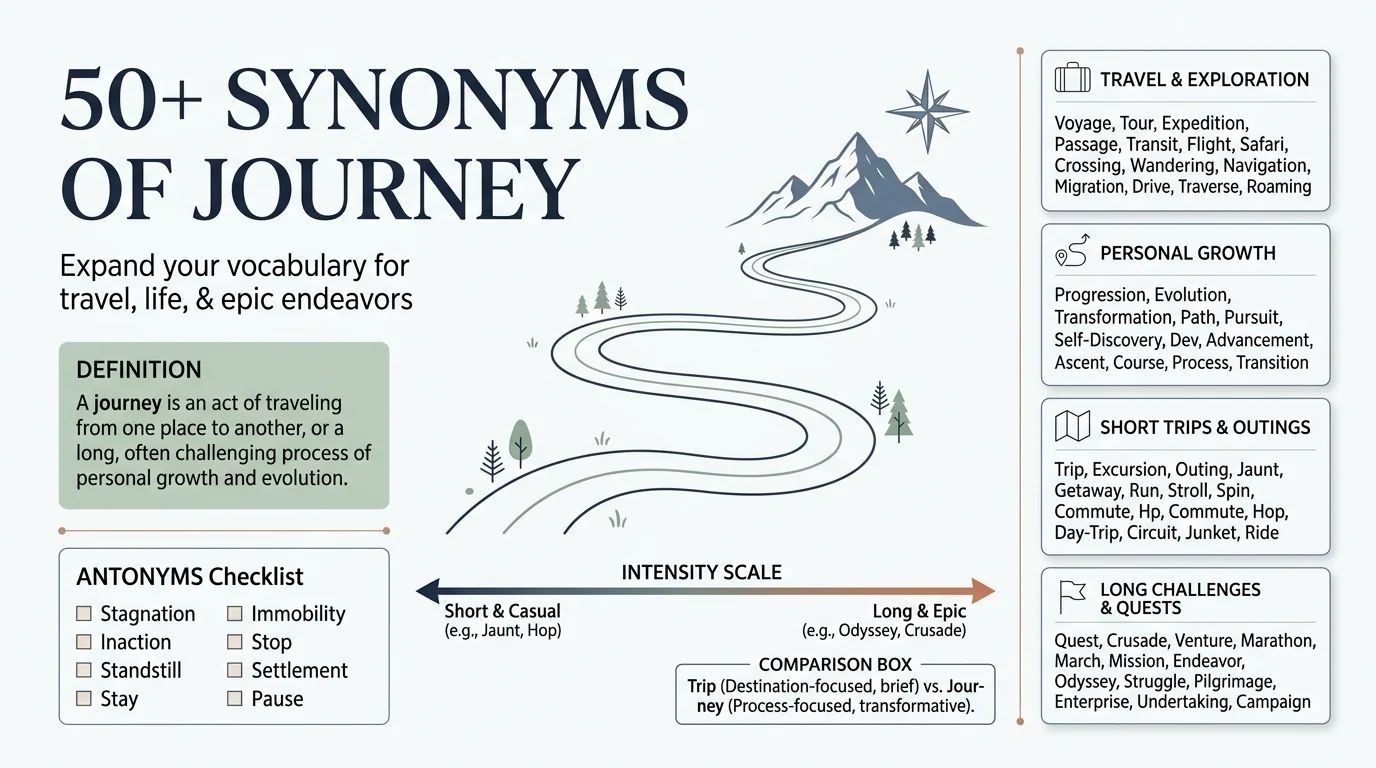
Have you ever needed to describe a trip, a process of personal growth, or a long path toward a goal but felt that “journey” was too broad or overused? You want to capture the specific nature of the travel, the transformation, or the distance covered, and the word “journey” comes to mind. Choosing the right synonym for “journey” can transform a basic statement into a precise expression of travel, progress, or experience. This guide explores the best synonyms of journey, explaining exactly which word to use and when.
Quick Answer: “Journey” means an act of traveling from one place to another, or a long and often difficult process of personal change or development. For physical travel, choose trip, voyage, or expedition. For personal growth, use path, passage, or odyssey. For a short distance, use excursion or outing. For a long, challenging process, use quest or pilgrimage.
Meaning, Tone, and Context
Understanding the core meaning of “journey” is the first step to using it effectively.
Simple Definition: An act of traveling from one place to another; a long and often difficult process of personal change and development.
Part of Speech: Noun and verb.
Overall Tone: Neutral to positive. It can indicate adventure, growth, or simply travel.
Formality Level: Neutral to formal. The word is appropriate in most contexts.
Common Uses: Native English speakers use it for travel (“a journey to Europe”), personal growth (“a journey of self-discovery”), and metaphors (“the journey to success”).
Word Forms: Related words include the noun journeyer and the verb journey.
When and How to Use “Journey”
“Journey” is the perfect choice when you want to describe travel or personal development. Here are seven realistic examples.
Travel: “The journey to the mountains took six hours.”
Personal Growth: “Her journey to recovery was long and difficult.”
Professional: “The company’s journey from startup to industry leader is inspiring.”
Academic: “The book describes the intellectual journey of the philosopher.”
Creative: “The novel follows the hero’s journey across distant lands.”
Emotional: “Grief is a journey that no one chooses.”
Social Media: “Enjoy the journey, not just the destination.”
Best Synonyms of “Journey”
No synonym is identical in every situation. Here is your guide to the best replacement for “journey” based on your writing context.
For Physical Travel
Most Common: Trip means a journey to a place and back. “We took a trip to the beach.”
Voyage: Voyage means a long journey by sea or space. “The voyage across the Atlantic took weeks.”
Expedition: Expedition means an organized journey for a purpose. “The expedition to the South Pole was historic.”
Tour: Tour means a journey visiting several places. “They went on a tour of Europe.”
For Personal Growth and Development
Path: Path means a way of life or development. “Her path to success was not easy.”
Passage: Passage means a journey or transition. “The passage from childhood to adulthood is challenging.”
Odyssey: Odyssey means a long, eventful journey. “His odyssey across the country changed him.”
Quest: Quest means a long search or journey. “The quest for knowledge never ends.”
For Short Journeys
Excursion: Excursion means a short journey for pleasure. “We took an excursion to the nearby island.”
Outing: Outing means a short trip for pleasure. “The family outing to the park was fun.”
Jaunt: Jaunt means a short excursion. “They took a jaunt to the city.”
Errand: Errand means a short trip for a purpose. “I have to run an errand.”
For Long and Challenging Journeys
Pilgrimage: Pilgrimage means a journey to a sacred place. “The pilgrimage to Mecca is a religious duty.”
Trek: Trek means a long, difficult journey on foot. “The trek through the mountains was exhausting.”
Venture: Venture means a risky or daring journey. “The venture into unknown territory was dangerous.”
Migration: Migration means movement from one region to another. “The migration of birds is a natural wonder.”
When Not to Use “Journey”
Using “journey” can sound wrong or awkward in certain situations.
When You Mean “Trip”: “Journey” is more formal or epic. “Trip” is casual.
Better Choice: Trip or vacation. “We took a trip to Florida.”
When You Mean “Commute”: “Journey” is for longer travel. “Commute” is for daily travel.
Better Choice: Commute or drive. “My commute takes an hour.”
When It Sounds Too Dramatic: “Journey” can sound grand for simple tasks.
Better Choice: Errand or trip. “I need to run an errand.”
Words Commonly Confused With “Journey”
| Word | Difference | When to Use | Example |
|---|---|---|---|
| Trip | A journey to a place and back | Vacation and travel | “A trip to Paris.” |
| Voyage | A long journey by sea or space | Sea and space travel | “A voyage across the ocean.” |
| Expedition | An organized journey | Exploration and research | “An expedition to Antarctica.” |
| Tour | A journey visiting several places | Sightseeing and travel | “A tour of Italy.” |
| Path | A way of life or development | Personal growth | “Her path to success.” |
| Quest | A long search or journey | Goals and discovery | “The quest for truth.” |
Best Synonyms of “Journey” by Context
| Context | Best Synonym | Why It Works | Example |
|---|---|---|---|
| Formal writing | Voyage | Formal and epic | “The voyage was long and dangerous.” |
| Academic writing | Odyssey | Literary and profound | “The intellectual odyssey was documented.” |
| Professional | Path | Professional and growth | “The company’s path to success.” |
| Business | Venture | Business and risk | “The new venture was risky.” |
| Travel | Trip | Casual and common | “We took a trip to the mountains.” |
| Personal | Passage | Emotional and transitional | “The passage to adulthood.” |
| Casual | Outing | Simple and natural | “We had an outing to the beach.” |
How to Choose the Best Synonym of “Journey”
Choosing the right word is a simple decision. Answer these questions.
What type of journey am I describing? For travel, use trip or voyage. For personal growth, use path or passage. And for a short trip, use excursion or outing. Also for a long challenge, use quest or pilgrimage.
What is my audience? For a formal report, use voyage or path. For a friend, use trip or outing.
What is my purpose? Are you describing travel, growth, or a process? The correct synonym depends entirely on this.
What is the emotional strength? Odyssey and pilgrimage are stronger. Errand is milder. Pick the one that matches your message.
Real Life Examples of “Journey”
School: Basic: “The class took a journey.” Improved: “The class took a trip to the museum.”
College: Basic: “Her journey to graduation was hard.” Improved: “Her path to graduation was challenging.”
Workplace: Basic: “The project was a journey.” Improved: “The project was a venture into new territory.”
Business: Basic: “The company’s journey is inspiring.” Improved: “The company’s odyssey is inspiring.”
Email: Basic: “Have a safe journey.” Improved: “Have a safe trip.”
Conversation: Basic: “The journey was long.” Improved: “The drive was long.”
Storytelling: Basic: “The hero’s journey was epic.” Improved: “The hero’s quest was epic.”
Top 10 Synonyms of “Journey”
| Synonym | Simple Meaning | Best Used For | Example Sentence |
|---|---|---|---|
| Trip | A journey to a place and back | Casual travel | “We took a trip to the beach.” |
| Voyage | A long journey by sea or space | Sea and space travel | “The voyage across the Atlantic.” |
| Expedition | An organized journey for a purpose | Exploration and research | “The expedition to the South Pole.” |
| Path | A way of life or development | Personal growth | “Her path to success.” |
| Passage | A journey or transition | Emotional and transitional | “The passage to adulthood.” |
| Odyssey | A long, eventful journey | Literary and epic | “His odyssey across the country.” |
| Quest | A long search or journey | Goals and discovery | “The quest for knowledge.” |
| Excursion | A short journey for pleasure | Short trips | “We took an excursion to the island.” |
| Pilgrimage | A journey to a sacred place | Religious and spiritual | “The pilgrimage to Mecca.” |
| Trek | A long, difficult journey on foot | Hiking and adventure | “The trek through the mountains.” |
Synonyms of “Journey” by Usage
Professional vs. Personal Synonyms
In the workplace, choose path, venture, or odyssey. With friends, use trip, outing, or drive.
Formal vs. Conversational Synonyms
For formal writing, use voyage, odyssey, or pilgrimage. For casual conversations, use trip, outing, or drive.
Academic Synonyms
For research and essays, choose odyssey for literary contexts, path for development, and passage for transitions.
Professional and Business Synonyms
For maximum impact, choose path for strategy, venture for risk, and expedition for projects.
Creative and Literary Synonyms
To add emotion and imagery, choose odyssey, quest, or pilgrimage. These words create atmosphere.
Slang or Modern Synonyms
In modern American slang, trip, ride, or journey are common. For example, “Enjoy the ride.” These are casual and should be avoided in formal writing.
Strongest to Mildest Synonyms
Mild: outing, errand, jaunt
Moderate: trip, journey, excursion
Strong: voyage, expedition, passage
Very Strong: odyssey, quest, pilgrimage
Emotional vs. Neutral Synonyms
Emotional Synonyms: Odyssey, pilgrimage, passage. These words hint at transformation. Use them when you want to evoke feeling.
Neutral Synonyms: Trip, journey, excursion. These words communicate factual information.
Antonyms of “Journey”
| Antonym | Meaning | Example Sentence |
|---|---|---|
| Stay | Remaining in one place | “We decided to stay home.” |
| Stationary | Not moving | “The stationary object was easy to photograph.” |
| Stillness | Lack of movement | “The stillness of the lake was calming.” |
| Rest | Ceasing movement | “We needed a rest after the journey.” |
| Stagnation | Lack of movement | “The stagnation of the project was concerning.” |
| Destination | The end of a journey | “The destination was beautiful.” |
| Arrival | Reaching a place | “The arrival was celebrated.” |
| Stop | Ceasing to move | “The bus made a stop.” |
| Halt | A stop | “The halt was temporary.” |
| Pause | A temporary stop | “The pause was brief.” |
| Delay | A postponement | “The delay frustrated travelers.” |
| Remain | To stay | “We will remain here.” |
| Inactivity | Lack of action | “The inactivity was boring.” |
| Immobility | Unable to move | “The immobility was frustrating.” |
| Fixed | Not moving | “The fixed point was a landmark.” |
Comparison: “Journey” vs Similar Words
Journey vs. Trip
Main Difference: “Journey” is longer and more epic. “Trip” is casual.
Which Is Stronger? “Journey” is stronger.
Which Is More Formal? “Journey” is more formal.
When to Use Each: Use “trip” for vacations. Use “journey” for personal growth.
Examples:
Journey: “Her journey to recovery was long.”
Trip: “We took a trip to the beach.”
Journey vs. Voyage
Main Difference: “Journey” is broader. “Voyage” is by sea or space.
Which Is Stronger? “Voyage” is more specific.
Which Is More Formal? Both are formal.
When to Use Each: Use “voyage” for sea travel. Use “journey” for general contexts.
Examples:
Journey: “The journey was difficult.”
Voyage: “The voyage across the Atlantic.”
Journey vs. Expedition
Main Difference: “Journey” is broader. “Expedition” is organized for a purpose.
Which Is Stronger? “Expedition” is more specific.
Which Is More Formal? Both are formal.
When to Use Each: Use “expedition” for exploration. Use “journey” for general contexts.
Examples:
Journey: “The journey to the summit.”
Expedition: “The expedition to Antarctica.”
Journey vs. Path
Main Difference: “Journey” is about travel. “Path” is about direction.
Which Is Stronger? “Path” is more metaphorical.
Which Is More Formal? Both are neutral.
When to Use Each: Use “path” for personal growth. Use “journey” for travel.
Examples:
Journey: “The journey was long.”
Path: “Her path to success.”
Journey vs. Odyssey
Main Difference: “Journey” is broader. “Odyssey” is long and eventful.
Which Is Stronger? “Odyssey” is stronger.
Which Is More Formal? “Odyssey” is more formal.
When to Use Each: Use “odyssey” for epic journeys. Use “journey” for general contexts.
Examples:
Journey: “The journey was tiring.”
Odyssey: “His odyssey across the country.”
Journey vs. Quest
Main Difference: “Journey” is broader. “Quest” is a search.
Which Is Stronger? “Quest” is more purposeful.
Which Is More Formal? Both are formal.
When to Use Each: Use “quest” for goals. Use “journey” for general contexts.
Examples:
Journey: “The journey to the top.”
Quest: “The quest for knowledge.”
Common Phrases and Expressions with “Journey”
Phrase: Hero’s journey
Meaning: A narrative pattern of adventure and transformation.
Example Sentence: “The novel follows the hero’s journey.”
Phrase: Journey of self-discovery
Meaning: A process of learning about oneself.
Example Sentence: “Her trip was a journey of self-discovery.”
Phrase: Safe journey
Meaning: A wish for safe travel.
Example Sentence: “Have a safe journey.”
Phrase: Long journey
Meaning: A difficult or lengthy process.
Example Sentence: “The long journey to success was worth it.”
Phrase: Journey to the top
Meaning: The process of achieving success.
Example Sentence: “Their journey to the top was inspiring.”
Phrase: Enjoy the journey
Meaning: Appreciate the process, not just the destination.
Example Sentence: “Enjoy the journey, not just the destination.”
Common Mistakes to Avoid
Mistake 1: Using “journey” when you mean “trip”.
Incorrect: “We took a journey to the store.”
Better: “We took a trip to the store.”
Why: “Trip” is for short, casual travel.
Mistake 2: Using “journey” when you mean “commute”.
Incorrect: “My journey to work takes an hour.”
Better: “My commute to work takes an hour.”
Why: “Commute” is for daily travel.
Mistake 3: Overusing “journey” in conversation.
Incorrect: “The journey was long.”
Better: “The drive was long.”
Why: “Drive” sounds more natural.
Mistake 4: Using “journey” when you mean “path”.
Incorrect: “Her journey to success was hard.”
Better: “Her path to success was hard.”
Why: “Path” is for personal growth.
Mistake 5: Using “journey” when you mean “odyssey”.
Incorrect: “The journey was epic.”
Better: “The odyssey was epic.”
Why: “Odyssey” is for long, eventful journeys.
Frequently Asked Questions
1. What are the best synonyms of “journey”?
The best synonyms depend on your context. For travel, choose trip or voyage. For personal growth, use path or passage. And for a short trip, use excursion or outing.
2. What are the best formal synonyms of “journey”?
The best formal synonyms are voyage, expedition, and odyssey. These words are suitable for academic papers, professional reports, and literary works.
3. What are common informal synonyms of “journey”?
For informal settings, use trip, outing, or drive. These alternatives sound more natural in everyday conversation.
4. What is another word for “journey” in professional writing?
In professional writing, path is an excellent choice. It conveys growth and progress. Venture is also strong for risky projects.
5. What is the difference between “journey” and “trip”?
“Journey” is longer and more epic. “Trip” is casual and shorter. Use “trip” for vacations and “journey” for personal growth.
6. What is the opposite of “journey”?
The most direct opposites (antonyms) of journey are stay, stillness, and destination. These words describe remaining in one place.
Conclusion
“Journey” is a powerful and evocative word for describing travel, personal growth, and transformation. The term is neutral and widely accepted in most contexts, yet it can sound too dramatic for simple trips or too broad for specific descriptions. The best choice among the synonyms of journey depends entirely on your audience, tone, and purpose. For a formal, epic effect, use voyage or odyssey. For a practical, everyday context, trip or drive works perfectly. And for personal growth, choose path or passage. Also for a long challenge, use quest or pilgrimage. Remember, no single synonym works perfectly in every situation. Your goal is to choose the word that communicates your message with the most clarity and impact. A practical tip for your vocabulary growth is to pay attention to how writers describe travel and transformation and practice using different synonyms in your writing.









