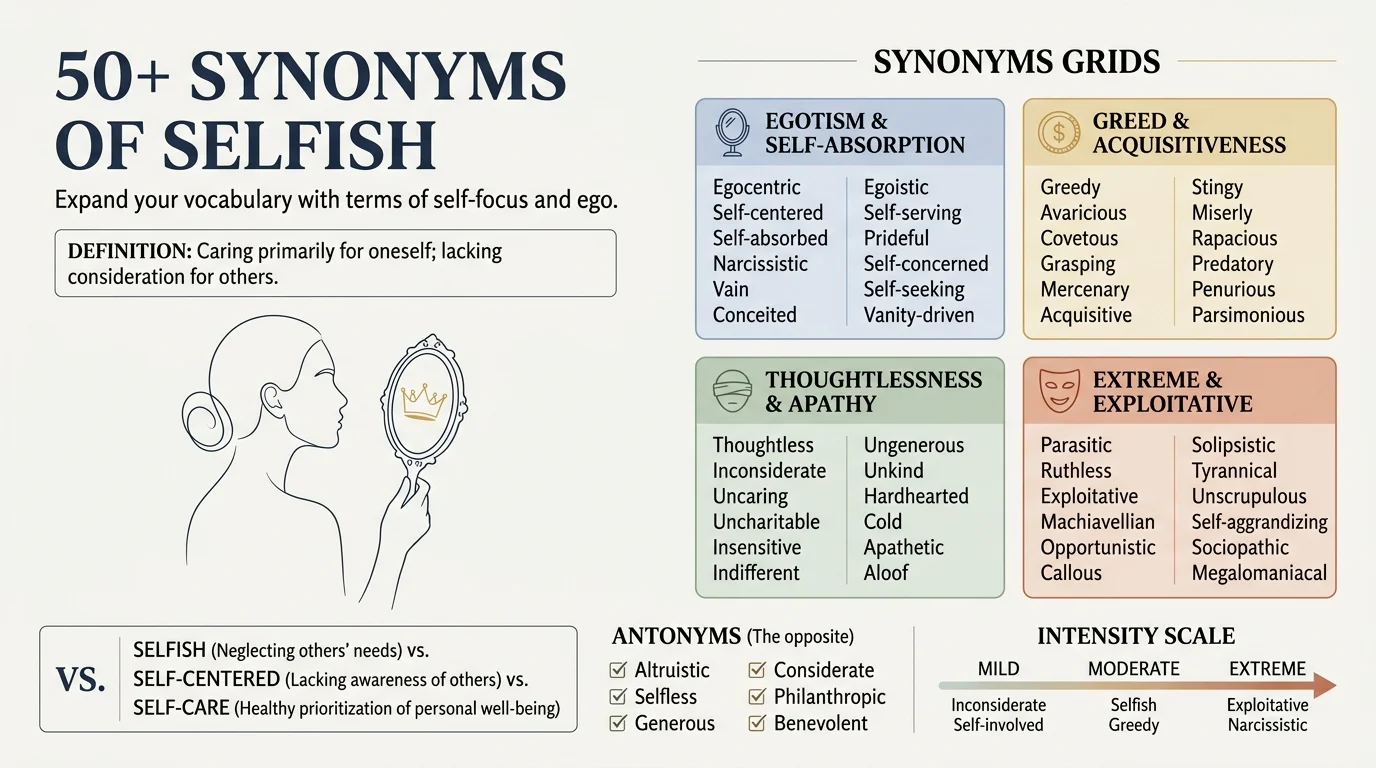
Have you ever needed to describe someone who puts their own needs above everyone else but felt that “greedy” or “mean” was too simple? You want to capture the specific lack of consideration, the egotism, or the self-centered behavior, and the word “selfish” comes to mind. Choosing the right synonym for “selfish” can transform a basic criticism into a precise expression of egotism, greed, or disregard for others. This guide explores the best synonyms of selfish, explaining exactly which word to use and when.
Quick Ans: “Selfish” means caring only about oneself and disregarding others. For formal writing, choose egotistical, self-centered, or self-serving. For casual conversation, use greedy, stingy, or me-first. For emotional emphasis, use, self-absorbed, or egomaniacal. For milder descriptions, use inconsiderate or thoughtless.
Meaning, Tone, and Context
Understanding the core meaning of “selfish” is the first step to using it effectively.
Simple Definition: Caring only about oneself and not about others; lacking consideration for other people.
Part of Speech: Adjective.
Overall Tone: Negative. It indicates a lack of consideration, greed, or egotism.
Formality Level: Neutral. The word is appropriate in most contexts, though more formal alternatives exist.
Common Uses: Native English speakers use it to describe people (“selfish person”), actions (“selfish behavior”), decisions (“selfish choice”), and attitudes (“selfish attitude”).
Word Forms: Related words include the noun selfishness, the adverb selfishly, and the adjective unselfish (the opposite).
When and How to Use “Selfish”
“Selfish” is the perfect choice when you want to describe someone who prioritizes themselves over others. Here are seven realistic examples.
Personal: “He is too selfish to share his toys.”
Professional: “Her selfish decision cost the team the project.”
Academic: “The study examines selfish behavior in economic games.”
Workplace: “His selfish attitude alienated his colleagues.”
Emotional: “She called him selfish for not considering her feelings.”
Social: “It was selfish of them to leave without helping.”
Social Media: “Selfish people never change. Protect your peace.”
Best Synonyms of “Selfish”
No synonym is identical in every situation. Here is your guide to the best replacement for “selfish” based on your writing context.
For Egotism and Self-Centeredness
Most Formal: Egotistical means excessively conceited. “His egotistical behavior annoyed everyone.”
Self-centered: Self-centered means focused on oneself. “She is too self-centered to notice others.”
Self-absorbed: Self-absorbed means preoccupied with oneself. “He was too self-absorbed to help.”
For Greed and Self-Serving Behavior
Greedy: Greedy means wanting more than needed. “The greedy executive took all the credit.”
Self-serving: Self-serving means acting for personal gain. “His self-serving motives were obvious.”
Avaricious: Avaricious means extremely greedy. “The avaricious landlord raised rents.”
Mercenary: Mercenary means motivated by money. “His mercenary approach alienated friends.”
For Thoughtlessness and Inconsideration
Inconsiderate: Inconsiderate means not thinking of others. “His inconsiderate remark hurt her.”
Thoughtless: Thoughtless means lacking consideration. “Her thoughtless actions caused problems.”
Unthinking: Unthinking means acting without thought. “His unthinking comment offended many.”
Tactless: Tactless means saying or doing insensitive things. “Her tactless question embarrassed him.”
For Strong Negative Emphasis
Egomaniacal: Egomaniacal means obsessively self-centered. “His egomaniacal demands were unreasonable.”
Exploitative: Exploitative means taking advantage of others. “The exploitative boss overworked his staff.”
Predatory: Predatory means exploiting others. “The predatory lender targeted the vulnerable.”
When Not to Use “Selfish”
Using “selfish” can sound wrong or awkward in certain situations.
When You Mean “Independent”: “Selfish” is negative. “Independent” is positive.
Better Choice: Independent or self-reliant. “She is very independent.”
When You Mean “Confident”: “Selfish” is about disregard. “Confident” is about self-assurance.
Better Choice: Confident or assertive. “He is confident in his abilities.”
When It Sounds Too Harsh: For minor slights, “selfish” can be too strong.
Better Choice: Inconsiderate or thoughtless. “That was inconsiderate of him.”
Words Commonly Confused With “Selfish”
| Word | Difference | When to Use | Example |
|---|---|---|---|
| Greedy | Wants more than needed | Money and resources | “The greedy banker.” |
| Self-centered | Focused on oneself | Personality and behavior | “She is self-centered.” |
| Egotistical | Conceited | Personality and attitude | “His egotistical remarks.” |
| Inconsiderate | Not thinking of others | Behavior and manners | “An inconsiderate act.” |
| Selfish | Self-obsessed | Psychology and personality | “A selfish leader.” |
| Thoughtless | Lacking thought | Actions and words | “A thoughtless comment.” |
Best Synonyms of “Selfish” by Context
| Context | Best Synonym | Why It Works | Example |
|---|---|---|---|
| Formal writing | Egotistical | Formal and precise | “His egotistical behavior was noted.” |
| Academic writing | Self-serving | Standard in research | “The self-serving bias was studied.” |
| Professional | Self-centered | Professional and clear | “A self-centered approach fails.” |
| Business | Greedy | Business and finance | “The greedy executives profited.” |
| Casual | Me-first | Simple and natural | “He has a me-first attitude.” |
| Mild | Inconsiderate | Milder and less harsh | “Her inconsiderate remark hurt.” |
How to Choose the Best Synonym of “Selfish”
Choosing the right word is a simple decision. Answer these questions.
What type of selfishness am I describing? For egotism, use egotistical or self-centered. And For greed, use greedy or self-serving. For thoughtlessness, use inconsiderate or thoughtless. For extreme cases, use egomaniacal.
What is my audience? For a formal report, use egotistical or self-serving. For a friend, use greedy or me-first.
What is my purpose? Are you describing a person, an action, or an attitude? The correct synonym depends entirely on this.
What is the emotional strength? egomaniacal are stronger. Inconsiderate is milder. Pick the one that matches your message.
Real Life Examples of “Selfish”
School: Basic: “The student was selfish.” Improved: “The student was inconsiderate of his classmates.”
College: Basic: “The policy is selfish.” Improved: “The policy is self-serving and ignores the poverty threshold.”
Workplace: Basic: “His behavior was selfish.” Improved: “His behavior was self-centered and unprofessional.”
Business: Basic: “The CEO was selfish.” Improved: “The CEO was greedy and prioritized bonuses over employees.”
Email: Basic: “That was selfish.” Improved: “That was inconsiderate.”
Conversation: Basic: “He is so selfish.” Improved: “He is so me-first.”
Storytelling: Basic: “The villain was selfish.” Improved: “The villain was cruel.”
Top 10 Synonyms of “Selfish”
| Synonym | Simple Meaning | Best Used For | Example Sentence |
|---|---|---|---|
| Egotistical | Excessively conceited | Formal and personality | “His egotistical behavior annoyed everyone.” |
| Self-centered | Focused on oneself | General and behavior | “She is too self-centered to notice others.” |
| Greedy | Wanting more than needed | Money and resources | “The greedy executive took all the credit.” |
| Self-serving | Acting for personal gain | Professional and motives | “His self-serving motives were obvious.” |
| Inconsiderate | Not thinking of others | Behavior and manners | “His inconsiderate remark hurt her.” |
| Thoughtless | Lacking consideration | Actions and words | “Her thoughtless actions caused problems.” |
| Me-first | Prioritizing oneself | Casual and attitude | “He has a me-first attitude.” |
| Egomaniacal | Obsessively self-centered | Strong emphasis | “His egomaniacal demands were unreasonable.” |
| Self-absorbed | Preoccupied with oneself | Personality and behavior | “He was too self-absorbed to help.” |
Synonyms of “Selfish” by Usage
Professional vs. Personal Synonyms
In the workplace, choose self-serving, self-centered, or egotistical. With friends, use greedy, me-first, or inconsiderate.
Formal vs. Conversational Synonyms
For formal writing, use egotistical, self-serving. For casual conversations, use greedy, me-first, or stingy.
Academic Synonyms
For research and essays, choose self-serving for bias, egotistical for personality, and for psychology.
Professional and Business Synonyms
For maximum impact, choose self-serving for motives, greedy for executives, and self-centered for leadership.
Creative and Literary Synonyms
To add emotion and imagery, choose egomaniacal, or avaricious. These words create strong characters.
Slang or Modern Synonyms
In modern American slang, selfish, me-first, stingy, or toxic are common. For example, “He is so toxic.” These are casual and should be avoided in formal writing.
Strongest to Mildest Synonyms
Mild: inconsiderate, thoughtless, tactless
Moderate: selfish, self-centered, greedy
Strong: egotistical, self-serving, self-absorbed
Very Strong: egomaniacal, avaricious, exploitative
Emotional vs. Neutral Synonyms
Emotional Synonyms: egomaniacal, exploitative. These words hint at strong negative emotion. Use them when you want to evoke feeling.
Neutral Synonyms: Selfish, self-centered, inconsiderate. These words communicate factual information about behavior.
Antonyms of “Selfish”
| Antonym | Meaning | Example Sentence |
|---|---|---|
| Selfless | Concerned more with others | “Her selfless act saved the child.” |
| Altruistic | Unselfishly concerned for others | “His altruistic motives were admired.” |
| Generous | Willing to give more | “She was generous with her time.” |
| Unselfish | Not selfish | “His unselfish behavior was praised.” |
| Considerate | Thinking of others | “He was considerate of her feelings.” |
| Thoughtful | Showing consideration | “Her thoughtful gift touched him.” |
| Charitable | Generous to those in need | “The charitable donation helped many.” |
| Kind | Friendly and considerate | “He was kind to everyone.” |
| Compassionate | Sympathetic and concerned | “She showed compassion to the needy.” |
| Caring | Displaying kindness | “He is a caring father.” |
| Benevolent | Kind and generous | “The benevolent donor funded the school.” |
| Magnanimous | Generous and forgiving | “His magnanimous gesture was appreciated.” |
| Self-sacrificing | Giving up own interests | “Her self-sacrificing devotion inspired all.” |
| Devoted | Loyal and loving | “He was devoted to his family.” |
| Giving | Providing freely | “She has a giving nature.” |
Comparison: “Selfish” vs Similar Words
Selfish vs. Greedy
Main Difference: “Selfish” is about lack of consideration. “Greedy” is about wanting more.
Which Is Stronger? “Greedy” is more specific to desire.
Which Is More Formal? Both are neutral.
When to Use Each: Use “selfish” for behavior. Use “greedy” for money.
Examples:
Selfish: “He is too selfish to share.”
Greedy: “The greedy banker took bonuses.”
Selfish vs. Self-Centered
Main Difference: “Selfish” is about disregard. “Self-centered” is about focus.
Which Is Stronger? “Self-centered” is more specific to focus.
Which Is More Formal? Both are neutral.
When to Use Each: Use “self-centered” for personality. Use “selfish” for behavior.
Examples:
Selfish: “It was selfish to leave early.”
Self-centered: “She is too self-centered to notice.”
Selfish vs. Egotistical
Main Difference: “Egotistical” is about conceit. “Selfish” is about disregard.
Which Is Stronger? “Egotistical” is stronger for conceit.
Which Is More Formal? Both are formal.
When to Use Each: Use “egotistical” for personality. Use “selfish” for behavior.
Examples:
Selfish: “He is selfish with his time.”
Egotistical: “His egotistical remarks annoyed everyone.”
Examples:
Selfish: “He is selfish with resources.”
Selfish vs. Inconsiderate
Main Difference: “Inconsiderate” is milder. “Selfish” is stronger.
Which Is Stronger? “Selfish” is stronger.
Which Is More Formal? Both are neutral.
When to Use Each: Use “inconsiderate” for minor slights. Use “selfish” for deliberate disregard.
Examples:
Selfish: “His selfish decision hurt the team.”
Inconsiderate: “That was inconsiderate of him.”
Selfish vs. Self-Serving
Main Difference: “Self-serving” is about motives. “Selfish” is broader.
Which Is Stronger? “Self-serving” is more specific.
Which Is More Formal? Both are formal.
When to Use Each: Use “self-serving” for motives. Use “selfish” for general behavior.
Examples:
Selfish: “He is selfish with his money.”
Self-serving: “His self-serving motives were obvious.”
Common Phrases and Expressions with “Selfish”
Phrase: Selfish behavior
Meaning: Actions that disregard others.
Example Sentence: “His selfish behavior alienated his friends.”
Phrase: Selfish motives
Meaning: Reasons based on personal gain.
Example Sentence: “Her selfish motives were exposed.”
Phrase: Selfish decision
Meaning: A choice that benefits only oneself.
Example Sentence: “The selfish decision hurt the whole team.”
Phrase: Selfish attitude
Meaning: A mindset focused on oneself.
Example Sentence: “His selfish attitude cost him the job.”
Phrase: Selfishness knows no bounds
Meaning: Selfishness is limitless.
Example Sentence: “His selfishness knows no bounds.”
Common Mistakes to Avoid
Mistake 1: Using “selfish” when you mean “independent”.
Incorrect: “She is selfish for living alone.”
Better: “She is independent for living alone.”
Why: “Selfish” is negative.
Mistake 2: Using “selfish” when you mean “confident”.
Incorrect: “He is selfish in his abilities.”
Better: “He is confident in his abilities.”
Why: “Confident” is positive.
Mistake 3: Overusing “selfish” in conversation.
Incorrect: “That was selfish.”
Better: “That was inconsiderate.”
Why: “Inconsiderate” is milder.
Mistake 4: Using “selfish” when you mean “greedy”.
Incorrect: “The selfish banker took all the money.”
Better: “The greedy banker took all the money.”
Why: “Greedy” is for money.
Frequently Asked Questions
1. What are the best synonyms of “selfish”?
The best synonyms depend on your context. For egotism, choose egotistical or self-centered. And For greed, use greedy or self-serving. For thoughtlessness, use inconsiderate. For extreme cases, use egomaniacal.
2. What are the best formal synonyms of “selfish”?
The best formal synonyms are egotistical, self-serving. These words are suitable for academic papers, professional reports, and business communications.
3. What are common informal synonyms of “selfish”?
For informal settings, use greedy, me-first, or stingy. These alternatives sound more natural in everyday conversation.
4. What is another word for “selfish” in professional writing?
In professional writing, self-serving is an excellent choice. It conveys personal gain. Self-centered is also strong for behavior.
5. What is the difference between “selfish” and “greedy”?
“Selfish” is about lack of consideration. “Greedy” is about wanting more. Use “greedy” for money and “selfish” for behavior.
6. What is the opposite of “selfish”?
The most direct opposites (antonyms) of selfish are selfless, altruistic, and generous. These words describe concern for others.
Conclusion
“Selfish” is a powerful and common word for describing disregard for others, egotism, and greed. The term is neutral and widely accepted in most contexts, yet it can sound too harsh for minor slights or too mild for extreme cases. The best choice among the synonyms of selfish depends entirely on your audience, tone, and purpose. Remember, no single synonym works perfectly in every situation. Your goal is to choose the word that communicates your message with the most clarity and impact. A practical tip for your vocabulary growth is to pay attention to how writers describe character flaws and practice using different synonyms in your writing.










4 thoughts on “50+ Synonyms of Selfish: Meanings, Uses, Examples, and Best Alternatives 2026”