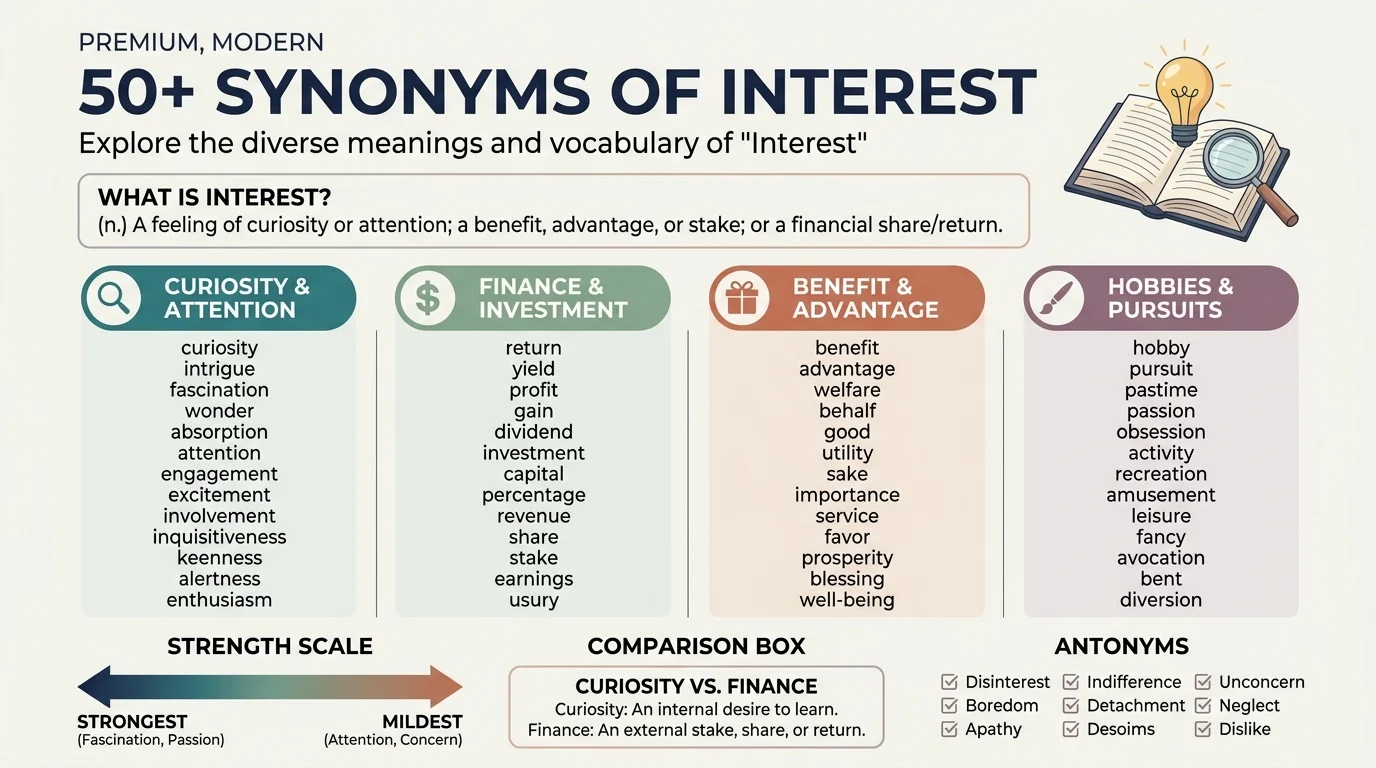
Have you ever needed to describe curiosity, a financial stake, or a benefit but felt that “interest” was too broad or repetitive? You want to capture the specific type of attention, investment, or advantage, and the word “interest” comes to mind. Choosing the right synonym for “interest” can transform a basic statement into a precise expression of curiosity, concern, or benefit. This guide explores the best synonyms of interest, explaining exactly which word to use and when.
Quick Ans: “Interest” means curiosity or attention, a financial stake or charge, or a benefit or advantage. For curiosity, choose curiosity, fascination, or attention. For financial contexts, use stake, investment, or return. For benefit, use advantage, benefit, or concern. For hobbies, use pastime, hobby, or pursuit.
Meaning, Tone, and Context
Understanding the core meaning of “interest” is the first step to using it effectively.
Simple Definition: The feeling of wanting to know or learn about something; a financial stake or charge; a benefit or advantage; a hobby or pastime.
Part of Speech: Noun and verb.
Overall Tone: Neutral to positive. It can indicate curiosity, investment, or benefit.
Formality Level: Neutral. The word works in most contexts, from casual to formal.
Common Uses: Native English speakers use it in personal contexts (“interest in art”), finance (“interest rate”), business (“conflict of interest”), and hobbies (“special interest”).
Word Forms: Related words include the adjective interested, the adjective interesting, and the adverb interestingly.
When and How to Use “Interest”
“Interest” is the perfect choice when you want to describe curiosity, investment, or benefit. Here are seven realistic examples.
Personal: “She has a strong interest in classical music.”
Financial: “The bank offers a 5% interest rate on savings.”
Professional: “He declared a conflict of interest before the vote.”
Business: “The company has a vested interest in the outcome.”
Academic: “The study examines student interest in science.”
Hobby: “Photography is his main interest outside work.”
Social Media: “This topic has generated a lot of interest online.”
Best Synonyms of “Interest”
No synonym is identical in every situation. Here is your guide to the best replacement for “interest” based on your writing context.
For Curiosity and Attention
Most Direct: Curiosity means a strong desire to know. “Her curiosity about the topic was evident.”
Fascination: Fascination means intense interest. “His fascination with space began in childhood.”
Attention: Attention means notice or awareness. “The exhibit drew a lot of attention.”
Engagement: Engagement means active involvement. “The audience showed great engagement.”
For Financial Contexts
Stake: Stake means a financial share. “He has a stake in the company.”
Investment: Investment means money put into something. “The investment yielded high returns.”
Return: Return means profit from investment. “The return on the bond was attractive.”
Charge: Charge means a fee or cost. “The interest charge was added to the balance.”
For Benefit and Advantage
Advantage: Advantage means a benefit. “It is in your advantage to apply early.”
Benefit: Benefit means a positive outcome. “The policy works to the benefit of all.”
Concern: Concern means a matter of importance. “Safety is our primary concern.”
Welfare: Welfare means well-being. “The decision affects the welfare of the community.”
For Hobbies and Pastimes
Pastime: Pastime means an activity done for enjoyment. “Reading is her favorite pastime.”
Hobby: Hobby means an activity done for pleasure. “His hobby is woodworking.”
Pursuit: Pursuit means an activity pursued. “Her pursuit of photography began young.”
Avocation: Avocation means a hobby. “Teaching was his avocation.”
When Not to Use “Interest”
Using “interest” can sound wrong or awkward in certain situations.
When You Mean “Curiosity”: “Interest” is broader. “Curiosity” is specific.
Better Choice: Curiosity. “Her curiosity led her to explore.”
When You Mean “Benefit”: “Interest” can be vague. “Benefit” is clearer.
Better Choice: Benefit. “The change was to his benefit.”
When It Sounds Too Formal: In casual conversation, “interest” can sound stiff.
Better Choice: Like or enjoy. “I like photography.”
Words Commonly Confused With “Interest”
| Word | Difference | When to Use | Example |
|---|---|---|---|
| Curiosity | Desire to know | Personal and intellectual | “Her curiosity was endless.” |
| Hobby | Leisure activity | Personal and casual | “His hobby is painting.” |
| Stake | Financial share | Business and finance | “He has a stake in the firm.” |
| Benefit | Positive outcome | General and formal | “The benefit is clear.” |
| Attention | Notice or focus | General and formal | “The attention was welcome.” |
| Concern | Matter of importance | Formal and serious | “Safety is a concern.” |
Best Synonyms of “Interest” by Context
| Context | Best Synonym | Why It Works | Example |
|---|---|---|---|
| Formal writing | Concern | Formal and precise | “Safety is our primary concern.” |
| Academic writing | Engagement | Standard in research | “Student engagement was measured.” |
| Professional | Stake | Business and investment | “He has a stake in the project.” |
| Business | Advantage | Business and strategy | “It is to our advantage to act.” |
| Financial | Investment | Finance and banking | “The investment paid off.” |
| Casual | Hobby | Simple and natural | “Photography is his hobby.” |
| Emotional | Fascination | Emotional and personal | “Her fascination with art grew.” |
How to Choose the Best Synonym of “Interest”
Choosing the right word is a simple decision. Answer these questions.
What type of interest am I describing? For curiosity, use curiosity or fascination. And For finance, use stake or investment. For benefit, use advantage or benefit. For hobbies, use hobby or pastime.
What is my audience? For a formal report, use concern or stake. For a friend, use hobby or curiosity.
What is my purpose? Are you describing curiosity, investment, or benefit? The correct synonym depends entirely on this.
What is the emotional strength? Fascination is stronger. Attention is milder. Pick the one that matches your message.
Real Life Examples of “Interest”
School: Basic: “The student has interest.” Improved: “The student shows curiosity about the topic.”
College: Basic: “The study examines interest.” Improved: “The study examines student engagement.”
Workplace: Basic: “He has an interest in the project.” Improved: “He has a stake in the project.”
Business: Basic: “The interest is clear.” Improved: “The benefit is clear.”
Email: Basic: “Thank you for your interest.” Improved: “Thank you for your attention.”
Conversation: Basic: “That is my interest.” Improved: “That is my hobby.”
Storytelling: Basic: “Her interest grew.” Improved: “Her fascination grew.”
Top 10 Synonyms of “Interest”
| Synonym | Simple Meaning | Best Used For | Example Sentence |
|---|---|---|---|
| Curiosity | Desire to know | Personal and intellectual | “Her curiosity was evident.” |
| Fascination | Intense interest | Emotional and personal | “His fascination with space grew.” |
| Attention | Notice or focus | General and formal | “The exhibit drew attention.” |
| Stake | Financial share | Business and finance | “He has a stake in the company.” |
| Investment | Money put into something | Finance and banking | “The investment paid off.” |
| Advantage | Benefit | Business and strategy | “It is to our advantage.” |
| Benefit | Positive outcome | General and formal | “The benefit is clear.” |
| Hobby | Leisure activity | Personal and casual | “Her hobby is painting.” |
| Pastime | Activity for enjoyment | Personal and casual | “Reading is his pastime.” |
| Engagement | Active involvement | Academic and professional | “Student engagement was high.” |
Synonyms of “Interest” by Usage
Professional vs. Personal Synonyms
In the workplace, choose stake, concern, or engagement. With friends, use hobby, curiosity, or fascination.
Formal vs. Conversational Synonyms
For formal writing, use concern, advantage, or engagement. For casual conversations, use hobby, curiosity, or fascination.
Academic Synonyms
For research and essays, choose engagement for involvement, curiosity for learning, and concern for implications.
Professional and Business Synonyms
For maximum impact, choose stake for investment, advantage for strategy, and benefit for outcomes.
Creative and Literary Synonyms
To add emotion and imagery, choose fascination, curiosity, or passion. These words create atmosphere.
Slang or Modern Synonyms
In modern American slang, into, vibe, or thing are common. For example, “I am into photography.” These are casual and should be avoided in formal writing.
Strongest to Mildest Synonyms
Mild: attention, regard, notice
Moderate: interest, curiosity, concern
Strong: fascination, engagement, stake
Very Strong: passion, obsession, investment
Emotional vs. Neutral Synonyms
Emotional Synonyms: Fascination, passion, curiosity. These words hint at strong feeling. Use them when you want to evoke emotion.
Neutral Synonyms: Interest, attention, concern. These words communicate factual information.
Antonyms of “Interest”
| Antonym | Meaning | Example Sentence |
|---|---|---|
| Boredom | Lack of interest | “The boredom was obvious.” |
| Apathy | Lack of concern | “The apathy of the voters was concerning.” |
| Indifference | Lack of interest | “His indifference hurt her.” |
| Disinterest | Lack of interest | “The disinterest was disappointing.” |
| Unconcern | Lack of concern | “Her unconcern was surprising.” |
| Inattention | Lack of attention | “Inattention led to mistakes.” |
| Neglect | Failure to care | “The neglect of the garden was evident.” |
| Disregard | Lack of attention | “Her disregard for the rules was punished.” |
| Detachment | Lack of involvement | “His detachment was noticeable.” |
| Aloofness | Distance and lack of interest | “Her aloofness made her hard to know.” |
| Disdain | Lack of respect | “His disdain for the idea was clear.” |
| Contempt | Lack of respect | “The contempt in his voice was obvious.” |
| Scorn | Lack of respect | “She looked at him with scorn.” |
| Aversion | Strong dislike | “His aversion to risk was strong.” |
| Repulsion | Strong dislike | “The repulsion was evident.” |
Comparison: “Interest” vs Similar Words
Interest vs. Curiosity
Main Difference: “Interest” is broader. “Curiosity” is a desire to know.
Which Is Stronger? “Curiosity” is more specific.
Which Is More Formal? Both are neutral.
When to Use Each: Use “curiosity” for wanting to know. Use “interest” for general contexts.
Examples:
Interest: “She has an interest in art.”
Curiosity: “Her curiosity led her to explore.”
Interest vs. Hobby
Main Difference: “Interest” is broader. “Hobby” is a leisure activity.
Which Is Stronger? “Hobby” is more specific.
Which Is More Formal? Both are neutral.
When to Use Each: Use “hobby” for leisure. Use “interest” for general contexts.
Examples:
Interest: “His interest in music is strong.”
Hobby: “Photography is his hobby.”
Interest vs. Stake
Main Difference: “Interest” is broader. “Stake” is a financial share.
Which Is Stronger? “Stake” is more specific to finance.
Which Is More Formal? Both are formal.
When to Use Each: Use “stake” for business. Use “interest” for general contexts.
Examples:
Interest: “She has an interest in the company.”
Stake: “He has a stake in the company.”
Interest vs. Benefit
Main Difference: “Interest” is broader. “Benefit” is a positive outcome.
Which Is Stronger? “Benefit” is more specific.
Which Is More Formal? Both are formal.
When to Use Each: Use “benefit” for advantages. Use “interest” for general contexts.
Examples:
Interest: “It is in your interest to apply.”
Benefit: “The benefit is clear.”
Interest vs. Attention
Main Difference: “Interest” is broader. “Attention” is focus.
Which Is Stronger? “Attention” is more specific to focus.
Which Is More Formal? Both are neutral.
When to Use Each: Use “attention” for focus. Use “interest” for general contexts.
Examples:
Interest: “The topic has generated interest.”
Attention: “The exhibit drew attention.”
Interest vs. Concern
Main Difference: “Interest” is broader. “Concern” is worry or importance.
Which Is Stronger? “Concern” is more serious.
Which Is More Formal? Both are formal.
When to Use Each: Use “concern” for importance. Use “interest” for general contexts.
Examples:
Interest: “He has an interest in the outcome.”
Concern: “Safety is our primary concern.”
Common Phrases and Expressions with “Interest”
Phrase: Take an interest
Meaning: Become interested.
Example Sentence: “She took an interest in the project.”
Phrase: Conflict of interest
Meaning: A situation where personal interests conflict with professional duties.
Example Sentence: “He declared a conflict of interest.”
Phrase: In the interest of
Meaning: For the sake of.
Example Sentence: “In the interest of safety, we canceled the event.”
Phrase: Vested interest
Meaning: A personal stake in something.
Example Sentence: “She has a vested interest in the outcome.”
Phrase: Interest rate
Meaning: The percentage charged for borrowing.
Example Sentence: “The interest rate is rising.”
Phrase: Special interest
Meaning: A particular area of interest.
Example Sentence: “His special interest is ancient history.”
Common Mistakes to Avoid
Mistake 1: Using “interest” when you mean “curiosity”.
Incorrect: “His interest was insatiable.”
Better: “His curiosity was insatiable.”
Why: “Curiosity” is more specific.
Mistake 2: Using “interest” when you mean “hobby”.
Incorrect: “Fishing is his interest.”
Better: “Fishing is his hobby.”
Why: “Hobby” is for leisure activities.
Mistake 3: Overusing “interest” in conversation.
Incorrect: “That is my interest.”
Better: “That is my hobby.”
Why: “Hobby” sounds more natural.
Mistake 4: Using “interest” when you mean “stake”.
Incorrect: “He has an interest in the company.”
Better: “He has a stake in the company.”
Why: “Stake” is for finance.
Mistake 5: Using “interest” when you mean “benefit”.
Incorrect: “It is in your interest to apply.”
Better: “It is to your benefit to apply.”
Why: “Benefit” is clearer.
Frequently Asked Questions
1. What are the best synonyms of “interest”?
The best synonyms depend on your context. For curiosity, choose curiosity or fascination. And For finance, use stake or investment. For benefit, use advantage or benefit. For hobbies, use hobby or pastime.
2. What are the best formal synonyms of “interest”?
The best formal synonyms are concern, stake, and engagement. These words are suitable for academic papers, professional reports, and business communications.
3. What are common informal synonyms of “interest”?
For informal settings, use hobby, curiosity, or fascination. These alternatives sound more natural in everyday conversation.
4. What is another word for “interest” in professional writing?
In professional writing, stake is an excellent choice. It conveys investment. Engagement is also strong for involvement.
5. What is the difference between “interest” and “curiosity”?
“Interest” is broader. “Curiosity” is a desire to know. Use “curiosity” for wanting to learn.
6. What is the opposite of “interest”?
The most direct opposites (antonyms) of interest are boredom, apathy, and indifference. These words describe a lack of attention or concern.
Conclusion
“Interest” is a versatile and essential word for describing curiosity, investment, and benefit. The term is neutral and widely accepted in most contexts, yet it can sound too broad for specific descriptions or too formal for casual conversation. The best choice among the synonyms of interest depends entirely on your audience, tone, and purpose. Remember, no single synonym works perfectly in every situation. Your goal is to choose the word that communicates your message with the most clarity and impact. A practical tip for your vocabulary growth is to pay attention to how writers describe curiosity and investment and practice using different synonyms in your writing.










1 thought on “50+ Synonyms of Interest: Meanings, Uses, Examples, and Best Alternatives 2026”