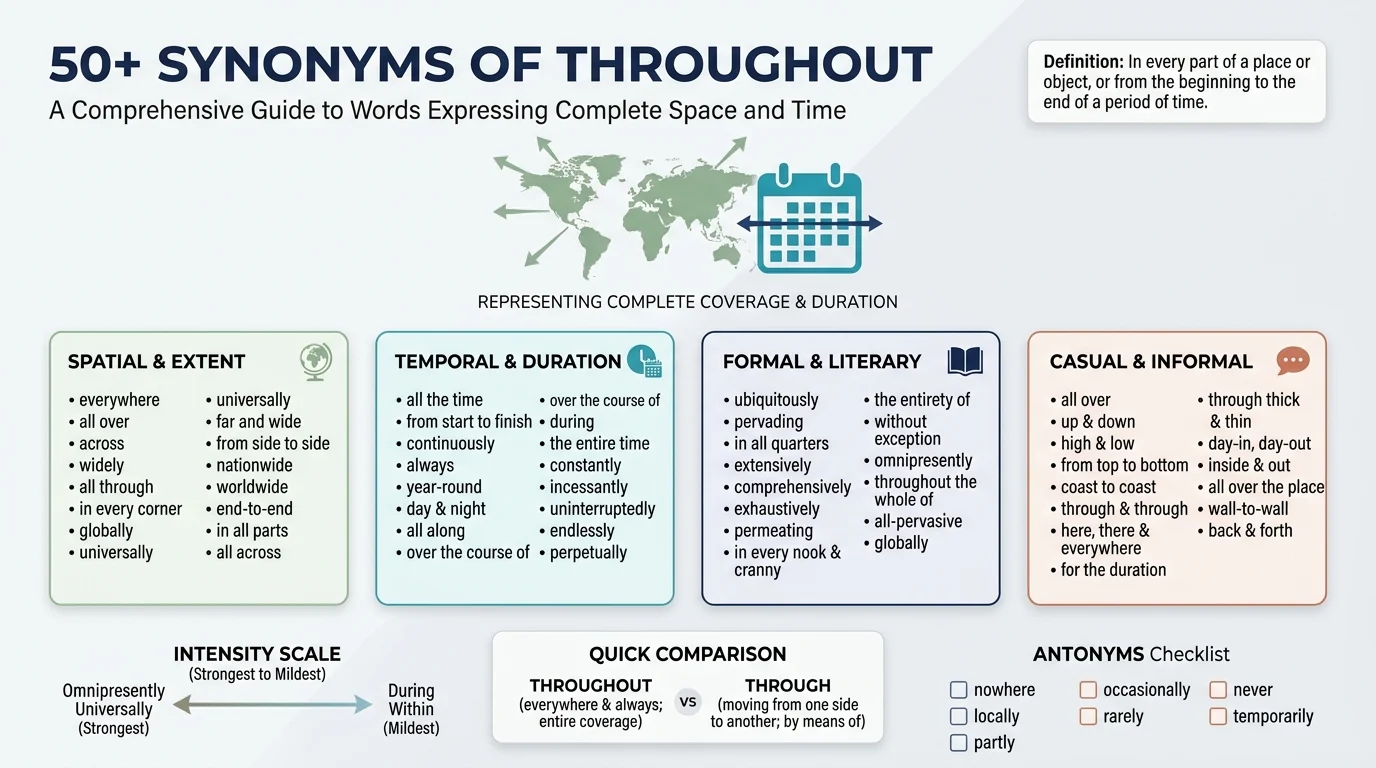
Have you ever needed to describe something that extends across an entire area or period but felt that “throughout” was too simple or repetitive? You want to capture the sense of complete coverage, duration, or pervasiveness, and the word “throughout” comes to mind. Choosing the right synonym for “throughout” can transform a basic statement into a precise expression of extent, duration, or universality. This guide explores the best synonyms of throughout, explaining exactly which word to use and when.
Quick Ans: “Throughout” means in every part of a place or during the whole of a period. For spatial coverage, choose everywhere in, all over, or across. For temporal duration, use during the entire, for the whole, or all through. For emphasis, use pervasively or universally. For formal contexts, use extensively or comprehensively.
Meaning, Tone, and Context
Understanding the core meaning of “throughout” is the first step to using it effectively.
Simple Definition: In every part of a place or thing; during the whole of a period of time.
Part of Speech: Preposition and adverb.
Overall Tone: Neutral. It is a functional word indicating complete coverage or duration.
Formality Level: Neutral. The word works in most contexts.
Common Uses: Native English speakers use it in spatial contexts (“throughout the building”), temporal contexts (“throughout the year”), and abstract contexts (“throughout history”).
Word Forms: Related words include through and out (the components of the compound).
When and How to Use “Throughout”
“Throughout” is the perfect choice when you want to describe complete coverage or duration. Here are seven realistic examples.
Spatial: “The fire spread throughout the building.”
Temporal: “She worked on the project throughout the summer.”
Historical: “Throughout history, people have sought meaning.”
Professional: “The policy applies throughout the organization.”
Academic: “The theme appears throughout the novel.”
Personal: “He remained calm throughout the ordeal.”
Social Media: “The festival was celebrated throughout the city.”
Best Synonyms of “Throughout”
No synonym is identical in every situation. Here is your guide to the best replacement for “throughout” based on your writing context.
For Spatial Coverage
Most Direct: All over means in every part. “There were flowers all over the garden.”
Everywhere in: Everywhere in means in every part of a place. “There was graffiti everywhere in the city.”
Across: Across means from one side to the other. “The news spread across the country.”
Over: Over means covering a surface. “There was a blanket of snow over the field.”
For Temporal Duration
During the entire: During the entire means for the whole period. “He was quiet during the entire meeting.”
For the whole: For the whole means for the entire duration. “She stayed for the whole concert.”
All through: All through means during the entire time. “He slept all through the night.”
From start to finish: From start to finish means for the entire duration. “She was engaged from start to finish.”
For Abstract and Formal Contexts
Extensively: Extensively means over a wide range. “The topic was discussed extensively.”
Comprehensively: Comprehensively means completely. “The issue was studied comprehensively.”
Universally: Universally means in all cases. “The rule is applied universally.”
Pervasively: Pervasively means spreading throughout. “The influence was felt pervasively.”
For Emphasis
Everywhere: Everywhere means in all places. “There were signs everywhere.”
All over: All over means in all parts. “There were papers all over the desk.”
Far and wide: Far and wide means over a large area. “They searched far and wide.”
When Not to Use “Throughout”
Using “throughout” can sound wrong or awkward in certain situations.
When You Mean “During”: “Throughout” implies complete duration. “During” is less emphatic.
Better Choice: During or in. “During the meeting, she was quiet.”
When You Mean “Across”: “Throughout” implies every part. “Across” is more general.
Better Choice: Across or over. “The bridge goes across the river.”
When It Sounds Too Formal: In casual conversation, “throughout” can sound formal.
Better Choice: All over or during. “I looked all over the house.”
Words Commonly Confused With “Throughout”
| Word | Difference | When to Use | Example |
|---|---|---|---|
| During | At some point in a period | Time periods | “During the meeting.” |
| Across | From one side to another | Spatial crossing | “Across the bridge.” |
| Over | Above or covering | Spatial coverage | “Over the hill.” |
| All over | In every part | Casual and spatial | “All over the house.” |
| Everywhere | In all places | General and spatial | “Everywhere in the city.” |
| Through | From one end to another | Movement and duration | “Through the tunnel.” |
Best Synonyms of “Throughout” by Context
| Context | Best Synonym | Why It Works | Example |
|---|---|---|---|
| Formal writing | Comprehensively | Formal and complete | “The issue was studied comprehensively.” |
| Academic writing | Extensively | Standard in research | “The topic was discussed extensively.” |
| Professional | Across | Professional and spatial | “The policy applies across the organization.” |
| Business | Universally | Business and consistent | “The rule is applied universally.” |
| Historical | Throughout | Standard in historical context | “Throughout history.” |
| Casual | All over | Simple and natural | “The toys were all over the floor.” |
| Emotional | From start to finish | Emphasis on duration | “She was engaged from start to finish.” |
How to Choose the Best Synonym of “Throughout”
Choosing the right word is a simple decision. Answer these questions.
What type of throughout am I describing? For spatial, use all over or across. And For temporal, use during the entire or all through. For abstract, use extensively or comprehensively.
What is my audience? For a formal report, use comprehensively or extensively. For a friend, use all over or during.
What is my purpose? Are you describing space, time, or emphasis? The correct synonym depends entirely on this.
What is the emotional strength? From start to finish is stronger for duration. All over is casual. Pick the one that matches your message.
Real Life Examples of “Throughout”
School: Basic: “The rule applies throughout the school.” Improved: “The rule applies across the school.”
College: Basic: “The theme appears throughout the novel.” Improved: “The theme appears extensively in the novel.”
Workplace: Basic: “The policy applies throughout the company.” Improved: “The policy applies across the company.”
Business: Basic: “The change was felt throughout the industry.” Improved: “The change was felt universally in the industry.”
Email: Basic: “I was available throughout the day.” Improved: “I was available all through the day.”
Conversation: Basic: “There were flowers throughout the garden.” Improved: “There were flowers all over the garden.”
Storytelling: Basic: “He remained calm throughout the crisis.” Improved: “He remained calm from start to finish of the crisis.”
Top 10 Synonyms of “Throughout”
| Synonym | Simple Meaning | Best Used For | Example Sentence |
|---|---|---|---|
| All over | In every part | Casual and spatial | “The toys were all over the floor.” |
| Across | From one side to another | Spatial and professional | “The news spread across the country.” |
| Everywhere in | In every part of | General and spatial | “There was graffiti everywhere in the city.” |
| During the entire | For the whole period | Temporal and formal | “He was quiet during the entire meeting.” |
| For the whole | For the entire duration | Temporal and general | “She stayed for the whole concert.” |
| All through | During the entire time | Temporal and casual | “He slept all through the night.” |
| Extensively | Over a wide range | Formal and academic | “The topic was discussed extensively.” |
| Comprehensively | Completely | Formal and thorough | “The issue was studied comprehensively.” |
| Universally | In all cases | Formal and logical | “The rule is applied universally.” |
| From start to finish | For the entire duration | Emphasis and temporal | “She was engaged from start to finish.” |
Synonyms of “Throughout” by Usage
Professional vs. Personal Synonyms
In the workplace, choose across, universally, or comprehensively. With friends, use all over, during, or all through.
Formal vs. Conversational Synonyms
For formal writing, use comprehensively, extensively, or universally. For casual conversations, use all over, during, or all through.
Academic Synonyms
For research and essays, choose extensively for discussion, comprehensively for study, and universally for rules.
Professional and Business Synonyms
For maximum impact, choose across for organizations, universally for policies, and comprehensively for analysis.
Creative and Literary Synonyms
To add emphasis, choose from start to finish, all through, or everywhere. These words create atmosphere.
Slang or Modern Synonyms
In modern American slang, all over, everywhere, or the whole time are common. For example, “He was talking the whole time.” These are casual and should be avoided in formal writing.
Strongest to Mildest Synonyms
Mild: during, in, over
Moderate: throughout, across, all over
Strong: extensively, comprehensively, everywhere in
Very Strong: universally, from start to finish, pervasively
Emotional vs. Neutral Synonyms
Emotional Synonyms: From start to finish, all through. These words hint at complete involvement. Use them when you want to evoke feeling.
Neutral Synonyms: Throughout, across, during. These words communicate factual information.
Antonyms of “Throughout”
| Antonym | Meaning | Example Sentence |
|---|---|---|
| Partially | Only in part | “The room was partially cleaned.” |
| Partly | To some extent | “The project was partly completed.” |
| In some places | Not everywhere | “There were signs in some places.” |
| Occasionally | From time to time | “He visited occasionally.” |
| Sometimes | Now and then | “She sometimes works late.” |
| Sporadically | At irregular intervals | “The rain fell sporadically.” |
| Intermittently | With pauses | “The signal was intermittent.” |
| Locally | In a specific area | “The impact was felt locally.” |
| Regionally | In a region | “The policy applies regionally.” |
| Briefly | For a short time | “He stayed briefly.” |
| Temporarily | For a limited time | “The road was temporarily closed.” |
| Nowhere | In no place | “The item was nowhere to be found.” |
| Not at all | In no way | “He was not at all interested.” |
| Rarely | Seldom | “She rarely complains.” |
| Seldom | Not often | “He seldom visits.” |
Comparison: “Throughout” vs Similar Words
Throughout vs. During
Main Difference: “Throughout” means for the entire period. “During” means at some point in the period.
Which Is Stronger? “Throughout” is stronger for completeness.
Which Is More Formal? Both are neutral.
When to Use Each: Use “throughout” for complete duration. Use “during” for general time.
Examples:
Throughout: “She worked throughout the night.”
During: “She worked during the night.”
Throughout vs. Across
Main Difference: “Throughout” means in every part. “Across” means from one side to another.
Which Is Stronger? “Throughout” is stronger for completeness.
Which Is More Formal? Both are neutral.
When to Use Each: Use “throughout” for every part. Use “across” for crossing.
Examples:
Throughout: “The news spread throughout the country.”
Across: “The bridge goes across the river.”
Throughout vs. All over
Main Difference: “Throughout” is formal. “All over” is casual.
Which Is Stronger? They are similar.
Which Is More Formal? “Throughout” is more formal.
When to Use Each: Use “throughout” in formal writing. Use “all over” in casual conversation.
Examples:
Throughout: “The fire spread throughout the building.”
All over: “The toys were all over the floor.”
Throughout vs. Everywhere
Main Difference: “Throughout” is about coverage. “Everywhere” is about all places.
Which Is Stronger? They are similar.
Which Is More Formal? Both are neutral.
When to Use Each: Use “throughout” for a specific area. Use “everywhere” for all places.
Examples:
Throughout: “There was silence throughout the room.”
Everywhere: “There was silence everywhere.”
Throughout vs. Extensively
Main Difference: “Throughout” is spatial or temporal. “Extensively” is about range.
Which Is Stronger? “Extensively” is more about breadth.
Which Is More Formal? Both are formal.
When to Use Each: Use “extensively” for discussion. Use “throughout” for space or time.
Examples:
Throughout: “The theme appears throughout the novel.”
Extensively: “The topic was discussed extensively.”
Throughout vs. Comprehensively
Main Difference: “Throughout” is spatial or temporal. “Comprehensively” is about completeness.
Which Is Stronger? “Comprehensively” is more about thoroughness.
Which Is More Formal? Both are formal.
When to Use Each: Use “comprehensively” for study. Use “throughout” for space or time.
Examples:
Throughout: “The policy applies throughout the organization.”
Comprehensively: “The issue was studied comprehensively.”
Common Phrases and Expressions with “Throughout”
Phrase: Throughout history
Meaning: During the entire course of history.
Example Sentence: “Throughout history, people have sought freedom.”
Phrase: Throughout the year
Meaning: During the whole year.
Example Sentence: “The festival is celebrated throughout the year.”
Phrase: Throughout the world
Meaning: In every part of the world.
Example Sentence: “The brand is recognized throughout the world.”
Phrase: Throughout the day
Meaning: During the entire day.
Example Sentence: “She was busy throughout the day.”
Phrase: Throughout the building
Meaning: In every part of the building.
Example Sentence: “The alarm sounded throughout the building.”
Phrase: Throughout the process
Meaning: During the entire process.
Example Sentence: “He remained calm throughout the process.”
Common Mistakes to Avoid
Mistake 1: Using “throughout” when you mean “during”.
Incorrect: “Throughout the meeting, I was tired.”
Better: “During the meeting, I was tired.”
Why: “During” is more natural for a single event.
Mistake 2: Using “throughout” when you mean “across”.
Incorrect: “The bridge goes throughout the river.”
Better: “The bridge goes across the river.”
Why: “Across” is for crossing.
Mistake 3: Overusing “throughout” in conversation.
Incorrect: “I looked throughout the house.”
Better: “I looked all over the house.”
Why: “All over” sounds more natural.
Mistake 4: Using “throughout” when you mean “everywhere”.
Incorrect: “I looked throughout for my keys.”
Better: “I looked everywhere for my keys.”
Why: “Everywhere” is for all places.
Mistake 5: Using “throughout” when you mean “extensively”.
Incorrect: “The topic was discussed throughout.”
Better: “The topic was discussed extensively.”
Why: “Extensively” is for depth.
Frequently Asked Questions
1. What are the best synonyms of “throughout”?
The best synonyms depend on your context. For spatial, choose all over or across.And For temporal, use during the entire or all through. For formal, use extensively or comprehensively.
2. What are the best formal synonyms of “throughout”?
The best formal synonyms are comprehensively, extensively, and universally. These words are suitable for academic papers, professional reports, and business communications.
3. What are common informal synonyms of “throughout”?
For informal settings, use all over, during, or all through. These alternatives sound more natural in everyday conversation.
4. What is another word for “throughout” in professional writing?
In professional writing, across is an excellent choice. It conveys coverage. Universally is also strong for rules.
5. What is the difference between “throughout” and “during”?
“Throughout” means for the entire period. “During” means at some point in the period. Use “throughout” for completeness and “during” for general time.
6. What is the opposite of “throughout”?
The most direct opposites (antonyms) of throughout are partially, partly, and occasionally. These words describe incomplete coverage or duration.
Conclusion
“Throughout” is a precise and essential word for describing complete coverage or duration. The term is neutral and widely accepted in most contexts, yet it can sound too formal for casual conversation or too broad for specific descriptions. The best choice among the synonyms of throughout depends entirely on your audience, tone, and purpose. Remember, no single synonym works perfectly in every situation. Your goal is to choose the word that communicates your message with the most clarity and impact. A practical tip for your vocabulary growth is to pay attention to how writers describe coverage and duration and practice using different synonyms in your writing.










3 thoughts on “50+ Synonyms of Throughout: Meanings, Uses, Examples, and Best Alternatives 2026”