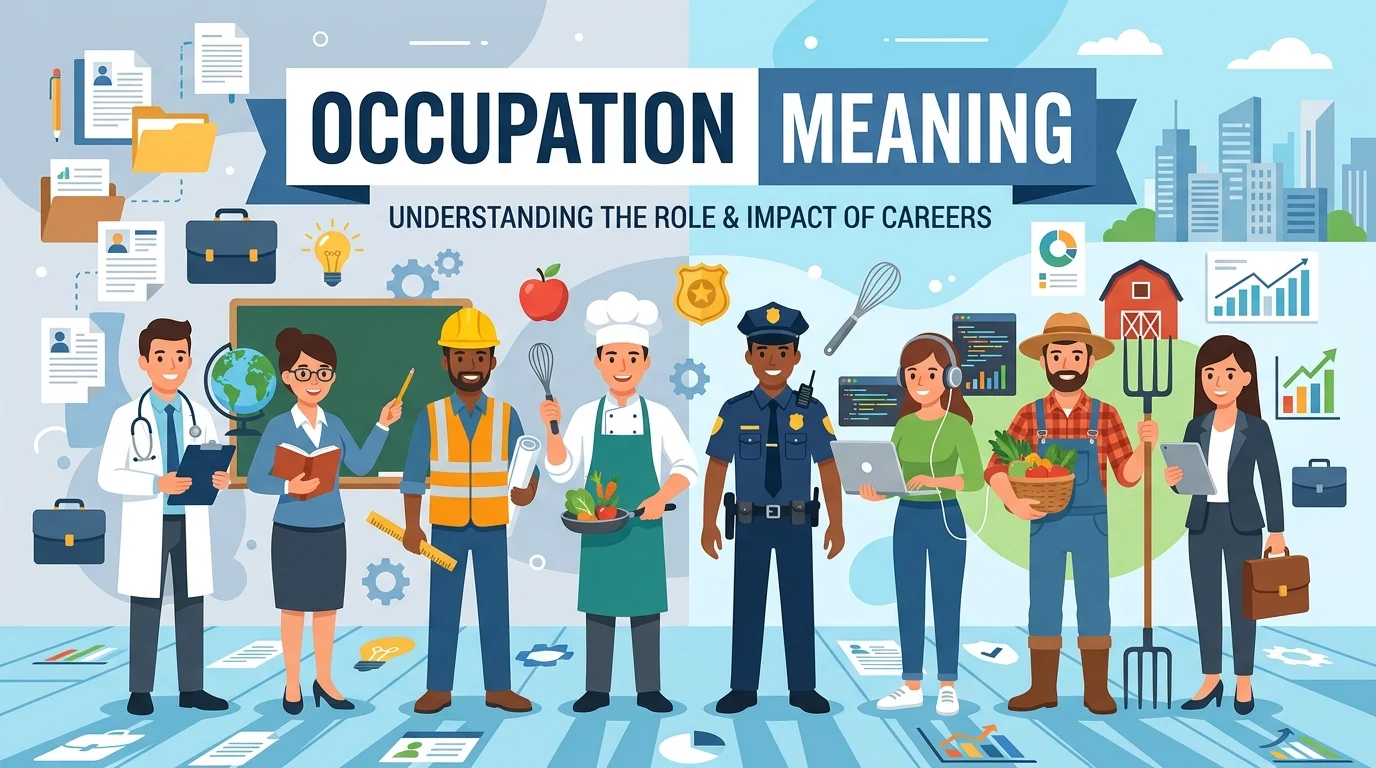
Quick Ans: Occupation refers to a person’s job, profession, trade, or regular work that they do to earn a living. It is commonly requested on job applications, government forms, school documents, banking forms, and official records. In everyday conversations, occupation simply means what someone does for work.
If you’ve ever filled out a job application, opened a bank account, applied for a passport, or completed an online form, you’ve probably seen a field asking for your occupation. While the word is common, many people wonder exactly what it means and how it differs from terms like job, career, profession, or employment.
In simple terms, your occupation is the type of work you regularly perform. It describes how you earn your income or spend your working life. Whether you’re a teacher, engineer, doctor, student, freelancer, business owner, or homemaker, your occupation helps identify your primary role.
This guide explains the occupation meaning, its definition, examples, common types, real-life usage, differences from similar terms, where you’ll encounter it, and frequently asked questions.
Quick Answer Box
| Topic | Answer |
|---|---|
| Meaning | A person’s regular job, profession, trade, or work |
| Type | General English vocabulary |
| Common Usage | Forms, resumes, applications, interviews, official documents |
| Examples | Teacher, doctor, engineer, student, accountant, driver |
| Purpose | Identifies what a person does for work |
What Does Occupation Mean?
An occupation is the work or activity that a person regularly performs to earn a living or contribute to society.
In everyday English, occupation simply answers the question:
“What do you do for a living?”
For example:
- Teacher
- Nurse
- Software Engineer
- Electrician
- Farmer
- Accountant
- Police Officer
- Business Owner
Each of these is considered an occupation.
Full Definition
The word occupation refers to a person’s principal work, employment, profession, or trade.
Unlike a temporary task, an occupation usually represents your regular source of income or your long-term work role.
For example:
- A doctor practices medicine as their occupation.
- A carpenter builds furniture as their occupation.
- A pilot flies aircraft as their occupation.
Even if someone changes jobs, their occupation may remain within the same field.
Context and Usage
The word occupation appears in many situations.
Government Forms
Many government forms ask:
Occupation: __________
You simply enter your current profession or job.
Example:
Occupation: Teacher
Bank Applications
Banks often request your occupation to verify employment information.
Example:
Occupation: Accountant
Job Applications
Employers may ask about your current or previous occupation.
Example:
Occupation: Marketing Manager
School Forms
Parents may be asked to provide their occupations.
Example:
Father’s Occupation: Civil Engineer
Mother’s Occupation: Doctor
Passport and Visa Applications
Many immigration documents include an occupation field.
Example:
Occupation: Software Developer
Types of Occupations
Occupations can be grouped into several categories.
Professional Occupations
Examples include:
- Doctor
- Lawyer
- Engineer
- Architect
- Accountant
- Pharmacist
These usually require specialized education or professional training.
Skilled Trades
Examples include:
- Electrician
- Plumber
- Welder
- Mechanic
- Carpenter
These occupations often involve vocational training or apprenticeships.
Business Occupations
Examples include:
- Entrepreneur
- Business Owner
- Store Manager
- Sales Manager
Technical Occupations
Examples include:
- Software Developer
- Web Designer
- Network Engineer
- Data Analyst
Service Occupations
Examples include:
- Chef
- Waiter
- Hairdresser
- Driver
- Receptionist
Creative Occupations
Examples include:
- Writer
- Photographer
- Graphic Designer
- Musician
- Actor
Real-Life Examples
Example 1
Question: What is your occupation?
Answer: I’m a teacher.
Example 2
Question: Please enter your occupation.
Answer: Software Engineer
Example 3
Interviewer: What’s your current occupation?
Candidate: I’m a registered nurse.
Example 4
Bank Form
Occupation:
Business Owner
Example 5
Passport Application
Occupation:
Mechanical Engineer
Occupation vs Job
These words are related but not identical.
Job
A job is a specific position you currently hold.
Example:
Cashier at a grocery store.
Occupation
Occupation refers to your broader type of work.
Example:
Retail Worker.
A person may change jobs while remaining in the same occupation.
Occupation vs Profession
A profession usually requires specialized education, certification, or licensing.
Examples:
- Doctor
- Lawyer
- Chartered Accountant
Every profession is an occupation, but not every occupation is considered a profession.
Occupation vs Career
A career is the long-term journey of your working life.
An occupation is the type of work you perform.
Example:
Career: Healthcare
Occupation: Registered Nurse
Common Occupation Examples
Some of the most common occupations include:
- Teacher
- Doctor
- Nurse
- Police Officer
- Firefighter
- Software Developer
- Civil Engineer
- Accountant
- Electrician
- Plumber
- Mechanic
- Driver
- Chef
- Farmer
- Sales Representative
- Business Owner
- Student
- Homemaker
- Freelancer
- Graphic Designer
Why Occupation Matters
Knowing someone’s occupation helps organizations:
- Verify employment
- Understand professional background
- Process applications
- Conduct surveys
- Prepare statistics
- Determine eligibility for certain services
It also helps employers understand an applicant’s work experience.
Common Mistakes
Many people confuse occupation with:
Employer
Occupation:
Teacher
Employer:
Lincoln High School
Company Name
Occupation:
Software Engineer
Company:
Employment Status
Occupation:
Accountant
Employment Status:
Full-time
These are different pieces of information.
When to Use the Word Occupation
Use occupation when referring to:
- Employment forms
- Resume information
- Government records
- Visa applications
- Banking documents
- Insurance forms
- Surveys
- Official interviews
In casual conversation, people often simply ask:
“What do you do?”
instead of
“What is your occupation?”
Usage Tips
To use the word correctly:
- Describe your main work role.
- Use a clear job title.
- Avoid listing your employer instead.
- Keep your answer accurate and up to date.
- Use official titles when completing legal or government forms.
Frequently Asked Questions
What does occupation mean?
Occupation refers to a person’s regular job, profession, trade, or work.
Is occupation the same as a job?
Not exactly. A job is a specific position, while occupation refers to a broader category of work.
What should I write for occupation on a form?
Write your current job or profession, such as Teacher, Engineer, Nurse, Student, or Business Owner.
Can a student have an occupation?
Yes. If requested, many students simply write Student.
Is homemaker an occupation?
Yes. Homemaker is commonly accepted as an occupation on many forms.
What is the difference between occupation and profession?
A profession usually requires specialized education, while occupation includes all kinds of work.
Why do banks ask for occupation?
Banks use occupation information to help verify employment and understand a customer’s financial profile.
Can I change my occupation?
Yes. Your occupation changes whenever you move into a different type of work.
Is freelancer an occupation?
Yes. Freelancer is a valid occupation for self-employed professionals.
Why is occupation important?
Occupation helps identify what a person does for work and is commonly required for employment, banking, education, and government records.
Conclusion
The occupation meaning is simple: it refers to the regular work, profession, trade, or job a person performs. Whether you’re completing official paperwork, applying for a job, opening a bank account, or introducing yourself professionally, your occupation identifies the kind of work you do.
While people often use job, career, and profession interchangeably with occupation, each term has a slightly different meaning. Understanding these differences can help you complete forms accurately and communicate more clearly in both personal and professional settings.
Discover More:-
- What Does EPO Mean in Health Insurance? Complete Guide 2026
- BY Meaning in Text Slang: What It Means, How to Use It, Examples & More 2026

Amelia Brooks is a professional content writer and digital publishing specialist with a passion for creating clear, engaging, and informative content. She has extensive experience writing about technology, business, lifestyle, and online services.