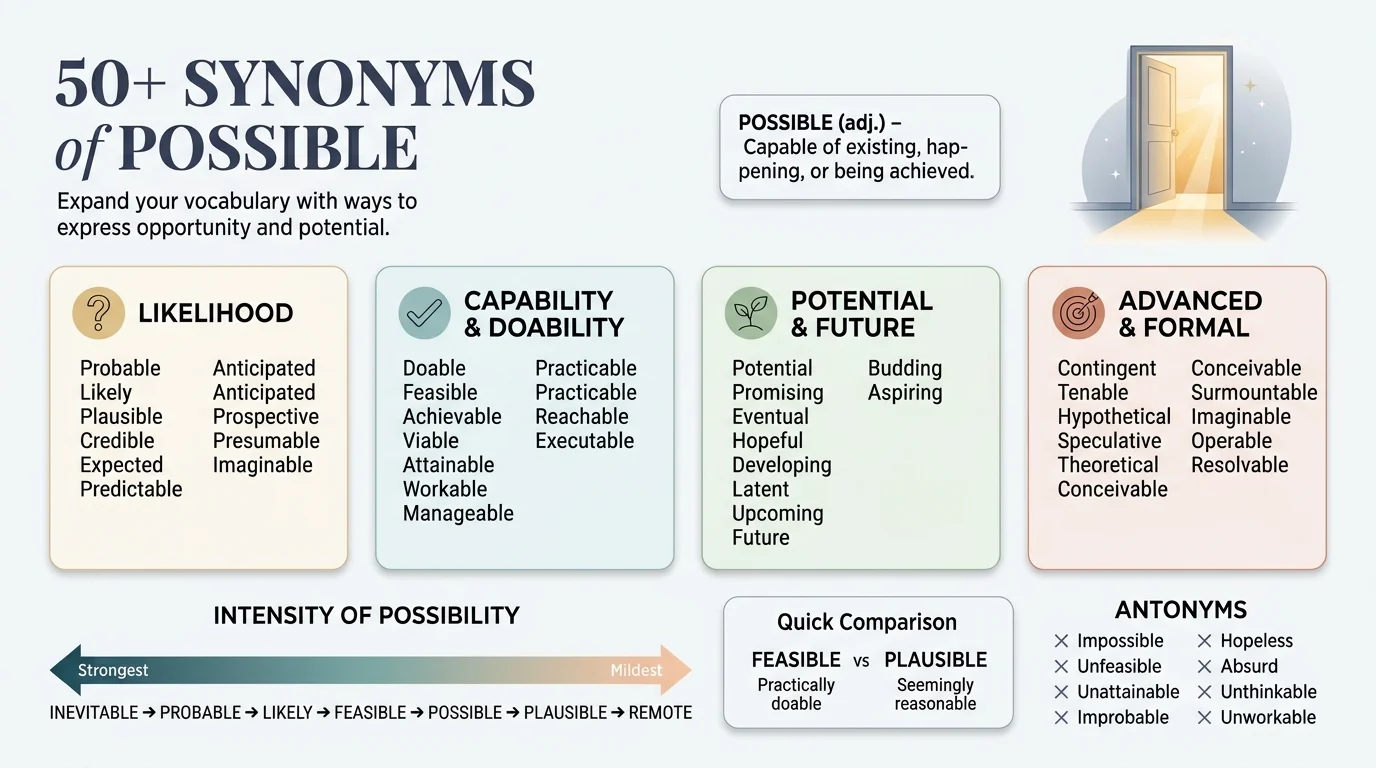
Have you ever needed to describe something that could happen or be done but felt that “possible” was too simple or repetitive? You want to capture the likelihood, potential, or feasibility of a situation, and the word “possible” comes to mind. Choosing the right synonym for “possible” can transform a basic statement into a precise expression of potential, probability, or capability. This guide explores the best synonyms of possible, explaining exactly which word to use and when.
Quick Ans: “Possible” means capable of happening, existing, or being done; potentially true or achievable. For likelihood, choose probable or likely. For capability, use feasible or viable. For potential, use potential or conceivable. For formal contexts, use practicable or attainable.
Meaning, Tone, and Context
Understanding the core meaning of “possible” is the first step to using it effectively.
Simple Definition: Capable of happening, existing, or being done; potentially true or achievable.
Part of Speech: Adjective.
Overall Tone: Neutral. It can indicate likelihood, capability, or potential.
Formality Level: Neutral to formal. The word is appropriate in most contexts.
Common Uses: Native English speakers use it in everyday conversation (“Is it possible?”), business (“possible solutions”), science (“possible outcomes”), and academic writing (“possible implications”).
Word Forms: Related words include the noun possibility, the adverb possibly, and the adjective impossible (the opposite).
When and How to Use “Possible”
“Possible” is the perfect choice when you want to describe something that could happen or be done. Here are seven realistic examples.
Everyday: “Is it possible to finish this by Friday?”
Business: “We need to explore all possible solutions.”
Academic: “The study examines possible causes of the phenomenon.”
Science: “The experiment explores possible outcomes.”
Professional: “Please let me know your earliest possible availability.”
Personal: “It is possible that I will be late.”
Social Media: “Anything is possible if you work hard enough.”
Best Synonyms of “Possible”
No synonym is identical in every situation. Here is your guide to the best replacement for “possible” based on your writing context.
For Likelihood and Probability
Most Direct: Probable means likely to happen. “It is probable that it will rain.”
Likely: Likely means expected to happen. “She is likely to win.”
Plausible: Plausible means seeming reasonable. “His explanation was plausible.”
Conceivable: Conceivable means able to be imagined. “It is conceivable that they will agree.”
For Capability and Feasibility
Feasible: Feasible means possible to do easily. “The plan is feasible.”
Viable: Viable means capable of working. “The solution is viable.”
Practicable: Practicable means able to be done. “The method is practicable.”
Achievable: Achievable means able to be accomplished. “The goal is achievable.”
For Potential and Capacity
Potential: Potential means having the capacity to develop. “She is a potential leader.”
Attainable: Attainable means able to be reached. “The target is attainable.”
Workable: Workable means practical and effective. “The arrangement is workable.”
Realizable: Realizable means able to be achieved. “The vision is realizable.”
For Formal and Academic Contexts
Imaginable: Imaginable means able to be imagined. “The best imaginable outcome.”
Theoretical: Theoretical means existing in theory. “A theoretical possibility.”
Hypothetical: Hypothetical means based on a hypothesis. “A hypothetical scenario.”
Speculative: Speculative means based on guesswork. “The claim is speculative.”
When Not to Use “Possible”
Using “possible” can sound wrong or awkward in certain situations.
When You Mean “Certain”: “Possible” means could happen. “Certain” means will happen.
Better Choice: Certain or definite. “It is certain that we will finish.”
When You Mean “Easy”: “Possible” is about ability. “Easy” is about effort.
Better Choice: Easy or simple. “The task is easy.”
When It Sounds Too Vague: “Possible” can be unclear.
Better Choice: Likely, feasible, or achievable. “The plan is feasible.”
Words Commonly Confused With “Possible”
| Word | Difference | When to Use | Example |
|---|---|---|---|
| Probable | Likely to happen | Predictions and forecasts | “It is probable that it will rain.” |
| Feasible | Possible to do | Plans and projects | “The plan is feasible.” |
| Likely | Expected to happen | Predictions and trends | “She is likely to win.” |
| Plausible | Seeming reasonable | Explanations and theories | “His explanation was plausible.” |
| Viable | Capable of working | Solutions and businesses | “The solution is viable.” |
| Impossible | Not possible | The opposite | “It is impossible to finish.” |
Best Synonyms of “Possible” by Context
| Context | Best Synonym | Why It Works | Example |
|---|---|---|---|
| Formal writing | Feasible | Formal and precise | “The plan is feasible.” |
| Academic writing | Plausible | Standard in research | “The theory is plausible.” |
| Professional | Achievable | Professional and clear | “The target is achievable.” |
| Business | Viable | Business and strategy | “The solution is viable.” |
| Science | Probable | Scientific and precise | “The outcome is probable.” |
| Casual | Likely | Simple and natural | “It is likely to rain.” |
| Everyday | Maybe | Simple and direct | “Maybe I will come.” |
How to Choose the Best Synonym of “Possible”
Choosing the right word is a simple decision. Answer these questions.
What type of possibility am I describing? For likelihood, use probable or likely. And For capability, use feasible or viable. For potential, use potential or conceivable. For formal, use practicable or attainable.
What is my audience? For a formal report, use feasible or achievable. For a friend, use maybe or likely.
What is my purpose? Are you describing likelihood, capability, or potential? The correct synonym depends entirely on this.
What is the emotional strength? Plausible is stronger for credibility. Maybe is milder. Pick the one that matches your message.
Real Life Examples of “Possible”
School: Basic: “It is possible to improve.” Improved: “It is achievable to improve.”
College: Basic: “The study examines possible causes.” Improved: “The study examines plausible causes.”
Workplace: Basic: “We need possible solutions.” Improved: “We need viable solutions.”
Business: Basic: “The plan is possible.” Improved: “The plan is feasible.”
Email: Basic: “Is it possible to meet tomorrow?” Improved: “Is it convenient to meet tomorrow?”
Conversation: Basic: “It is possible.” Improved: “It is likely.”
Storytelling: Basic: “Anything is possible.” Improved: “Anything is conceivable.”
Top 10 Synonyms of “Possible”
| Synonym | Simple Meaning | Best Used For | Example Sentence |
|---|---|---|---|
| Feasible | Possible to do easily | Plans and projects | “The plan is feasible.” |
| Probable | Likely to happen | Predictions and forecasts | “It is probable that it will rain.” |
| Likely | Expected to happen | Predictions and trends | “She is likely to win.” |
| Plausible | Seeming reasonable | Explanations and theories | “His explanation was plausible.” |
| Viable | Capable of working | Solutions and businesses | “The solution is viable.” |
| Achievable | Able to be accomplished | Goals and targets | “The goal is achievable.” |
| Conceivable | Able to be imagined | Ideas and possibilities | “It is conceivable that they will agree.” |
| Potential | Having the capacity to develop | Future and development | “She is a potential leader.” |
| Practicable | Able to be done | Methods and approaches | “The method is practicable.” |
| Attainable | Able to be reached | Goals and objectives | “The target is attainable.” |
Synonyms of “Possible” by Usage
Professional vs. Personal Synonyms
In the workplace, choose feasible, viable, or achievable. With friends, use maybe, likely, or possible.
Formal vs. Conversational Synonyms
For formal writing, use feasible, plausible, or practicable. For casual conversations, use maybe, likely, or possible.
Academic Synonyms
For research and essays, choose plausible for theories, probable for outcomes, and conceivable for ideas.
Professional and Business Synonyms
For maximum impact, choose viable for solutions, achievable for goals, and feasible for plans.
Creative and Literary Synonyms
To add emotion and imagery, choose conceivable, potential, or attainable. These words create depth.
Slang or Modern Synonyms
In modern American slang, maybe, doable, or in the cards are common. For example, “It is doable.” These are casual and should be avoided in formal writing.
Strongest to Mildest Synonyms
Mild: maybe, perhaps, possibly
Moderate: possible, likely, probable
Strong: feasible, viable, plausible
Very Strong: achievable, attainable, practicable
Emotional vs. Neutral Synonyms
Emotional Synonyms: Potential, conceivable, attainable. These words hint at hope and ambition. Use them when you want to evoke feeling.
Neutral Synonyms: Possible, likely, feasible. These words communicate factual information.
Antonyms of “Possible”
| Antonym | Meaning | Example Sentence |
|---|---|---|
| Impossible | Not possible | “It is impossible to finish.” |
| Unlikely | Not likely | “It is unlikely to happen.” |
| Unattainable | Not able to be reached | “The goal is unattainable.” |
| Infeasible | Not possible to do | “The plan is infeasible.” |
| Impractical | Not practical | “The idea is impractical.” |
| Unimaginable | Not able to be imagined | “The outcome was unimaginable.” |
| Inconceivable | Not able to be conceived | “It is inconceivable that he would lie.” |
| Unachievable | Not able to be achieved | “The target is unachievable.” |
| Hopeless | Without hope | “The situation seems hopeless.” |
| Futile | Pointless | “The effort was futile.” |
| Vain | Without success | “The attempt was in vain.” |
| Unrealistic | Not realistic | “The expectation is unrealistic.” |
| Implausible | Not seeming reasonable | “The explanation is implausible.” |
| Doubtful | Uncertain | “The outcome is doubtful.” |
| Dubious | Not to be relied on | “The claim is dubious.” |
Comparison: “Possible” vs Similar Words
Possible vs. Probable
Main Difference: “Possible” means could happen. “Probable” means likely to happen.
Which Is Stronger? “Probable” is stronger for likelihood.
Which Is More Formal? Both are formal.
When to Use Each: Use “probable” for predictions. Use “possible” for general contexts.
Examples:
Possible: “It is possible to finish.”
Probable: “It is probable that it will rain.”
Possible vs. Feasible
Main Difference: “Possible” is broader. “Feasible” is about practicality.
Which Is Stronger? “Feasible” is more specific.
Which Is More Formal? Both are formal.
When to Use Each: Use “feasible” for plans. Use “possible” for general contexts.
Examples:
Possible: “It is possible to do.”
Feasible: “The plan is feasible.”
Possible vs. Likely
Main Difference: “Possible” is about ability. “Likely” is about probability.
Which Is Stronger? “Likely” is stronger for probability.
Which Is More Formal? Both are neutral.
When to Use Each: Use “likely” for predictions. Use “possible” for general contexts.
Examples:
Possible: “It is possible to win.”
Likely: “She is likely to win.”
Possible vs. Plausible
Main Difference: “Possible” is about ability. “Plausible” is about credibility.
Which Is Stronger? “Plausible” is stronger for credibility.
Which Is More Formal? Both are formal.
When to Use Each: Use “plausible” for explanations. Use “possible” for general contexts.
Examples:
Possible: “It is possible that he is right.”
Plausible: “His explanation is plausible.”
Possible vs. Viable
Main Difference: “Possible” is broader. “Viable” is about working capability.
Which Is Stronger? “Viable” is more specific.
Which Is More Formal? Both are formal.
When to Use Each: Use “viable” for solutions. Use “possible” for general contexts.
Examples:
Possible: “It is possible to fix.”
Viable: “The solution is viable.”
Possible vs. Achievable
Main Difference: “Possible” is broader. “Achievable” is about accomplishment.
Which Is Stronger? “Achievable” is more specific.
Which Is More Formal? Both are formal.
When to Use Each: Use “achievable” for goals. Use “possible” for general contexts.
Examples:
Possible: “It is possible to succeed.”
Achievable: “The goal is achievable.”
Common Phrases and Expressions with “Possible”
Phrase: As soon as possible
Meaning: As quickly as one can.
Example Sentence: “Please respond as soon as possible.”
Phrase: As much as possible
Meaning: To the greatest extent.
Example Sentence: “Try to save as much as possible.”
Phrase: If possible
Meaning: If it can be done.
Example Sentence: “Please come early if possible.”
Phrase: Possible outcome
Meaning: A result that could happen.
Example Sentence: “We need to consider every possible outcome.”
Phrase: Possible solution
Meaning: A way to solve a problem.
Example Sentence: “We explored every possible solution.”
Phrase: Not possible
Meaning: Cannot be done.
Example Sentence: “It is not possible to finish today.”
Common Mistakes to Avoid
Mistake 1: Using “possible” when you mean “probable”.
Incorrect: “It is possible that it will rain.”
Better: “It is probable that it will rain.”
Why: “Probable” is stronger for likelihood.
Mistake 2: Using “possible” when you mean “feasible”.
Incorrect: “The plan is possible.”
Better: “The plan is feasible.”
Why: “Feasible” is for plans.
Mistake 3: Overusing “possible” in conversation.
Incorrect: “It is possible to do.”
Better: “It is doable.”
Why: “Doable” sounds more natural.
Mistake 4: Using “possible” when you mean “achievable”.
Incorrect: “The goal is possible.”
Better: “The goal is achievable.”
Why: “Achievable” is for goals.
Mistake 5: Using “possible” when you mean “plausible”.
Incorrect: “The explanation is possible.”
Better: “The explanation is plausible.”
Why: “Plausible” is for explanations.
Frequently Asked Questions
1. What are the best synonyms of “possible”?
The best synonyms depend on your context. For likelihood, choose probable or likely. And For capability, use feasible or viable. For potential, use potential or conceivable.
2. What are the best formal synonyms of “possible”?
The best formal synonyms are feasible, plausible, and practicable. These words are suitable for academic papers, professional reports, and business communications.
3. What are common informal synonyms of “possible”?
For informal settings, use maybe, likely, or doable. These alternatives sound more natural in everyday conversation.
4. What is another word for “possible” in professional writing?
In professional writing, feasible is an excellent choice. It conveys practicality. Achievable is also strong for goals.
5. What is the difference between “possible” and “probable”?
“Possible” means could happen. “Probable” means likely to happen. Use “probable” for stronger likelihood.
6. What is the opposite of “possible”?
The most direct opposite (antonym) of possible is impossible. Other opposites include unlikely and unattainable.
Conclusion
“Possible” is a versatile and essential word for describing likelihood, capability, and potential. The term is neutral and widely accepted in most contexts, yet it can sound too vague for specific descriptions or too simple for formal writing. The best choice among the synonyms of possible depends entirely on your audience, tone, and purpose. Remember, no single synonym works perfectly in every situation. Your goal is to choose the word that communicates your message with the most clarity and impact. A practical tip for your vocabulary growth is to pay attention to how writers describe likelihood and capability and practice using different synonyms in your writing.









