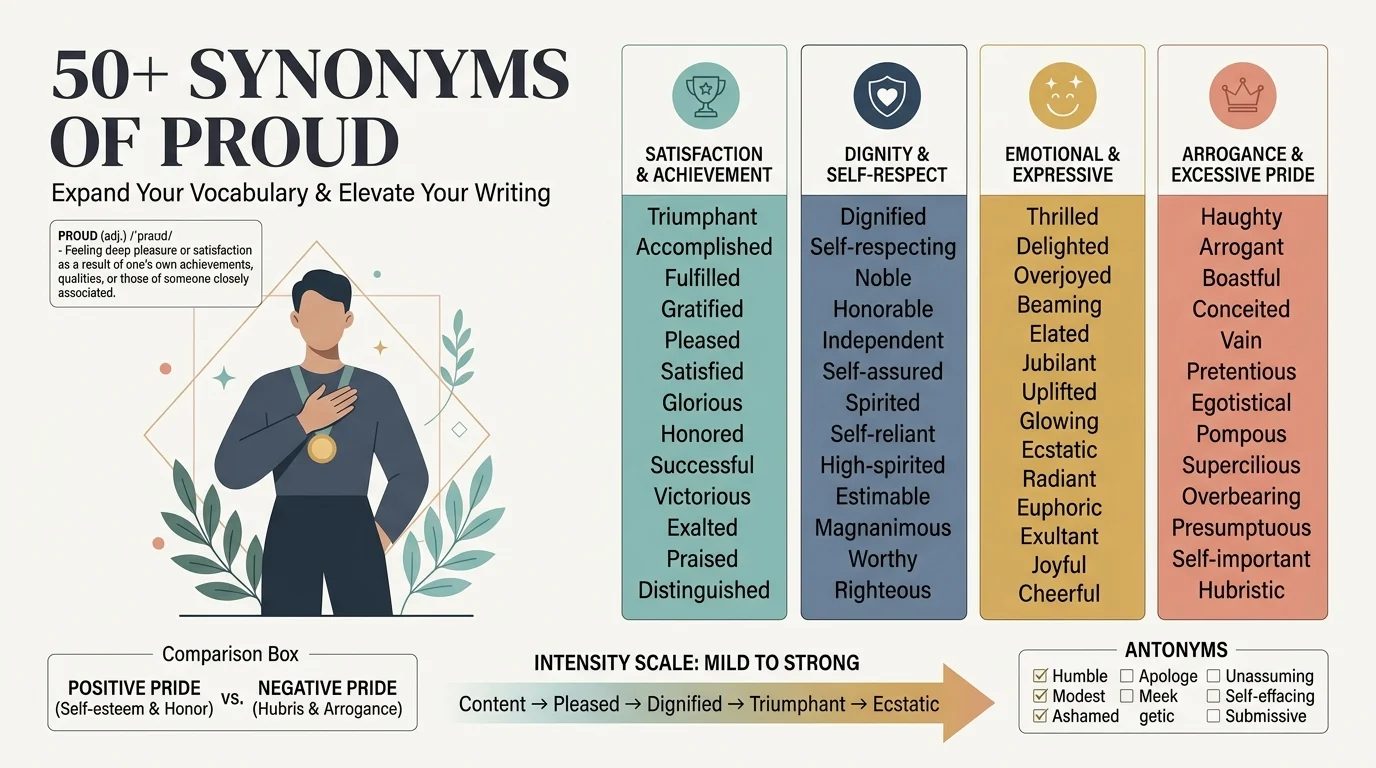
Have you ever needed to describe someone who feels satisfied with their achievements or expresses dignity but felt that “proud” was too simple or repetitive? You want to capture the specific sense of satisfaction, honor, or arrogance, and the word “proud” comes to mind. Choosing the right synonym for “proud” can transform a basic statement into a precise expression of accomplishment, dignity, or conceit. This guide explores the best synonyms of proud, explaining exactly which word to use and when.
Quick Answer: “Proud” means feeling deep satisfaction from achievements, having a high opinion of oneself, or showing dignity. For positive pride, choose pleased, gratified, or honored. For dignity and self-respect, use dignified or noble. For negative pride, use arrogant or conceited. For satisfaction, use content or satisfied.
Meaning, Tone, and Context
Understanding the core meaning of “proud” is the first step to using it effectively.
Simple Definition: Feeling deep pleasure or satisfaction as a result of one’s own achievements, qualities, or possessions; having a high opinion of oneself; showing dignity.
Part of Speech: Adjective.
Overall Tone: Positive to negative. It can indicate satisfaction and dignity or arrogance and conceit.
Formality Level: Neutral. The word is appropriate in most contexts.
Common Uses: Native English speakers use it to describe personal achievements (“proud of my son”), national identity (“proud American”), and negative attitudes (“too proud to apologize”).
Word Forms: Related words include the noun pride, the adverb proudly, and the adjective prideful.
When and How to Use “Proud”
“Proud” is the perfect choice when you want to describe satisfaction, dignity, or arrogance. Here are seven realistic examples.
Personal: “I am proud of my daughter’s accomplishments.”
Professional: “The team is proud of the project’s success.”
National: “She is proud of her heritage.”
Academic: “He was proud of his research findings.”
Workplace: “We are proud to announce the new product.”
Emotional: “She felt proud after completing the marathon.”
Social Media: “Proud parent moment at graduation.”
Best Synonyms of “Proud”
No synonym is identical in every situation. Here is your guide to the best replacement for “proud” based on your writing context.
For Satisfaction and Achievement
Most Direct: Pleased means feeling satisfaction. “I am pleased with the results.”
Gratified: Gratified means feeling satisfied. “She was gratified by the recognition.”
Honored: Honored means feeling privileged. “We are honored to receive this award.”
Content: Content means satisfied. “He felt content with his progress.”
For Dignity and Self-Respect
Dignified: Dignified means showing self-respect. “He maintained a dignified manner.”
Noble: Noble means having high moral qualities. “She had a noble spirit.”
Distinguished: Distinguished means worthy of respect. “He had a distinguished career.”
Stately: Stately means impressive and dignified. “The stately building stood proudly.”
For Negative Pride
Arrogant: Arrogant means having an exaggerated sense of importance. “His arrogant attitude annoyed everyone.”
Conceited: Conceited means excessively proud of oneself. “She was conceited about her looks.”
Haughty: Haughty means arrogantly superior. “The haughty waiter ignored us.”
Vain: Vain means having an excessively high opinion of oneself. “He was vain about his appearance.”
For Emotional and Social Contexts
Satisfied: Satisfied means content. “She was satisfied with her work.”
Fulfilled: Fulfilled means having achieved potential. “He felt fulfilled after the project.”
Elated: Elated means extremely happy. “She was elated by the news.”
Triumphant: Triumphant means victorious. “The triumphant team celebrated.”
When Not to Use “Proud”
Using “proud” can sound wrong or awkward in certain situations.
When You Mean “Happy”: “Proud” is about achievement. “Happy” is about emotion.
Better Choice: Happy or glad. “I am happy for you.”
When You Mean “Satisfied”: “Proud” is stronger. “Satisfied” is milder.
Better Choice: Satisfied or content. “I am satisfied with the results.”
When It Sounds Too Strong: For minor achievements, “proud” can be too much.
Better Choice: Pleased or glad. “I am pleased with your work.”
Words Commonly Confused With “Proud”
| Word | Difference | When to Use | Example |
|---|---|---|---|
| Pleased | Satisfied | General and formal | “I am pleased with the result.” |
| Arrogant | Having exaggerated importance | Negative and critical | “His arrogant attitude.” |
| Dignified | Showing self-respect | Formal and positive | “A dignified manner.” |
| Conceited | Excessively proud | Negative and personal | “She was conceited.” |
| Honored | Feeling privileged | Formal and grateful | “We are honored.” |
| Haughty | Arrogantly superior | Negative and literary | “A haughty look.” |
Best Synonyms of “Proud” by Context
| Context | Best Synonym | Why It Works | Example |
|---|---|---|---|
| Formal writing | Honored | Formal and grateful | “We are honored to receive this award.” |
| Academic writing | Gratified | Standard in formal praise | “She was gratified by the recognition.” |
| Professional | Pleased | Professional and positive | “We are pleased with the results.” |
| Business | Satisfied | Business and measurable | “We are satisfied with the outcome.” |
| Emotional | Elated | Emotional and expressive | “She was elated by the news.” |
| Negative | Arrogant | Negative and critical | “His arrogant attitude annoyed us.” |
| Casual | Happy | Simple and natural | “I am happy for you.” |
How to Choose the Best Synonym of “Proud”
Choosing the right word is a simple decision. Answer these questions.
What type of pride am I describing? For satisfaction, use pleased or gratified. For dignity, use dignified or noble. And for negative pride, use arrogant or conceited.
What is my audience? For a formal report, use honored or gratified. For a friend, use happy or pleased.
What is my purpose? Are you describing an achievement, a character trait, or an attitude? The correct synonym depends entirely on this.
What is the emotional strength? Elated and triumphant are stronger. Pleased is milder. Pick the one that matches your message.
Real Life Examples of “Proud”
School: Basic: “The student was proud.” Improved: “The student was pleased with her progress.”
College: Basic: “The professor was proud of the research.” Improved: “The professor was gratified by the research.”
Workplace: Basic: “We are proud of the project.” Improved: “We are honored by the project’s success.”
Business: Basic: “The company is proud.” Improved: “The company is satisfied with the results.”
Email: Basic: “I am proud to announce.” Improved: “I am pleased to announce.”
Conversation: Basic: “I am so proud.” Improved: “I am so happy.”
Storytelling: Basic: “She was proud.” Improved: “She was elated by the achievement.”
Top 10 Synonyms of “Proud”
| Synonym | Simple Meaning | Best Used For | Example Sentence |
|---|---|---|---|
| Pleased | Feeling satisfaction | General and formal | “I am pleased with the results.” |
| Gratified | Feeling satisfied | Formal and academic | “She was gratified by the recognition.” |
| Honored | Feeling privileged | Formal and grateful | “We are honored to receive this award.” |
| Dignified | Showing self-respect | Formal and positive | “He maintained a dignified manner.” |
| Arrogant | Having exaggerated importance | Negative and critical | “His arrogant attitude annoyed everyone.” |
| Conceited | Excessively proud | Negative and personal | “She was conceited about her looks.” |
| Satisfied | Content | Business and general | “We are satisfied with the outcome.” |
| Elated | Extremely happy | Emotional and expressive | “She was elated by the news.” |
| Content | Satisfied | General and personal | “He felt content with his progress.” |
| Noble | Having high moral qualities | Formal and literary | “She had a noble spirit.” |
Synonyms of “Proud” by Usage
Professional vs. Personal Synonyms
In the workplace, choose pleased, honored, or satisfied. With friends, use happy, elated, or proud.
Formal vs. Conversational Synonyms
For formal writing, use honored, gratified, or dignified. For casual conversations, use happy, pleased, or glad.
Academic Synonyms
For research and essays, choose gratified for recognition, satisfied for results, and dignified for manner.
Professional and Business Synonyms
For maximum impact, choose pleased for announcements, satisfied for results, and honored for awards.
Creative and Literary Synonyms
To add emotion and imagery, choose elated, triumphant, or noble. These words create atmosphere.
Slang or Modern Synonyms
In modern American slang, stoked, pumped, or proud are common. For example, “I am stoked about the result.” These are casual and should be avoided in formal writing.
Strongest to Mildest Synonyms
Mild: content, pleased, glad
Moderate: proud, satisfied, gratified
Strong: honored, dignified, elated
Very Strong: triumphant, noble, arrogant, conceited
Emotional vs. Neutral Synonyms
Emotional Synonyms: Elated, triumphant, proud. These words hint at strong emotion. Use them when you want to evoke feeling.
Neutral Synonyms: Pleased, satisfied, content. These words communicate factual information.
Antonyms of “Proud”
| Antonym | Meaning | Example Sentence |
|---|---|---|
| Ashamed | Feeling shame | “He was ashamed of his mistake.” |
| Humble | Having a modest view of oneself | “She remained humble despite success.” |
| Modest | Not boastful | “He was modest about his achievements.” |
| Humiliated | Feeling embarrassed | “She felt humiliated by the failure.” |
| Embarrassed | Feeling awkward | “He was embarrassed by the attention.” |
| Meek | Submissive | “She was meek and quiet.” |
| Insecure | Lacking confidence | “He felt insecure about his abilities.” |
| Doubtful | Uncertain | “She was doubtful about the outcome.” |
| Apologetic | Expressing regret | “He was apologetic for the error.” |
| Remorseful | Feeling regret | “She was remorseful for her actions.” |
| Submissive | Yielding to others | “He was submissive to authority.” |
| Self-effacing | Modest | “She was self-effacing about her success.” |
| Servile | Excessively eager to please | “He was servile to his boss.” |
| Ingratiating | Trying to please | “He was ingratiating to the judges.” |
| Compliant | Obedient | “She was compliant with the rules.” |
Comparison: “Proud” vs Similar Words
Proud vs. Pleased
Main Difference: “Proud” is stronger. “Pleased” is milder.
Which Is Stronger? “Proud” is stronger.
Which Is More Formal? Both are neutral.
When to Use Each: Use “proud” for achievements. Use “pleased” for general satisfaction.
Examples:
Proud: “I am proud of my daughter.”
Pleased: “I am pleased with the results.”
Proud vs. Arrogant
Main Difference: “Proud” can be positive. “Arrogant” is negative.
Which Is Stronger? “Arrogant” is negative.
Which Is More Formal? Both are neutral.
When to Use Each: Use “proud” for achievements. Use “arrogant” for negative attitudes.
Examples:
Proud: “She was proud of her work.”
Arrogant: “His arrogant attitude annoyed us.”
Proud vs. Dignified
Main Difference: “Proud” is broader. “Dignified” is about self-respect.
Which Is Stronger? “Dignified” is more formal.
Which Is More Formal? “Dignified” is more formal.
When to Use Each: Use “dignified” for manner. Use “proud” for general contexts.
Examples:
Proud: “He was proud of his heritage.”
Dignified: “He maintained a dignified manner.”
Proud vs. Conceited
Main Difference: “Proud” can be positive. “Conceited” is negative.
Which Is Stronger? “Conceited” is negative.
Which Is More Formal? Both are neutral.
When to Use Each: Use “conceited” for negative self-image. Use “proud” for achievements.
Examples:
Proud: “She was proud of her team.”
Conceited: “She was conceited about her looks.”
Proud vs. Honored
Main Difference: “Proud” is broader. “Honored” is about privilege.
Which Is Stronger? “Honored” is more specific.
Which Is More Formal? “Honored” is more formal.
When to Use Each: Use “honored” for awards. Use “proud” for general contexts.
Examples:
Proud: “I am proud to be part of this team.”
Honored: “We are honored to receive this award.”
Proud vs. Satisfied
Main Difference: “Proud” is emotional. “Satisfied” is neutral.
Which Is Stronger? “Proud” is stronger.
Which Is More Formal? Both are neutral.
When to Use Each: Use “satisfied” for results. Use “proud” for achievements.
Examples:
Proud: “I am proud of my accomplishment.”
Satisfied: “I am satisfied with the outcome.”
Common Phrases and Expressions with “Proud”
Phrase: Proud of
Meaning: Feeling satisfaction about something.
Example Sentence: “I am proud of my son.”
Phrase: Proud to be
Meaning: Feeling honored to be part of something.
Example Sentence: “I am proud to be an American.”
Phrase: Do proud
Meaning: To make someone proud.
Example Sentence: “You did your family proud.”
Phrase: Proud moment
Meaning: A time of great satisfaction.
Example Sentence: “Graduation was a proud moment.”
Phrase: Too proud
Meaning: Excessively proud.
Example Sentence: “He was too proud to apologize.”
Phrase: Proud as a peacock
Meaning: Very proud.
Example Sentence: “He strutted around proud as a peacock.”
Common Mistakes to Avoid
Mistake 1: Using “proud” when you mean “happy”.
Incorrect: “I am proud for you.”
Better: “I am happy for you.”
Why: “Happy” is for general emotion.
Mistake 2: Using “proud” when you mean “satisfied”.
Incorrect: “I am proud with the results.”
Better: “I am satisfied with the results.”
Why: “Satisfied” is for results.
Mistake 3: Overusing “proud” in conversation.
Incorrect: “I am proud of my dinner.”
Better: “I am pleased with my dinner.”
Why: “Pleased” sounds more natural.
Mistake 4: Using “proud” when you mean “arrogant”.
Incorrect: “He is too proud.”
Better: “He is too arrogant.”
Why: “Arrogant” is for negative pride.
Mistake 5: Using “proud” when you mean “honored”.
Incorrect: “I am proud to receive this award.”
Better: “I am honored to receive this award.”
Why: “Honored” is for awards.
Frequently Asked Questions
1. What are the best synonyms of “proud”?
The best synonyms depend on your context. For satisfaction, choose pleased or gratified. For dignity, use dignified or noble. And for negative pride, use arrogant or conceited.
2. What are the best formal synonyms of “proud”?
The best formal synonyms are honored, gratified, and dignified. These words are suitable for academic papers, professional reports, and business communications.
3. What are common informal synonyms of “proud”?
For informal settings, use happy, pleased, or glad. These alternatives sound more natural in everyday conversation.
4. What is another word for “proud” in professional writing?
In professional writing, pleased is an excellent choice. It conveys satisfaction. Honored is also strong for awards.
5. What is the difference between “proud” and “arrogant”?
“Proud” can be positive. “Arrogant” is negative. Use “proud” for achievements and “arrogant” for negative attitudes.
6. What is the opposite of “proud”?
The most direct opposites (antonyms) of proud are ashamed, humble, and modest. These words describe a lack of pride or humility.
Conclusion
“Proud” is a powerful and versatile word for describing satisfaction, dignity, and negative pride. The term is neutral and widely accepted in most contexts, yet it can sound too strong for minor achievements or too mild for extreme arrogance. The best choice among the synonyms of proud depends entirely on your audience, tone, and purpose. For a formal, professional effect, use honored or pleased. For a personal, emotional context, elated or grateful works perfectly. And for negative pride, choose arrogant or conceited.Also for casual conversation, use happy or pleased. Remember, no single synonym works perfectly in every situation. Your goal is to choose the word that communicates your message with the most clarity and impact. A practical tip for your vocabulary growth is to pay attention to how writers express pride and satisfaction and practice using different synonyms in your writing.










1 thought on “50+ Synonyms of Proud: Meanings, Uses, Examples, and Best Alternatives”