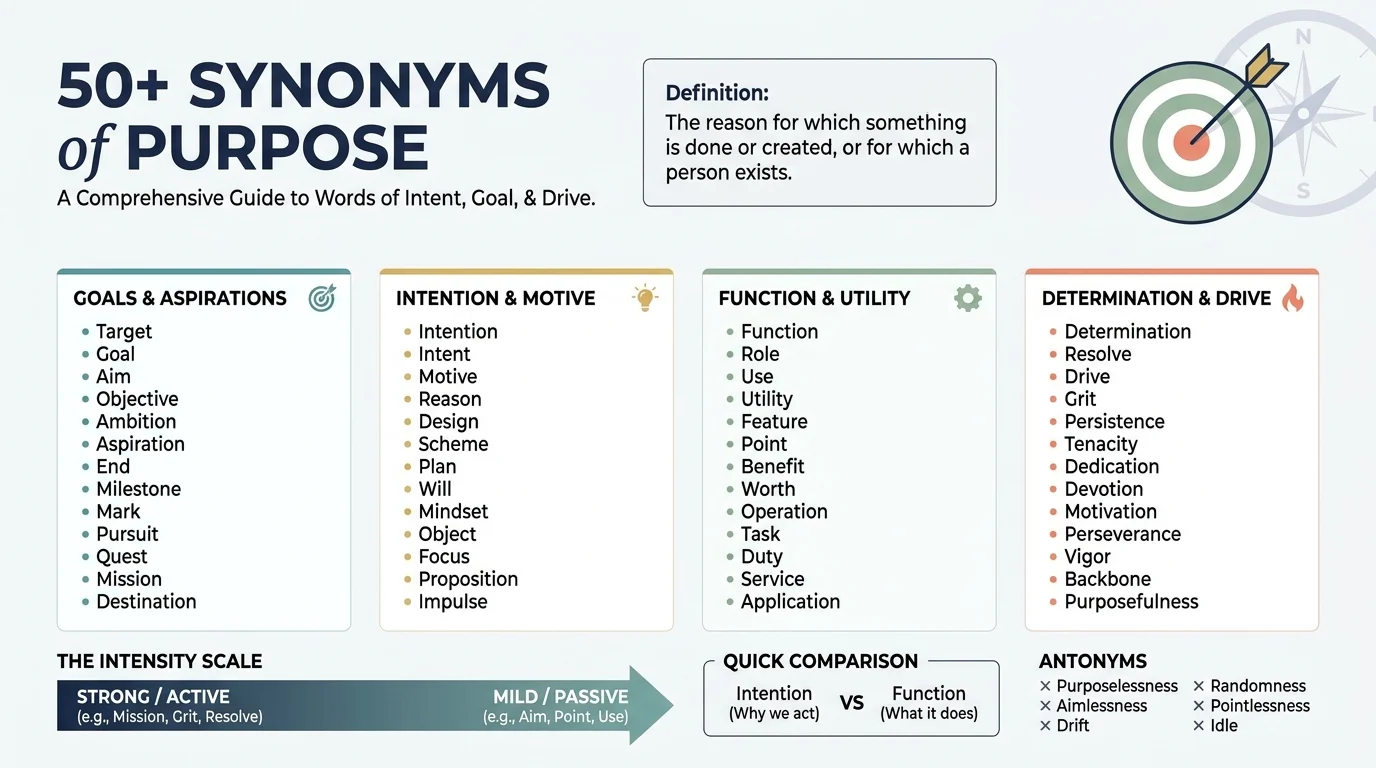
Have you ever needed to describe the reason behind an action, the goal of a project, or the intended function of something but felt that “purpose” was too broad or repetitive? You want to capture the specific sense of intention, objective, or function, and the word “purpose” comes to mind. Choosing the right synonym for “purpose” can transform a basic statement into a precise expression of aim, resolve, or utility. This guide explores the best synonyms of purpose, explaining exactly which word to use and when.
Quick Ans: “Purpose” means the reason for which something is done or created, an intended goal, or determination. For goals, choose aim or objective. For intention, use intention or intent. For function, use function or role. For determination, use resolve or determination.
Meaning, Tone, and Context
Understanding the core meaning of “purpose” is the first step to using it effectively.
Simple Definition: The reason for which something is done or created; an intended goal; determination or resolve.
Part of Speech: Noun.
Overall Tone: Neutral to positive. It can indicate intention, goal, or determination.
Formality Level: Neutral to formal. The word is appropriate in most contexts.
Common Uses: Native English speakers use it in business (“purpose of the meeting”), personal (“sense of purpose”), academic (“research purpose”), and general contexts (“on purpose”).
Word Forms: Related words include the adjective purposeful, the adverb purposefully, and the adjective purposeless.
When and How to Use “Purpose”
“Purpose” is the perfect choice when you want to describe intention, goal, or function. Here are seven realistic examples.
Professional: “The purpose of this meeting is to discuss the budget.”
Academic: “The purpose of the study is to examine the effects of climate change.”
Personal: “She found her purpose in helping others.”
Business: “The purpose of the campaign is to increase brand awareness.”
Legal: “The purpose of the contract is to protect both parties.”
Everyday: “He broke the vase on purpose.”
Social Media: “Live with purpose and passion.”
Best Synonyms of “Purpose”
No synonym is identical in every situation. Here is your guide to the best replacement for “purpose” based on your writing context.
For Goals and Objectives
Most Direct: Aim means a purpose or intention. “The aim of the project is to reduce waste.”
Objective: Objective means a goal. “Our objective is to increase sales.”
Goal: Goal means an aim. “The goal is to finish by Friday.”
Target: Target means a goal. “We hit our sales target.”
For Intention and Intent
Intention: Intention means an aim or plan. “Her intention was to help.”
Intent: Intent means purpose. “The intent of the law is clear.”
Design: Design means purpose or intention. “The design of the program is to educate.”
Object: Object means a purpose. “The object of the exercise is to improve fitness.”
For Function and Role
Function: Function means the purpose of something. “The function of the heart is to pump blood.”
Role: Role means a function. “The role of the teacher is to guide.”
Use: Use means the purpose of something. “The use of this tool is to cut wood.”
Utility: Utility means usefulness. “The utility of the invention is obvious.”
For Determination and Resolve
Resolve: Resolve means determination. “She showed great resolve.”
Determination: Determination means firmness of purpose. “His determination was inspiring.”
Tenacity: Tenacity means persistence. “Her tenacity paid off.”
Willpower: Willpower means self-control. “It takes willpower to succeed.”
When Not to Use “Purpose”
Using “purpose” can sound wrong or awkward in certain situations.
When You Mean “Reason”: “Purpose” is about intention. “Reason” is about cause.
Better Choice: Reason or cause. “The reason for the delay was weather.”
When You Mean “Function”: “Purpose” is broader. “Function” is specific.
Better Choice: Function or role. “The function of the liver is to filter blood.”
When It Sounds Too Formal: In casual conversation, “purpose” can sound stiff.
Better Choice: Point or reason. “What is the point?”
Words Commonly Confused With “Purpose”
| Word | Difference | When to Use | Example |
|---|---|---|---|
| Aim | A purpose or intention | Goals and plans | “The aim of the project.” |
| Objective | A goal | Business and academic | “Our objective is clear.” |
| Intention | An aim or plan | Personal and formal | “Her intention was good.” |
| Function | The purpose of something | Biology and mechanics | “The function of the heart.” |
| Reason | A cause | General and logical | “The reason for the delay.” |
| Goal | An aim | Personal and business | “The goal is to win.” |
Best Synonyms of “Purpose” by Context
| Context | Best Synonym | Why It Works | Example |
|---|---|---|---|
| Formal writing | Objective | Formal and precise | “The objective of the study.” |
| Academic writing | Aim | Standard in research | “The aim of the research.” |
| Professional | Goal | Professional and clear | “The goal of the meeting.” |
| Business | Target | Business and sales | “We hit our target.” |
| Legal | Intent | Legal and formal | “The intent of the law.” |
| Casual | Point | Simple and natural | “What is the point?” |
| Emotional | Resolve | Emotional and strong | “She showed great resolve.” |
How to Choose the Best Synonym of “Purpose”
Choosing the right word is a simple decision. Answer these questions.
What type of purpose am I describing? For goals, use aim or objective. And For intention, use intention or intent. For function, use function or role. For determination, use resolve or determination.
What is my audience? For a formal report, use objective or aim. For a friend, use point or reason.
What is my purpose? Are you describing a goal, an intention, or a function? The correct synonym depends entirely on this.
What is the emotional strength? Resolve and determination are stronger. Point is neutral. Pick the one that matches your message.
Real Life Examples of “Purpose”
School: Basic: “The purpose of the lesson is to learn.” Improved: “The aim of the lesson is to learn.”
College: Basic: “The purpose of the study is to examine.” Improved: “The objective of the study is to examine.”
Workplace: Basic: “The purpose of the meeting is to plan.” Improved: “The goal of the meeting is to plan.”
Business: Basic: “The purpose of the campaign is sales.” Improved: “The target of the campaign is sales.”
Email: Basic: “The purpose of this email is to inform.” Improved: “The reason for this email is to inform.”
Conversation: Basic: “What is the purpose?” Improved: “What is the point?”
Storytelling: Basic: “She found her purpose.” Improved: “She found her calling.”
Top 10 Synonyms of “Purpose”
| Synonym | Simple Meaning | Best Used For | Example Sentence |
|---|---|---|---|
| Aim | A purpose or intention | Goals and plans | “The aim of the project is to reduce waste.” |
| Objective | A goal | Business and academic | “Our objective is to increase sales.” |
| Goal | An aim | Personal and business | “The goal is to finish by Friday.” |
| Intention | An aim or plan | Personal and formal | “Her intention was to help.” |
| Intent | Purpose | Legal and formal | “The intent of the law is clear.” |
| Function | The purpose of something | Biology and mechanics | “The function of the heart is to pump blood.” |
| Role | A function | Professional and social | “The role of the teacher is to guide.” |
| Resolve | Determination | Emotional and personal | “She showed great resolve.” |
| Target | A goal | Business and sales | “We hit our sales target.” |
| Point | The purpose or meaning | Casual and general | “What is the point?” |
Synonyms of “Purpose” by Usage
Professional vs. Personal Synonyms
In the workplace, choose objective, goal, or target. With friends, use point, reason, or aim.
Formal vs. Conversational Synonyms
For formal writing, use objective, intention, or intent. For casual conversations, use point, reason, or aim.
Academic Synonyms
For research and essays, choose aim for research questions, objective for goals, and intention for design.
Professional and Business Synonyms
For maximum impact, choose objective for strategy, target for sales, and goal for teams.
Creative and Literary Synonyms
To add emotion and imagery, choose resolve, calling, or mission. These words create atmosphere.
Slang or Modern Synonyms
In modern American slang, point, reason, or why are common. For example, “What is the why?” These are casual and should be avoided in formal writing.
Strongest to Mildest Synonyms
Mild: point, reason, use
Moderate: purpose, aim, goal
Strong: objective, intention, function
Very Strong: resolve, determination, mission
Emotional vs. Neutral Synonyms
Emotional Synonyms: Resolve, determination, calling. These words hint at passion and commitment. Use them when you want to evoke feeling.
Neutral Synonyms: Purpose, aim, objective. These words communicate factual information.
Antonyms of “Purpose”
| Antonym | Meaning | Example Sentence |
|---|---|---|
| Aimlessness | Lack of purpose | “His aimlessness worried his parents.” |
| Purposelessness | Lack of purpose | “The purposelessness of the task was frustrating.” |
| Pointlessness | Lack of meaning | “The pointlessness of the argument was clear.” |
| Futility | Uselessness | “The futility of the effort was obvious.” |
| Indecision | Lack of decision | “Her indecision cost her the opportunity.” |
| Irresolution | Lack of resolve | “His irresolution frustrated the team.” |
| Vacillation | Wavering | “The vacillation of the leader was criticized.” |
| Hesitation | Pausing in doubt | “His hesitation was costly.” |
| Accident | Unintended event | “The mistake was an accident.” |
| Chance | Random occurrence | “It happened by chance.” |
| Randomness | Lack of pattern | “The randomness of the results was odd.” |
| Drift | Aimless movement | “The drift of the conversation was confusing.” |
| Confusion | Lack of clarity | “The confusion led to mistakes.” |
| Uncertainty | Lack of certainty | “The uncertainty made planning difficult.” |
| Doubt | Lack of conviction | “His doubt held him back.” |
Comparison: “Purpose” vs Similar Words
Purpose vs. Aim
Main Difference: “Purpose” is broader. “Aim” is a specific intention.
Which Is Stronger? “Aim” is more specific.
Which Is More Formal? Both are formal.
When to Use Each: Use “aim” for goals. Use “purpose” for general contexts.
Examples:
Purpose: “The purpose of the meeting.”
Aim: “The aim of the project.”
Purpose vs. Objective
Main Difference: “Purpose” is broader. “Objective” is a specific goal.
Which Is Stronger? “Objective” is more specific.
Which Is More Formal? Both are formal.
When to Use Each: Use “objective” for business. Use “purpose” for general contexts.
Examples:
Purpose: “The purpose of the study.”
Objective: “Our objective is to increase sales.”
Purpose vs. Intention
Main Difference: “Purpose” is about reason. “Intention” is about plan.
Which Is Stronger? “Intention” is more personal.
Which Is More Formal? Both are formal.
When to Use Each: Use “intention” for personal plans. Use “purpose” for general contexts.
Examples:
Purpose: “The purpose of the law.”
Intention: “Her intention was to help.”
Purpose vs. Function
Main Difference: “Purpose” is broader. “Function” is about role.
Which Is Stronger? “Function” is more specific.
Which Is More Formal? Both are formal.
When to Use Each: Use “function” for biology. Use “purpose” for general contexts.
Examples:
Purpose: “The purpose of the tool.”
Function: “The function of the heart.”
Purpose vs. Resolve
Main Difference: “Purpose” is about reason. “Resolve” is about determination.
Which Is Stronger? “Resolve” is more emotional.
Which Is More Formal? Both are formal.
When to Use Each: Use “resolve” for determination. Use “purpose” for general contexts.
Examples:
Purpose: “She found her purpose.”
Resolve: “She showed great resolve.”
Purpose vs. Goal
Main Difference: “Purpose” is broader. “Goal” is a specific target.
Which Is Stronger? “Goal” is more specific.
Which Is More Formal? Both are neutral.
When to Use Each: Use “goal” for targets. Use “purpose” for general contexts.
Examples:
Purpose: “The purpose of the campaign.”
Goal: “The goal is to finish by Friday.”
Common Phrases and Expressions with “Purpose”
Phrase: On purpose
Meaning: Intentionally.
Example Sentence: “He broke the vase on purpose.”
Phrase: For the purpose of
Meaning: For a specific reason.
Example Sentence: “For the purpose of this study, we will use a sample.”
Phrase: Sense of purpose
Meaning: A feeling of meaning.
Example Sentence: “Volunteering gave her a sense of purpose.”
Phrase: Purpose-built
Meaning: Designed for a specific use.
Example Sentence: “The building is purpose-built for concerts.”
Phrase: Fit for purpose
Meaning: Suitable for the intended use.
Example Sentence: “The equipment is fit for purpose.”
Phrase: Serve a purpose
Meaning: Be useful.
Example Sentence: “The old tools still serve a purpose.”
Common Mistakes to Avoid
Mistake 1: Using “purpose” when you mean “reason”.
Incorrect: “The purpose for the delay was weather.”
Better: “The reason for the delay was weather.”
Why: “Reason” is for cause.
Mistake 2: Using “purpose” when you mean “function”.
Incorrect: “The purpose of the heart is to pump blood.”
Better: “The function of the heart is to pump blood.”
Why: “Function” is for biology.
Mistake 3: Overusing “purpose” in conversation.
Incorrect: “What is the purpose?”
Better: “What is the point?”
Why: “Point” sounds more natural.
Mistake 4: Using “purpose” when you mean “aim”.
Incorrect: “The purpose of the project is to reduce waste.”
Better: “The aim of the project is to reduce waste.”
Why: “Aim” is more specific.
Mistake 5: Using “purpose” when you mean “resolve”.
Incorrect: “She showed great purpose.”
Better: “She showed great resolve.”
Why: “Resolve” is for determination.
Frequently Asked Questions
1. What are the best synonyms of “purpose”?
The best synonyms depend on your context. For goals, choose aim or objective. And For intention, use intention or intent. For function, use function or role. For determination, use resolve or determination.
2. What are the best formal synonyms of “purpose”?
The best formal synonyms are objective, intention, and intent. These words are suitable for academic papers, professional reports, and legal documents.
3. What are common informal synonyms of “purpose”?
For informal settings, use point, reason, or aim. These alternatives sound more natural in everyday conversation.
4. What is another word for “purpose” in professional writing?
In professional writing, objective is an excellent choice. It conveys a clear goal. Goal is also strong for teams.
5. What is the difference between “purpose” and “objective”?
“Purpose” is broader. “Objective” is a specific goal. Use “objective” for business and “purpose” for general contexts.
6. What is the opposite of “purpose”?
The most direct opposites (antonyms) of purpose are aimlessness, pointlessness, and futility. These words describe a lack of purpose.
Conclusion
“Purpose” is a fundamental and versatile word for describing intention, goal, and function. The term is neutral and widely accepted in most contexts, yet it can sound too broad for specific descriptions or too formal for casual conversation. The best choice among the synonyms of purpose depends entirely on your audience, tone, and purpose. Remember, no single synonym works perfectly in every situation. Your goal is to choose the word that communicates your message with the most clarity and impact. A practical tip for your vocabulary growth is to pay attention to how writers describe goals and intentions and practice using different synonyms in your writing.









